Europe is making significant strides in the world of robotics, not just with flashy concepts, but with a clear, coordinated vision aimed at real-world impact. The continent is actively building a robust ecosystem, driven by strategic investments, collaborative initiatives, and a strong focus on ethical development. This collective effort is positioning Europe as a key player in powering the next generation of intelligent machines, with recent announcements and ongoing projects highlighting a period of intense breakthrough and innovation.
Europe's Grand Vision for Robotics
The ambition to lead in robotics isn't new for Europe, but the current momentum reflects a heightened sense of urgency and strategic alignment. The core idea is to foster a "Whole Europe" approach, bringing together researchers, industry, and policymakers to create an unbroken chain from lab research to market deployment. This includes aligning standards and regulations with market needs and ensuring investment and fiscal policies support growth not just in robotics itself, but also in sectors that can benefit from smarter robots.
At the heart of this coordinated effort is euRobotics aisbl, a Brussels-based international non-profit association founded in September 2012. Its mission is to strengthen Europe's competitiveness, ensure industrial leadership for manufacturers and end-users of robotics technology, boost research, development, and innovation, and cultivate a positive perception of robotics. euRobotics plays a crucial role by collaborating with the European Commission (EC) to develop and implement a comprehensive strategy and roadmap for robotics research, technological development, and innovation.
Building on previous successes like the SPARC Public-Private Partnership under Horizon 2020 (which was once the largest civilian robotics research program globally with a public contribution of around €700 million), euRobotics is now a founding partner of the AI, Data and Robotics Association (ADRA) asbl. Established in May 2021, ADRA is a key European Partnership under the current Horizon Europe programme (2021-2027), working to support the development of Europe's AI, data, and robotics ecosystem.
Strategic Funding and Key Initiatives
Europe's commitment to robotics is backed by substantial financial and strategic programs:
-
Horizon Europe: This is the EU’s flagship research and innovation program, with significant allocations for AI and robotics. It funds a wide array of projects, from fundamental research to market-ready solutions. For example, a recent call within Horizon Europe, HORIZON-CL5-2026-02-D4-01, focuses on "Sustainable Building Robotics," allocating €15 million for three grants to develop innovative on-site robotic and automated solutions, including 3D printing, for more sustainable and less disruptive building renovation and construction. The deadline for this call is February 17, 2026. Another call, HORIZON-CL4-2025-03-DIGITAL-EMERGING-07, targets "Robust and trustworthy Generative AI for Robotics and industrial automation," with a substantial budget of €85 million and an opening date of June 10, 2025.
-
Digital Europe Programme (DIGITAL): With an overall budget exceeding €8.1 billion for 2021-2027, the Digital Europe Programme is designed to bring digital technology to businesses, citizens, and public administrations. It provides strategic funding for key capacity areas such as supercomputing, artificial intelligence, cybersecurity, and advanced digital skills, including specialized education programs for AI and robotics, which received €120 million in the first two years of the program.
-
Networks of Excellence: The European Commission has invested over €100 million through Horizon 2020 and Horizon Europe to establish a network of AI & Robotics Excellence Centres. These networks bring together over 1000 researchers and 100 industry organizations, forming a powerful European AI & Robotics community. Key projects include AI4Media, ELISE, HumanE-AI-Net, TAILOR, ELSA, euROBIN, ELIAS, dAIEDGE, and ENFIELD.
-
EU AI Act and EU Chips Act: The EU AI Act, which took partial effect in February 2025, provides a comprehensive regulatory framework for AI systems, including those in robotics, with a strong emphasis on ethical considerations. Complementing this, the €43 billion EU Chips Act is channeling significant funding into semiconductor capacity, which is vital for advanced robotics and edge AI development.
-
National Initiatives: Beyond EU-wide programs, individual member states are also making substantial investments. For example, the France 2030 plan has earmarked €7.5 billion specifically for AI and robotics sovereignty.
Unprecedented Investment and Emerging Leaders
The financial landscape for European robotics is booming. In 2025 alone, European robotics and physical AI startups collectively raised a record €1.45 billion, more than doubling the investment from the previous year. This surge in funding highlights growing investor confidence and the increasing maturity of the European robotics ecosystem. Notable funding rounds include Neura Robotics' €120 million Series B in January 2025 and Wandercraft's $75 million Series D in June 2025.
Several European startups are gaining significant attention for their innovative contributions:
-
Neura Robotics (Germany): Valued at over €1 billion after its €120 million Series B, Neura Robotics is a leading developer of humanoid robots. The company opened the world's first large-scale physical AI training center, "Neura Gym," in Metzingen, Germany, in October 2025. Their 4NE1 humanoid robot is designed for cognitive tasks in warehouses and homes, aiming to set new standards for human-robot interaction.
-
ANYbotics (Switzerland): A spinout from ETH Zurich, ANYbotics specializes in four-legged robots like ANYmal for automated industrial inspection in hazardous environments such as oil and gas plants, chemical facilities, and power stations.
-
fruitcore robotics (Germany): This company has deployed over 1,300 units of its AI robotics solutions across European manufacturers for tasks like machine tending, assembly, and palletizing, demonstrating scalable and dependable products.
-
Monumental (Netherlands): Based in Amsterdam, Monumental develops brick-laying robots and operates as a subcontractor, charging per meter of wall completed, thereby removing the capital cost and maintenance burden from contractors.
-
Wandercraft (France): Known for its advanced walking exoskeletons, Wandercraft received a significant Series D funding round, showcasing European leadership in assistive robotics.
Breakthroughs in Application and Technology
Europe's robotics breakthroughs span various critical sectors, driven by a blend of advanced AI, hardware innovation, and a strong ethical framework:
-
Human-Centric AI and Ethical Guidelines: A defining characteristic of Europe's approach is its emphasis on "human-centric" AI and robotics. The EU has published comprehensive ethical guidelines for trustworthy AI, focusing on principles like human agency and oversight, technical robustness and safety, privacy and data governance, transparency, diversity, non-discrimination and fairness, societal and environmental well-being, and accountability. This proactive stance aims to ensure that technological advancements align with European values and societal needs, potentially giving European industry a competitive edge globally.
-
Advanced Manufacturing and Industrial Automation: Robotics is considered essential for enhancing productivity and competitiveness in Europe's manufacturing sector, especially given an aging workforce. Projects like JARVIS, supported by Horizon Europe, are advancing human-robot collaboration through AI-driven multimodal interaction, developing interfaces for robot control, programming, and providing social skills to robotic platforms. The "Apply AI: Robotics for Manufacturing" initiative under Horizon Europe also focuses on developing advanced robotics skills for tasks like high-precision pick-and-place and human-robot collaboration.
-
Service Robotics for Societal Challenges: Robots are increasingly offering solutions to societal challenges such as an aging population, healthcare, smart transport, security, energy, and environmental protection. Innovations include robots for complex surgical procedures, assistance for the elderly, and autonomous systems for logistics and agriculture. The DEX Smart project, for instance, is developing advanced manipulators for service robots, enhancing capabilities in precise and dexterous manipulation.
-
Integration of Generative AI: The convergence of AI and robotics is accelerating, with a strong focus on next-generation AI models, including hybrid neuro-symbolic, multimodal, and frugal AI. These advancements enable robots to achieve higher levels of autonomy and decision-making in complex, unstructured environments while maintaining energy and computational efficiency. The Horizon Europe call for "Robust and trustworthy Generative AI for Robotics and industrial automation" underscores this priority.
-
Emergence of Humanoid Robots: Europe is making significant strides in developing practical, deployment-ready humanoid robots for various applications, from factories and healthcare to everyday environments. Besides Neura Robotics' 4NE1, other examples include Germany's Agile One, Italy's Oversonic RoBee & GENE.01, and Poland's Clone Robotics Protoclone, which features bio-inspired muscles. This shift focuses on real-world utility rather than just demonstrative capabilities.
The Google DeepMind Accelerator: Robotics
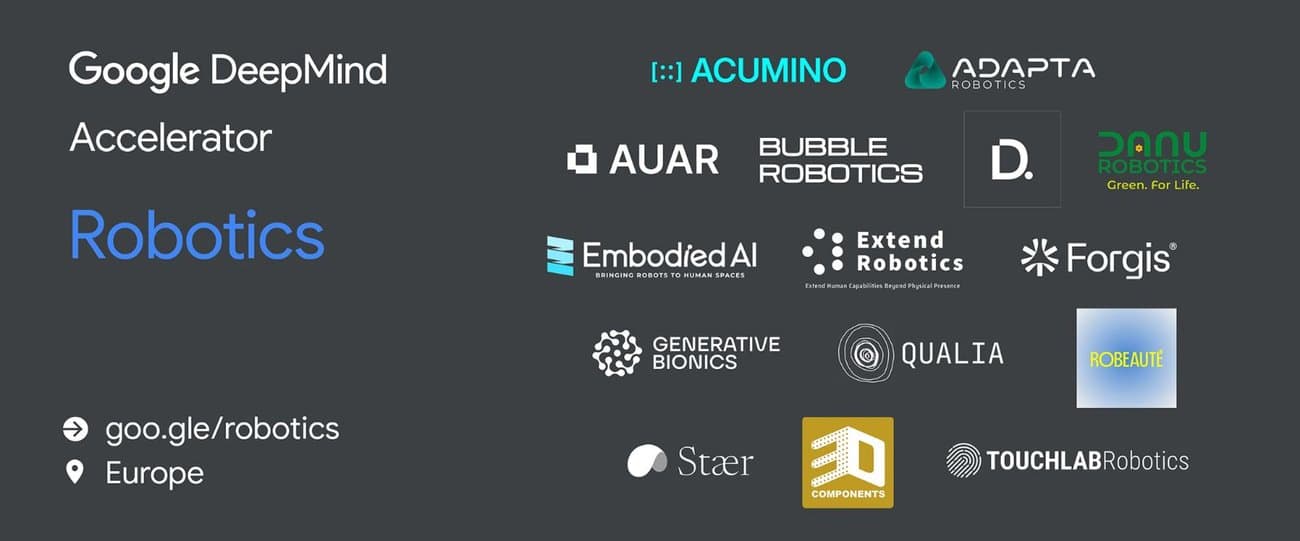
Further bolstering Europe's robotics landscape, Google DeepMind recently launched an accelerator program focused on robotics. This three-month initiative supports early-stage robotics startups across Europe, providing them with critical resources to translate cutting-edge AI research into real-world applications. Selected founders gain access to Google's advanced AI stack, technical expertise, and Gemini robotics models. They also receive hands-on mentorship and product guidance from Google DeepMind and Google experts, along with access to a wide network of partners.
The inaugural cohort of this accelerator reflects the broad potential of embodied AI, with startups working on diverse applications:
- 3D-Components AS (Norway): Developing RobTrack, an AI-driven platform for automating parameter selection and quality control in robotic welding and metal 3D-printing.
- Acumino (Greece): Creating hardware-agnostic Physical AI that enables robots to perform complex industrial tasks scalably and cost-efficiently.
- Adapta Robotics (Romania): Deploying physical AI that replicates human touch for testing devices and software in healthcare, automotive, and consumer electronics.
- Forgis (Switzerland): Developing AI agents that understand machines like experienced engineers, predicting failures and optimizing operations.
- Generative Bionics (Italy): Focused on developing humanoid robots based on physical AI, designed for global scalability.
- Qualia (Denmark): Building infrastructure to help companies deploy robotic foundation models, automating and optimizing manual labor.
This program signifies a major investment from a global tech leader into the European robotics scene, providing crucial support for startups to scale their innovations and address significant challenges in the physical world.
Conclusion
Europe is clearly on a trajectory to cement its position as a global leader in robotics. Through strategic governmental programs like Horizon Europe and the Digital Europe Programme, the collaborative efforts of organizations like euRobotics and ADRA, significant private investments, and groundbreaking work from both established companies and innovative startups, the continent is creating a dynamic and ethical framework for the future of intelligent automation. The focus on human-centric AI, industrial adoption, and addressing societal challenges ensures that these technological breakthroughs are not just advanced, but also responsible and beneficial for all.


