Key Takeaways
- Optimizing LLM inference isn't just about more GPUs; it's about eliminating wasted work from every request.
- Techniques like quantization, continuous batching, and speculative decoding can drastically cut latency and costs.
- Model-level, system-level, and application-level optimizations combined offer the most significant gains.
- Specialized inference engines like vLLM and TensorRT-LLM are critical for high-throughput, low-latency deployment.
Large Language Models (LLMs) are transforming how we build intelligent applications, but bringing them to production at scale comes with significant challenges. Developers often face a dilemma: how to deliver lightning-fast responses without breaking the bank. The common misconception is that scaling LLMs simply means throwing more GPUs at the problem. However, the real secret to efficient LLM deployment lies in a more nuanced approach: systematically removing wasted work from every request. This deep dive explores 12 key strategies that AI practitioners and software developers can use to reduce LLM latency and inference costs in production.
Why LLM Optimization Matters
In the world of AI applications, latency and cost are not just technical metrics; they directly impact user experience and business viability. Slow responses can lead to user frustration and abandonment, while high inference costs can quickly make an application unsustainable. LLMs generate text token by token, an autoregressive process where each new token depends on the previous ones. This sequential nature, coupled with the massive size of these models, often leads to performance bottlenecks. Optimizing LLM inference means ensuring your AI feels fast, remains affordable, and can handle fluctuating user demand without compromising quality.
The Core Problem: Wasted Work
The essence of LLM optimization is to minimize "wasted work." This refers to any computation that doesn't directly contribute to generating the desired output efficiently. Examples include recomputing attention for static parts of a prompt, waiting for the longest request in a batch to finish, or processing unnecessary tokens. By identifying and eliminating these inefficiencies at various levels—model, system, and application—developers can unlock substantial gains in both speed and cost-effectiveness.
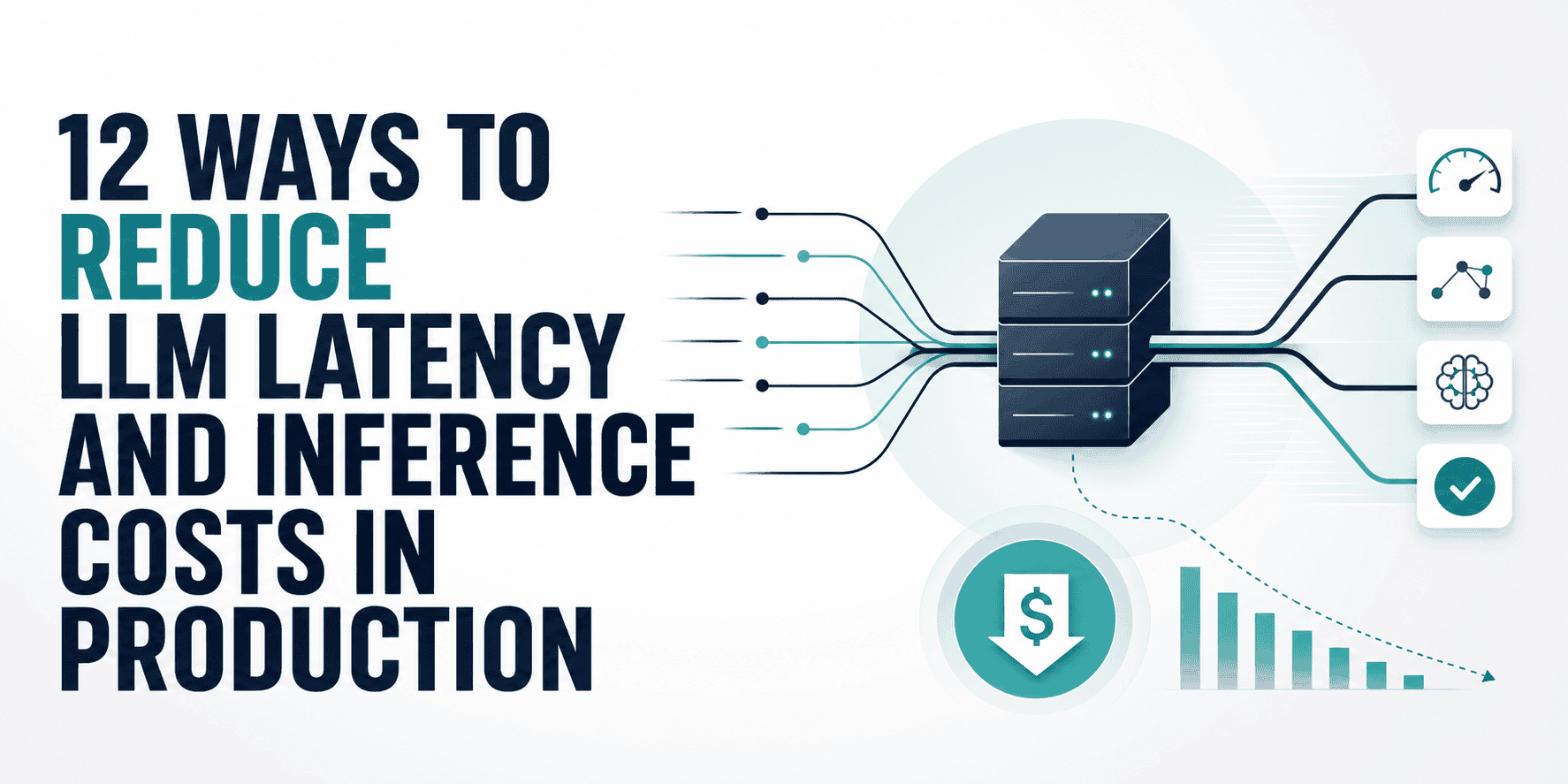
12 Ways to Reduce LLM Latency and Inference Costs in Production
1. Quantization: Shrinking Models for Efficiency
What it is: Quantization reduces the precision of model weights (e.g., from FP16 to INT8 or INT4), making the model smaller and faster to load and compute. This significantly cuts down the VRAM footprint, allowing larger models to fit on less expensive GPUs or more models on the same GPU.
Why it matters: A Llama-3-70B model in BF16 might need ~140GB of VRAM, requiring multiple high-end GPUs. Quantizing it to 4-bit can fit it comfortably on dual RTX A6000s (96GB total), potentially leading to over 80% cost reduction with minimal quality loss. Libraries like AutoGPTQ and AutoAWQ are commonly used for this.
2. Continuous Batching: Keeping GPUs Busy
What it is: Traditional batching waits for all requests in a batch to complete before processing the next. Continuous batching (also known as in-flight batching or iteration-level scheduling) addresses this by dynamically adding new requests to the batch as soon as others finish generating tokens. This maximizes GPU utilization by preventing idle time.
Why it matters: LLM inference is often memory-bound during the decode phase, meaning GPUs can be underutilized. Continuous batching can lead to significant throughput improvements (e.g., up to 23x with vLLM) and lower P50 latency. Inference engines like vLLM, SGLang, TensorRT-LLM, and LMDeploy support this technique.
3. Speculative Decoding: Guessing Ahead
What it is: Speculative decoding accelerates token generation by using a smaller, faster "draft" model to predict several future tokens. A larger, more accurate "target" model then verifies these proposed tokens in parallel, accepting those that match its own predictions. If the draft is correct, multiple tokens are generated in one step; otherwise, the target model corrects and proceeds.
Why it matters: This technique reduces inter-token latency (Time Per Output Token - TPOT) without compromising output quality, making it ideal for latency-sensitive applications like chatbots and code completion. It offloads part of the work to a less resource-intensive model, effectively cutting latency without requiring hardware changes.
4. KV Cache Optimization: Smart Memory Management
What it is: In Transformer models, the Key (K) and Value (V) tensors for previous tokens are cached and reused for subsequent attention calculations. This prevents recomputing attention from scratch for every new token, which would otherwise lead to quadratic cost increase with sequence length. Advanced techniques like PagedAttention (used in vLLM) optimize KV cache memory usage by reducing fragmentation and over-allocation, often wasting 60-80% of allocated memory.
Why it matters: KV cache management is a critical bottleneck, as memory consumption grows linearly with sequence length and batch size. PagedAttention can deliver 2-4x throughput improvements by reducing waste to under 4%. Techniques like KV cache offloading move inactive or shared KV data to cheaper storage (CPU memory or disk) to free up GPU resources. Prefix caching reuses KV states for common prompt prefixes across requests, significantly cutting Time to First Token (TTFT).
5. FlashAttention: Memory-Efficient Attention
What it is: FlashAttention is an optimized attention algorithm that speeds up Transformer models by reducing memory traffic. Instead of materializing the full attention matrix in high-bandwidth memory (HBM), it uses tiling and recomputation to perform computations in faster on-chip SRAM.
Why it matters: It offers 2-4x faster attention computation and much lower memory usage (from O(N²) to O(N) with sequence length), enabling LLMs to handle much longer context windows (e.g., 128K tokens). FlashAttention has become a widely adopted backend for both training and inference in modern LLMs and is integrated into frameworks like PyTorch, Hugging Face Transformers, vLLM, and TensorRT-LLM.
6. Model Distillation: Smaller, Focused Models
What it is: Model distillation involves transferring the knowledge from a large, complex "teacher" model to a smaller, more efficient "student" model. The student model learns to mimic the teacher's behavior, often by training on "soft" probability distributions from the teacher rather than just hard labels.
Why it matters: Distilled models are significantly smaller, leading to faster inference (2-8x faster), reduced memory footprint, and lower computational costs. This makes them suitable for deployment on resource-constrained environments like mobile devices or edge computing, and for task-specific applications where a general-purpose frontier model is overkill.
7. Early Exiting: Stopping When Confident
What it is: Early exiting (or early inference) augments Transformer models with intermediate "exit heads" at various layers. During inference, if an intermediate exit head determines with high confidence that it can produce an accurate output, the computation terminates early, bypassing the remaining layers of the model.
Why it matters: This adaptive compute paradigm reduces inference cost and latency, especially for "easy" tasks that don't require the full depth of the model. Frameworks like EE-LLM support training and inference with early exits. It can be combined with speculative decoding for further gains.
8. Optimized Inference Engines: Specialized Software
What it is: Specialized inference engines are software frameworks designed from the ground up to optimize LLM serving. They incorporate many of the techniques mentioned above (like continuous batching, PagedAttention, and FlashAttention) into highly efficient implementations.
Why it matters: Engines like vLLM (developed by UC Berkeley's Large-scale AI Applications Lab), NVIDIA TensorRT-LLM, and ONNX Runtime (GitHub repository) provide significant performance boosts. vLLM, for instance, is known for its high throughput due to PagedAttention and continuous batching. TensorRT-LLM is optimized for NVIDIA GPUs, while ONNX Runtime offers cross-platform compatibility and acceleration across various hardware (CPUs, GPUs from different vendors, NPUs).
9. Prompt Engineering & Reduction: Less is More
What it is: This involves crafting prompts to be concise, clear, and efficient, as well as actively reducing the number of input and output tokens. Strategies include setting realistic `max_tokens` limits, asking for concise answers, using stop sequences, avoiding redundant instructions, and using compact JSON schemas.
Why it matters: Both input and output token counts directly correlate with latency and cost. Reducing output tokens, in particular, can cut latency by roughly the same percentage. Techniques like RAG (Retrieval Augmented Generation) can also reduce prompt size by retrieving relevant information instead of stuffing everything into the context window.
10. Model Routing & Tiering: Right Model for the Job
What it is: Instead of using the largest, most expensive LLM for every request, implement a system that routes requests to different models based on their complexity or criticality. Simple tasks can go to smaller, cheaper models, while complex ones are escalated to more powerful (and costly) models only when needed.
Why it matters: This strategy significantly reduces average processing cost and latency. It ensures that you're not overpaying for compute on straightforward queries, optimizing resource allocation across your LLM infrastructure.
11. Caching Strategies: Reusing Past Work
What it is: Beyond KV caching, various caching mechanisms can prevent redundant LLM calls. This includes prompt caching (reusing the KV state of static prefixes across calls), semantic caching (matching queries by embedding similarity), exact-match caching (hash-based), and response caching (storing completed outputs).
Why it matters: Caching aggressively can lead to substantial cost reductions (e.g., up to 90% cost reduction and 85% latency reduction for long cached prompts reported by Anthropic) and faster responses by serving requests directly from cache.
12. Batch Processing for Non-Real-time Workloads
What it is: For tasks that don't require immediate responses, process requests in large batches rather than individually. This involves collecting requests over a period and running them together.
Why it matters: Batch mode can be significantly more cost-effective than on-demand processing, often halving the per-token price for non-real-time workloads. It maximizes GPU utilization by amortizing overheads across many requests, leading to higher throughput.
Conclusion
Scaling LLMs in production is a multi-faceted challenge that extends far beyond simply adding more hardware. The most effective strategy involves a combination of model-level optimizations, intelligent system designs, and application-level fine-tuning. By systematically addressing "wasted work" through techniques like quantization, continuous batching, speculative decoding, KV cache optimization, and smart prompt engineering, developers can achieve significant reductions in both latency and inference costs. Adopting specialized inference engines and strategic caching further enhances efficiency, making LLM applications faster, more reliable, and economically viable for a wide range of real-world use cases.
Frequently Asked Questions
What is LLM inference latency?
LLM inference latency is the total time it takes from when a user sends a request to an LLM until they receive the final response. It includes network latency, request processing time, model inference time, token generation time, and post-processing.
Why is optimizing LLM inference costs important?
Optimizing LLM inference costs is crucial because large models are resource-intensive. High costs can make AI applications financially unsustainable, especially as usage scales. Efficient optimization allows businesses to serve more users, offer longer contexts, and deploy more complex AI features within budget.
What are the main categories of LLM optimization techniques?
LLM optimization techniques generally fall into three categories: model-level (e.g., quantization, distillation, pruning), system-level (e.g., continuous batching, PagedAttention, speculative decoding), and application-level (e.g., prompt optimization, caching, model routing). Stacking these optimizations yields the best results.
Which inference engines are recommended for optimized LLM serving?
For high-performance LLM serving, specialized inference engines like vLLM, NVIDIA TensorRT-LLM, and ONNX Runtime are highly recommended. vLLM is known for its throughput with PagedAttention and continuous batching. TensorRT-LLM is optimized for NVIDIA GPUs, while ONNX Runtime offers cross-platform compatibility and acceleration.