Key Takeaways
- Access powerful Large Language Models (LLMs) for free through various API providers, enabling cost-effective AI development and experimentation.
- Providers like Google AI Studio (Gemini API), Hugging Face, Together AI, Perplexity AI Labs, and OpenRouter.ai offer generous free tiers for developers.
- These free APIs support diverse applications, including fast inference, multimodal AI, and the development of agentic applications.
- Developers can leverage these platforms for prototyping, learning, and integrating AI into projects without initial investment, though usage limits apply.
In the fast-evolving world of Artificial Intelligence, Large Language Models (LLMs) have become indispensable tools for developers and innovators. From powering intelligent chatbots to generating creative content and automating complex tasks, LLMs are at the heart of many cutting-edge applications. However, accessing these powerful models typically comes with a price tag, often charged per token or per request, which can quickly add up for hobbyists, students, or projects on a tight budget.
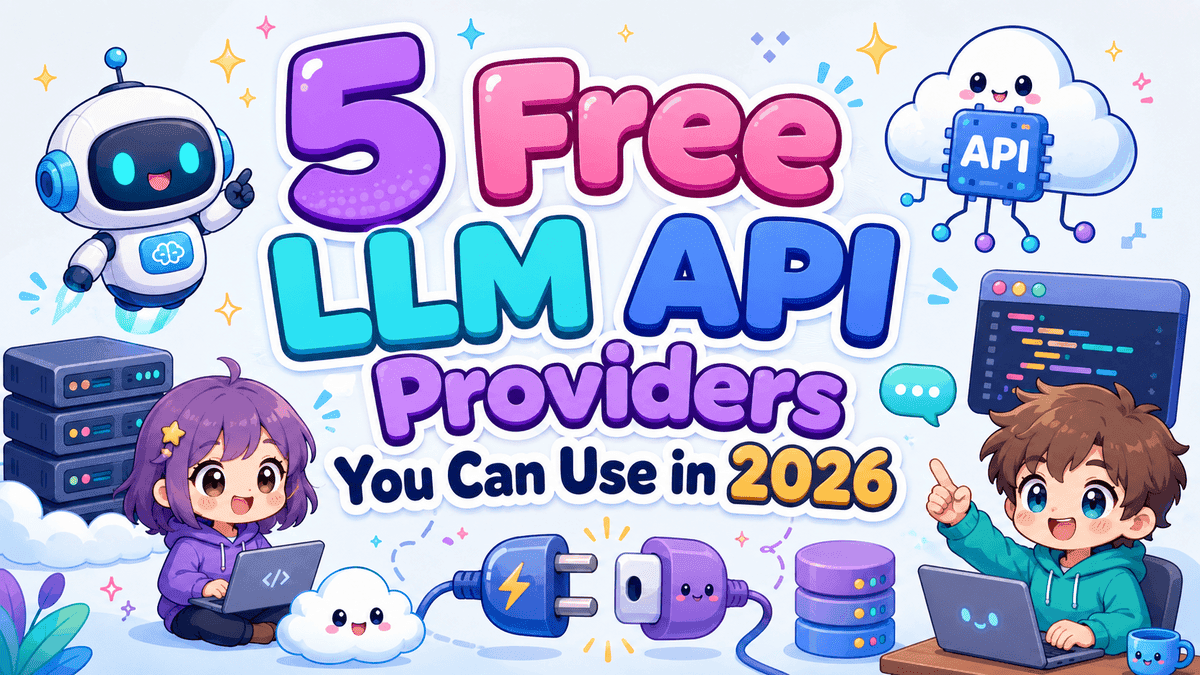
The good news is that as we look ahead to 2026, a growing number of providers are making LLM APIs accessible without upfront costs. These free tiers and generous trial programs are game-changers, allowing developers to experiment, learn, and even build functional prototypes without worrying about API usage fees. This article dives deep into five such free LLM API providers, exploring what they offer and how you can leverage them for your next AI project.
Understanding LLM APIs: Your Gateway to AI Innovation
An LLM API (Application Programming Interface) is essentially a set of rules and protocols that allows different software applications to communicate with a Large Language Model. Instead of running a massive LLM on your own hardware, an API lets your application send requests (like a text prompt or an image) to a provider's server, which then processes the request using their LLM and sends back a response. This abstraction makes it incredibly easy for developers to integrate sophisticated AI capabilities into their applications without needing to manage complex model infrastructure.
For developers, LLM APIs are critical because they:
- Enable Fast Inference: They provide quick responses to user queries, crucial for real-time applications like chatbots and virtual assistants.
- Support Multimodal AI: Many modern LLMs can handle more than just text. Multimodal APIs allow you to input and receive information across different data types, such as text, images, audio, and even video, opening doors for richer, more interactive AI experiences.
- Facilitate Agentic Applications: This is a newer frontier where LLMs can plan and execute complex tasks by interacting with tools and external environments. APIs with function calling capabilities are key to building these sophisticated AI agents.
Why Go Free? The Benefits of Zero-Cost LLM Access
The primary advantage of free LLM API providers is, naturally, cost savings. But the benefits extend beyond just your wallet:
- Experimentation and Learning: New to LLMs? Free APIs provide a sandbox to test ideas, understand model behaviors, and learn API integration without financial risk.
- Rapid Prototyping: Quickly build proofs-of-concept and Minimum Viable Products (MVPs) to validate your ideas before investing in paid services.
- Accessibility: Levels the playing field for students, independent developers, and startups who might not have the budget for high-end AI infrastructure.
- Community Contribution: Many free tiers are associated with open-source models, fostering a vibrant community of developers contributing to and improving AI technology.
Top 5 Free LLM API Providers for 2026
Here are five excellent options for developers looking to tap into the power of LLMs without incurring immediate costs:
1. Google AI Studio / Gemini API
Google's Generative AI Studio and its underlying Gemini API offer a powerful entry point into Google's latest LLMs. Designed with developers in mind, it provides a user-friendly interface for prompt engineering and seamless API access for integration into applications.
- Developer: Google
- Key Features: Fast inference, robust multimodal capabilities allowing input of text, images, and video, and strong support for function calling to build agentic applications.
- Models Available: Access to the Gemini Pro and Gemini Pro Vision models. Gemini 1.0 Pro is generally available, while Gemini 1.5 Pro is often available for free during its public preview phases, which are likely to extend into 2026.
- Free Tier Details: The Gemini API offers a generous free tier for developers. You can use Gemini 1.0 Pro for free up to 60 requests per minute (RPM) and 2,500 requests per day. This allows for substantial experimentation and development.
- Official Link: Google AI for Developers
2. Hugging Face Inference API
Hugging Face is a central hub for open-source AI models, and its Inference API provides a way to interact with a vast collection of these models programmatically. It's an excellent choice for developers who want to explore a wide range of specialized models beyond general-purpose LLMs.
- Developer: Hugging Face
- Key Features: Access to thousands of diverse models from the Hugging Face Hub, supporting a wide array of tasks including text generation, summarization, translation, image classification, and more. It's highly community-driven, offering incredible flexibility.
- Models Available: An extensive catalog of open-source models (e.g., Llama, Mistral, Falcon, Bloom, various transformers) contributed by the AI community.
- Free Tier Details: The Hugging Face Inference API provides a free tier for "Community" models. This tier typically has rate limits, such as 100 requests per hour for some models, and limited compute resources. While not as high-volume as some other free tiers, it's perfect for testing and integrating many different open-source models.
- Official Link: Hugging Face Inference API Documentation
3. Together AI
Together AI is a platform focused on making open-source AI models accessible and performant. They provide API access to a curated selection of leading open-source LLMs, often with very competitive inference speeds and pricing for their paid tiers, complemented by a solid free offering.
- Developer: Together AI
- Key Features: High-performance inference for a wide range of popular open-source models. Focus on speed and efficiency.
- Models Available: Supports many prominent open-source models, including different versions of Llama 2, Mixtral, CodeLlama, Falcon, and more.
- Free Tier Details: Together AI typically provides new users with $25 in free credits upon signup. These credits can cover a significant amount of API usage for experimentation and development, especially with smaller models. They also impose rate limits on free usage.
- Official Link: Together AI Official Website
4. Perplexity AI Labs
Perplexity AI is known for its powerful search and answer engine, and its API extends these capabilities to developers. Their models are optimized for factual accuracy and real-time information retrieval, making them ideal for applications requiring up-to-date knowledge.
- Developer: Perplexity AI
- Key Features: Models are designed for online search and answering, providing accurate and current information. Fast inference and a focus on generating factual responses.
- Models Available: Perplexity's own models, such as
pplx-7b-online,pplx-70b-online,pplx-7b-chat, andpplx-70b-chat. The "online" models have real-time internet access. - Free Tier Details: Perplexity AI offers a free tier for its smaller models, specifically
pplx-7b-onlineandpplx-7b-chat. This tier comes with usage caps, such as 250 requests per minute and 50,000 tokens per day, providing ample room for many projects. - Official Link: Perplexity AI API Documentation
5. OpenRouter.ai
OpenRouter.ai acts as a unified API gateway to a multitude of LLMs from various providers, including many open-source options. What makes it particularly interesting for free usage is its explicit support for certain models that are completely free to access through their platform.
- Developer: OpenRouter.ai
- Key Features: A single API endpoint to access a vast array of models, simplifying model switching and integration. They provide a clear indication of which models are free to use.
- Models Available: A very broad selection of models from different providers, including specific versions of Llama, Mistral, Zephyr, and many others. The list of free models is dynamic and can be filtered on their website.
- Free Tier Details: OpenRouter.ai explicitly marks certain models as "Free" on their platform. These are typically smaller, open-source models that can be used without cost, making it an excellent resource for developers to experiment with different architectures and capabilities.
- Official Link: OpenRouter.ai Official Website
Choosing the Right Free LLM API for Your Project
With several excellent free options available, how do you pick the best one for your needs? Consider these factors:
- Model Type and Capabilities: Do you need a general-purpose chat model, a model for code generation, or one with strong multimodal capabilities? Google's Gemini API excels in multimodal tasks, while Hugging Face and OpenRouter.ai offer a wider variety of specialized models.
- Usage Limits and Rate Limits: Check the free tier's specific caps on requests per minute, daily tokens, or total requests. Some providers are more generous for continuous low-volume use, while others might offer larger initial credits.
- Specific Features: If you're building agentic applications, look for robust function calling support. If real-time information is crucial, Perplexity AI's online models are a strong contender.
- Ease of Integration and Documentation: Good documentation and SDKs can significantly speed up your development process. All listed providers offer comprehensive API documentation.
- Community Support: Platforms like Hugging Face benefit from a massive, active community, which can be invaluable for troubleshooting and finding resources.
The Future of Free LLM APIs
The trend towards offering free or highly accessible LLM APIs is likely to continue. As AI technology becomes more ubiquitous, providers are incentivized to attract developers and foster innovation on their platforms. While free tiers often come with limitations, they serve as crucial gateways for learning, prototyping, and ultimately, driving the next wave of AI applications. For developers in 2026, the landscape of free LLM access is richer and more diverse than ever before, making it an exciting time to build with AI.
Frequently Asked Questions
What exactly is an LLM API?
An LLM API (Application Programming Interface) is a service that allows software applications to communicate with a Large Language Model hosted by a provider. It lets your application send prompts or data to the LLM and receive responses back, integrating AI capabilities without needing to manage the complex AI model directly.
Are these "free" APIs truly free forever, or are they trials?
Most of the listed providers offer a persistent "free tier" with specific usage limits (e.g., requests per minute, daily tokens) rather than just a time-limited trial. For example, Google's Gemini API has a free tier for Gemini 1.0 Pro. Some, like Together AI, offer significant free credits that can last a long time for small projects. Always check the current terms for each provider, as these can change.
Can I build commercial applications using these free LLM APIs?
While you can certainly prototype and develop initial versions of commercial applications using free tiers, the usage limits often mean they are not suitable for production-scale commercial use. For higher volumes or dedicated performance, you would typically need to upgrade to a paid plan. Always review the specific terms of service for commercial use with each provider.
Do these free APIs support multimodal AI and agentic applications?
Yes, several free LLM APIs, particularly Google's Gemini API, offer multimodal capabilities allowing for inputs beyond just text (like images and video). Many also support function calling, which is a key feature for building agentic applications that can interact with external tools and services.