Key Takeaways
- NVIDIA Switchyard is an open-source Rust library and proxy for intelligently routing Large Language Model (LLM) requests.
- It helps cut AI inference costs and reduce latency by directing requests to the most suitable model, rather than always using the most expensive one.
- Switchyard offers features like API protocol translation, multiple routing algorithms, and operational metrics, making AI deployments more flexible and efficient.
- Currently in pre-alpha, it's a promising tool for AI/ML engineers and developers looking to optimize their multi-model AI agent workflows.
The world of Artificial Intelligence is moving at an incredible pace, with new models and capabilities emerging constantly. While these advancements bring immense power, they also introduce significant challenges, especially concerning the operational costs and performance of deploying AI models in real-world applications. Many AI systems, particularly those built around large language models (LLMs), often send every single request to their most powerful and, consequently, most expensive model. This approach can quickly drain budgets and introduce unnecessary delays.
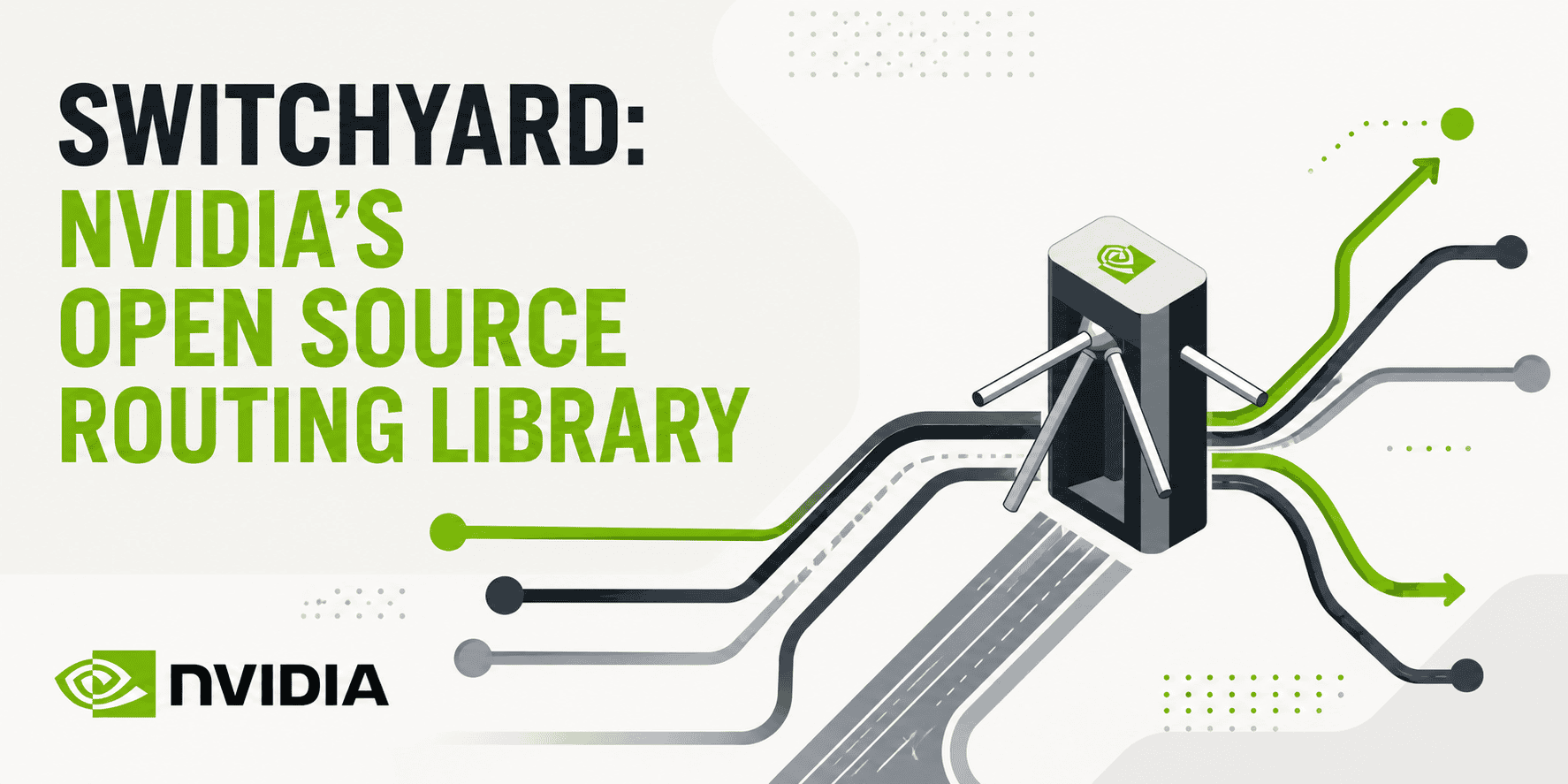
Enter NVIDIA Switchyard: an innovative open-source routing library designed to tackle this exact problem. Released by NVIDIA, Switchyard acts as an intelligent traffic controller for your AI requests, ensuring that each task goes to the most appropriate model. The core idea is simple yet powerful: stop sending every AI request to your most expensive model. By intelligently routing these requests, Switchyard can help cut costs and reduce latency without significantly compromising quality.
What is NVIDIA Switchyard?
NVIDIA Switchyard is an open-source Rust-based proxy and library specifically engineered for managing Large Language Model (LLM) traffic. Think of it as a smart layer that sits between your AI application and the various LLMs you might be using. Instead of your application directly calling a specific model, it sends the request to Switchyard. Switchyard then, based on a set of rules and algorithms, decides which backend model is best suited to handle that particular request.
Developed by NVIDIA as part of its NeMo framework, Switchyard aims to bring efficiency and control to complex AI deployments, especially those involving AI agents that interact with multiple models or need to optimize for different performance criteria.
Why Intelligent Routing Matters for AI
The shift from simple chatbots to sophisticated, autonomous AI agents has highlighted a critical issue: not all AI tasks are created equal. A quick classification, a simple data extraction, or a basic conversational turn doesn't always require the immense computational power of a frontier-level LLM. Yet, in many current deployments, every single interaction, regardless of its complexity, is routed to these expensive models.
This "one-size-fits-all" approach leads to several problems:
- High Costs: Running powerful LLMs for every query, no matter how trivial, incurs substantial inference costs. These costs can quickly escalate, making large-scale AI deployments financially challenging.
- Increased Latency: Larger models often have higher latency, meaning they take longer to process requests. For interactive applications or real-time agents, this can degrade the user experience.
- Underutilized Resources: Dedicated hardware or cloud instances for powerful models might be underutilized when handling simpler tasks, leading to inefficient resource allocation.
- Lack of Flexibility: Tightly coupling an application to a single model or provider makes it difficult to switch models, experiment with new ones, or adapt to changing pricing and performance landscapes.
Intelligent routing directly addresses these issues. By dynamically selecting the most appropriate model for each request – a smaller, more efficient model for simple tasks and a larger, more capable one for complex reasoning – organizations can achieve significant cost savings and latency reductions. Reports suggest that intelligent routing can cut inference costs by 30% to 85% while maintaining high quality. NVIDIA itself claims Switchyard can reduce costs to one-third compared to solely relying on a single expensive model like Opus.
How Switchyard Works: The Routing Mechanism
At its core, Switchyard operates as a proxy that intercepts LLM requests. When a request comes in, Switchyard analyzes it and, based on configured routing algorithms, decides which backend model should process it. This decision-making process can be highly sophisticated, taking into account various factors:
- Request Complexity: Simple questions or commands might be routed to a smaller, faster, and cheaper model, while complex multi-step reasoning tasks are sent to a more powerful, albeit more expensive, frontier model.
- Cost-Effectiveness: The router can prioritize models that offer the best price-to-performance ratio for a given task.
- Latency Requirements: For time-sensitive applications, requests can be directed to models known for their low latency.
- Model Capabilities: Different models excel at different types of tasks (e.g., one for code generation, another for summarization). Switchyard can route requests based on these specialized capabilities.
A key enabler of this intelligent routing is Switchyard's ability to perform protocol translation. Many AI agents are designed to speak specific APIs, such as OpenAI's Chat Completions API or Anthropic's Messages API. However, the backend models might use different formats or be served by various platforms like vLLM, NVIDIA NIM, or Ollama. Switchyard acts as a universal translator, decoding the incoming request into a provider-neutral format, running the routing algorithm, re-encoding the request into the chosen backend's format, and then translating the response back to the client's expected API. This decoupling means developers don't need to rewrite their agents or applications when integrating new models or providers.
The routing logic itself is highly configurable. Developers can implement various strategies, including:
- Random Routing: For A/B testing or simple load balancing.
- LLM-as-Classifier Routing: Using a small, fast LLM to classify the incoming request's intent or complexity, and then routing it to a specialized model.
- Signal-Driven Stage Routing: Particularly useful for multi-turn agentic workflows. For example, early turns in a coding agent's process (exploring files) might go to a cheaper model, while later turns requiring complex reasoning or debugging are escalated to a stronger model.
- Custom Algorithms: Developers have the flexibility to write their own routing logic tailored to specific application needs.
Key Features That Empower Developers
NVIDIA Switchyard is packed with features designed to make LLM traffic management efficient and flexible for developers:
- Multi-Backend Routing with Composable Algorithms: Switchyard supports various routing strategies, from simple random distribution to sophisticated, signal-driven decision-making. Developers can compose these algorithms or create their own to perfectly match their application's logic and cost/performance goals.
- API Protocol Translation: This is a standout feature. Switchyard can translate between OpenAI Chat, Anthropic Messages, and OpenAI Responses formats. This means your coding agent, for example, can continue to use its native API while Switchyard seamlessly routes the request to an open-source model served by vLLM, NVIDIA NIM, or Ollama.
- Open-Source Nature: Released under the Apache 2.0 license, Switchyard is fully open source and available on GitHub. This allows developers to inspect, modify, and contribute to the codebase, fostering community-driven improvements and ensuring transparency.
- Operational Metrics via Prometheus: To truly optimize, you need to measure. Switchyard exposes detailed Prometheus metrics covering requests, errors, latency, tokens processed, and routing overhead. This observability is crucial for understanding the economic impact of your routing decisions and continuously refining your strategies.
- Flexible Deployment Options: Developers can integrate Switchyard in two primary ways: either run it as a standalone Rust proxy server or embed its routing algorithms directly into their own Rust applications as a library. This flexibility caters to different architectural preferences and existing infrastructure.
- Integration with NVIDIA NeMo Relay: While the integration is currently experimental and undergoing updates, Switchyard is designed to work within the broader NVIDIA NeMo ecosystem, specifically with NeMo Relay, to enhance agentic AI workflows.
- Cost and Performance Optimization: By enabling dynamic model selection, Switchyard directly addresses the trade-offs between model quality, inference cost, and response latency, allowing developers to fine-tune their deployments for optimal balance.
Who Should Use NVIDIA Switchyard?
NVIDIA Switchyard is a powerful tool, particularly beneficial for:
- AI/ML Engineers and MLOps Practitioners: Those responsible for deploying, managing, and optimizing LLM-powered applications in production environments will find Switchyard invaluable for cost control, performance tuning, and increasing system resilience.
- Software Developers Building AI Agents: If you're creating complex AI agents that rely on multiple LLMs for different sub-tasks, Switchyard provides the necessary infrastructure to route these tasks intelligently and abstract away model-specific API differences. For instance, developers running coding agents like Claude Code or Codex can use Switchyard to direct requests to open-source models without rewriting their agent's API calls.
- Researchers and Experimenters: The open-source nature and flexible routing algorithms make it an excellent platform for experimenting with different model combinations, A/B testing various LLMs, and evaluating the quality-cost trade-offs for specific workloads.
- Companies Seeking Cost Efficiency: Any organization scaling up its use of LLMs will benefit from the significant cost reductions Switchyard can enable by ensuring that expensive frontier models are only used when truly necessary.
Getting Started: A Developer's Perspective
As a developer, getting started with Switchyard involves either installing it as a standalone proxy or integrating its library into a Rust application. The project is hosted on GitHub under the NVIDIA-NeMo organization.
For the standalone proxy, you can typically install it using Cargo (Rust's package manager):
cargo install --locked switchyard-server
You would then configure your routing rules in a TOML file (e.g., routes.toml), specifying your LLM clients, targets, and routing logic. This configuration file defines which models are available and how Switchyard should decide between them. For example, you might define a "strong" model (like GPT-4o) and a "weak" model (a smaller, cheaper one) and then implement a routing strategy that sends easier prompts to the "weak" model.
An example routing configuration might look like this (simplified):
schema_version = 1

[llm_clients.openrouter]
format = "openai_chat"
base_url = "https://openrouter.ai/api/v1"
api_key = "${OPENROUTER_API_KEY}"

[routes.ab-test]
type = "random_routing"
strong = { model = "openai/gpt-4o" }
weak = { model = "mistralai/mistral-7b-instruct" }
Once configured, you can start the server:
switchyard-server --config routes.toml --host 127.0.0.1 --port 4000
Your application would then send its LLM requests to http://localhost:4000, and Switchyard would handle the intelligent routing behind the scenes.
It's important to note that Switchyard is currently labeled as "pre-alpha" and experimental. NVIDIA advises that it is not for production use yet, and its APIs and algorithms are expected to change significantly before reaching version 1.0. This means developers should approach it with an understanding that it's an evolving project, ideal for evaluation and early integration.
The Broader Impact on AI Deployment
NVIDIA Switchyard represents a significant step towards more efficient and controllable AI deployments. As AI systems increasingly become "systems of models" – where different models specialize in different tasks – intelligent routing becomes not just an optimization, but a foundational piece of infrastructure. It allows developers to abstract away the complexities of managing multiple LLMs, enabling them to focus on building powerful applications rather than getting bogged down in integration challenges.
By empowering developers to optimize for cost, latency, and quality, Switchyard helps democratize access to advanced AI capabilities. It makes it more feasible for smaller teams and startups to leverage cutting-edge LLMs without prohibitive operational expenses. Furthermore, its open-source nature promotes innovation and collaboration within the AI community, potentially leading to new routing algorithms and integrations that further push the boundaries of efficient AI.
Conclusion
NVIDIA Switchyard is a compelling open-source library that addresses one of the most pressing challenges in modern AI deployment: the cost and latency associated with large language models. By providing an intelligent, flexible, and observable routing layer, it empowers developers to optimize their AI workflows, reduce operational expenses, and enhance the performance of their applications. While still in its early stages of development, Switchyard's potential to reshape how we interact with and deploy AI models is clear. For any developer or organization serious about building scalable and cost-effective AI solutions, keeping an eye on NVIDIA Switchyard and exploring its capabilities is a smart move.
Frequently Asked Questions
What problem does NVIDIA Switchyard primarily solve?
NVIDIA Switchyard primarily solves the problem of high costs and latency associated with sending every AI request to large, expensive language models. It intelligently routes requests to the most suitable model, optimizing for cost, speed, and quality.
Is NVIDIA Switchyard open source?
Yes, NVIDIA Switchyard is fully open source and available on GitHub under the Apache 2.0 license.
What programming language is Switchyard written in?
NVIDIA Switchyard is primarily written in Rust, and it can be used as a standalone proxy or embedded as a library in Rust applications.
Is Switchyard ready for production use?
Currently, NVIDIA Switchyard is labeled as "pre-alpha" and experimental. NVIDIA advises that it is not yet recommended for production use, and its APIs and algorithms are expected to change significantly before reaching version 1.0.