Key Takeaways
- Agentic AI allows autonomous systems to reason, plan, and execute complex, multi-step tasks in enterprise environments without constant human intervention.
- It differs from traditional automation and generative AI by acting independently, learning, and adapting in real-time across various business systems.
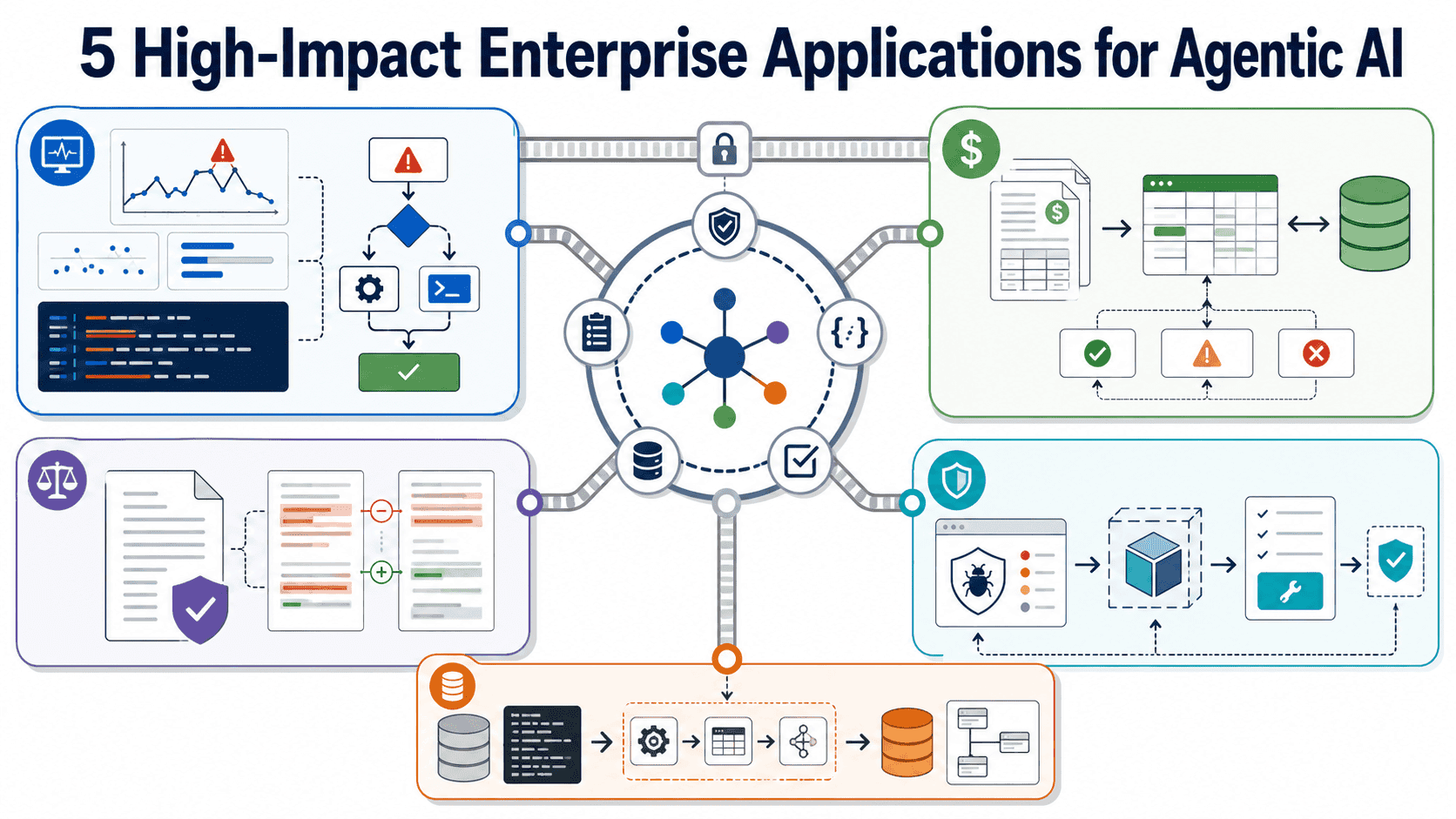
- Key applications include optimizing SRE incident response, enhancing financial fraud detection and compliance, streamlining legal workflows, accelerating IT and data migration, and bolstering cybersecurity defenses.
- Deterministic safety constraints are crucial, ensuring agents operate within strict, auditable boundaries to prevent unintended actions and maintain trust in sensitive enterprise operations.
In the rapidly evolving landscape of artificial intelligence, a new frontier is emerging that promises to reshape how businesses operate: Agentic AI. Moving beyond simple task automation or content generation, agentic AI introduces autonomous systems capable of reasoning, planning, and executing complex, multi-step workflows. This isn't just about making processes faster; it's about making them smarter, more adaptable, and truly self-managing within an enterprise context.
For AI practitioners and businesses looking to leverage the next wave of automation, understanding agentic AI is no longer optional. It's a strategic necessity. This deep dive will explore what agentic AI is, why it's becoming vital for enterprises, how it works at a high level, and its transformative applications across critical business functions like Site Reliability Engineering (SRE), finance, legal, migration, and security, all while emphasizing the importance of deterministic safety constraints.
What Exactly is Agentic AI?
At its core, Agentic AI refers to artificial intelligence systems designed to act autonomously to achieve specific goals. Unlike traditional automation, which follows predefined rules and scripts, or even generative AI, which primarily creates content based on prompts, agentic AI can interpret context, make decisions, and execute multi-step tasks with minimal human intervention.
Think of it this way: traditional automation is like a robot arm programmed to perform a single, repetitive motion. Generative AI is like a brilliant assistant who can write a perfect report if given clear instructions. Agentic AI, however, is like a proactive manager who understands a high-level objective, breaks it down into actionable steps, delegates tasks (even to other AI agents or tools), monitors progress, adapts to unexpected challenges, and reports back on the outcome.
How Agentic AI Works (A High-Level View)
The power of agentic AI comes from several interconnected components:
- Reasoning Layer: Often powered by large language models (LLMs), this layer allows the agent to interpret goals, understand context, and generate a plan of action.
- Memory: Agents retain information from past interactions and experiences, enabling continuous learning and adaptation to new situations.
- Tool Use: Agentic systems can interact with external tools, databases, APIs, and other business systems to gather information or execute commands. This allows them to perform real-world actions like sending emails, updating records, or deploying code.
- Planning and Execution: The agent breaks down complex goals into smaller, manageable steps, executes them, and monitors the results. If a step fails or new information emerges, it can adapt its plan dynamically.
- Feedback Loops: Agents can evaluate their own performance and refine their strategies, leading to continuous improvement without explicit human reprogramming for every scenario.
Companies like OpenAI, Microsoft, and Google are among the foundational model providers enabling agentic AI. Others like Moxo, Kore.ai, and Moveworks focus on process orchestration platforms, while implementation partners like Kanerika help businesses deploy tailored solutions.
Why Agentic AI Matters for Enterprise Automation
The shift towards agentic AI is a strategic necessity for enterprises looking to maintain a competitive edge. It offers significant advantages over traditional automation methods:
- Enhanced Adaptability: Agentic AI can handle exceptions and adapt to changing scenarios, unlike rule-based RPA which often requires reprogramming for minor process changes.
- Increased Intelligence: With sophisticated AI models, agentic systems understand context and make informed decisions, going beyond the fixed logic of traditional automation.
- Operational Efficiency: By automating routine and complex tasks, agents free up human resources for more strategic activities, leading to measurable productivity gains.
- Scalability: Agentic AI can scale to handle hundreds of steps end-to-end, managing enterprise initiatives that span numerous processes.
- Cost Reduction: By reducing manual work and errors, agentic AI can significantly lower operational costs.
Gartner predicts that by 2028, 33% of enterprise software applications will include agentic AI, a substantial leap from less than 1% in 2024.
The Critical Role of Deterministic Safety Constraints
With greater autonomy comes greater responsibility and potential risk. This is where deterministic safety constraints become absolutely critical, especially in sensitive enterprise environments. Deterministic controls ensure that AI agents operate within strict, auditable boundaries, preventing unintended actions.
Unlike probabilistic safety gates that merely reduce the likelihood of an error, deterministic controls provide a hard "security box" external to the agent's reasoning loop. This means that even if an agent's internal logic might suggest an action, external, explicit rules will prevent it if it violates security, compliance, or operational policies. These controls govern what tools an agent can access, what operations it can perform, and what data it can reach.
For regulated industries like finance and legal, risk management by design is essential, incorporating human-in-the-loop approvals, least-privilege non-human identities, and durable audit trails. Organizations should expand agent autonomy progressively based on demonstrated performance, not grant it by default.
5 Real-World Applications of Agentic AI in Enterprise Automation
1. Site Reliability Engineering (SRE)
SRE teams are constantly battling complexity, dealing with massive amounts of telemetry data from distributed services and environments. Agentic AI is transforming SRE by moving from reactive troubleshooting to proactive, structured investigation and resolution.
- Anomaly Detection and Alerting: Agentic AI can augment traditional monitoring by detecting anomalies in regular behavior rather than relying solely on static thresholds. Agents collect signals, feed them to models for anomaly detection, and can even consider customer feedback.
- Incident Response and Root Cause Analysis: When an alert fires, an AI SRE agent can autonomously investigate by querying logs, metrics, traces, and recent changes. It gathers evidence, forms hypotheses about the cause, and proposes mitigations. Companies like Resolve AI and Middleware OpsAI are developing platforms for autonomous SRE, aiming for high resolution rates.
- Runbook and Documentation Improvement: AI agents can continuously monitor and improve playbooks and production documentation based on their usage during incidents, and even generate new playbooks from past incidents.
- Automated Remediation: While human approval is often still required for high-risk actions, AI agents can pre-process and enrich alerts with context, and autonomous AI alert handlers can address or mitigate many issues, leading to faster resolution.
The goal is to significantly reduce the time SREs spend on issues, allowing them to focus on higher-value tasks, while maintaining transparency and control over agent actions.
2. Finance
The financial sector, characterized by high-volume transactions, strict regulations, and the need for real-time decision-making, is a prime candidate for agentic AI.
- Fraud Detection and Prevention: Agentic AI can monitor account activity and transaction flows continuously, identifying and pausing payments that deviate from established patterns, initiating reviews, or escalating cases immediately. Unlike static rule-based systems, agents adapt to evolving fraud tactics.
- Regulatory Compliance Monitoring: Agents can autonomously scan global regulators for changes, perform first-pass impact analysis, track filing deadlines, and audit corporate records. This ensures continuous compliance and reduces the risk of penalties.
- Internal Finance Workflow Optimization: Agentic AI can inject autonomous execution into core financial workflows like procure-to-pay, record-to-report, and order-to-cash. Agents can handle tasks, reconcile transactions, propose adjustments, and flag only true anomalies for human review.
- Credit Assessment and Underwriting: By analyzing a wider range of inputs—from payment histories to utility bills—AI agents can quickly assess risk, recommend credit terms, and explain their decisions, making underwriting faster and more consistent.
- Wealth Management Recommendations: Agents can generate tailored insights in real-time and automate meeting preparation for wealth managers.
Companies like Neurons Lab are specifically developing agentic AI for financial services, with a focus on compliance and enterprise-grade trust. Moveworks also highlights agentic AI's role in orchestrating multi-step work across financial systems like SAP and Workday.
3. Legal
The legal profession is seeing agentic AI redefine workflows, automating complex tasks and freeing lawyers to focus on high-value client strategy.
- Contract Lifecycle Management: Agents can handle autonomous intake, obligation tracking, renewal alerts, contract review, and even redlining, emailing counterparties, and filing signed documents. Ironclad's "Jurist" is an example of an agentic AI assistant for contract review.
- Legal Research and Memo Drafting: An agentic AI can research specific legal questions, search databases, synthesize findings, draft initial memorandums, and suggest related areas of inquiry.
- Regulatory & Compliance Monitoring: Autonomous agents can perform horizon scanning across global regulators with first-pass impact analysis, ensuring legal teams stay updated.
- Litigation & eDiscovery Management: Agents can automate legal holds, custodian tracking, and first-pass document review, significantly streamlining the eDiscovery process.
- Corporate Governance & Records: Agents can track filing deadlines, draft routine resolutions, and audit corporate record repositories.
Legal AI adoption is accelerating, with 52% of corporate legal departments using AI in 2025, up from 23% in 2024, driven by the measurable productivity gains from agentic capabilities.
4. Migration (IT & Data)
Migrating applications and data, especially from legacy systems to cloud environments, is often a complex, time-consuming, and error-prone process. Agentic AI is changing this by blending automation with strategic reasoning.
- Application Dependency Mapping: AI-powered migration tools can assess on-premises servers, map complex application dependencies, and recommend optimized resource allocations for cloud environments.
- Code Modernization: Agentic AI uses code understanding models to analyze legacy codebases (e.g., COBOL, Java, .NET) and automate upgrades to newer versions. Microsoft Azure and GitHub Copilot are offering agentic AI tools to accelerate modernization for Java and .NET applications.
- Migration Plan Generation: Agents can generate precise cloud migration plans, reducing planning time and improving accuracy. They can translate on-premises architectures to native cloud constructs.
- Automated Data Migration: While not explicitly detailed in the search results, the ability of agents to interact with databases and APIs suggests potential for automating the extraction, transformation, and loading (ETL) of data during migration processes, with appropriate safety constraints.
These agentic tools aim to simplify migration across teams, helping organizations tackle technical debt faster and with less friction.
5. Security
In cybersecurity, agentic AI marks a significant evolution from traditional AI, which primarily focused on detection. Agentic AI moves towards autonomous investigation and response.
- Real-time Threat Detection and Response: Agentic AI security solutions protect autonomous AI systems by analyzing alerts, automating routine tasks, and supporting investigative work. Agents can identify unusual network behavior and autonomously isolate impacted devices to prevent compromise without human intervention.
- Vulnerability Management: While not directly covered, the ability to scan, analyze, and interact with systems implies potential for agents to identify vulnerabilities, prioritize them, and even suggest or apply patches within defined parameters.
- Managing Alert Fatigue: SOC teams are often overwhelmed by alerts. Agentic AI excels at triaging and correlating alerts, allowing human analysts to focus on complex threats.
- Autonomous Remediation: Agents can autonomously plan tasks, collect and analyze data, and execute responses to mitigate threats, freeing SOC analysts to concentrate on complex threat analysis. However, human oversight for critical remediation remains a best practice.
- Securing Agentic AI Systems: Agentic AI security also involves protecting the agents themselves. This includes securing the prompts they receive, the tools they call, their identities and permissions, and the runtime actions they take across multiple systems.
Companies like Palo Alto Networks are developing agentic AI security solutions to protect these autonomous systems across their lifecycle. AWS also emphasizes deterministic external controls as the starting point for agentic security.
Challenges and Future Outlook
While agentic AI offers immense potential, its deployment in enterprises comes with challenges. Ensuring trust, managing complexity, and integrating with existing legacy systems are key concerns. The need for robust governance frameworks, addressing issues like AI drift, data access, and ethical alignment, is paramount.
However, the trend is clear: agentic AI is rapidly transitioning from a novel concept to a strategic necessity. As models improve, and as organizations develop clearer strategies for human-in-the-loop oversight and deterministic controls, agentic AI will continue to reshape enterprise automation, leading to unprecedented levels of efficiency, responsiveness, and innovation.
Conclusion
Agentic AI represents a significant leap forward in enterprise automation. By empowering AI systems to reason, plan, and execute complex, multi-step tasks autonomously, businesses can unlock new levels of efficiency and adaptability. From revolutionizing SRE and financial operations to transforming legal processes, IT migrations, and cybersecurity, the real-world applications are vast and impactful. The key to successful deployment lies in carefully implementing deterministic safety constraints, ensuring that these powerful agents operate reliably, securely, and in alignment with business goals, always with appropriate human oversight.
Frequently Asked Questions
What is the main difference between Agentic AI and traditional automation?
Traditional automation, like Robotic Process Automation (RPA), follows fixed, predefined rules and requires human intervention for exceptions. Agentic AI, in contrast, uses advanced reasoning (often powered by LLMs) to interpret goals, plan actions, make decisions, and adapt to new situations autonomously across multiple steps and systems, with minimal human oversight.
Is Agentic AI meant to replace human jobs?
Not primarily. Agentic AI is designed to augment human capabilities by automating routine, complex, and time-consuming tasks. This frees human employees to focus on more strategic thinking, creative problem-solving, and tasks that require uniquely human judgment and empathy.
How do "deterministic safety constraints" work with Agentic AI?
Deterministic safety constraints are external, infrastructure-level controls that strictly govern an AI agent's actions, regardless of its internal reasoning. These controls define what tools an agent can use, what data it can access, and what operations it can perform. This ensures that even highly autonomous agents operate within predefined, auditable boundaries, preventing unintended or harmful actions in sensitive enterprise environments.
What industries are seeing the most impact from Agentic AI right now?
Industries dealing with complex, multi-step workflows, high data volumes, and critical compliance requirements are seeing significant impact. This includes Site Reliability Engineering (SRE), finance, legal, cybersecurity, and IT operations (especially for migration and modernization).