Key Takeaways
- CLI agentic coding with AI streamlines development by automating tasks directly from the command line.
- Alternatives to Claude models offer cost savings, faster execution, local model support, and greater control over context.
- Tools like Continue.dev, Ollama with code models, and Aider provide powerful open-source options for developers.
- Many alternatives support multi-context programming (MCP) and improved context handling for complex projects.
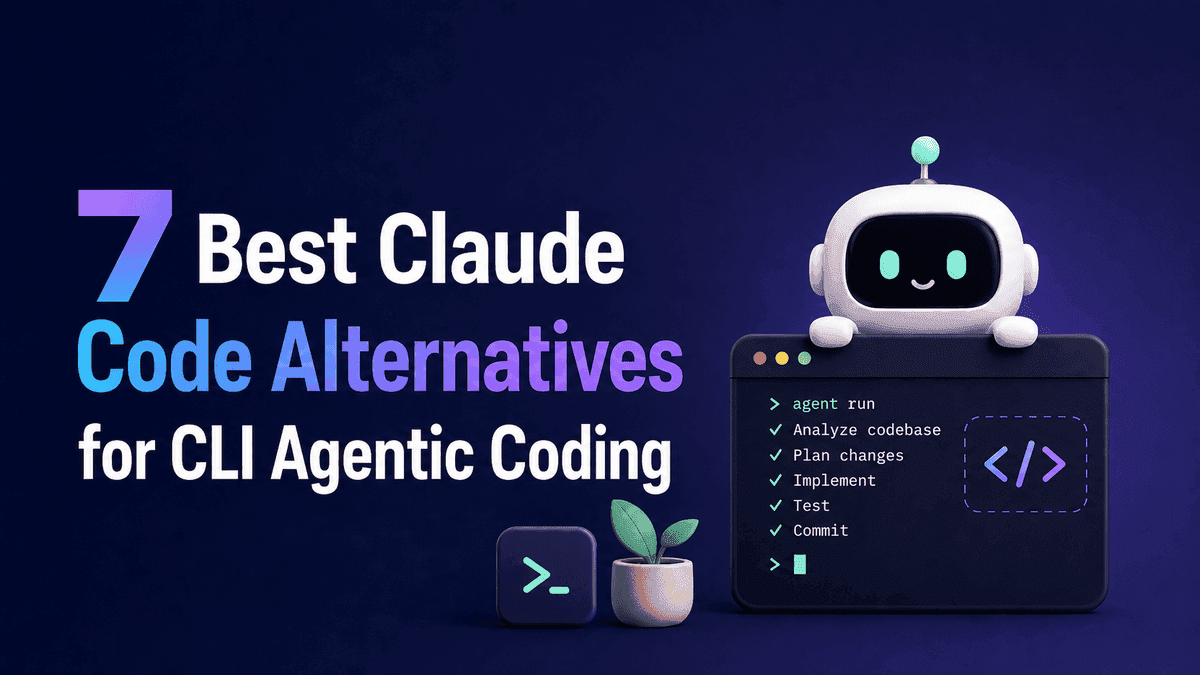
In the fast-evolving world of AI-assisted development, Command Line Interface (CLI) agentic coding has become a game-changer for many software developers. Imagine an AI assistant that lives right in your terminal, understanding your project, writing code, fixing bugs, and even managing your Git commits – all through simple text commands. This is the promise of CLI agentic coding.
Anthropic's Claude models, particularly Claude Opus, Sonnet, and Haiku, have been powerful contenders for these tasks due to their strong reasoning capabilities and large context windows. Developers often integrate these models into custom CLI scripts or agentic frameworks to automate complex coding workflows. However, relying solely on proprietary cloud-based models like Claude can come with trade-offs: cost, latency, vendor lock-in, and sometimes, less granular control over the coding environment and context.
This is where the demand for robust alternatives comes in. Developers are looking for tools that offer similar, if not superior, capabilities while addressing these concerns. Specifically, the focus is on solutions that are cheaper, faster, support open-source models, run locally, offer Multi-Context Programming (MCP) support, and provide better context control. This deep dive explores seven such alternatives that empower developers with efficient, flexible, and often more economical ways to do agentic coding directly from their CLI.
What is CLI Agentic Coding and Why Does it Matter?
CLI agentic coding refers to using AI agents or tools through the command line to perform programming tasks autonomously or semi-autonomously. Instead of just suggesting code snippets, these agents can understand a problem, plan a solution, write the code, execute tests, debug, and even refactor existing code, all while interacting with your project files and environment. The "agentic" part means they can take multiple steps to achieve a goal, often with some level of reasoning and self-correction.
Why does this matter for developers? It significantly boosts productivity. Tasks that might take hours of manual coding and debugging can be dramatically shortened. From generating boilerplate code and creating new features to refactoring legacy systems and fixing obscure bugs, AI agents handle the heavy lifting, freeing developers to focus on higher-level design and architectural challenges. The CLI aspect means these tools integrate seamlessly into existing developer workflows, without needing a full IDE or graphical interface.
While Claude models excel at complex reasoning and understanding large codebases, their API costs can add up, especially for iterative agentic workflows. Furthermore, sending sensitive code to external APIs can be a concern for some organizations. This has fueled the search for alternatives that offer similar power with more control and better economics.
The Quest for Better Alternatives: Key Criteria
When looking for alternatives to Claude-based CLI agentic coding, several criteria stand out:
- Cost-Effectiveness: Reducing API costs or eliminating them entirely with local models.
- Speed and Latency: Faster response times, especially crucial for iterative agentic loops.
- Open-Source: Transparency, community contributions, and freedom from vendor lock-in.
- Local Model Support: The ability to run powerful LLMs directly on your machine, keeping code private and reducing API dependency.
- Multi-Context Programming (MCP): The capacity to understand and operate across multiple files, directories, and even different programming languages within a single project. This goes beyond just a single file's context window.
- Better Context Control: Fine-grained control over what information the AI agent sees and uses, allowing for more precise and relevant code generation.
Top 7 Claude Code Alternatives for CLI Agentic Coding
1. Continue.dev
Continue.dev is a powerful open-source AI code assistant that integrates deeply with your IDE (VS Code, JetBrains) but also offers robust CLI capabilities, making it an excellent agentic coding alternative. It focuses on keeping your AI assistant "always on" and context-aware.
- Developer: Continue.dev team (an active open-source project).
- Release Date: Actively developed, with public releases gaining traction in late 2022 and throughout 2023.
- Key Features:
- Local Model Support: Seamlessly integrates with local LLMs via Ollama, LM Studio, or custom local servers, allowing you to run models like Code Llama, Deepseek Coder, or Phind-CodeLlama directly on your machine.
- Context Awareness: Automatically provides relevant code snippets, file contents, and even documentation to the LLM, ensuring the AI has the necessary context for accurate suggestions and modifications.
- Customizable Workflows: Define custom commands and agentic workflows to automate repetitive coding tasks.
- Multi-Context Programming (MCP): Its strong context retrieval system allows it to "see" and understand code across multiple files and directories, crucial for project-wide changes.
- Chat Interface: Offers a chat-like interaction for describing tasks and receiving code, which can be extended to CLI use.
- Pricing: Free and open-source. Costs are only for the LLM APIs you choose to use (if not running locally) or your local hardware.
- Official Links: Continue.dev Official Website, Continue.dev GitHub Repository.
2. OpenDevin
OpenDevin is a community-driven open-source project aiming to replicate and enhance the capabilities of autonomous AI software engineers like Cognition Labs' Devin. It's designed for full-stack development tasks, operating through a shell environment, browser, and code editor.
- Developer: A large community of open-source contributors.
- Release Date: Gained significant momentum and public attention in early 2024 following the buzz around Devin.
- Key Features:
- Autonomous Software Development: Aims to plan, execute, and debug code autonomously, interacting with a real shell and browser environment.
- LLM Flexibility: Supports various LLMs, including local models (via Ollama) and proprietary APIs (GPT-4, Claude, etc.), giving developers choice and control.
- Environment Interaction: Can run commands in a terminal, browse the web, and interact with a code editor, mimicking a human developer's workflow.
- Planning and Reasoning: Features a robust planning module to break down complex tasks into manageable steps.
- Multi-Context Programming (MCP): Designed to handle complex projects, it inherently manages context across files and tools within its simulated development environment.
- Pricing: Free and open-source. Costs depend on the LLM APIs used or your local hardware for self-hosting.
- Official Links: OpenDevin Official Website, OpenDevin GitHub Repository.
3. Ollama + Open-source Code Models (e.g., Code Llama, Deepseek Coder)
Ollama isn't an agent itself, but it's a critical enabler for local, open-source agentic coding. It simplifies the process of running large language models on your local machine. When combined with specialized open-source code models, it becomes a powerful foundation for custom CLI agents.
- Developer: Ollama team (led by Jeffrey Morgan).
- Release Date: First publicly released in October 2023.
- Key Features:
- Easy Local LLM Deployment: Provides a simple command-line interface to download, run, and manage various LLMs locally.
- Extensive Model Library: Offers a wide range of optimized models, including coding-focused ones like Code Llama, Deepseek Coder, Phind-CodeLlama, and many others, ready to be pulled and run.
- API Endpoint: Exposes a local API endpoint, allowing developers to integrate these local models into custom scripts, agents, and applications.
- Privacy and Security: Keeps your code and data entirely on your machine, eliminating concerns about sending sensitive information to third-party APIs.
- Cost-Effective: Once set up, running models is free, leveraging your existing hardware.
- Pricing: Free and open-source. Hardware costs apply for running models locally.
- Official Links: Ollama Official Website, Ollama GitHub Repository, Ollama Model Library.
4. Aider
Aider is an open-source command-line tool designed for AI pair programming. It focuses on making it easy to use an LLM to edit code directly in your terminal, with a strong emphasis on Git integration and context management.
- Developer: Paul Gauthier.
- Release Date: Actively developed since late 2023 / early 2024.
- Key Features:
- CLI-First Design: Built from the ground up for command-line interaction, making it natural for developers who live in the terminal.
- Interactive Coding: Provides a chat-like interface where you can describe changes, and Aider will propose code modifications.
- Automatic Commits: Automatically stages and commits changes with descriptive commit messages after successful modifications, streamlining the Git workflow.
- Git-Aware Context: Uses Git to understand the project structure and provides relevant file context to the LLM, including recent changes.
- LLM Agnostic: Supports various models via LiteLLM, including OpenAI's GPT models, Anthropic's Claude, and local models via Ollama, giving flexibility.
- Multi-Context Programming (MCP): Automatically manages the context of multiple open files and can operate on changes across them.
- Pricing: Free and open-source. Costs depend on the LLM API used.
- Official Links: Aider Official Website, Aider GitHub Repository.
5. Smol-developer
Smol-developer is a minimalist, open-source agent that takes a prompt and generates an entire codebase. It's designed to be "smol" (small) in terms of its codebase and its approach, focusing on generating complete, functional projects quickly from a high-level description.
- Developer: Swyx (Shawn Wang) and community contributors.
- Release Date: Released in early 2024.
- Key Features:
- Full Codebase Generation: Given a single prompt, it can generate all necessary files (e.g., Python code, HTML, CSS, tests) for a small project.
- Minimalist Approach: Designed to be simple and efficient, focusing on getting a working prototype quickly.
- CLI-Driven: Operates entirely from the command line, taking input and outputting generated files.
- LLM Agnostic: While often demonstrated with GPT-4, its architecture allows for integration with other LLMs that can handle code generation tasks.
- Good for Prototyping: Excellent for rapidly spinning up small applications or components.
- Pricing: Free and open-source. Costs depend on the LLM API used.
- Official Links: Smol-developer GitHub Repository.
6. GPT-Engineer
GPT-Engineer is another open-source tool that lets you specify a project requirement in natural language and then generates an entire codebase. It uses an iterative process, asking clarifying questions to refine the requirements before generating the code.
- Developer: Anton Osika (original creator), now maintained by a community.
- Release Date: Gained popularity in mid-2023.
- Key Features:
- Iterative Code Generation: Starts with a high-level prompt, then engages in a "conversation" to gather more details and requirements before generating code.
- Full Project Output: Produces a complete set of files for a project, including source code, tests, and configuration files.
- CLI Interface: Primarily command-line driven, making it easy to integrate into existing development workflows.
- Customizable Prompts: Allows users to define and refine the prompts and instructions given to the LLM.
- LLM Flexibility: Supports various LLMs, including OpenAI models, and can be configured to use others.
- Pricing: Free and open-source. Costs depend on the LLM API used.
- Official Links: GPT-Engineer Website, GPT-Engineer GitHub Repository.
7. Auto-GPT (Adapted for Coding)
While originally a more general-purpose autonomous agent, Auto-GPT can be adapted and configured for agentic coding tasks. It's known for its ability to set goals, generate sub-tasks, and execute them autonomously using various tools.
- Developer: Significant community contributions, originally by Toran Bruce Richards.
- Release Date: Rose to prominence in early 2023.
- Key Features:
- Goal-Oriented Autonomy: Capable of taking a high-level goal and breaking it down into actionable steps, executing them sequentially.
- Tool Use: Can interact with various tools, including shell commands, file system operations, and web browsing, which are essential for coding.
- Memory Management: Incorporates short-term and long-term memory to maintain context across tasks.
- LLM Agnostic: Supports different LLMs, primarily OpenAI models, but can be configured for others.
- Open-Ended Development: Can be set up to tackle complex coding projects by iteratively planning, coding, and testing.
- Pricing: Free and open-source. Costs depend on the LLM API used.
- Official Links: Auto-GPT GitHub Repository.
Choosing the Right Alternative
The "best" alternative depends heavily on your specific needs:
- If you prioritize deep IDE integration with local model support and robust context management, Continue.dev is an excellent choice.
- For truly autonomous, full-stack development aspirations with strong environmental interaction, OpenDevin is a promising, albeit more complex, option.
- If running powerful open-source models locally is your primary goal for custom agent development, Ollama combined with specialized code models is indispensable.
- For an interactive, Git-aware CLI pair programming experience, Aider stands out.
- For rapid prototyping of small, complete codebases from a single prompt, both Smol-developer and GPT-Engineer offer quick results.
- If you need a highly adaptable, goal-oriented autonomous agent framework that you can customize for complex coding projects, Auto-GPT provides that foundation.
Many of these tools are open-source and actively developed, meaning they are constantly improving and integrating new features, including better support for local models and advanced context handling techniques.
Conclusion
The landscape of AI-powered coding tools is diversifying rapidly. While Claude models offer impressive capabilities for agentic coding, the increasing availability of open-source models and intelligent frameworks provides compelling alternatives. These tools empower developers with more control over their environment, enhance privacy by enabling local execution, and significantly reduce operational costs. By exploring and integrating these alternatives, developers can build more efficient, flexible, and customized CLI agentic coding workflows, pushing the boundaries of what's possible in AI-assisted development.
Frequently Asked Questions
What is CLI agentic coding?
CLI agentic coding involves using AI agents through the command line to perform complex programming tasks autonomously. These agents can understand goals, plan solutions, write, test, and debug code, interacting directly with your project files and environment via text commands.
Why look for alternatives to Claude for agentic coding?
While Claude models are powerful, alternatives often offer benefits like lower cost, faster execution, the ability to run models locally for enhanced privacy, open-source transparency, and more granular control over context and workflows.
What does "Multi-Context Programming (MCP) support" mean in this context?
MCP support refers to an AI agent's ability to understand and work with information from multiple files, directories, and even different programming languages within a larger project simultaneously. This allows the AI to make more informed decisions and implement changes that span across an entire codebase, rather than just isolated files.
Can I run these alternatives entirely offline?
Many of the listed alternatives, especially when combined with Ollama and local open-source models (like Code Llama or Deepseek Coder), can be configured to run entirely offline, ensuring maximum privacy and eliminating API costs. However, some tools might still default to cloud-based LLMs if not explicitly configured for local models.