Key Takeaways
- AI coding agent benchmarks are vital tools for software developers to objectively measure, compare, and improve the capabilities of AI in automating software engineering tasks.
- Benchmarks range from evaluating single-function code generation (HumanEval, MBPP) to complex, multi-step tasks like resolving real-world GitHub issues (SWE-bench) and rebuilding entire programs (ProgramBench).
- Newer benchmarks like SlopCodeBench and Terminal-Bench focus on agentic behavior, assessing iterative development, code quality erosion, and interaction within a terminal environment.
- Choosing the right benchmark depends on the specific AI agent's intended use, task complexity, and the level of autonomy it needs to demonstrate.
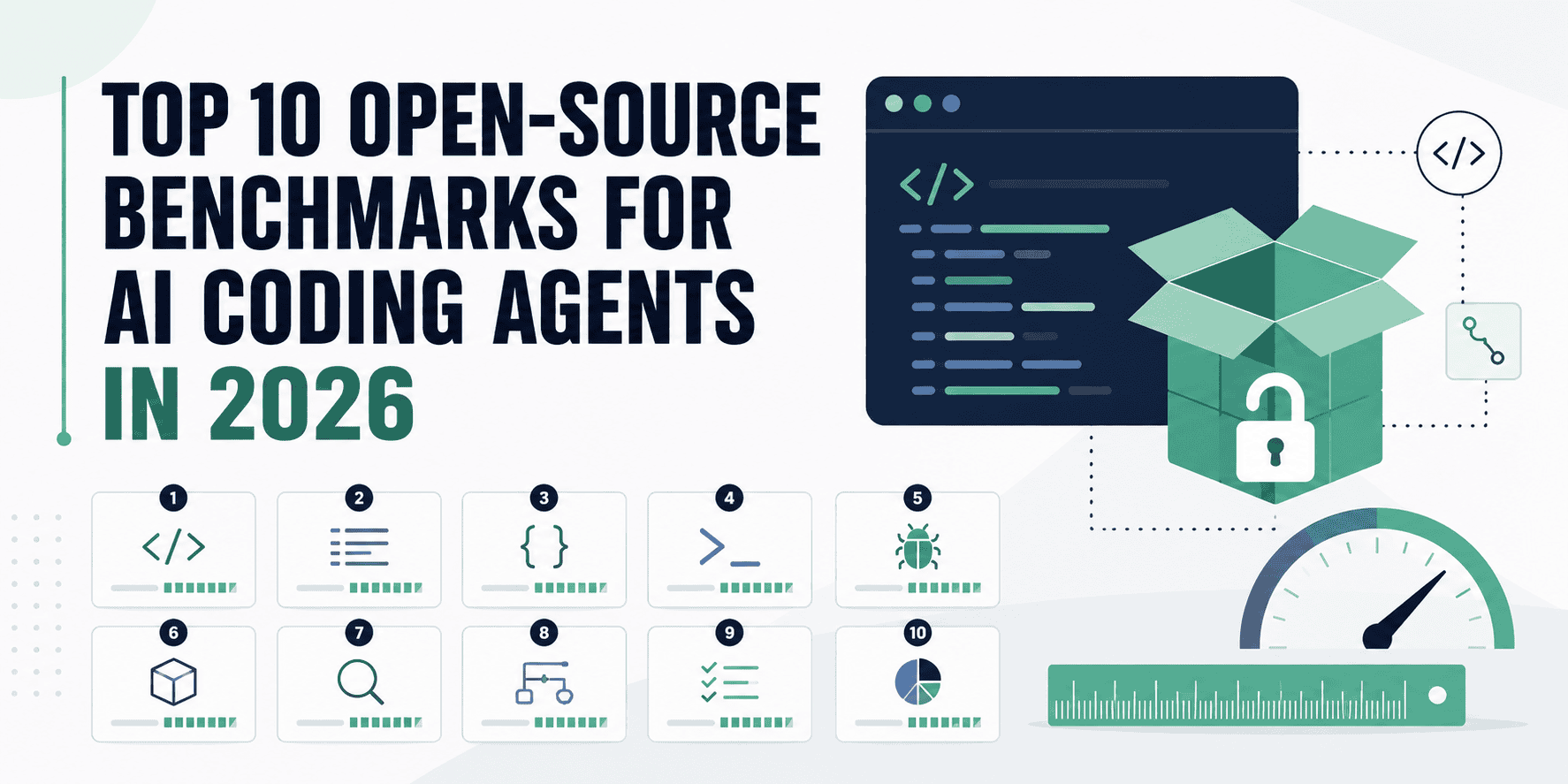
Top 10 Open-Source Benchmarks for AI Coding Agents in 2026: A Developer's Guide
AI coding agents are rapidly changing how we develop software. These intelligent systems can write code, debug, refactor, and even manage entire repositories, promising a future where developers can offload more routine tasks to AI. But how do we know if an AI coding agent is truly effective? How do we compare one against another? This is where open-source benchmarks become essential.
For software developers, understanding and utilizing these benchmarks is crucial. They provide a standardized way to evaluate an agent's performance, identify its strengths and weaknesses, and ultimately choose the right tools for specific engineering challenges. This article dives deep into the top 10 open-source benchmarks for AI coding agents in 2026, explaining what each one measures and why it matters to you.
What are AI Coding Agent Benchmarks?
In simple terms, an AI coding agent benchmark is a standardized test designed to measure specific capabilities of an AI model or agent in a coding context. Think of them like a comprehensive exam for an AI programmer. These benchmarks consist of datasets of coding problems, tasks, or scenarios, along with a defined evaluation methodology to score the agent's output.
Unlike traditional software tests that verify a human-written program, these benchmarks evaluate an AI's ability to generate, understand, modify, or interact with code autonomously. They go beyond simple code completion, often assessing complex problem-solving, logical reasoning, and even strategic decision-making in a simulated development environment.
Why Do These Benchmarks Matter for Developers?
For anyone working with or building AI coding agents, these benchmarks are invaluable for several reasons:
- Objective Evaluation: Benchmarks provide an unbiased way to compare different AI models and agents. Instead of relying on anecdotal evidence, developers can use quantifiable scores to assess performance.
- Identifying Strengths and Weaknesses: Each benchmark often focuses on different aspects of coding. By evaluating an agent across multiple benchmarks, developers can pinpoint where an agent excels (e.g., algorithmic problem-solving) and where it struggles (e.g., complex system design).
- Driving Innovation: Public leaderboards and benchmark results foster healthy competition among AI researchers and developers, pushing the boundaries of what AI coding agents can achieve.
- Informed Tool Selection: When choosing an AI coding agent for a specific project or workflow, benchmark scores can guide decisions, helping developers select tools best suited for their needs.
- Tracking Progress: Benchmarks allow the AI community to track the overall advancement of AI in software engineering over time, highlighting areas of rapid improvement and persistent challenges.
Deep Dive into the Top 10 Open-Source Benchmarks
Here's a look at some of the most influential and widely used open-source benchmarks for AI coding agents in 2026:
1. SWE-bench
What it is: SWE-bench (Software Engineering Benchmark) is a benchmark designed to evaluate AI systems on real-world GitHub issues. It tests an agent's ability to resolve bugs and implement features in existing codebases, mimicking the daily tasks of a software engineer.
Developer/Organization: Built and maintained by researchers from Stanford University and Princeton University.
Release Date: Released in October 2023. Updates like SWE-bench Verified (a subset of 500 solvable problems) were introduced in August 2024. SWE-bench Multilingual was introduced to evaluate LLMs across a range of programming languages in 2026.
Key Features:
- Uses 2,294 task instances collected from pull requests and issues across 12 popular open-source Python repositories.
- Each task provides the AI system with an issue description and the codebase, requiring it to generate a patch that resolves the problem.
- Evaluation relies on "Fail-to-Pass" tests within a Dockerized environment, ensuring reproducible and objective assessment of the patch.
- Beyond the original SWE-bench, there are variants like SWE-bench Multilingual for evaluating performance across various programming languages.
Official Link: SWE-bench GitHub Repository, SWE-bench Official Website
2. Terminal-Bench
What it is: Terminal-Bench measures how well AI agents complete real, complex tasks within a command-line environment. This includes tasks like compiling code, training small machine learning models, configuring servers, debugging, and general system administration work. It's designed to test an agent's ability to interact autonomously with a shell, observe output, and iterate towards a goal.
Developer/Organization: Created as a collaboration between Stanford and Laude Institute.
Release Date: Currently in beta with various versions (e.g., Terminal-Bench 2.0, 2.1, 3.0) being actively developed and released.
Key Features:
- Tasks run inside isolated Docker sandboxes with natural-language instructions.
- Evaluates multi-step and stateful terminal workflows, where success is determined by the final state of the environment, not just the agent's transcript.
- Covers a broad range of CLI, sysadmin, ML, and data tasks.
- Built on the Harbor framework for execution and continuous benchmarking.
Official Link: Terminal-Bench GitHub Repository, Terminal-Bench Official Website
3. SlopCodeBench (SCBench)
What it is: SlopCodeBench evaluates coding agents under iterative specification refinement, meaning the agent implements a specification and then extends its own code as the specification changes over time. This benchmark focuses on measuring "code erosion," technical debt, and architectural degradation as agents make multiple changes, exposing behaviors that single-shot benchmarks miss.
Developer/Organization: Developed by researchers from the University of Wisconsin–Madison, Washington State University, and MIT. Supported by Snorkel AI.
Release Date: Initial release in early 2026.
Key Features:
- Contains 20 language-agnostic problems spanning 93 checkpoints, simulating real feature development with evolving specifications.
- Measures correctness and tracks code quality metrics like "verbosity" (redundant code) and "structural erosion" (complexity concentration) across trajectories.
- Problems specify only observable behavior at a CLI or API boundary, allowing for evaluation in any implementation language.
- Aims to push agents toward producing maintainable, high-quality software over time.
Official Link: SlopCodeBench GitHub Repository, SlopCodeBench Official Website
4. ProgramBench
What it is: ProgramBench is a challenging benchmark where AI coding agents must rebuild entire programs from scratch, given only a compiled executable and its usage documentation. It assesses an agent's ability to architect and implement a complete codebase that reproduces the original program's behavior.
Developer/Organization: Developed by John Yang and a team of researchers.
Release Date: Paper published in May 2026.
Key Features:
- Removes scaffolding like function signatures or source files, forcing agents to infer behavior by running the executable and designing the architecture.
- Evaluates holistic software development, from architectural decisions to writing the codebase and build scripts.
- Includes 200 tasks ranging from compact CLI tools to complex software like FFmpeg and SQLite.
- Uses end-to-end behavioral tests generated via agent-driven fuzzing to compare the agent's output against the original program.
Official Link: ProgramBench arXiv Paper, ProgramBench Leaderboard on BenchLM.ai
5. HumanEval
What it is: HumanEval is a benchmark for assessing the code generation capabilities of large language models (LLMs), particularly for Python. It consists of 164 handwritten programming problems designed to evaluate functional correctness. It was originally developed by OpenAI to evaluate early versions of the AI models powering Codex.
Developer/Organization: OpenAI.
Release Date: Introduced in 2021 alongside Codex.
Key Features:
- Comprises 164 Python programming problems, similar to algorithmic questions in technical interviews.
- Each problem includes a function signature, a docstring, and a hidden suite of unit tests.
- Measures "functional correctness" using the pass@k metric, where a generated code sample is deemed correct if it passes all unit tests.
- While foundational, it's a single-turn benchmark and doesn't assess agentic behavior like planning or debugging.
Official Link: HumanEval GitHub Repository
6. MBPP (Mostly Basic Python Problems)
What it is: MBPP is a benchmark of 974 crowd-sourced Python programming problems designed to be solvable by entry-level programmers. It focuses on fundamental programming concepts and standard library functionality with visible test cases, making it a more accessible yet comprehensive evaluation framework than some other benchmarks.
Developer/Organization: Google Research (Austin et al., 2021).
Release Date: Released in August 2021.
Key Features:
- Contains 974 entry-level Python programming tasks.
- Unlike HumanEval, MBPP originally focused on problems with visible test cases, providing immediate feedback.
- Aims to evaluate the full spectrum of programming competence, from basic skills to advanced capabilities.
- While important for foundational skills, many frontier models now score above 90%, making it less useful for differentiating top-tier models.
Official Link: While a specific official GitHub for MBPP isn't as prominently linked as others, the dataset is widely available through research papers and platforms like Hugging Face.
7. RepoBench
What it is: RepoBench is a benchmark specifically designed for evaluating repository-level code auto-completion systems. It addresses the gap left by single-file benchmarks by focusing on more complex, real-world, multi-file programming scenarios in both Python and Java.
Developer/Organization: Tianyang Liu, Canwen Xu, Julian McAuley.
Release Date: Published in June 2023.
Key Features:
- Consists of three interconnected evaluation tasks: RepoBench-R (Retrieval of relevant code snippets), RepoBench-C (Code Completion with cross-file context), and RepoBench-P (Pipeline combining retrieval and prediction).
- Uses datasets sourced from GitHub, including repositories with 32-128 files for training and newly crawled repositories for testing to ensure no overlap with model training data.
- Emphasizes the importance of repository-scale understanding for coding agents.
Official Link: RepoBench arXiv Paper, RepoBench on Hugging Face
8. ProjDevBench
What it is: ProjDevBench is a benchmark for evaluating AI coding agents on end-to-end project development. Unlike benchmarks focusing on single functions or bug fixes, ProjDevBench tasks agents with constructing complete software projects from high-level specifications, including autonomous design and build configuration.
Developer/Organization: Developed by Z. Shi et al.
Release Date: Paper published in February 2026.
Key Features:
- Agents receive only simple high-level instructions without an initial codebase.
- Requires agents to generate full software repositories that can be executed.
- Employs a dual evaluation protocol combining Online Judge (OJ) for execution-based correctness and LLM-assisted code review for detecting rule violations and "cheating" solutions.
- Curates 20 programming problems across 8 categories, covering concept-oriented tasks and real-world application scenarios.
Official Link: ProjDevBench GitHub Repository, ProjDevBench arXiv Paper
9. CodeXGLUE
What it is: CodeXGLUE stands for General Language Understanding Evaluation benchmark for CODE. It's a comprehensive benchmark for code intelligence, encompassing 14 datasets for 10 diversified programming language tasks. It covers various scenarios like code-to-code tasks (e.g., clone detection, code completion, code refinement) and text-to-code tasks (e.g., natural language code search, text-to-code generation).
Developer/Organization: Microsoft.
Release Date: Introduced in September 2020.
Key Features:
- Evaluates a wide array of code intelligence tasks, providing a holistic view of an AI's understanding and generation capabilities across different programming languages.
- Includes tasks like defect detection, code summarization, and documentation translation.
- Supports the development of models that can be applied to various code intelligence problems to increase developer productivity.
Official Link: CodeXGLUE GitHub Repository, CodeXGLUE Microsoft Research Page
10. LiveCodeBench
What it is: LiveCodeBench is a contamination-free coding benchmark that continuously harvests fresh competitive programming problems from platforms like LeetCode, AtCoder, and CodeForces. It evaluates holistic coding capabilities, including code generation, self-repair, and execution prediction, reflecting real-world software development scenarios.
Developer/Organization: Naman Jain, King Han, Alex Gu, Wen-Ding Li, Fanjia Yan, Tianjun Zhang, Sida Wang, Armando Solar-Lezama, Koushik Sen, Ion Stoica.
Release Date: Introduced with problems published between May 2023 and May 2024.
Key Features:
- Continuously updates with new problems to prevent "contamination" (models being trained on test data).
- Evaluates beyond just code generation, including self-repair, code execution, and test output prediction.
- Problems are annotated with release dates to allow evaluation on unseen problems.
- Aims to provide a more robust and future-proof evaluation for LLMs applied to code.
Official Link: LiveCodeBench arXiv Paper, LiveCodeBench Leaderboard on Artificial Analysis
How to Choose the Right Benchmark for Your Needs
With so many benchmarks available, selecting the right one depends on what you want to evaluate in an AI coding agent:
- For foundational code generation: Start with HumanEval and MBPP to gauge basic Python function synthesis. These are good baseline tests.
- For real-world bug fixing and feature implementation: SWE-bench is your go-to, as it directly assesses an agent's ability to resolve GitHub issues in existing repositories.
- For multi-step terminal interactions and system administration: Terminal-Bench is ideal, focusing on how agents operate within a live command-line environment.
- For evaluating code quality and iterative development: SlopCodeBench provides insights into how an agent's code evolves and degrades over multiple changes.
- For end-to-end project construction from scratch: ProjDevBench offers a holistic evaluation of an agent's architectural and implementation skills.
- For repository-level code completion and multi-file understanding: RepoBench is designed for scenarios where an agent needs to understand context across multiple files.
- For comprehensive code intelligence across many tasks and languages: CodeXGLUE provides a broad assessment of various code-related capabilities.
- For robust, contamination-free evaluation of competitive programming skills: LiveCodeBench is excellent for models that need to solve fresh, unseen algorithmic problems.
Often, a combination of benchmarks will give you the most comprehensive picture of an AI coding agent's capabilities. Remember that no single benchmark can cover the entire spectrum of real-world software engineering tasks.
The Future of AI Coding Agent Benchmarking
The field of AI coding agents is moving incredibly fast. As agents become more sophisticated, capable of handling long-horizon tasks, collaborating with humans, and operating across complex systems, benchmarks will also need to evolve. We're seeing a shift from single-function evaluation to multi-step, multi-agent, and even security-focused benchmarks. The goal is to create benchmarks that accurately reflect the challenges and nuances of real-world software development, ensuring that AI agents are not just "smart" but also reliable, maintainable, and secure.
Conclusion
Open-source benchmarks are the backbone of progress in AI coding agents. They provide the transparency and objective measurement needed to push the boundaries of what AI can do in software engineering. For developers, these tools are indispensable for understanding the current state of AI capabilities, making informed decisions about integrating AI into their workflows, and contributing to the development of the next generation of intelligent coding assistants.
Frequently Asked Questions
What is the main difference between HumanEval and SWE-bench?
HumanEval primarily measures an AI model's ability to generate correct Python functions from docstrings, focusing on functional correctness for isolated problems. SWE-bench, on the other hand, evaluates an AI agent's capability to resolve real-world software bugs and implement features within complex, existing GitHub repositories, which is a much more involved, multi-step task.
Why are "contamination-free" benchmarks important for AI coding agents?
Contamination-free benchmarks are crucial because many large language models (LLMs) are trained on vast amounts of code data from the internet. If a benchmark's problems were part of the training data, the model might "memorize" solutions rather than genuinely understand and solve the problem. Benchmarks like LiveCodeBench address this by continuously sourcing new, unseen problems to ensure a fair and accurate evaluation of a model's true capabilities.
Do these benchmarks evaluate code quality and technical debt?
While many benchmarks focus on functional correctness, some newer ones like SlopCodeBench specifically aim to evaluate code quality, maintainability, and the accumulation of technical debt as AI agents iteratively modify and extend code. This is a growing area of focus as AI agents move towards more autonomous and long-term software development roles.
Are these benchmarks only for Python, or do they support other languages?
While many foundational benchmarks like HumanEval and MBPP are Python-centric, a growing number of benchmarks support multiple languages. For example, RepoBench supports Python and Java, CodeXGLUE covers various programming languages across its diverse tasks, and SWE-bench has introduced a Multilingual variant.