The promise of Artificial Intelligence isn't just about answering questions; it's about AI taking initiative, planning, and executing complex tasks autonomously. This is the realm of Agentic AI, and while the demos look incredibly powerful, the reality for freelancers today is a mix of groundbreaking potential and significant practical limitations. Agentic AI is real and transformative, but currently sits in a phase where its practical application requires careful human guidance and understanding of its boundaries, rather than simply "set it and forget it."
For freelancers and small business owners, the idea of an AI agent handling everything from market research to content creation, project management, or even coding, sounds like a dream come true. Imagine an AI that receives a request, breaks it down into subtasks, uses various tools, handles errors, and delivers a polished result – all without constant hand-holding. This is the vision driving the "Agentic AI Hype Cycle," but as with any emerging technology, separating the dazzling demos from day-to-day utility is crucial.
At NerdsTool, we're dedicated to helping you navigate the ever-evolving landscape of AI tools to boost your productivity and profitability. Let's deep dive into Agentic AI, unpack the hype, understand what’s genuinely achievable right now, and what’s still missing from making it a truly autonomous partner for your freelance business.
What Exactly is Agentic AI? Unpacking the Concept
Before we dissect the hype, let's clarify what we mean by Agentic AI. Unlike traditional AI models that respond to a single prompt, an Agentic AI system is designed to:
- Understand Complex Goals: It takes a high-level request (e.g., "Plan a marketing campaign for a new product").
- Decompose Tasks: It breaks that goal into smaller, manageable steps (e.g., "Research target audience," "Draft social media posts," "Create email sequence").
- Utilize Tools: It can access and use external tools – web browsers for research, code interpreters, APIs for project management software, image generators, etc.
- Execute and Monitor: It performs the tasks, monitors its progress, and checks if it's on track to meet the overall goal.
- Self-Correct and Adapt: Crucially, it attempts to identify and fix errors, or adapt its plan based on new information or failures.
- Iterate: It can refine its output based on intermediate results or feedback.
Think of it less like a calculator and more like a junior assistant who, given a clear objective, will figure out the steps, use the right resources, and try to solve problems along the way, reporting back with progress and challenges. This multi-step, autonomous problem-solving capability is what sets Agentic AI apart and fuels its immense potential.
The Allure for Freelancers
For freelancers, the appeal is obvious:
- Time Savings: Automate repetitive and time-consuming tasks.
- Scalability: Take on more projects without increasing your workload linearly.
- New Capabilities: Access expertise or perform tasks you might not have the skills for (e.g., complex data analysis).
- Enhanced Efficiency: Streamline workflows and accelerate project delivery.
The Agentic AI Hype Cycle: Reality Check for Freelancers
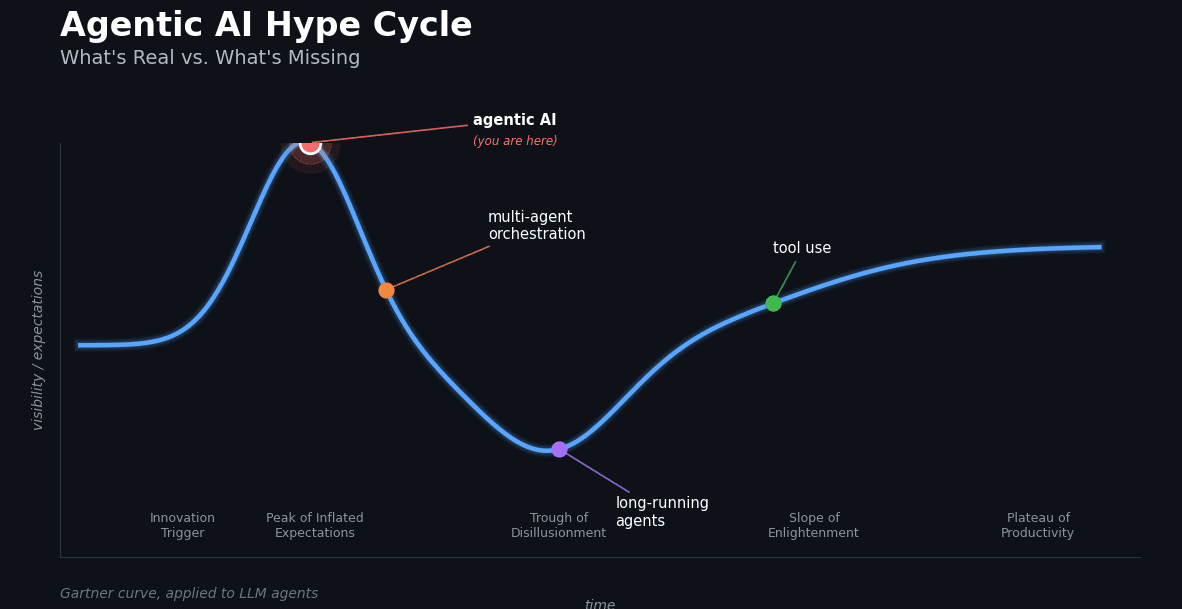
The "Hype Cycle" is a concept developed by Gartner that illustrates the maturity, adoption, and social application of specific technologies. It typically involves five phases: Innovation Trigger, Peak of Inflated Expectations, Trough of Disillusionment, Slope of Enlightenment, and Plateau of Productivity.
The Peak of Inflated Expectations: The "Perfect Demo"
This is where Agentic AI currently shines in demonstrations. You see videos of an AI agent seamlessly building a website from a simple prompt, conducting intricate market research, or even developing a complex app. The agent receives a request, decomposes it perfectly, calls the right tools every time, handles errors gracefully, and produces a flawless result. These demos are often carefully curated, showcasing ideal scenarios where the agent's capabilities align perfectly with the task. This leads to the expectation that Agentic AI can immediately and autonomously handle complex, open-ended tasks with minimal human intervention.
- What it looks like: Viral social media posts, impressive tech demos, bold claims about AI's independence.
- Freelancer takeaway: "I can finally automate my entire business!"
The Trough of Disillusionment: The Harsh Reality
Once freelancers try to implement these agents in their real-world workflows, they often hit a wall. The "perfect demo" rarely translates directly into everyday utility without significant effort. This is the trough where the initial excitement gives way to frustration as users encounter the numerous limitations.
- Failure Modes are Common: Agents often get stuck in loops, misinterpret instructions, fail to use tools correctly, or simply stop making progress.
- "Hallucinations" and Inaccuracies: The agent might confidently generate incorrect information, requiring rigorous fact-checking.
- Context Window Limitations: Agents struggle with long, complex tasks that require remembering a vast amount of information or a long history of interactions.
- Cost of Execution: Each step an agent takes, especially when calling external APIs (like GPT-4), costs money. A looping or inefficient agent can quickly rack up a hefty bill.
- Lack of Nuance and Common Sense: Agents struggle with subjective tasks, understanding implicit instructions, or dealing with ambiguity. They lack the "common sense" reasoning humans possess.
- Brittle Error Handling: While agents are designed to handle errors, their recovery mechanisms are often not robust enough for unexpected real-world scenarios.
- Setup and Maintenance Overhead: Getting an agent to work effectively often requires significant upfront prompting, debugging, and ongoing monitoring – sometimes more effort than doing the task manually.
This phase is crucial because it helps temper expectations and forces developers to focus on addressing fundamental challenges rather than just showcasing ideal outcomes.
The Slope of Enlightenment: Gradual Progress and Practical Applications
We are slowly climbing this slope. Developers are actively working on solutions to the problems identified in the "Trough." For freelancers, this means understanding that Agentic AI is an incredibly powerful assistant, not yet a fully autonomous replacement. Practical applications are emerging where agents excel at specific, well-defined tasks, especially when integrated into existing workflows and supervised by a human.
- Improved Tool Use: Better frameworks for agents to reliably use a wider array of tools.
- Better Planning and Self-Correction: Advances in how agents plan their steps and recover from failures.
- Hybrid Human-in-the-Loop Systems: Designing workflows where the AI agent handles the bulk of the work, but a human steps in for critical decisions, quality checks, or complex problem-solving.
- Specialized Agents: Agents designed for very specific tasks (e.g., a "research agent" or a "code debugging agent") perform much better than general-purpose agents.
Pros and Cons of Agentic AI for Freelancers (Right Now)
Let's weigh the good against the challenging for your freelance business today.
Pros of Agentic AI
- Automated Research & Data Aggregation: Agents can scour the web, synthesize information, and present summaries much faster than manual methods. Great for market research, competitive analysis, or content ideation.
- Drafting & Content Generation (Initial Stages): For blog post outlines, social media captions, email drafts, or basic ad copy, agents can kickstart the process, saving you significant time on initial ideation.
- Code Generation & Debugging Assistance: Programmers can use agents to generate boilerplate code, suggest solutions to bugs, or even help refactor existing code.
- Task Decomposition & Project Planning: Agents can help break down large projects into smaller steps, suggesting resources or tools needed for each.
- Enhanced Productivity for Repetitive Tasks: Any task that follows a clear, repeatable process (e.g., data entry, report generation from structured data) can see significant efficiency gains.
- Scalability Potential: By automating parts of your workflow, you can handle more client work without necessarily working longer hours.
- Learning & Skill Augmentation: Agents can act as a tireless assistant, explaining concepts, answering questions, and even teaching you new skills by demonstrating processes.
Cons of Agentic AI
- High Oversight Requirement: Despite the "autonomous" label, current agents demand significant human monitoring, intervention, and correction. They are not truly "set it and forget it."
- Unpredictability & Reliability Issues: Agents can fail unexpectedly, get stuck, or produce irrelevant results, leading to wasted time and resources.
- Cost Overruns: Inefficient agent loops or frequent API calls can quickly become expensive, especially with premium models like GPT-4.
- Lack of Creativity & Nuance: For highly creative tasks, subjective decision-making, or understanding subtle client needs, agents often fall short, producing generic or off-target outputs.
- Security & Privacy Concerns: Feeding sensitive client data or proprietary information to an agent that uses external APIs requires careful consideration of data privacy and security.
- Debugging & Troubleshooting: When an agent fails, understanding why it failed and how to fix it can be a complex and time-consuming process.
- Integration Challenges: Seamlessly integrating agents with your existing freelance tech stack can be technically challenging.
- Ethical Dilemmas: Who is responsible when an agent makes a mistake that impacts a client? Issues of accountability and bias are still being explored.
Agentic AI Rating for Freelancers: 6.5/10
Current Practicality Score: 6.5/10
Future Potential Score: 10/10
Why 6.5? Agentic AI, in its current iteration, is a powerful tool with immense potential, but it's not yet the fully autonomous assistant many hope for. It excels at specific, well-defined tasks, especially when guided and supervised by a human. For freelancers, this means it's an advanced assistant that can significantly boost productivity for certain workflows, but it's not ready to replace your expertise or critical thinking.
It requires a learning curve, patience, and a willingness to understand its limitations. If you're willing to invest the time to learn how to prompt, debug, and oversee these agents, they can be incredibly valuable. However, if you're expecting a magic bullet that works perfectly out of the box, you'll likely be disappointed. The "6.5" reflects its current utility as a powerful augmentation tool rather than a truly independent agent.
What's Still Missing (and What's on the Horizon)
The journey up the "Slope of Enlightenment" involves addressing these key areas:
- Robust Self-Correction: Agents need to get much better at autonomously identifying when they're off track and correcting their course without human intervention.
- True Long-Term Memory & Context Management: Overcoming the context window limitations to allow agents to work on complex, multi-day projects with a deep understanding of past interactions.
- Enhanced "Common Sense" Reasoning: The ability to infer implicit meanings, handle ambiguity, and make decisions based on general world knowledge.
- Cost Efficiency: Developing more efficient agent architectures and models that reduce the computational cost of complex tasks.
- Seamless Tool Integration: Easier and more reliable connections to a vast array of software and APIs without extensive manual configuration.
- Ethical Frameworks & Transparency: Clearer guidelines and mechanisms for understanding an agent's decision-making process and ensuring ethical behavior.
- User-Friendly Interfaces: Making it easier for non-technical freelancers to build, deploy, and manage agents.
As these areas improve, we'll see Agentic AI move closer to the "Plateau of Productivity," becoming a more reliable and indispensable part of the freelance toolkit.
Conclusion: Embrace the Agent, Understand the Assistant
The Agentic AI hype is real, and for good reason: the underlying technology holds incredible promise. For freelancers, it's not a question of if Agentic AI will transform your work, but when and how you integrate it. Right now, it's a powerful, albeit finicky, assistant. It can handle many tasks with impressive speed and efficiency, but it still requires a human in the loop to provide direction, verify outputs, and troubleshoot when things go awry.
Don't be swayed solely by the perfect demos. Instead, approach Agentic AI with a healthy dose of curiosity and pragmatism. Experiment with frameworks, understand their limitations, and identify specific, well-defined tasks where they can genuinely augment your productivity. The future of autonomous AI agents is bright, but for today's freelancer, mastering the art of collaboration with these intelligent systems is the key to unlocking their true value.
Ready to Supercharge Your Freelance Business?
The world of Agentic AI is moving fast. Are you experimenting with AI agents in your freelance work? What successes or challenges have you encountered? Share your experiences in the comments below! And if you're looking for more practical AI tools and strategies to boost your freelance productivity, subscribe to the NerdsTool blog for the latest insights and reviews!


