Apple's Dual AI Play: What Siri's Gemini Move and On-Device LLMs Mean for Freelancers
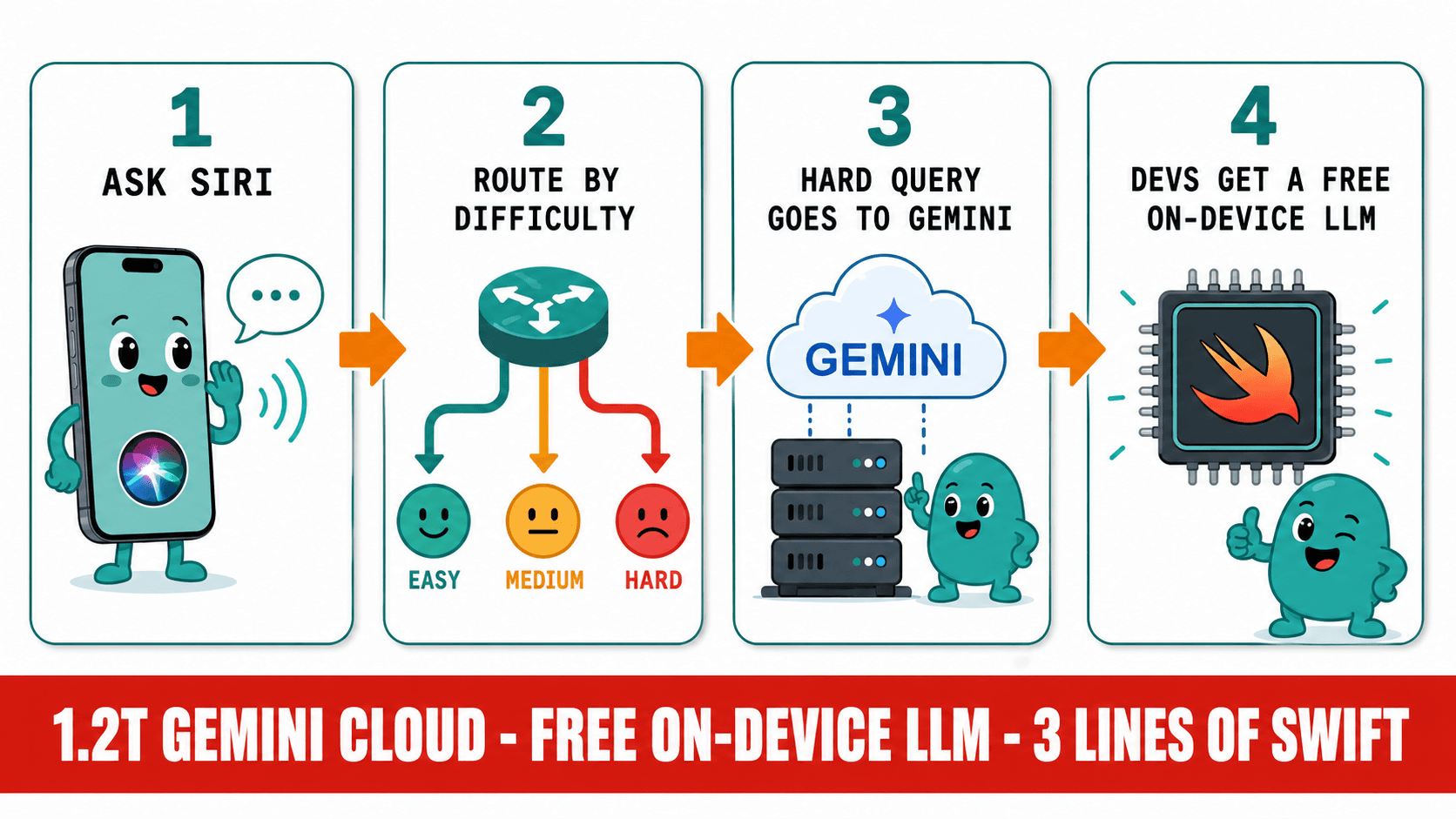
Apple's recent WWDC announcements delivered a fascinating paradox: while Siri is tapping into Google's powerful Gemini model for enhanced intelligence, Apple also unveiled a robust on-device Large Language Model (LLM) for developers. For freelancers, this means a pivotal shift in AI strategy, offering both potential privacy concerns with cloud-based AI and exciting new opportunities for secure, high-performance local AI development.
The Big Reveal: Siri Meets Gemini and the Rise of On-Device AI
The tech world buzzed when news broke that Apple, a company synonymous with privacy, is reportedly leveraging Google's formidable Gemini AI for its revamped Siri. This strategic partnership aims to supercharge Siri's capabilities, bringing it closer to the advanced conversational AI experiences offered by competitors. For everyday users, this promises a smarter, more capable digital assistant.
But here's the twist that truly matters for the freelance community: concurrently, Apple introduced "Apple Intelligence," a suite of AI features, many of which are powered by a sophisticated LLM designed to run
directly on your device. This on-device processing capability is a game-changer, promising enhanced privacy, speed, and offline functionality for a wide array of applications.
This dual approach—outsourcing core AI for a flagship product while simultaneously empowering developers with local AI—presents a complex landscape. As a freelancer, understanding these nuances is crucial for navigating future projects, ensuring data privacy, and leveraging cutting-edge technology effectively.
Diving Deeper: Siri's Brain Transplant with Gemini
For years, Siri has been a familiar voice, but often lagged behind rivals in terms of conversational fluidity and contextual understanding. The reported integration with Google's Gemini model, a $1B powerhouse, is Apple's ambitious answer to this challenge.
Why Apple Would Outsource Siri's Intelligence
Scale and Sophistication: Building an LLM from scratch that rivals Gemini's capabilities requires immense resources, data, and time. Partnering with Google allows Apple to rapidly upgrade Siri's intelligence without diverting vast internal resources from other projects.
Competitive Edge: In the fiercely competitive AI assistant market, a significant leap in Siri's performance is essential to keep pace with Google Assistant and Amazon Alexa, both powered by highly advanced AI.
Existing Infrastructure: Google already has the robust cloud infrastructure to handle the massive computational demands of a global AI assistant like Siri.
The Privacy Paradox for Freelancers and Clients
This move, while beneficial for Siri's functionality, raises immediate questions for privacy-conscious freelancers and their clients. Apple has long championed "privacy by design," emphasizing on-device processing wherever possible. However, sending Siri queries to Google's cloud inherently involves third-party data processing.
Data Handling: While Apple will undoubtedly implement stringent privacy protocols and anonymization techniques, the fact remains that user data, even if stripped of direct identifiers, will be processed on Google's servers. Freelancers working with sensitive client data or in regulated industries must be acutely aware of these data flows.
Trust and Transparency: This partnership might challenge the perception of Apple as an impenetrable fortress of user privacy. Freelancers advising clients on tech solutions will need to articulate this new reality and its implications.
Terms of Service: Understanding the updated terms of service for both Apple and Google regarding data processed via Siri will be paramount for anyone concerned about data governance.
The On-Device Revolution: Apple's Local LLM for Developers
In stark contrast to the cloud-dependent Siri, Apple Intelligence heavily emphasizes on-device processing. This means a powerful LLM runs
directly on your iPhone, iPad, or Mac, bringing AI capabilities closer to the user than ever before.
The Power of Local LLMs for Freelancers
This is where the real excitement and opportunity lie for the freelance community. An on-device LLM offers distinct advantages:
Unparalleled Privacy: Data never leaves the device. This is a massive win for sensitive applications, client confidentiality, and compliance with data protection regulations (e.g., GDPR, HIPAA). Freelancers building apps that handle personal information, medical records, or proprietary business data can now offer a higher level of assurance.
Blazing Speed and Offline Functionality: Processing happens locally, eliminating network latency. This translates to near-instant responses and the ability to use AI features even without an internet connection. Imagine a writing assistant that works seamlessly on a plane, or a design tool that generates ideas offline.
Cost Efficiency: For many AI tasks, processing on your device means you're not paying for cloud compute cycles. This can significantly reduce operational costs for applications that would otherwise rely on expensive API calls to cloud-based LLMs.
Customization and Control: Developers gain more direct control over the AI model's behavior and integration within their applications, potentially leading to more tailored and efficient solutions.
New Development Paradigms: This opens up entirely new categories of applications that were previously impractical due to privacy concerns, latency, or cost. Think about hyper-personalized AI assistants, advanced local data analysis, or creative tools that respect user privacy by default.
How Freelancers Can Leverage On-Device AI
Building Privacy-First Applications: Develop tools for highly sensitive industries (healthcare, legal, finance) where data never leaving the device is a non-negotiable requirement.
Enhancing Existing Apps: Integrate AI features like smart text summarization, content generation, image editing, or code completion directly into your client's existing desktop or mobile applications for improved performance and privacy.
Offline Productivity Tools: Create powerful productivity apps that leverage AI for tasks like note-taking, research, or content creation, ensuring full functionality even without an internet connection.
Personalized User Experiences: Design applications that adapt and learn from individual user behavior, all while keeping that data securely on the user's device.
Prototyping and Experimentation: Use the local LLM for rapid prototyping of AI features without incurring cloud costs or worrying about data leakage during early development stages.
Pros and Cons: Cloud vs. On-Device AI for Freelancers
Understanding the trade-offs is key for making informed decisions on your freelance projects.
| Feature |
Cloud-Based AI (e.g., Siri with Gemini) |
On-Device AI (e.g., Apple's Local LLM) |
| Processing Location |
Remote servers (Google's cloud) |
User's local device (iPhone, Mac, iPad) |
| Privacy |
Potential third-party data exposure, even with anonymization. Requires trust in provider's protocols. |
Maximized privacy; data never leaves the device. Ideal for sensitive info. |
| Performance |
Dependent on internet connection and server load; can have latency. |
Near-instantaneous responses; no network latency. |
| Offline Capability |
Generally requires an internet connection. |
Fully functional offline. |
| Model Size/Complexity |
Can leverage extremely large, complex models (billions of parameters). |
Limited by device hardware and memory; models are typically smaller but highly optimized. |
| Development Cost |
API costs, data transfer fees, potential vendor lock-in. |
Initial development effort for optimization; reduced ongoing cloud costs. |
| Maintenance/Updates |
Managed by the cloud provider; seamless updates. |
Requires application updates to incorporate new model versions. |
Pros for Freelancers |
Access to state-of-the-art models without local hardware constraints. Easier initial integration for some tasks. |
Superior privacy, offline functionality, faster performance, cost-efficiency for ongoing use, new market opportunities. |
| Cons for Freelancers |
Privacy concerns for sensitive data, dependency on internet, potential higher long-term costs, less control over data. |
Model size limitations, requires specific hardware, potentially more complex local integration and optimization. |
Impact on Freelancers and Small Businesses
This dual AI strategy from Apple is more than just tech news; it's a blueprint for the future of AI integration, with significant implications for freelancers.
1.
New Specialization Niches: Freelancers specializing in "privacy-first AI development" or "on-device machine learning optimization" will be in high demand.
2.
Client Education: You'll need to educate clients on the trade-offs between cloud-based and on-device AI, particularly concerning privacy, cost, and performance. This will become a standard part of project scoping.
3.
Ethical AI Consulting: The ethical implications of AI, especially data handling, will become even more prominent. Freelancers offering ethical AI consulting or auditing services will find a growing market.
4.
Hardware Considerations: Developing for on-device AI means understanding the capabilities and limitations of different Apple devices. Optimizing models for various chipsets (e.g., A-series vs. M-series) will be a valuable skill.
5.
Competitive Advantage: Freelancers who master the art of integrating local LLMs can offer unique, high-value solutions that stand out from competitors relying solely on cloud APIs.
Navigating the Dual AI Strategy: A Freelancer's Playbook
Apple's seemingly contradictory approach isn't a flaw; it's a strategic response to the diverse needs of the AI landscape. For tasks requiring immense generalized knowledge and constant updates (like a global assistant), a powerful cloud model makes sense. For personal, sensitive, or performance-critical tasks, on-device AI is superior.
As a freelancer, your role is to understand this spectrum and advise your clients accordingly:
Assess Project Needs: For each client project, carefully evaluate whether privacy, offline access, or raw computational power is the highest priority.
Hybrid Solutions: Consider building hybrid applications that leverage the best of both worlds—using cloud AI for broad knowledge retrieval and on-device AI for personalized, private tasks.
Stay Updated: The AI landscape is evolving at lightning speed. Keep abreast of Apple's developer tools, Google's Gemini advancements, and new privacy regulations.
Skill Up: Invest time in learning about Core ML, on-device model optimization, and privacy-enhancing technologies.
Rating the Implications for Freelancers: 9/10
The implications of Apple's dual AI strategy for freelancers are overwhelmingly positive, warranting a high rating. While the Siri-Gemini partnership introduces minor privacy considerations that require attention, the widespread availability of a powerful, on-device LLM represents a monumental opportunity. It empowers freelancers to build more private, performant, and innovative applications, opening up entirely new markets and allowing for greater differentiation in their services. The emphasis on privacy and local processing aligns perfectly with a growing demand for secure and user-centric digital solutions.
Conclusion: Embrace the AI Paradox
Apple's latest moves in the AI space signal a coming age of "intelligent flexibility." By strategically partnering for cloud-based power while simultaneously championing on-device intelligence, Apple is carving out a nuanced future for AI. For freelancers, this isn't just about choosing between two technologies; it's about understanding when and how to deploy each to deliver the most secure, efficient, and innovative solutions for your clients.
The opportunities are immense. Whether you're a developer, a content creator, a marketer, or a consultant, mastering the nuances of both cloud-based and on-device AI will be a critical differentiator.
Ready to leverage this AI revolution? Start exploring Apple's developer resources for Apple Intelligence and consider how you can integrate privacy-first, high-performance AI into your next freelance project. The future of AI is local, and it's waiting on your device.