Key Takeaways
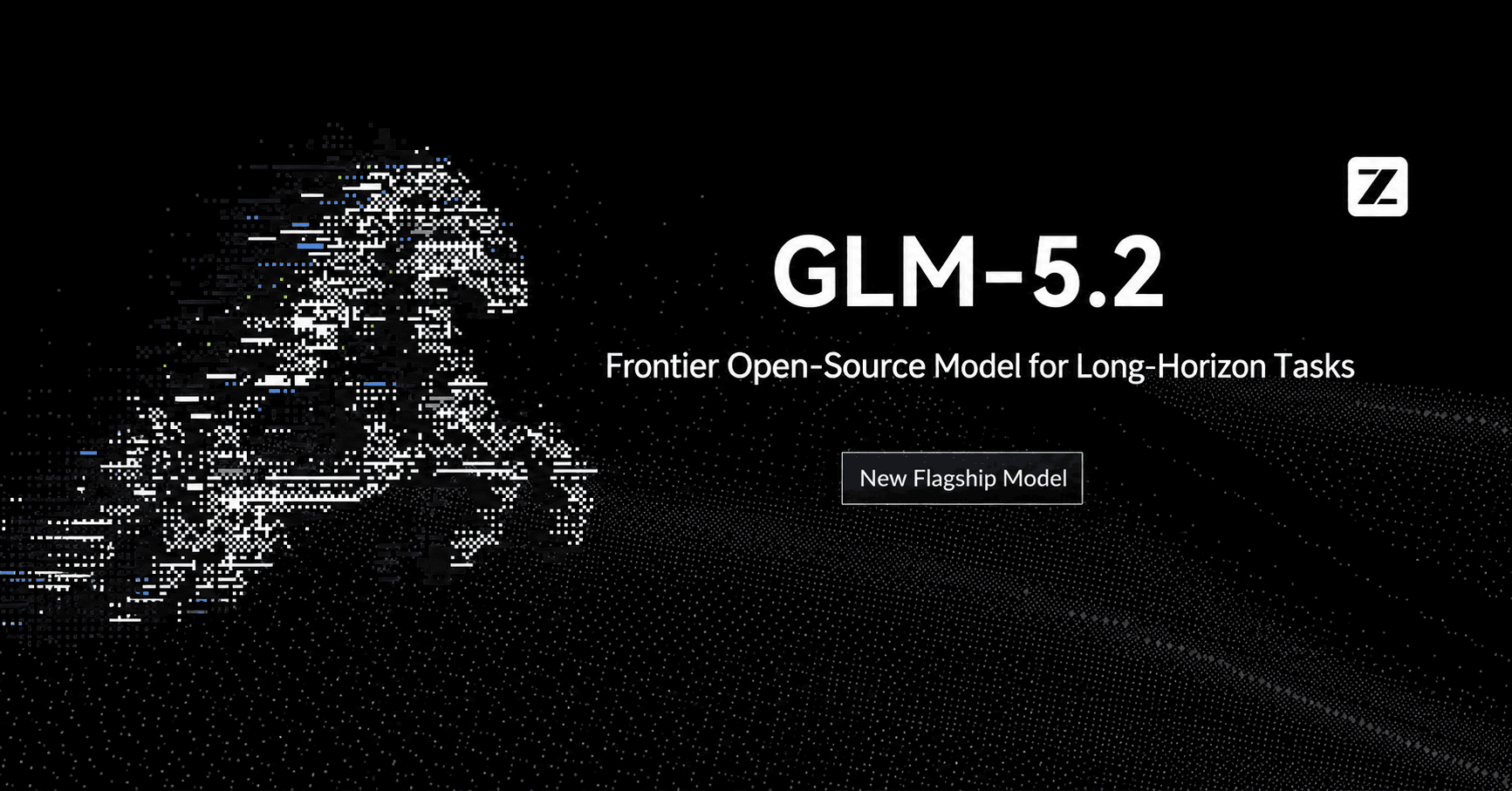
- GLM-5.2 is Z.ai's new flagship AI model, released June 13, 2026, specifically designed to excel at complex, multi-step "long-horizon" tasks.
- It features a groundbreaking, truly usable 1-million-token context window, a fivefold increase over its predecessor, GLM-5.1.
- GLM-5.2 introduces architectural innovations like IndexShare and flexible "High" and "Max" reasoning effort levels, boosting efficiency and performance on demanding coding and agentic workflows.
- Available via Z.ai's GLM Coding Plan and a pay-as-you-go API, its weights are also being open-sourced under an MIT license, making advanced AI more accessible.
The world of artificial intelligence is moving at an incredible pace, with new models pushing the boundaries of what's possible almost daily. One of the most significant challenges for large language models (LLMs) has been handling "long-horizon tasks"—complex problems that require maintaining context, performing multi-step reasoning, and executing a series of actions over extended periods. Enter GLM-5.2, Z.ai's latest flagship model, which aims to address this very challenge head-on.
Released on June 13, 2026, GLM-5.2 is making waves for its dedicated focus on these demanding tasks, particularly within the realm of agentic coding and software engineering. It boasts a truly usable 1-million-token context window, a feature that could redefine how developers and AI practitioners approach large-scale projects.
Who is Z.ai?
Before diving deeper into GLM-5.2, it's worth understanding the force behind its development. Z.ai is the international brand for Zhipu AI, a prominent Beijing-based foundation model company. Spun out of Tsinghua University in 2019, Zhipu AI has rapidly established itself as a key player in the global AI landscape, consistently pushing innovation in large language models. The GLM (General Language Model) series, which includes predecessors like GLM-5, GLM-5-Turbo, and GLM-5.1, has been a cornerstone of their efforts, with each iteration building on the last to tackle increasingly complex real-world software development tasks.
The Challenge of Long-Horizon Tasks
What exactly are "long-horizon tasks," and why are they so difficult for AI? Imagine asking an AI to write a short email. That's a relatively simple, short-horizon task. Now, imagine asking it to:
- Develop a complete, multi-platform software application from a set of requirements.
- Refactor an entire codebase, ensuring architectural consistency across hundreds of files.
- Conduct automated research, synthesize findings from numerous documents, and then implement a solution based on that research.
- Debug a complex mobile application by analyzing logs, screenshots, and runtime behavior over many interaction turns.
These are long-horizon tasks. They demand that the AI model not only understands a massive amount of information (the "context") but also remembers crucial details, plans multiple steps ahead, executes actions, learns from feedback, and maintains coherence over extended periods. Traditional LLMs often struggle with this, suffering from "context fragmentation" where they lose track of earlier parts of the conversation or project as the context window fills up.
What Makes GLM-5.2 Different?
GLM-5.2 has been specifically engineered to overcome these limitations. Its headline feature is a truly usable 1-million-token context window. For perspective, this is a fivefold increase over GLM-5.1's already substantial 200,000 tokens. But it's not just about a larger window; Z.ai emphasizes that this context is "truly usable," meaning the model maintains stable performance and doesn't degrade in quality as the context length increases.
This massive context allows GLM-5.2 to handle:
- Project-level engineering context: Placing an entire codebase within a single reasoning workflow.
- Stable long-horizon execution: Complex tasks can progress continuously without going off track easily.
- Reliable adherence to standards: Enforcing engineering constraints and maintaining consistency across multi-step processes.
Beyond the expanded context, GLM-5.2 introduces "flexible effort" with two reasoning modes: "High" and "Max" (sometimes referred to as "xhigh"). These modes allow users to balance the model's capability against task execution speed and computational cost. The "Max" effort level is recommended for deep reasoning and complex tasks, allocating additional computation when higher performance is critical.
Architectural Innovations: IndexShare and MTP
The ability to manage such a vast context efficiently isn't just about throwing more computing power at the problem; it requires clever architectural improvements. GLM-5.2 incorporates two key innovations:
- IndexShare for DSA: To efficiently handle the 1M context length, GLM-5.2 applies IndexShare. This technique reuses the same lightweight indexer across every four sparse attention layers. This significantly reduces the computational cost of the indexer's dot product and top-k operations, cutting per-token FLOPs by an impressive 2.9 times at a 1M context length.
- Improved MTP Layer: GLM-5.2 also features an improved Multi-Token Prediction (MTP) layer for speculative decoding. This enhancement increases the acceptance length by up to 20%, contributing to faster and more efficient generation of longer sequences.
These architectural changes are critical for making the 1M-token context practical and performant, addressing bottlenecks like KV-cache capacity and long-context kernel overhead.
Performance and Benchmarks
While Z.ai initially released GLM-5.2 without official benchmark scores, independent evaluations and subsequent reports have highlighted its impressive capabilities, especially for an open-source model.
- Standard Coding Benchmarks: GLM-5.2 is recognized as the strongest open-source model on standard coding benchmarks. It scored 81.0 on Terminal-Bench 2.1, placing it within a few points of closed-source frontier models like Claude Opus 4.8 (85.0) and ahead of Gemini 3.1 Pro. On SWE-bench Pro, it achieved 62.1, improving significantly over GLM-5.1 (58.4) and even surpassing GPT-5.5 (58.6).
- Long-Horizon Coding Benchmarks: This is where GLM-5.2 truly shines. It consistently ranks as the highest-ranked open-source model across benchmarks designed for extended, multi-hour engineering workloads.
- FrontierSWE: Measures an agent's ability to complete open-ended technical projects. GLM-5.2 trails Claude Opus 4.8 by only 1%, while edging out GPT-5.5 by 1% and Opus 4.7 by 11%.
- PostTrainBench: Evaluates how much an agent can improve small models through post-training. GLM-5.2 outperforms both Opus 4.7 and GPT-5.5, ranking second only to Opus 4.8.
- SWE-Marathon: An ultra-long-horizon benchmark for tasks like building compilers. GLM-5.2 is second only to the Opus series.
- Intelligence Index: On the Artificial Analysis Intelligence Index, GLM-5.2 scored 51, making it the highest-scoring open-weight model and comparable to leading proprietary models. BenchLM.ai also places it among the top tier, ranking #3 out of 124 models on its provisional leaderboard.
Real-World Applications for AI Practitioners and Developers
The capabilities of GLM-5.2 open up a new frontier for AI practitioners and freelancers. Its ability to maintain context over vast amounts of information and execute complex, multi-step tasks makes it ideal for:
- Autonomous Software Engineering: From initial requirements to multi-platform deployment, GLM-5.2 can manage full development workflows. This includes generating entire codebases, performing large-scale refactoring, migrating APIs, and restructuring directories.
- Advanced Agentic Workflows: Building sophisticated AI agents that can perform continuous, long-running tasks without losing coherence. This is particularly useful for tasks requiring multi-turn interactions, tool use, and complex sub-task decomposition.
- Large-Scale Document Analysis and Synthesis: Processing and understanding extensive documentation, research papers, or legal briefs to generate summaries, extract insights, or answer complex questions that require cross-referencing vast amounts of text.
- Automated Research and Experimentation: Turning model architectures and training scripts described in papers into runnable code, setting up model structures, debugging, and fixing environment issues autonomously.
- Client-Side and Mobile Engineering: Handling complex aspects of mobile development, including architecture, state management, UI logic, and even real-device debugging using tools like ADB and logcat.
Accessing GLM-5.2: API, Subscriptions, and Open-Source
Z.ai offers multiple ways to access GLM-5.2, catering to different user needs:
- GLM Coding Plan (Subscription): GLM-5.2 is immediately available to all users across the Lite, Pro, Max, and Team tiers of Z.ai's GLM Coding Plan. This plan offers predictable monthly costs with prompt-based quotas, designed for steady daily coding workflows.
- Standalone API (Pay-per-token): Developers can integrate GLM-5.2 into their applications via Z.ai's API, accessible through an Anthropic-compatible endpoint (https://api.z.ai/api/coding/paas/v4). This metered billing option is best for programmatic or spiky usage. You'll need a Z.ai API key, which can be generated from their management portal.
- Open-Source Weights: In a significant move, Z.ai has committed to releasing GLM-5.2's weights under an MIT open-source license. This "Pure Open" approach means no regional limits or technical access barriers, allowing enterprises and developers to download, customize, fine-tune, and even self-host the model. This is particularly appealing for those with strict data security requirements or high-volume needs, as it bypasses per-token costs after initial setup.
GLM-5.2 can also be integrated with popular agentic coding tools like Claude Code, Cline, and OpenClaw, often requiring just a base URL and model name swap.
Pricing Breakdown
For developers and businesses, understanding the cost is crucial. Z.ai offers competitive pricing for GLM-5.2:
- GLM Coding Plan (Subscription):
- Lite: ~$18/month (or $12.60/month annually) for small repos, lightweight iteration.
- Pro: ~$72/month (or $50.40/month annually) for mid-sized repos, daily development.
- Max: ~$160/month (or $112.00/month annually) for large repos, advanced workflows.
- Team: For organizations.
Note that these prices are estimates and can vary. GLM-5.2 usage within these plans is resource-intensive, with prompts deducting quota faster during peak hours (e.g., 3x standard quota during peak, 2x during off-peak, though a limited-time promo makes off-peak 1x until September).
- Standalone API (Pay-per-token):
- Input Tokens: $1.40 per 1 million tokens.
- Cached Input Tokens: $0.26 per 1 million tokens.
- Output Tokens: $4.40 per 1 million tokens.
This pricing is notably competitive, with GLM-5.2 API usage running roughly 5x to 8x below some frontier models like Claude Opus 4.8 for output tokens.
The Future of Long-Horizon AI
GLM-5.2 represents a significant step forward in AI's ability to handle complex, multi-faceted problems. By offering a robust 1-million-token context and specialized training for long-horizon coding agent scenarios, Z.ai is pushing the boundaries of what AI can achieve in practical, engineering-focused applications. The commitment to open-source weights also democratizes access to this cutting-edge technology, potentially fostering rapid innovation across the developer community. As AI models become more capable of sustained reasoning and complex task execution, we can expect to see them take on even more sophisticated roles in software development, research, and beyond.
Conclusion
GLM-5.2 is more than just another large language model; it's a specialized tool built for the demands of long-horizon tasks. With its expansive and stable 1-million-token context, innovative architecture, and strong performance on agentic coding benchmarks, it offers a powerful solution for developers and AI practitioners grappling with complex, multi-step projects. Its accessibility through both subscription plans and a pay-as-you-go API, coupled with the promise of open-source weights, positions GLM-5.2 as a major contender in the evolving landscape of advanced AI models.
Frequently Asked Questions
What is GLM-5.2 and who developed it?
GLM-5.2 is Z.ai's (formerly Zhipu AI) flagship large language model, released on June 13, 2026. It is specifically built for "long-horizon tasks," meaning complex, multi-step problems that require maintaining extensive context and performing sustained reasoning.
What is the key feature of GLM-5.2?
The standout feature of GLM-5.2 is its truly usable 1-million-token context window (1,048,576 tokens). This allows the model to process and retain information from very long inputs, crucial for handling entire codebases or extended project workflows.
How can I access GLM-5.2?
You can access GLM-5.2 through Z.ai's GLM Coding Plan, which offers various subscription tiers. Developers can also use its pay-as-you-go API via an Anthropic-compatible endpoint. Additionally, Z.ai plans to release the model's weights under an MIT open-source license, allowing for self-hosting and customization.
What are "long-horizon tasks" and why is GLM-5.2 good at them?
"Long-horizon tasks" are complex problems requiring an AI to maintain coherence, context, and perform multi-step reasoning over extended interactions or large datasets, such as developing a full software application or refactoring a large codebase. GLM-5.2 excels due to its 1-million-token context window and architectural improvements like IndexShare, which enable it to process and manage vast amounts of information efficiently and stably.