Key Takeaways
- Building effective evaluations (evals) for AI agents is crucial for ensuring their reliability, accuracy, and performance in real-world scenarios.
- Evals involve defining clear tasks, choosing appropriate graders (human or AI), setting up robust eval harnesses, and continuously tracking performance.
- Tools like OpenAI Evals, LangChain's evaluation modules via LangSmith, LlamaIndex's evaluators, Ragas, and Arize Phoenix offer frameworks and metrics for building and running these evaluations.
- Consistent evaluation helps developers iterate faster, catch regressions, and ensure AI agents meet desired quality standards before and after deployment.
How to Build Effective Evals for AI Agents: A Step-by-Step Guide
AI agents are quickly becoming essential tools, from automating customer service to assisting with complex data analysis. But just like any software, they aren't perfect from day one. Ensuring an AI agent performs reliably, accurately, and safely requires a robust system of evaluation, often called "evals." Without effective evals, you're essentially flying blind, unable to tell if your agent is improving, regressing, or even hallucinating. This tutorial will walk you through the essential steps to build effective evals for your AI agents, helping you build more trustworthy and performant AI applications.
What Are AI Agent Evals and Why Do They Matter?
At its core, an AI agent eval is a structured test or benchmark designed to measure the quality of an AI agent's output on specific tasks. It's about turning subjective judgments into objective, repeatable checks. Imagine you've built an AI agent to answer customer queries about your product. An eval would involve feeding it a series of typical (and sometimes tricky) questions and then systematically checking if its answers are correct, helpful, and free of errors or harmful content.
Why is this so important? Because AI agents, especially those powered by Large Language Models (LLMs), can be unpredictable. Small changes to a prompt, a model update, or even new data can significantly impact their behavior. Evals help you:
- Ensure Stability: Catch regressions and unexpected behaviors before they reach users.
- Measure Progress: Objectively compare different versions of your agent and understand if your changes are leading to improvements.
- Reduce Hallucinations and Errors: Systematically test for factual accuracy, instruction following, and reasoning ability.
- Speed Up Iteration: Get clear feedback on what's working and what's not, allowing for faster development cycles.
Step 1: Define Your Agent's Purpose and Success Metrics
Before you can evaluate anything, you need to know what "good" looks like. What is your AI agent supposed to do? What problem does it solve? And how will you know if it's doing a good job?
For example, if your agent is a customer support chatbot, "good" might mean:
- Accuracy: Providing correct information 95% of the time.
- Helpfulness: Resolving user issues without requiring human intervention.
- Safety: Avoiding toxic, biased, or harmful responses.
- Efficiency: Responding quickly and concisely.
Translate these high-level goals into specific, measurable metrics. This often involves defining what constitutes a "correct" answer, a "helpful" interaction, or an "unsafe" response. This initial step is critical because it sets the foundation for all subsequent evaluation efforts.
Step 2: Design Clear Evaluation Tasks (Test Cases)
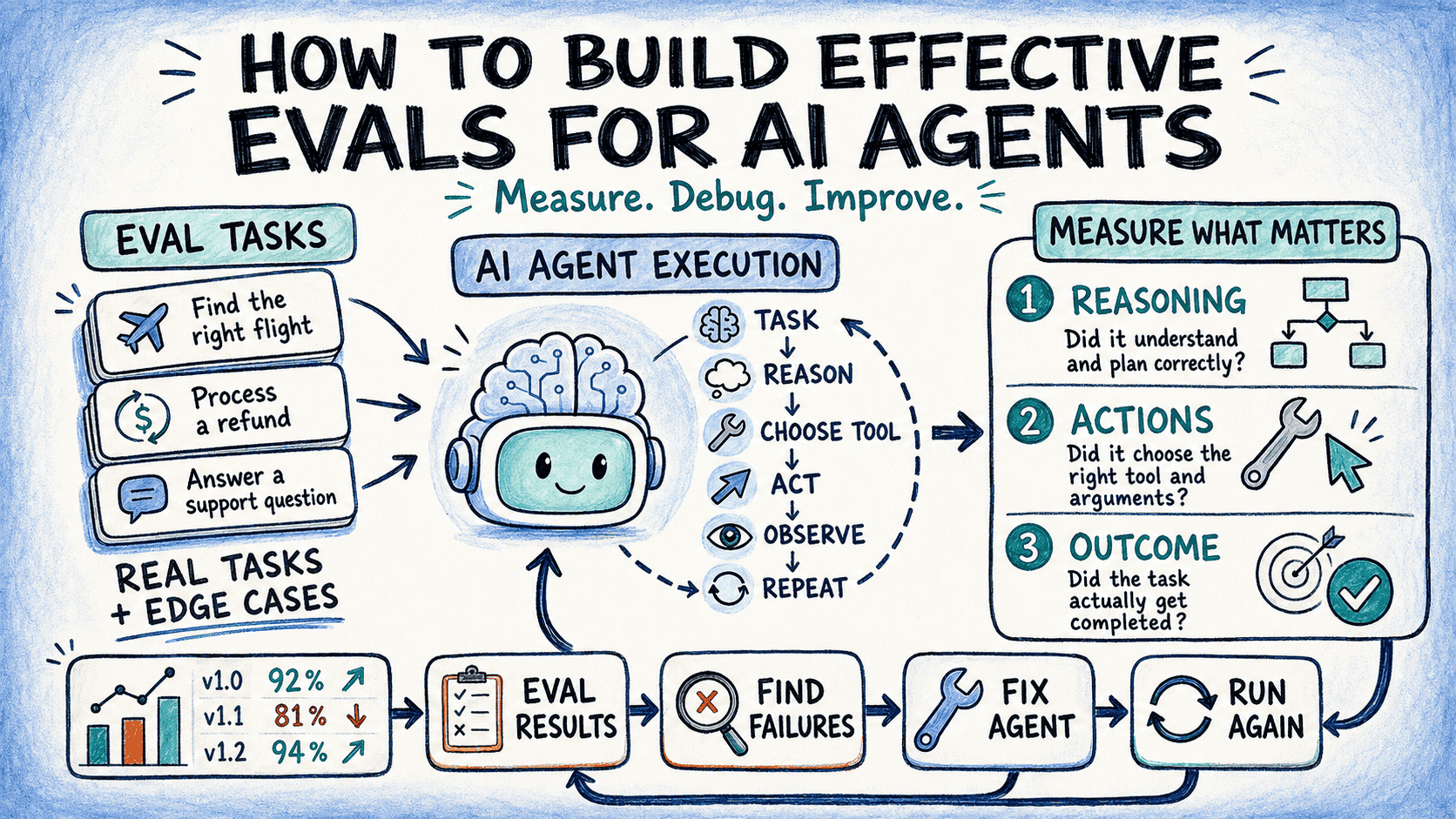
With your success metrics in hand, the next step is to create a dataset of test cases that realistically reflect how your agent will be used. These test cases are the inputs you'll feed to your agent to see how it performs.
Types of Test Cases:
- Curated Datasets: Hand-picked examples covering common scenarios, edge cases, and known failure modes. These can be static JSON files or CSVs.
- Synthetically Generated Data: For tasks where real-world data is scarce, you can use LLMs to generate realistic prompts and expected answers. LlamaIndex, for instance, can generate questions from your data for evaluation.
- Production Logs: Capture real user interactions with your agent (anonymized, of course) to create a highly representative test set.
- Benchmark Datasets: For general-purpose LLMs, established benchmarks like MMLU, MATH, or HumanEval can be used.
What makes a good test case?
- Clear Input: The prompt or query you give to the agent.
- Expected Output (Ground Truth): What the ideal response should be. This can be a specific answer, a range of acceptable answers, or a set of criteria.
- Evaluation Criteria: Specific rules or guidelines for judging the agent's response against the expected output.
Consider creating different "flavors" of test cases: simple questions, complex multi-turn dialogues, questions requiring tool use, and adversarial prompts designed to break the agent.
Step 3: Choosing the Right Graders (Human vs. AI Graders)
Once your agent generates a response to a test case, you need a way to score it. This is where "graders" come in. You have two main options:
Human Graders:
Human graders, or subject matter experts, are invaluable for nuanced evaluations. They can assess subjective qualities like tone, creativity, coherence, and complex reasoning that AI models struggle with. Tools like LangSmith allow you to route samples to human reviewers who can flag disagreements and provide feedback. This human feedback is crucial for calibrating automated evaluation metrics over time.
- Pros: High accuracy for subjective tasks, good for identifying subtle errors, provides rich qualitative feedback.
- Cons: Slow, expensive, can be inconsistent if guidelines aren't clear.
AI Graders (LLM-as-a-Judge):
Using another, often more capable, LLM to evaluate your agent's responses is a powerful and scalable approach. This "LLM-as-a-judge" paradigm is widely adopted in frameworks like OpenAI Evals, Ragas, and Arize Phoenix.
For example, you might instruct a powerful model like GPT-4 to act as an expert judge, comparing your agent's output to the ground truth or a set of criteria and assigning a score or a pass/fail.
- Pros: Fast, scalable, consistent (given clear prompts), cost-effective for large datasets.
- Cons: Can sometimes "agree" with incorrect answers from the agent being evaluated, may struggle with highly subjective or domain-specific nuances, susceptible to its own biases.
Often, the best approach is a hybrid one: use AI graders for most of your evaluations and then use human graders to review a subset of results, especially edge cases or where AI graders disagree with human intuition. This helps you refine your AI grading prompts and ensure their reliability.
Step 4: Building a Reliable Eval Harness (Tools and Frameworks)
An "eval harness" is the infrastructure that runs your test cases, feeds them to your agent, collects the responses, applies the graders, and aggregates the results. Building this from scratch can be complex, which is why several excellent open-source frameworks exist to help.
Key Features of an Eval Harness:
- Test Case Management: Storing and organizing your evaluation datasets.
- Agent Integration: Easily connecting to your AI agent.
- Execution Engine: Running tests in parallel or sequentially.
- Grading Logic: Applying human or AI graders.
- Reporting: Aggregating scores, identifying failure modes, and visualizing results.
Popular Tools and Frameworks:
1. OpenAI Evals
The OpenAI Evals framework is an open-source toolkit designed for systematically testing and benchmarking AI model performance. It allows developers to create custom evaluation suites, measure model accuracy, and compare performance across different AI systems. It supports various evaluation paradigms, including few-shot learning assessments and chain-of-thought reasoning evaluation. You can define data sources (JSON files, runtime samplers), configure which model to test, and apply graders using exact match, fuzzy matching, or custom scoring logic. The framework includes pre-built evaluation templates for common tasks like question answering and code generation. As of January 2026, it boasts significant community adoption with 17,600 stars and 2,900 forks on GitHub.
2. LangChain (with LangSmith)
LangChain is a popular framework for building LLM applications, and it offers robust evaluation capabilities, especially when combined with LangSmith. LangSmith is an AI agent and LLM model evaluation platform that provides a framework for measuring quality throughout the application lifecycle. It supports offline evaluations on curated datasets during development and online evaluations for real-world production traffic. LangSmith's evaluation framework supports various evaluator types, including human evaluation through annotation queues, heuristic checks, LLM-as-judge evaluators, and pairwise comparisons. It allows you to track experiments, compare application versions, and debug model performance.
3. LlamaIndex Evaluators
LlamaIndex, an orchestration framework for LLM applications and RAG systems, also provides LLM-based evaluation modules. These modules often use a "gold" LLM (like GPT-4) to determine the quality of generated results without always requiring ground-truth labels. LlamaIndex includes evaluators for RAG, response relevance, hallucination detection, context precision, and retrieval quality. It can also generate questions from your data to facilitate evaluation. LlamaIndex integrates with other evaluation tools like Ragas.
4. Ragas
Ragas (Retrieval Augmented Generation Assessment) is an open-source tool specifically designed for evaluating Retrieval-Augmented Generation (RAG) pipelines. It focuses on evaluating both the retriever and generator components of a RAG system. Ragas provides quantifiable, context-aware metrics such as faithfulness (how well the answer aligns with the retrieved context), answer relevance (consistency between answer and question), context relevance (how pertinent the retrieved information is to the query), and hallucination detection. A key advantage is its ability to perform reference-free evaluations, meaning you don't always need ground-truth labels. Ragas can be integrated into your CI/CD pipeline for automated checks.
5. Arize Phoenix
Arize Phoenix is Arize AI's open-source AI observability platform for experimentation, evaluation, and troubleshooting. It runs locally or in your cloud and offers tracing, dataset management, evaluations, RAG-specific metrics, and embeddings analysis. Phoenix uses OpenTelemetry-based instrumentation for tracing LLM application runtimes. It includes built-in evaluators for aspects like faithfulness, relevance, hallucination, and toxicity, and allows for custom criteria. Phoenix can also integrate with other evaluators like Ragas and DeepEval. It's a strong option for teams needing self-hosted observability and evaluation without subscription costs.
Step 5: Tracking and Iterating on Evals
Running evals once isn't enough. AI development is an iterative process. You need to continuously track your agent's performance, understand how changes impact it, and use those insights to improve.
Version Control for Evals:
Just like your code, your evaluation datasets, grading prompts, and eval harness configurations should be under version control. This ensures reproducibility and allows you to trace back changes if performance degrades.
Experiment Tracking:
Tools like Weights & Biases (W&B) are excellent for experiment tracking. W&B is an AI developer platform that helps you keep records, log successes and failures, and automate manual tasks during machine learning experimentation. It allows you to track every model, metric, and hyperparameter effortlessly, providing full visibility into your AI workflow to reproduce results, debug model performance, and optimize faster. You can log evaluation scores, model outputs, and even sample predictions to a dashboard, making it easy to compare different agent versions or prompt changes.
Automated CI/CD Integration:
Integrate your evals into your Continuous Integration/Continuous Deployment (CI/CD) pipeline. This means that every time you make a code change or update your agent, your evals run automatically. If an eval fails or performance drops below a certain threshold, the deployment can be blocked, preventing regressions from reaching production. This makes quality assurance automated and scalable.
Continuous Monitoring:
Even after deployment, continue monitoring your agent's performance in production. Tools like Arize Phoenix or LangSmith (with online evals) can help detect quality drift over time by scoring real-world production traffic. This helps you identify new failure modes that might not have been present in your development datasets.
Conclusion
Building effective evals for AI agents is not an afterthought; it's a fundamental part of responsible AI development. By systematically defining your agent's purpose, designing clear test cases, choosing the right graders, leveraging powerful eval harnesses, and continuously tracking your progress, you can build AI agents that are not only innovative but also reliable, accurate, and trustworthy. The ecosystem of tools for AI evaluation is growing, offering developers robust options to ensure their AI agents perform as expected, from development to production.
Frequently Asked Questions
What is an AI agent eval?
An AI agent eval (evaluation) is a structured test or benchmark used to measure the quality, performance, and reliability of an AI agent's outputs on specific tasks. It helps objectively assess if an agent is meeting its intended goals and behaving as expected.
Why are evals important for AI agents?
Evals are crucial because AI agents can be unpredictable. They help ensure application stability, measure progress between different agent versions, catch regressions before deployment, reduce issues like hallucinations, and provide objective metrics for faster iteration and debugging.
What are some popular tools for building AI agent evals?
Several tools and frameworks assist in building AI agent evaluations. Key examples include OpenAI Evals, LangChain's evaluation modules (often used with LangSmith), LlamaIndex's evaluators, Ragas (especially for RAG systems), and Arize Phoenix for observability and evaluation.
Should I use human graders or AI graders for my evals?
The best approach often combines both. AI graders (LLM-as-a-judge) are scalable and cost-effective for broad, objective evaluations, while human graders provide high accuracy for subjective tasks and help identify subtle errors and calibrate AI graders.