Key Takeaways
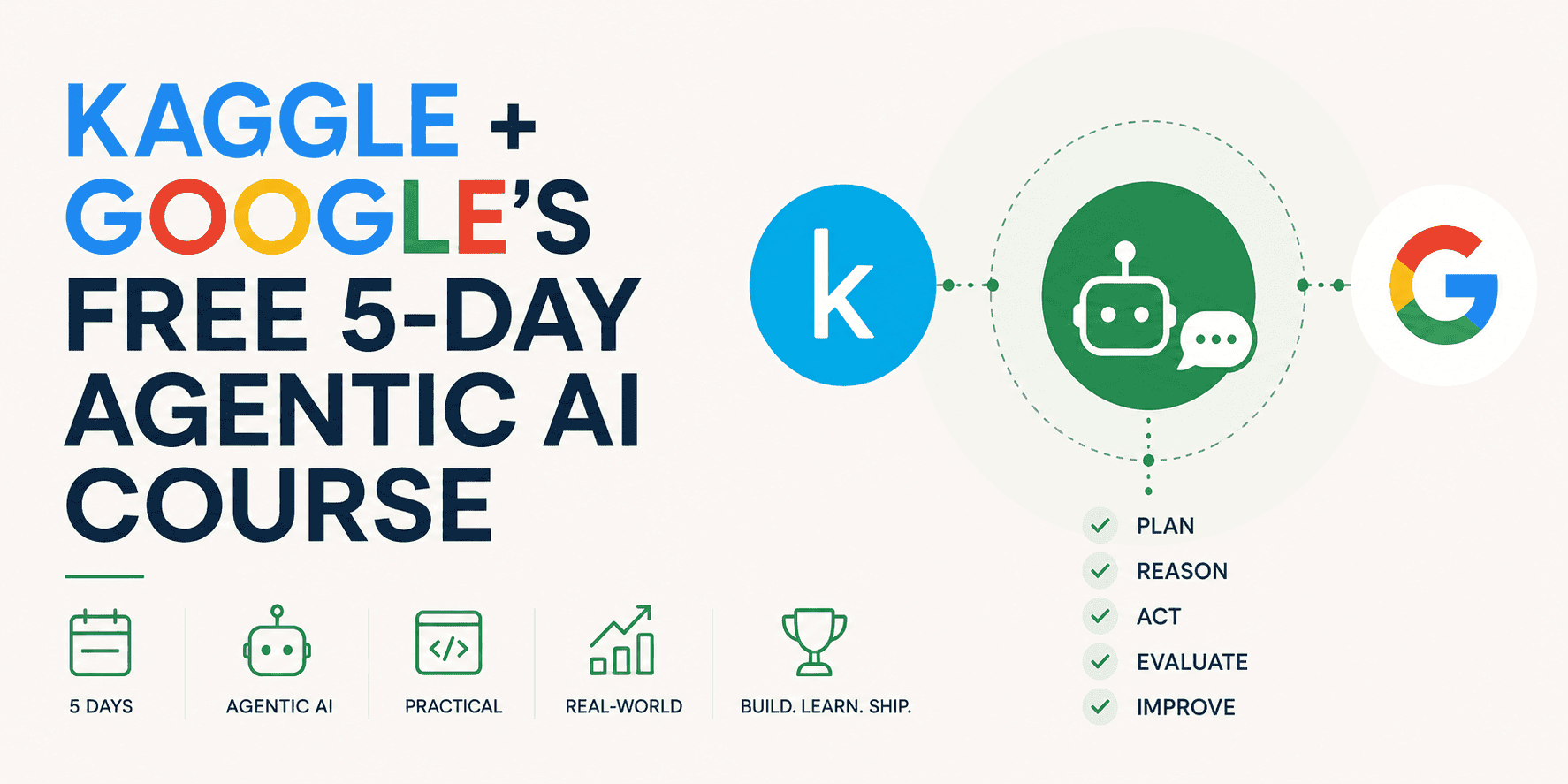
- Google and Kaggle offer a free, self-paced "5-Day Agentic AI Course" designed to teach you how to build autonomous AI agents.
- The course covers agent architectures, tool integration, context engineering, quality evaluation, and deployment to production using Google's Agent Development Kit (ADK), Gemini, and Antigravity.
- It's ideal for developers, AI practitioners, and anyone looking to gain practical, hands-on experience in the rapidly evolving field of agentic AI.
- The course emphasizes "vibe coding" – using natural language workflows to build powerful AI agents.
Unlock Autonomous AI: Google and Kaggle's Free 5-Day Agentic AI Course is Here
The world of Artificial Intelligence is always moving forward, and one of the most exciting areas right now is Agentic AI. Imagine AI systems that don't just respond to your commands but can set goals, plan tasks, and act on their own to achieve those goals. That's the power of AI agents, and now, Google and Kaggle have made it easier than ever to learn how to build them with their free, self-paced "5-Day Agentic AI Course." This isn't just another introductory AI course. This program, initially run as a highly successful live intensive in November 2025 and again in June 2026, is now available to everyone on demand. It provides a deep dive into the practical aspects of building production-ready AI agents, making advanced AI skills accessible to a wider audience.What Exactly is Agentic AI?
Before diving into the course, let's get clear on what "Agentic AI" means. At its core, Agentic AI refers to intelligent systems that can operate autonomously to achieve specific, predetermined goals with minimal human supervision. Unlike traditional AI models that primarily respond to prompts or analyze data, agentic AI goes a step further by being able to initiate actions and execute complex, multi-step tasks. Think of it this way: a generative AI model (like a large language model or LLM) can create content, such as writing an email or generating an image. An agentic AI system, however, can use that generated content, along with other tools, to complete a broader objective. For example, it could generate marketing materials, then deploy them, track their performance, and even adjust the marketing strategy based on the results, all on its own. Key characteristics of Agentic AI include:- Autonomy: Agents can perform tasks independently, making decisions without constant human oversight.
- Goal-Driven Behavior: They are designed to achieve specific goals, often breaking down complex objectives into smaller, manageable steps.
- Adaptability: Agentic systems can learn from their interactions, adapt to changing environments, and refine their actions based on feedback.
- Tool Use: They leverage external tools, APIs, and even other AI models to extend their capabilities and interact with the real world.
- Reasoning: Powered by LLMs, agents can analyze data, understand context, and formulate solutions.
About the Kaggle + Google 5-Day Agentic AI Course
This free course is a collaboration between Google, a leader in AI research and development, and Kaggle, the world's largest community for data scientists and machine learning practitioners. This partnership means you're learning from the best, with content that is both theoretically sound and practically applicable. The course is designed to be hands-on, guiding participants through the process of building production-ready AI agents. It uses Google's cutting-edge tools, including the Gemini API and the Agent Development Kit (ADK), along with Google Antigravity, an agentic AI IDE and CLI. The curriculum is structured over five days, each pairing a technical whitepaper with two practical codelabs.What You'll Learn: A Day-by-Day Breakdown
The course dives deep into various aspects of AI agent development, moving from foundational concepts to advanced deployment strategies. Here’s a high-level overview of the topics covered:Day 1: Introduction to Agents
This day sets the stage by exploring different agent architectures and helping you understand when a task truly benefits from an agentic approach versus a simpler workflow. You'll build your very first AI agent and even your first multi-agent system, grasping how agentic architectures differ from traditional LLM applications.
Day 2: Agent Tools & Interoperability with Model Context Protocol (MCP)
Here, you'll learn how AI agents use external tools to perform actions. This includes writing custom tools by turning your Python functions into agent actions. A key focus is the Model Context Protocol (MCP), which allows agents to communicate with external systems. You'll also learn about implementing "human-in-the-loop" approval for long-running operations, a crucial aspect for building safe and useful agents.
Day 3: Context Engineering
This day focuses on making agents "stateful." You'll learn techniques for managing conversation history, implementing working memory within sessions, and giving agents long-term memory that persists across conversations. This is essential for building agents that can maintain context and engage in more complex, ongoing interactions.
Day 4: Agent Quality
Building an agent is one thing; ensuring it works well and reliably is another. This unit covers critical aspects of agent quality, including observability through logs, traces, and metrics. You'll explore methods for evaluating your agents, such as "LLM-as-a-Judge" and "Human-in-the-Loop" validation, helping you identify and fix common pitfalls that often cause prototypes to fail.
Day 5: Prototype to Production
The final day focuses on taking your agent from a prototype to a production-ready system. You'll learn how to deploy your agent to Vertex AI Agent Engine on Google Cloud and build sophisticated multi-agent systems using the Agent2Agent (A2A) Protocol for agent collaboration.
The course also introduces the concept of "vibe coding," which emphasizes using natural language workflows to build powerful, autonomous agents, transforming how developers interact with AI development.Tools and Technologies
The course primarily leverages Google's ecosystem, providing practical experience with:
- Google's Gemini API: The backbone for integrating generative models into your applications and building conversational agents.
- Google Agent Development Kit (ADK): A set of tools and frameworks specifically designed for building AI agents.
- Google Antigravity: An agentic AI IDE and CLI that facilitates visual and headless "vibe coding" workflows.
- Vertex AI Agent Engine: Google Cloud's platform for deploying and managing agents at scale.
Why This Free Course Matters for AI Practitioners
The availability of this course for free is a significant opportunity for anyone looking to advance their AI skills.Here's why it's a game-changer:
- Accessibility: High-quality AI education, especially on advanced topics like agentic AI, often comes with a hefty price tag. Google and Kaggle making this course free removes a major barrier to entry.
- Practical Skills: The focus on hands-on codelabs and real-world application means you're not just learning theory; you're building actual agents. This practical experience is invaluable in the job market.
- Industry Relevance: Agentic AI is an emerging and rapidly growing field. Companies are increasingly looking for professionals who can design, build, and deploy autonomous AI systems to automate complex processes and optimize workflows. This course directly addresses that demand.
- Learning from Experts: Google is at the forefront of AI research and development. Learning directly from their materials and using their tools provides an authentic and up-to-date perspective on AI agent development.
- Career Advancement: For developers, data scientists, and AI engineers, mastering agentic AI can open up new career paths and enhance existing roles. Freelancers can leverage these skills to offer more sophisticated AI solutions to their clients.
Who Should Take This Course?
This course is perfect for:
- Software Developers: Especially those working with Python, looking to integrate AI agent capabilities into their applications.
- AI Engineers and Data Scientists: Professionals who want to deepen their understanding of autonomous AI systems and learn practical deployment strategies.
- Machine Learning Practitioners: Anyone familiar with LLMs and generative AI who wants to explore how to make these models more proactive and goal-oriented.
- Tech-Savvy Individuals: If you have a foundational understanding of programming (preferably Python) and are eager to explore the next frontier of AI, this course offers a structured learning path.
While the course provides whitepapers for conceptual understanding, the hands-on labs are primarily code-based, making some programming experience (especially in Python) highly beneficial.
How to Access and Get Started
Accessing the course is straightforward. Since it's hosted on Kaggle Learn, you can start immediately:
- Visit the official course page on Kaggle: Kaggle's 5-Day AI Agents: Intensive Vibe Coding Course With Google.
- Sign in with your Kaggle account (or create one if you don't have one).
- The course is self-paced, so you can work through the modules and codelabs at your own convenience.
Make sure you have a Google account, as the labs will likely integrate with Google Cloud services and the Gemini API, requiring authentication.
Final Thoughts
The release of the free "5-Day Agentic AI Course" by Google and Kaggle is a fantastic resource for anyone serious about building the next generation of AI applications. Agentic AI is moving beyond theoretical discussions and into practical, real-world implementations, and this course equips you with the knowledge and tools to be part of that shift. By offering this comprehensive training at no cost, Google and Kaggle are fostering a community of skilled AI practitioners ready to innovate. Don't miss this chance to level up your AI game and explore the exciting potential of autonomous AI agents.
Frequently Asked Questions
What are the prerequisites for taking this course?
While the course provides theoretical whitepapers, the hands-on codelabs are primarily in Python. A foundational understanding of programming, especially Python, and familiarity with basic AI/ML concepts will be highly beneficial for getting the most out of this intensive course.
Is there a certificate of completion for the course?
The primary benefit of the Kaggle Learn courses is the practical knowledge and skills gained. While Kaggle offers various courses and some platforms provide certificates, the information available indicates the main focus is on the learning material itself. It's best to check the specific course page on Kaggle for any details regarding certificates or badges upon completion.
How much time should I dedicate to complete the course?
The course is designed as a "5-day intensive," meaning it was originally structured to be completed over five focused days. However, as it's now self-paced, you can adapt it to your schedule. Each day typically involves reading a technical whitepaper and completing two hands-on codelabs, so budgeting a few hours per "day" of content would be a good approach.
What is "vibe coding" as mentioned in the course?
"Vibe coding" refers to a new workflow approach where natural language acts as the primary coding language to build powerful, autonomous AI agents. It emphasizes defining agent behavior and tasks using natural language prompts and configurations, often facilitated by tools like Google Antigravity, rather than writing extensive traditional code.