Key Takeaways
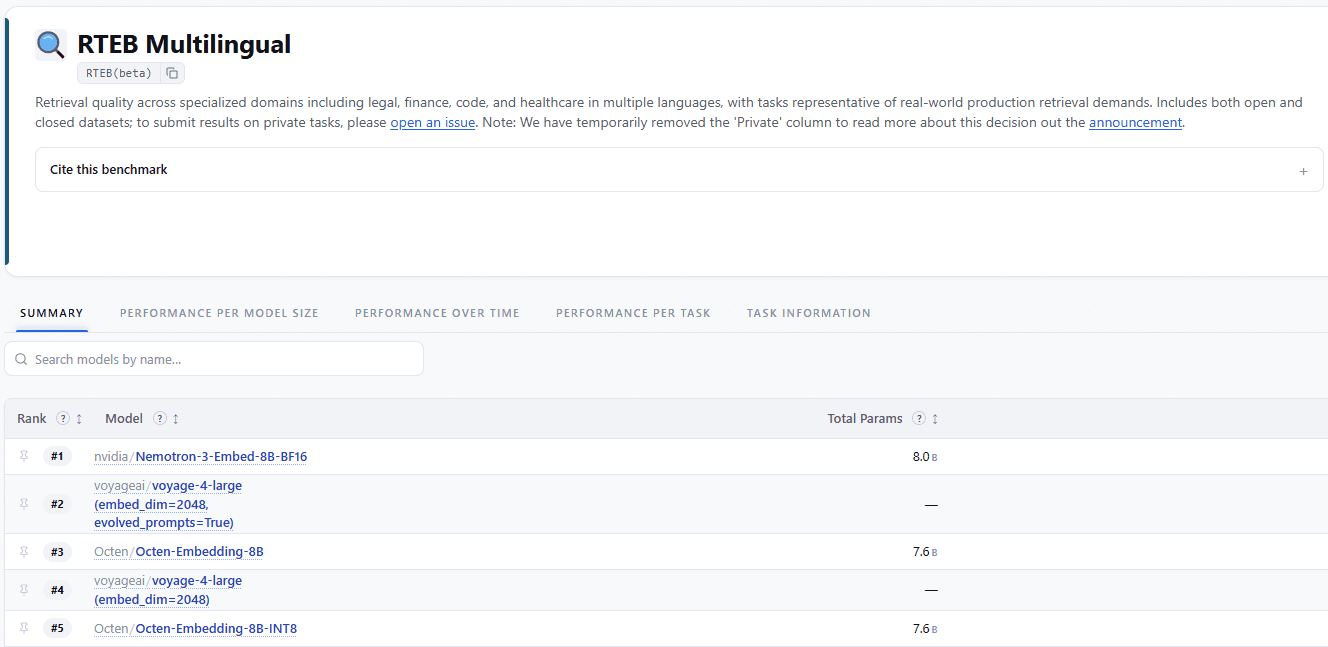
- NVIDIA Nemotron 3 Embed, an open collection of embedding models, now holds the #1 spot on the Retrieval Embedding Benchmark (RTEB) leaderboard.
- This achievement significantly advances "agentic retrieval," allowing AI agents to dynamically and iteratively fetch highly relevant information for complex tasks.
- The Nemotron 3 Embed family includes an 8B flagship model and efficient 1B variants, all featuring open weights, 32k context windows, multilingual support, and NVIDIA NVFP4 optimization for production use.
- RTEB is a crucial benchmark that uses a mix of public and private, industry-focused datasets across 20 languages to truly test an embedding model's real-world generalization.
The world of AI is always moving fast, and one of the most exciting recent developments comes from NVIDIA. They've just announced that their new collection of embedding models, NVIDIA Nemotron 3 Embed, has taken the top spot on the Retrieval Embedding Benchmark (RTEB) leaderboard. This isn't just another benchmark win; it's a big step forward for "agentic retrieval," a key technology that makes AI agents much smarter and more capable in how they find and use information.
For anyone building or working with AI systems, especially those dealing with complex data and multi-step tasks, this news is a game-changer. Let's break down what Nemotron 3 Embed is, why its top ranking on RTEB matters, and what it means for the future of AI development.
The Foundation: Understanding Embeddings and RAG
Before diving into Nemotron 3 Embed and agentic retrieval, it's good to quickly cover two core concepts: embeddings and Retrieval-Augmented Generation (RAG).
- Embeddings: In simple terms, an embedding model takes text (like a sentence, paragraph, or even an entire document) and turns it into a list of numbers, called a vector. These vectors capture the semantic meaning of the text. Texts with similar meanings will have vectors that are numerically "close" to each other. This numerical representation allows computers to understand relationships between words and concepts, which is crucial for efficient searching and matching.
- Retrieval-Augmented Generation (RAG): Large Language Models (LLMs) are powerful, but they sometimes "hallucinate" (make up facts) or lack up-to-date information. RAG addresses this by giving the LLM access to an external knowledge base. When you ask a question, a retrieval system (often powered by embedding models) first searches this knowledge base for relevant documents or snippets. These retrieved pieces of information are then fed to the LLM along with your original question, helping it generate a more accurate and informed answer.
Embeddings are the backbone of effective RAG systems, as they determine how well the system can find the most relevant information from a vast sea of data.
Beyond Basic Search: What is Agentic Retrieval?
Traditional RAG is like a librarian who fetches a book for you based on your initial request. It's a one-shot process. You ask, it retrieves, and then the LLM generates. But what if your request is complex, vague, or requires multiple steps of investigation?
This is where agentic retrieval comes in. Think of it as an intelligent research assistant. Instead of a single, fixed lookup, an AI agent takes control of the retrieval process. It can:
- Decide when to retrieve: The agent can determine if external information is even needed.
- Formulate and reformulate queries: If initial search results aren't good enough, the agent can intelligently refine its query and try again.
- Choose sources and tools: It can pick the best databases, search engines, or other tools to get the information it needs.
- Iterate and evaluate: The agent doesn't just accept the first results. It evaluates their relevance and quality, and if they fall short, it can go back to the drawing board, retrieve more information, or even switch strategies until it has enough evidence.
This iterative, decision-making approach makes agentic retrieval much more robust for complex tasks, multi-step questions, and scenarios where information might be spread across various documents or sources. It's crucial for building advanced AI agents that can handle real-world challenges in areas like healthcare, finance, or complex customer service.
RTEB: The Real-World Benchmark That Matters
When a new AI model comes out, it's often accompanied by benchmark scores. But not all benchmarks are created equal. The Retrieval Embedding Benchmark (RTEB), introduced by Hugging Face, is designed to be a "true litmus test" for embedding models.
Why is RTEB so important?
- Combating Overfitting: Many traditional benchmarks use public datasets that models can inadvertently "overfit" to during training, meaning they perform well on the test but poorly in real-world scenarios. RTEB tackles this with a unique "hybrid strategy" that combines both public and private datasets. Models are evaluated on these private datasets by MTEB maintainers, ensuring an unbiased measure of their ability to generalize to unseen data.
- Industry-Oriented Focus: RTEB isn't just about general text. It specifically focuses on critical enterprise domains like legal documents, financial reports, healthcare Q&A, and code retrieval. This makes its results highly relevant for businesses and developers building AI solutions for specific industries.
- Multilingual Support: The benchmark includes datasets covering 20 languages, from widely used ones like English and Japanese to less common languages, reflecting the global nature of enterprise data.
NVIDIA Nemotron 3 Embed's #1 ranking on RTEB, scoring 78.5% on RTEB and 75.5% on MMTEB Retrieval, shows that it doesn't just perform well on academic tests; it excels in the kind of complex, real-world retrieval tasks that are vital for advanced AI applications.
NVIDIA Nemotron 3 Embed: Architecture and Capabilities
NVIDIA Nemotron 3 Embed isn't a single model, but a collection built to offer flexibility and high performance. It was released on July 16, 2026. The collection includes three main variants:
- Nemotron-3-Embed-8B-BF16: This is the flagship model, designed for top-tier quality and precision. It's the one that achieved the #1 ranking on RTEB, making it ideal for precision-critical retrieval and high-stakes enterprise RAG.
- Nemotron-3-Embed-1B-BF16: A more efficient model, perfect for production environments where latency and cost are key considerations. It balances strong performance with resource efficiency.
- Nemotron-3-Embed-1B-NVFP4: This variant is specifically optimized for NVIDIA's Blackwell architecture, leveraging 4-bit quantization (NVFP4) for ultra-high-throughput retrieval and a smaller memory footprint. This means it can handle massive-scale infrastructure with incredible speed.
Beyond these variants, Nemotron 3 Embed comes packed with features designed for enterprise-grade AI:
- Open Weights, Datasets, and Recipes: NVIDIA has made the models open-source, providing developers with full control to inspect, tune, fine-tune, and deploy them on their own infrastructure. This transparency is crucial for customization and security.
- 32k Context Window: The models support a large context window, allowing them to process and retrieve information from very long documents, extensive codebases, and multi-turn conversations without losing context.
- Multilingual & Code Retrieval: These models are built to handle diverse data, enabling effective retrieval across global enterprise data, technical documentation, and complex multi-file code repositories.
- NVIDIA NVFP4 Efficiency: For those using NVIDIA's latest hardware, the NVFP4 variant offers significant efficiency gains, allowing for high-throughput deployments even with smaller models.
Why This Matters: Impact on AI Development
The success of Nemotron 3 Embed on RTEB and its focus on agentic retrieval has several profound implications for AI practitioners and developers:
- More Reliable AI Agents: Poor retrieval can derail an AI agent, leading to irrelevant information, wasted processing power, and inaccurate reasoning. By providing highly accurate and context-aware embeddings, Nemotron 3 Embed helps agents fetch the right information the first time, making them more reliable and effective in complex, multi-step workflows.
- Enhanced RAG Systems: The improved retrieval quality directly translates to more accurate and less "hallucinatory" RAG systems. This is vital for enterprise applications where factual accuracy is paramount, such as legal research, medical diagnostics, or financial analysis.
- Cost Efficiency: Stronger retrieval means agents need fewer attempts to find the correct information. NVIDIA notes that better retrieval reduces downstream agentic token costs, as agents complete tasks with fewer searches and reasoning steps. This can lead to significant cost savings in production environments.
- Flexibility and Customization: The open-source nature of Nemotron 3 Embed means developers aren't locked into a black-box solution. They can fine-tune the models with their specific domain data, ensuring optimal performance for unique enterprise needs.
- Hardware Optimization: With variants like Nemotron-3-Embed-1B-NVFP4, NVIDIA is making sure that these advanced capabilities are optimized for their latest hardware, offering a clear path to high-performance, scalable deployments.
Getting Started with Nemotron 3 Embed
For developers eager to leverage Nemotron 3 Embed, NVIDIA provides flexible access options:
- Hugging Face: The model weights, model cards, and example code are available on Hugging Face, making it easy for developers to get started with frameworks like SentenceTransformers, Transformers, and vLLM. You can find the models under the NVIDIA Hugging Face organization.
- NVIDIA NIM: For production-ready inference, optimized microservices are available on build.nvidia.com.
- AI Cloud and Inference Partners: Nemotron 3 Embed can also be deployed through leading ecosystem partners such as Baseten, Bitdeer AI, DeepInfra, Friendli AI, and OpenRouter.
NVIDIA also offers open-source training recipes through NVIDIA NeMo AutoModel, allowing for domain adaptation and footprint reduction.
Conclusion
NVIDIA Nemotron 3 Embed's leading performance on the RTEB benchmark marks a significant milestone in AI retrieval technology. By offering a collection of powerful, open-source embedding models tailored for agentic workflows, NVIDIA is empowering developers to build more intelligent, reliable, and efficient AI applications. This advancement will undoubtedly accelerate the creation of next-generation AI agents and RAG systems that can truly understand, navigate, and utilize vast amounts of information in real-world, complex scenarios.
Frequently Asked Questions
What is an embedding model?
An embedding model converts text into numerical vectors (lists of numbers) that capture its semantic meaning. Texts with similar meanings are represented by vectors that are numerically close to each other, enabling efficient search and comparison.
What is agentic retrieval and how is it different from traditional RAG?
Agentic retrieval is an advanced form of information retrieval where an AI agent dynamically controls the search process. Unlike traditional RAG, which typically performs a single, fixed lookup, an agentic system can iteratively reformulate queries, choose different sources, and evaluate results until it finds the most relevant information for a complex task.
Why is the RTEB benchmark important?
The Retrieval Embedding Benchmark (RTEB) is important because it uses a hybrid approach of both public and private datasets to prevent models from "overfitting" to known test data. It focuses on real-world, industry-specific use cases across multiple languages, providing a more accurate measure of an embedding model's true generalization capabilities.
How can developers access NVIDIA Nemotron 3 Embed?
Developers can access NVIDIA Nemotron 3 Embed through several channels: the model weights and code are available on Hugging Face, optimized microservices are offered via NVIDIA NIM, and deployment is also possible through various AI Cloud and Inference Partners.