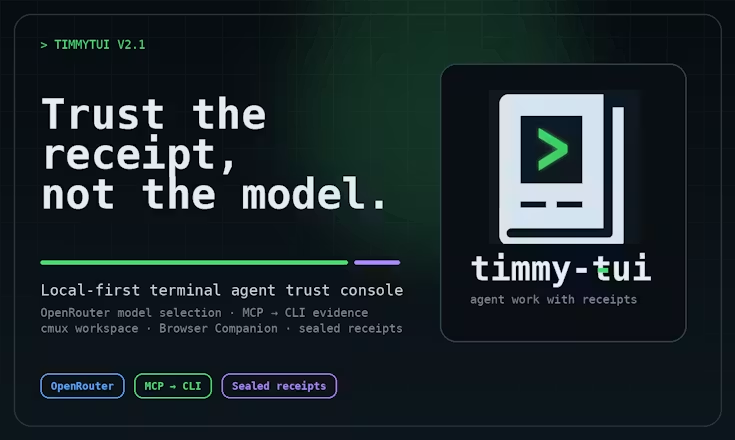
A new player has entered the arena of AI tools, promising a fresh approach to how professionals interact with their AI agents. Say hello to Timmy-TUI, a "local-first agent trust console with a safe local workspace" that recently made its debut on Product Hunt. This launch is creating a buzz, especially among freelancers and consultants who are constantly looking for ways to leverage AI while maintaining control and privacy over their sensitive data.
For those of us working with AI, the promise of an agent that can handle complex tasks is exciting. But the underlying concerns about data privacy, security, and the black-box nature of many cloud-based AI systems are very real. Timmy-TUI steps in to address these concerns head-on, offering a solution that puts the user back in the driver's seat by keeping AI operations right on your local machine.
What Exactly is a "Local-First Agent Trust Console"?
The core idea behind Timmy-TUI is straightforward yet powerful: it’s a terminal user interface (TUI) designed to manage and interact with your AI agents in a local environment. Think of it as a command center for your AI, but instead of relying on remote servers, everything happens on your computer. This "local-first" approach means your data stays on your machine, giving you unparalleled control and privacy. The "trust console" aspect implies a focus on transparency and oversight, allowing you to monitor your agents' actions and decisions closely.
In an age where data breaches and concerns about proprietary information being used for model training are common, a local-first solution is a breath of fresh air. It's a clear signal that developers are recognizing the growing demand for AI tools that respect user autonomy and data sovereignty. This is particularly relevant for freelancers and consultants who often handle confidential client information and cannot afford to expose it to third-party cloud services.
Why Does "Local-First" Matter for Your AI Workflow?
The shift towards local-first AI tools like Timmy-TUI isn't just a technical preference; it's a practical necessity for many. Here’s why this approach is gaining traction and what it means for you:
- Enhanced Privacy: This is arguably the biggest selling point. When your AI agents run locally, your sensitive data—whether it's client documents, proprietary code, or personal information—never leaves your machine. This eliminates the risk of data exposure through cloud service providers and gives you peace of mind. For consultants dealing with non-disclosure agreements, this is a game-changer.
- Uncompromised Security: By keeping operations local, you reduce your attack surface. You're not relying on the security infrastructure of a third-party, which can be a single point of failure. Instead, your AI agent operates within the secure confines of your own system. Tools like Timmy-TUI often incorporate sandboxing, creating isolated environments for agents to run, further enhancing security.
- Full Control and Transparency: A trust console implies that you have a clear view into what your AI agent is doing. Instead of a black box, you can monitor its thought process, tool usage, and proposed actions. This level of transparency is crucial for building confidence in your AI assistants and for debugging or refining their behavior.
- Offline Capability: Imagine being on a flight or in an area with unreliable internet. With local-first AI, your agents can continue working without interruption. This ensures consistent productivity, regardless of your network connectivity. For professionals who travel or work remotely, this is a significant advantage.
- Cost-Effectiveness: Running AI models and agents in the cloud often incurs API costs, which can quickly add up, especially with extensive use. Local-first solutions, particularly those that integrate with open-source local Large Language Models (LLMs) like those mentioned in discussions around local AI, can drastically reduce or even eliminate these ongoing expenses, making AI more accessible and sustainable for individual professionals and small businesses.
- Performance and Customization: While cloud resources offer scalability, local hardware, especially modern machines with powerful CPUs and GPUs, can run many smaller, specialized AI models at impressive speeds. This also allows for deep customization of models and tools to fit your exact workflow, something that's often restricted in multi-tenant cloud environments.
Expected Features of Timmy-TUI
While specific, exhaustive feature lists for Timmy-TUI are not yet widely available beyond its Product Hunt description, we can infer a range of capabilities that a "local-first agent trust console with a safe local workspace" would likely offer, based on the current landscape of AI agent development:
-
Secure Local Workspace Environment:
- Sandboxing: Agents likely operate within isolated environments to prevent malicious or erroneous actions from affecting your core system. This means any code executed by the AI agent is contained and its access to your files and network is strictly controlled.
- Permission Controls: Granular control over what your AI agent can access and modify on your local machine. You might be able to explicitly approve or deny file access, network requests, or specific tool executions.
-
Agent Management and Orchestration:
- Agent Lifecycle Management: Tools to easily start, stop, pause, and resume your AI agents.
- Task Routing: The ability to direct different tasks to specialized agents, or to orchestrate multi-step workflows where agents collaborate.
- Monitoring and Logging: A clear interface to observe agent activity, decision-making processes, and output in real-time. This is key to the "trust console" aspect, ensuring you understand and can audit what your AI is doing.
-
Local LLM Integration:
- Support for On-Device Models: Compatibility with various open-source Large Language Models (LLMs) that can be run directly on your hardware, such as those compatible with Ollama. This allows you to choose models optimized for speed, size, or specific tasks, without cloud dependencies.
- No API Costs: By running models locally, you eliminate reliance on external APIs, meaning no per-token charges or subscription fees for model inference.
-
Interactive Terminal User Interface (TUI):
- Command-Line Interaction: A responsive and efficient text-based interface for interacting with agents, ideal for developers and power users who prefer keyboard-driven workflows.
- Clear Status and Output: Well-structured display of agent progress, task status, and system metrics within the terminal.
-
Data Handling and Memory:
- Persistent Memory: Agents should be able to remember past interactions and learned information across sessions, allowing for more coherent and effective long-term assistance.
- Context Management: Advanced features for managing the context provided to the LLM, ensuring relevance and preventing "forgetting" important details in longer conversations.
Who Benefits Most from Timmy-TUI? Freelancers and Consultants
The target audience for a tool like Timmy-TUI is clear: professionals who need powerful AI assistance but also demand high standards of privacy, security, and control. This includes a large segment of freelancers and consultants across various industries:
- Independent Developers & Software Consultants: For those writing code, debugging, or automating development tasks, Timmy-TUI offers a secure sandbox for AI agents to operate. It means you can let an AI agent analyze proprietary code or test scripts without uploading potentially sensitive intellectual property to a third-party cloud. The ability to integrate with local LLMs also means a more cost-effective development cycle.
- Data Analysts & Researchers: Handling sensitive datasets is a daily reality. A local-first agent ensures that data analysis, report generation, or research summarization can be performed with AI without compromising data confidentiality. This is crucial for compliance with data protection regulations.
- Content Creators & Marketing Strategists: While creative tasks might seem less "sensitive," client briefs, campaign strategies, and early-stage content drafts are often confidential. Timmy-TUI allows AI to assist with brainstorming, content generation, and market analysis in a private environment, protecting client strategies.
- Legal & Financial Professionals: These fields are inherently sensitive. A local AI agent can assist with document review, contract analysis, or financial modeling while ensuring that highly confidential legal or financial data remains strictly on-premises. The "trust console" provides an audit trail for AI actions, which can be important for compliance.
- Anyone Concerned About Data Sovereignty: Beyond specific professions, any individual or small business that values owning their data and controlling its processing will find Timmy-TUI's local-first approach appealing. It empowers users to decide where their data lives and how it's used.
The Significance of Timmy-TUI's Launch
Timmy-TUI's launch on Product Hunt is more than just the debut of another AI tool; it represents a growing trend in the AI landscape. It highlights a maturing understanding that not all AI needs to live in the cloud, and that for many use cases, local execution offers superior benefits in terms of privacy, security, and user control. This movement is being driven by advancements in local hardware (like Apple's M-series chips and powerful consumer GPUs) and the increasing sophistication of open-source language models that can run efficiently on these devices.
As AI agents become more autonomous and capable of complex actions, the need for transparent, controllable, and secure environments becomes paramount. Tools like Timmy-TUI are at the forefront of this evolution, empowering users to integrate AI into their workflows responsibly and confidently.
Getting Started with Timmy-TUI
Since Timmy-TUI is a new launch, the best place to find the most up-to-date information, including installation instructions, detailed features, and community discussions, is its official Product Hunt page. The Product Hunt community often provides valuable insights, feedback, and direct engagement with the makers, which can be a great resource for early adopters.
As a local-first TUI, installation will likely involve command-line steps, potentially downloading a binary or cloning a GitHub repository if it's open-source. Keep an eye on the Product Hunt discussion for links to official documentation or community support channels.
Looking Ahead
The emergence of tools like Timmy-TUI points to an exciting future for AI. We're moving beyond generic chatbots to specialized, secure, and user-controlled AI assistants. For freelancers and consultants, this means the ability to harness the power of AI for automation, research, and creative tasks, all while maintaining the highest standards of data privacy and operational integrity. Timmy-TUI is a welcome addition to the AI toolkit, offering a robust foundation for building trust in our increasingly AI-driven workflows.