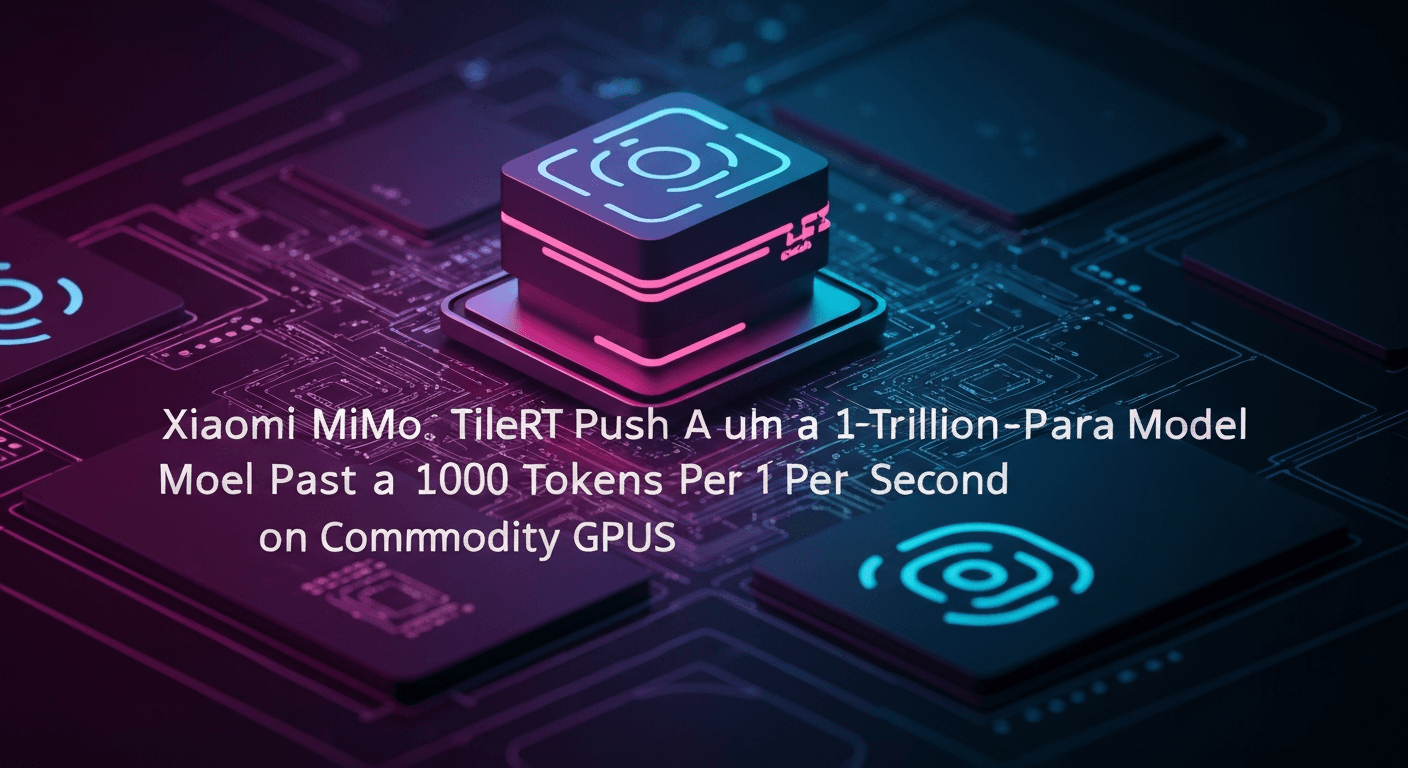
In the fast-paced world of artificial intelligence, breakthroughs happen constantly. But some news truly stands out, hinting at big changes for how we use and build AI. Recently, Xiaomi's MiMo team, working with TileRT, announced something pretty remarkable: they pushed a massive 1-trillion-parameter AI model to decode over 1000 tokens per second using just a single server with 8 standard GPUs. This isn't just a technical achievement; it's a game-changer for making powerful AI more accessible and affordable.
The Big Picture: What Did Xiaomi and TileRT Really Do?
Let's break down what this means. Imagine you're talking to an AI, like a very smart chatbot. When you type a question, the AI thinks and then generates an answer, word by word, or more accurately, token by token. A "token" can be a word, part of a word, or even a punctuation mark. The speed at which the AI can generate these tokens is called its "decoding speed" or "inference speed."
Xiaomi and TileRT, with their MiMo-V2.5-Pro-UltraSpeed serving mode for the MiMo-V2.5-Pro model, achieved an incredible milestone: more than 1000 tokens per second. To put that in perspective, a typical human reads around 200-300 words per minute. If each token is roughly a word, 1000 tokens per second is like the AI spitting out text faster than anyone could possibly read it in real-time. This speed is achieved on an enormous 1-trillion-parameter model.
The crucial part? They did this on a "commodity GPU node." This means they weren't using super-specialized, custom-built hardware that costs a fortune. They used standard, off-the-shelf GPUs that you might find in a high-end server. This detail is incredibly important because it means this kind of performance isn't just for a select few with unlimited budgets; it could become much more widespread.
Why Is This Speed a Game Changer for AI?
Running large AI models, especially those with billions or even trillions of parameters, is incredibly demanding. Historically, it has required huge data centers, vast amounts of power, and very expensive specialized hardware. This has created a bottleneck, limiting who can develop, deploy, and even experiment with these powerful AIs.
The Cost Problem
One of the biggest hurdles for deploying large language models (LLMs) has always been the cost of inference. Every time you ask an AI a question, it costs money in terms of computing power. If an AI is slow, it ties up expensive GPUs for longer, driving up operational costs significantly. Imagine running a popular AI service where millions of users are asking questions. If each response takes several seconds to generate, the amount of hardware needed to serve everyone simultaneously quickly becomes astronomical.
By achieving 1000 tokens per second, Xiaomi and TileRT are dramatically reducing the computational time per user interaction. This directly translates to lower costs for businesses and developers who want to use these powerful models. It means you can serve more users with less hardware, making AI applications much more economically viable.
Real-Time AI Applications
Many exciting AI applications require near-instant responses. Think about:
- Live Customer Support: Chatbots need to respond instantly to keep conversations flowing naturally.
- Voice Assistants: When you talk to an AI like Siri or Alexa, you expect an immediate answer. Delays are frustrating.
- Real-time Content Generation: Tools that help writers, coders, or designers need to keep up with their creative flow, providing suggestions or completing tasks without noticeable lag.
- Interactive Simulations and Games: AI characters or environments could become much more dynamic and responsive.
Previous slower speeds made some of these real-time interactions clunky or impossible with truly large, capable models. This new speed opens the door for a much smoother, more natural experience across a wide range of interactive AI tools.
Democratizing Access to Powerful AI
When powerful AI models are cheaper and easier to run on standard hardware, it lowers the barrier to entry for everyone. Smaller companies, independent developers, and even academic researchers can now potentially work with state-of-the-art models without needing access to supercomputers or massive cloud budgets. This can foster innovation and lead to a more diverse ecosystem of AI applications and ideas.
Understanding the Technology: MiMo-V2.5-Pro and TileRT
While the exact technical details of MiMo-V2.5-Pro-UltraSpeed are proprietary, we can infer some general principles based on what's known about optimizing LLM inference.
Xiaomi MiMo: The Model and Its Ecosystem
Xiaomi's MiMo likely refers to a suite of large language models and the systems designed to run them efficiently. "MiMo-V2.5-Pro" suggests a specific, highly capable model version. The "UltraSpeed" part indicates a focus on maximizing inference speed. Building a 1-trillion-parameter model is a monumental task in itself, requiring vast datasets, computational power for training, and sophisticated architectural design. The challenge then shifts to making that behemoth model perform practically once it's trained.
TileRT: The Engine for Speed
TileRT appears to be a crucial optimization layer or runtime environment. Its job is to take a large model like MiMo-V2.5-Pro and make it run as fast as possible on the available hardware. This involves a lot of clever engineering, often at a very low level, directly interacting with the GPU hardware.
Some of the techniques a system like TileRT might employ include:
- Efficient Memory Management: LLMs consume enormous amounts of memory, especially for the "key-value (KV) cache" which stores past computations to speed up future token generation. TileRT likely uses advanced techniques to manage this memory more effectively, reducing wasted space and speeding up access.
- Quantization: This is a method of reducing the precision of the numbers used in the model (e.g., from 32-bit floating point to 8-bit integers). This makes the model smaller and faster to compute, often with minimal impact on accuracy.
- Custom Kernel Development: GPUs are powerful but need specific instructions to perform computations efficiently. TileRT likely uses highly optimized, custom-written GPU "kernels" (small programs) that are tailored for the specific operations of the MiMo model, getting the most out of the hardware.
- Parallel Processing and Distribution: Even on a single node with multiple GPUs, distributing the workload effectively is key. TileRT would manage how different parts of the model or different user requests are split across the 8 GPUs to maximize parallel computation.
- Batching Strategies: Instead of processing one user's request at a time, GPUs can be much more efficient if they process several requests (a "batch") simultaneously. TileRT would likely have sophisticated batching algorithms to maximize throughput without excessively increasing latency for individual users.
- Speculative Decoding: This advanced technique involves using a smaller, faster "draft" model to predict a sequence of tokens quickly. Then, the large, powerful model only needs to verify these predictions, which is much faster than generating them from scratch. If the predictions are good, it's a huge speedup.
The Significance of "Commodity GPUs"
The term "commodity GPUs" is a critical part of this announcement. It means that this performance isn't locked behind specialized, expensive hardware like NVIDIA's H100 or A100 GPUs, which can cost tens of thousands of dollars each. While those high-end GPUs offer incredible performance, their cost makes them inaccessible for many. By achieving this on more standard, widely available GPUs (e.g., consumer-grade gaming GPUs or older professional cards often used in server racks), Xiaomi and TileRT are showing that top-tier AI performance can be achieved without breaking the bank on hardware. This significantly broadens the potential user base and deployment scenarios for such powerful models.
Looking Ahead: The Future Impact
This breakthrough by Xiaomi and TileRT isn't just a number on a benchmark; it represents a tangible step towards making advanced AI more pervasive and practical. Here's what we might expect:
- More Powerful Edge AI: Imagine truly intelligent assistants running on your phone, smart home devices, or even in your car, capable of complex reasoning without needing to constantly send data to the cloud. This speed makes that vision much closer to reality.
- Innovative AI Services: Startups and developers can now build AI-powered products that were previously too expensive or too slow to be viable. This could lead to a wave of new applications across various industries.
- Research Acceleration: Researchers can iterate faster on model development and experimentation, leading to quicker advancements in AI capabilities.
- Reduced Carbon Footprint: More efficient AI inference means less energy consumption per AI task, which is a positive step for sustainability in the increasingly energy-hungry AI industry.
The ability to run a 1-trillion-parameter model at over 1000 tokens per second on commodity hardware is a clear signal that the race for AI efficiency is just as important as the race for AI capability. As models grow larger and more powerful, the focus on making them run faster and cheaper will define the next era of AI innovation. Xiaomi and TileRT have just shown us a very exciting glimpse into that future.