Key Takeaways
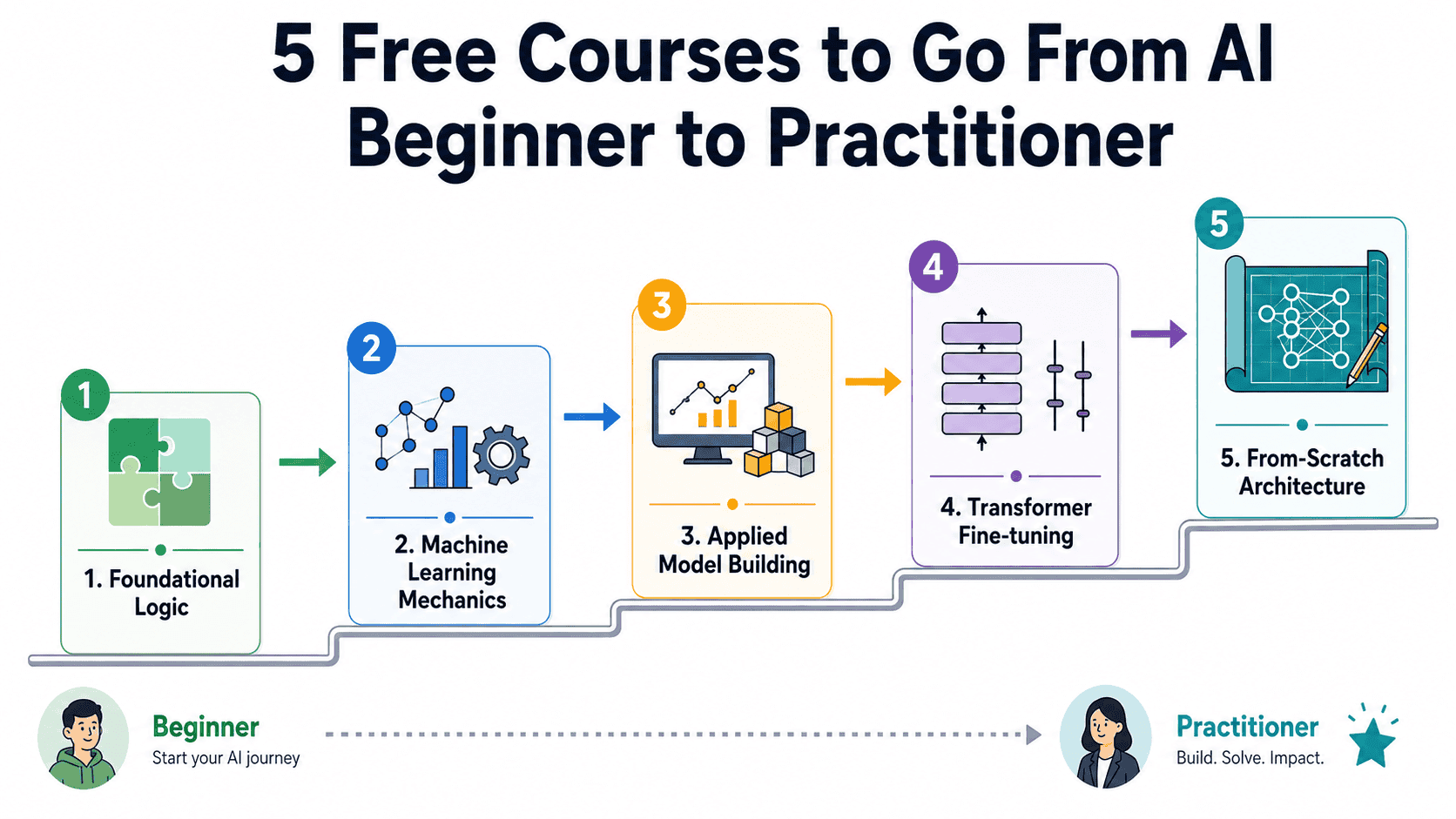
- Embark on a free, structured five-course journey designed to take you from foundational AI concepts to practical Large Language Model (LLM) application development.
- The roadmap covers essential Python programming, classical machine learning, deep learning fundamentals, core LLM understanding, advanced prompt engineering, and hands-on LLM fine-tuning.
- Access high-quality, free educational content from leading institutions and tech companies like Google, DeepLearning.AI, Cohere, Great Learning Academy, and Hugging Face.
- Gain real-world skills crucial for becoming an AI practitioner, enabling you to build, deploy, and work with modern AI systems and LLMs effectively.
Your Free Roadmap to Becoming an AI Practitioner: From Basics to LLMs
The world of Artificial Intelligence is moving at an incredible pace, with Large Language Models (LLMs) like Gemini, ChatGPT, and Claude leading the charge. For many, the idea of entering this field, or even just understanding it, can feel overwhelming. Where do you start? How do you move from a complete beginner to someone who can actually build and work with these powerful AI systems? Good news: you don't need to break the bank to get started. There's a wealth of high-quality, free educational resources available that can guide you through a comprehensive learning path. This article outlines a five-course roadmap specifically curated to take you from foundational AI concepts and classical algorithms all the way to understanding and practically working with LLMs, including the principles of training and fine-tuning. This isn't just a random collection of links; it's a structured progression designed for aspiring AI practitioners and developers who want to build real skills. Let's dive into the courses that will equip you for the AI-driven future.Why This Roadmap Matters for AI Practitioners
The demand for AI skills, particularly in areas touching on Large Language Models and generative AI, is soaring. Companies across industries are looking for professionals who can leverage these technologies to innovate, automate, and solve complex problems. Whether you're a software developer looking to pivot, a data analyst wanting to expand your toolkit, or a tech-savvy individual passionate about AI, a structured learning path is essential.
This roadmap addresses a critical need: bridging the gap between theoretical understanding and practical application. Many introductory AI courses exist, but few offer a clear, free progression that culminates in advanced LLM concepts. By following these carefully selected courses, you will:
- Build a Strong Foundation: Understand the core programming and mathematical concepts that underpin AI.
- Grasp Classical ML: Learn the algorithms that form the bedrock of many AI applications.
- Understand Deep Learning: Get familiar with neural networks, the engine behind modern AI.
- Master LLM Fundamentals: Comprehend how LLMs work, their capabilities, and their limitations.
- Develop Practical Skills: Learn prompt engineering, how to build applications with LLMs, and even how to fine-tune pre-trained models for specific tasks.
- Prepare for the Future: Stay relevant in a rapidly evolving tech landscape by acquiring sought-after skills.
Each course in this roadmap is free, widely recognized, and offers valuable insights from leading experts and institutions in the AI field.
The 5-Course Roadmap: Your Journey to AI Practitioner
Course 1: AI/ML Foundations with Python
Before diving deep into complex AI models, a solid grasp of programming fundamentals, especially Python, and basic machine learning concepts is crucial. This foundational course sets the stage for everything that follows.
- Official Course Name: Free Artificial Intelligence (AI) Courses Online
- Provider/Developer: Great Learning Academy
- Key Topics: This collection of free courses offers a comprehensive introduction to AI awareness, Machine Learning (ML) basics, neural networks, Python programming, data wrangling, data visualization, and statistics. It covers essential ML algorithms, model training, and evaluation.
- Approximate Duration: Varies depending on the specific courses taken within the academy, but typically ranges from a few hours to several weeks for a foundational understanding.
- Prerequisites: None. Designed for beginners.
- Why it Matters: Python is the lingua franca of AI and machine learning. Understanding its syntax, libraries (like Pandas and NumPy for data manipulation), and core ML concepts (like supervised vs. unsupervised learning) is non-negotiable for any aspiring AI practitioner. This course provides the necessary groundwork before tackling more advanced topics.
- Official Course Link: You can explore their offerings at Great Learning Academy AI Courses.
Course 2: Introduction to Generative AI
Once you have your programming and basic ML foundations, it's time to understand the broader landscape of Generative AI, which LLMs are a part of. This course provides a high-level yet informative overview.
- Official Course Name: Introduction to Generative AI
- Provider/Developer: Google Cloud
- Key Topics: This learning path includes microlearning courses explaining the basics of Generative AI, Large Language Models (LLMs), and responsible AI. It covers what Generative AI is, its applications, how it differs from traditional machine learning, LLM use cases, and techniques to enhance LLM performance.
- Approximate Duration: Self-paced, typically a few hours for the entire learning path.
- Prerequisites: Basic understanding of AI concepts (covered in Course 1 is beneficial but not strictly mandatory for this introductory overview).
- Why it Matters: This course serves as an excellent bridge from general AI to the specifics of generative models. It demystifies the core concepts of LLMs and how they fit into the broader Generative AI ecosystem, preparing you for deeper dives.
- Official Course Link: Access this free course through Google Cloud Skills Boost.
Course 3: Introduction to Large Language Models (LLMs)
With a general understanding of Generative AI, this course zooms in specifically on LLMs, covering their foundations and initial practical applications.
- Official Course Name: Introduction to Large Language Models
- Provider/Developer: Google
- Key Topics: This introductory-level course combines LLM foundations and the basics of prompt engineering. It's suitable for both end-users of LLM applications and those interested in a gentle introduction to the technology underlying these models.
- Approximate Duration: Approximately 30 minutes.
- Prerequisites: None, but a general interest in AI is helpful.
- Why it Matters: This quick yet impactful course provides a focused introduction to what LLMs are, how they work at a high level, and the fundamental concept of prompt engineering. It's an ideal starting point for anyone looking to understand the mechanics and initial interactions with LLMs.
- Official Course Link: You can find this course as part of Google's Generative AI offerings, often linked through Coursera or Google Cloud Skills Boost.
Course 4: Practical LLM Application Development with Cohere's LLM University
Moving beyond the basics, this course provides a more in-depth, hands-on approach to building with LLMs, covering crucial techniques for practical application.
- Official Course Name: LLM University (LLMU)
- Provider/Developer: Cohere
- Key Topics: LLM University is a comprehensive learning hub designed to help developers and technical professionals master LLMs and Generative AI. It offers hands-on modules covering key topics such as transformer architecture, embeddings, semantic search, prompt engineering, fine-tuning, and deploying LLMs in production environments. Practical modules also include step-by-step tutorials on building Retrieval Augmented Generation (RAG)-based chatbots and multi-turn AI agents.
- Approximate Duration: Self-paced, typically several hours to complete all modules.
- Prerequisites: A basic understanding of LLMs (from Course 3) and Python programming (from Course 1) is highly recommended.
- Why it Matters: This course is a significant step towards becoming an LLM practitioner. It moves from theoretical understanding to practical implementation, showing you how to build real-world applications using techniques like RAG, which are essential for making LLMs more accurate and context-aware.
- Official Course Link: Explore the curriculum and start learning at Cohere's LLM University.
Course 5: Advanced LLM Concepts: Transformers, Fine-tuning, and the Hugging Face Ecosystem
To truly go from beginner to practitioner, understanding the underlying architecture of LLMs (Transformers) and how to adapt them through techniques like fine-tuning is invaluable. The Hugging Face ecosystem is central to working with open-source LLMs.
- Official Course Name: Hugging Face NLP Course
- Provider/Developer: Hugging Face
- Key Topics: This course teaches you how to use the Hugging Face ecosystem, including Transformers, Datasets, and Tokenizers libraries. It covers foundational models, prompt engineering, embeddings, and more advanced topics like fine-tuning open-source LLMs for specific tasks. It also explores building AI agents and context engineering.
- Approximate Duration: Self-paced, often taking dozens of hours for comprehensive coverage.
- Prerequisites: Strong Python skills, understanding of deep learning fundamentals, and prior exposure to LLM concepts (as covered in previous courses).
- Why it Matters: This course is the capstone for aspiring practitioners. It equips you with the skills to work directly with state-of-the-art open-source LLMs. Understanding Transformers is key to comprehending how LLMs generate text, and fine-tuning allows you to adapt these powerful models to your specific data and use cases, moving you closer to the "training LLMs from scratch" concept by enabling you to customize and specialize existing models.
- Official Course Link: Start your advanced LLM journey at the Hugging Face Course.
What This Roadmap Means for AI Practitioners and Freelancers
For AI practitioners, developers, and even freelancers looking to integrate AI into their services, this roadmap offers a clear, actionable path. By completing these free courses, you'll gain:
- Technical Proficiency: The ability to write Python code for AI, understand machine learning pipelines, and work with deep learning frameworks.
- LLM Expertise: A deep understanding of how LLMs function, how to prompt them effectively, and how to integrate them into applications.
- Competitive Edge: Skills in fine-tuning and leveraging open-source LLMs, which are highly valued in the current job market.
- Project Readiness: The confidence and knowledge to start building your own AI projects, whether it's a chatbot, a content generation tool, or a data analysis assistant.
This journey will empower you to not just use AI tools, but to understand, build, and adapt them, making you a truly capable AI practitioner ready to tackle real-world challenges.
Frequently Asked Questions
Are these courses truly free?
Yes, all the courses listed in this roadmap are available for free. Some platforms might offer paid certificates or premium features, but the core learning content for each course is accessible without cost.
How long will it take to complete this entire roadmap?
The total time depends heavily on your prior experience and the number of hours you can dedicate each week. Conservatively, if you dedicate 5-10 hours a week, you could potentially complete this roadmap within 3-6 months. Some courses are short introductions, while others, like the Hugging Face course, are much more in-depth.
Do I need a strong math background to start?
While a strong mathematical background (linear algebra, calculus, probability) is beneficial for a deep theoretical understanding of AI, these introductory courses are designed to be accessible. Course 1 will cover some necessary statistical foundations. You can always deepen your math knowledge as you progress, but it's not a strict barrier to entry for starting this roadmap.
Will these courses teach me how to build an LLM from scratch like ChatGPT?
"Training an LLM from scratch" typically refers to building a foundational model with billions of parameters, which requires immense computational resources and expertise, usually undertaken by large research labs. This roadmap will teach you the principles behind LLMs, how they are constructed (via Transformers), and critically, how to fine-tune existing open-source LLMs for specific tasks. This practical skill of fine-tuning and adapting models is what most AI practitioners do in the real world, and it's a significant step beyond just using pre-trained models.