Key Takeaways
- Batching inputs by length is a critical optimization for Small Language Models (SLMs) to significantly boost inference speed and efficiency.
- Processing inputs one by one or using naive batching with excessive padding wastes computational resources, especially on hardware like CPUs or GPUs.
- Grouping requests with similar token lengths into batches minimizes padding, leading to better GPU utilization, faster throughput, and reduced operational costs.
- Tools like Hugging Face Transformers provide mechanisms such as
DataCollatorWithPaddingand custom collators to implement dynamic, length-based batching.
Optimizing Small Language Models: Why Batching by Length is a Game Changer
Small Language Models (SLMs) are becoming increasingly vital in the AI landscape. Unlike their larger, resource-intensive counterparts (LLMs), SLMs are designed for efficiency, specialization, and deployment in resource-constrained environments such as edge devices, mobile apps, or local machines. They offer a balance of capability and operational cost, making them ideal for focused tasks. However, even with their inherent efficiency, getting the most out of SLMs requires smart optimization techniques. One such powerful technique, often overlooked or implemented sub-optimally, is batching inputs by length instead of simply processing them one by one. This approach targets a fundamental inefficiency in how transformer models, the backbone of most SLMs, handle variable-length inputs. By intelligently grouping similar-length sequences, we can drastically reduce wasted computation and unlock significant performance gains. This deep dive will explain why this matters, how it works, and what it means for AI practitioners.The Efficiency Imperative for Small Language Models
SLMs, by definition, are built with fewer parameters and simpler neural architectures compared to LLMs, typically ranging from a few million to several billion parameters. This compact size allows for faster training, reduced energy consumption, and deployment on devices with limited resources. Yet, even a "small" model can be inefficient if its inference pipeline isn't optimized. When you're serving potentially thousands or millions of requests, every millisecond and every watt counts. The core problem we're addressing here arises from how neural networks, especially transformer-based models, process sequences of text. These models expect inputs of a uniform shape. When you have multiple text inputs that vary in length (which is almost always the case in real-world scenarios), they need to be "padded" to the same length before being fed to the model in a batch. Padding involves adding special tokens (like `[PAD]`) to the end of shorter sequences until they match the length of the longest sequence in the batch or a predefined maximum length.The Pitfall of Item-by-Item Looping and Naive Batching
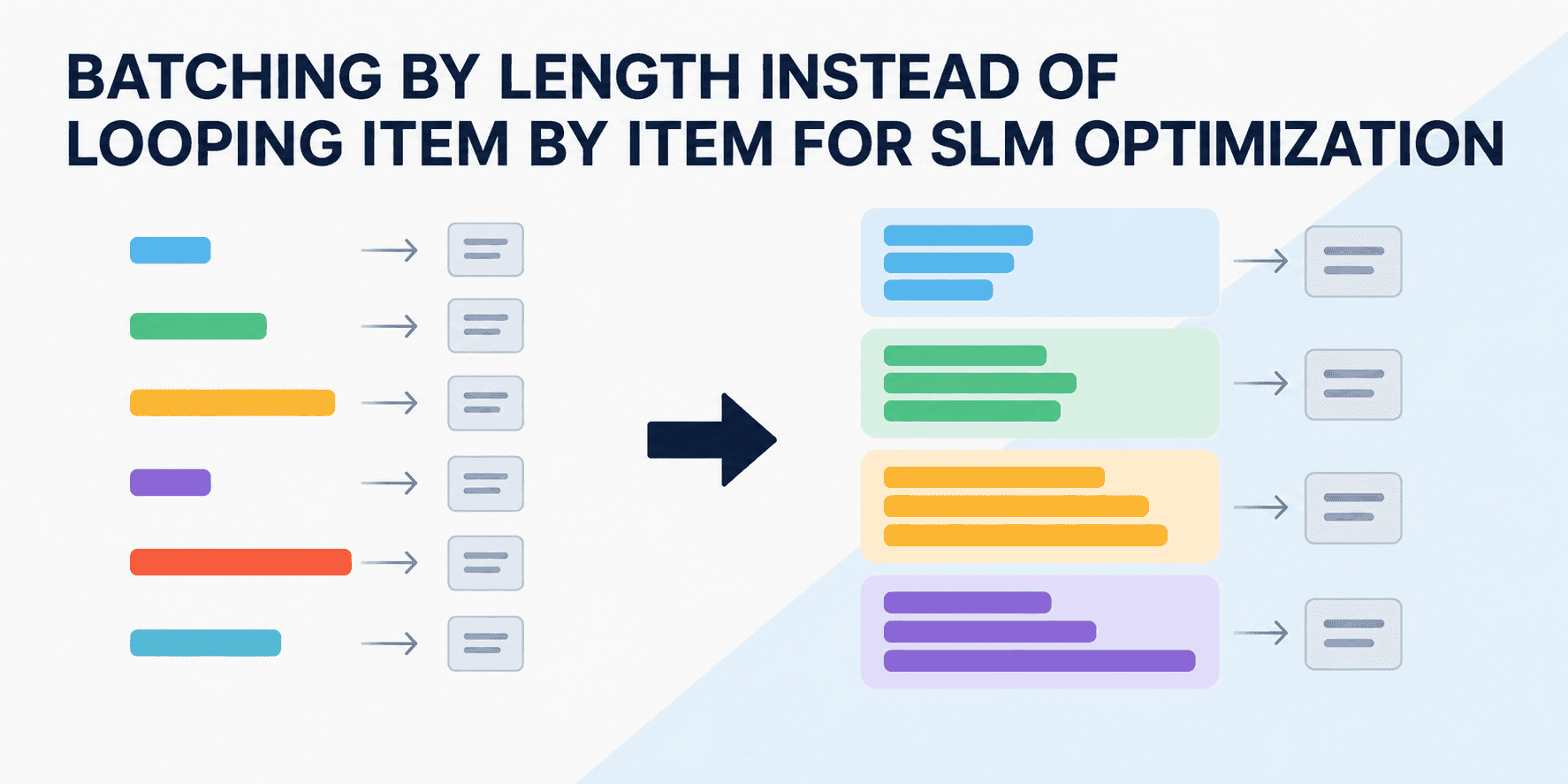
Let's consider two common, but inefficient, ways to handle inference:- Looping Item by Item (Batch Size 1): This is the simplest approach. You take each incoming request, prepare it (tokenize, add special tokens), and pass it through the model. Then you repeat for the next request. The problem? Modern hardware, especially GPUs (and even CPUs for smaller models), is designed for parallel processing. Processing a single item at a time means the hardware's computational units sit mostly idle between operations. The model's weights are streamed out of memory for one sequence, then again for the next, leading to significant memory bandwidth bottlenecks rather than compute bottlenecks.
- Naive Static Batching: A step up from item-by-item, this involves grouping a fixed number of requests into a batch. This helps amortize the overhead of loading model weights across multiple sequences. However, if you simply batch requests as they arrive, you'll often end up with batches where sequence lengths vary wildly. To make them uniform, all sequences must be padded to the length of the longest sequence in that batch. If your dataset has a "long tail" of very long sequences mixed with many short ones, a substantial portion of your computation will be spent processing padding tokens, which are essentially meaningless data. This wastes memory and compute cycles, hindering throughput.
The Solution: Batching by Length (Dynamic Batching with Bucketing)
The core idea behind batching by length is to minimize the wasted computation caused by padding. Instead of just grouping arbitrary inputs, we intelligently group inputs that have similar token lengths. This is a form of dynamic batching, where the batch size and composition can change based on the characteristics of the incoming data. Here's how it generally works: 1.Tokenization and Length Calculation
Each incoming text request is first tokenized, and its effective token length is determined. 2.Sorting or Bucketing
Instead of immediately forming batches, requests are either:- Sorted by Length: All pending requests are sorted by their token length. Then, batches are formed by taking a contiguous block of these sorted requests. This ensures that most items within a batch will have similar lengths.
- Bucketed by Length: Requests are placed into "buckets" based on predefined length ranges (e.g., 0-50 tokens, 51-100 tokens, 101-200 tokens, etc.). When enough requests accumulate in a bucket, a batch is formed from that bucket. This strategy helps reduce padding overhead and optimizes GPU memory usage.
Dynamic Padding within Batches
Once a batch is formed (containing similarly sized sequences), padding is applied, but only up to the length of the longest sequence within that specific batch. This is in contrast to static padding, which pads all sequences to a global maximum length regardless of the batch content. This "smart batching" or "length-bucketed batching" approach means that if you have a batch of sequences all around 50 tokens long, they will only be padded to 50 tokens. A separate batch of sequences all around 200 tokens long will be padded to 200 tokens. This significantly reduces the amount of padding tokens processed.Benefits of Length-Based Batching for SLMs
Implementing this optimization yields several critical advantages:- Increased Throughput: By minimizing padding, the GPU spends more of its cycles processing actual data rather than empty tokens. This directly translates to more requests processed per unit of time. Companies like Anthropic have seen significant increases in inference throughput (e.g., 37% for Claude 2) by implementing dynamic batching.
- Improved GPU/CPU Utilization: Hardware resources are kept busier and utilized more effectively, reducing idle time. This is especially important for SLMs often deployed on less powerful or consumer-grade hardware like CPUs or integrated GPUs where every bit of efficiency matters.
- Reduced Memory Footprint: Less padding means smaller tensors are passed to the model, which can save valuable GPU memory. This allows for larger effective batch sizes or for serving more models concurrently.
- Lower Operational Costs: Better utilization and higher throughput mean you can serve more requests with the same hardware, or achieve the same performance with less expensive hardware, directly cutting down operational expenses.
- Faster Inference Latency (for individual requests within a batch): While dynamic batching can introduce a slight queuing delay to form optimal batches, for overall system performance, it can lead to faster average response times by reducing the processing time per batch.
Practical Implementation Considerations
For AI practitioners working with SLMs, implementing length-based batching often involves leveraging existing deep learning frameworks and libraries.Hugging Face Transformers
The Hugging Face `transformers` library, a popular choice for working with language models, provides excellent tools for this. The `DataCollatorWithPadding` class is designed to handle dynamic padding. When used with a `DataLoader`, it ensures that sequences within each batch are padded only to the longest sequence in that specific batch, not to a global maximum. To implement length-based batching more explicitly, you typically:- Tokenize your dataset and store the input IDs and attention masks.
- During dataset creation or before creating the `DataLoader`, sort your dataset by the length of the input IDs.
- Use a custom `DataLoader` or a `DataCollator` that can handle the sorted data and apply dynamic padding. Hugging Face's `Trainer` API, for instance, allows you to specify a `DataCollator` which can then handle dynamic padding.
PyTorch and TensorFlow
Both PyTorch and TensorFlow offer the flexibility to implement custom data loading and batching strategies. You can create custom `Dataset` and `DataLoader` classes (in PyTorch) or `tf.data` pipelines (in TensorFlow) that:- Calculate sequence lengths.
- Group sequences into buckets based on their lengths.
- Apply padding dynamically to the longest sequence within each bucket-derived batch.
Advanced Batching Techniques
Beyond simple length-based batching, more sophisticated techniques exist, especially for LLM inference, which can also apply to SLMs:- Continuous Batching (In-Flight Batching): This is a more advanced scheduling technique where the batch composition changes dynamically at each decoding iteration. As soon as a sequence finishes generating tokens, it's ejected from the batch, and a new request takes its place. This maximizes GPU occupancy and is particularly effective for highly variable output lengths. Frameworks like vLLM, SGLang, and TensorRT-LLM support this.
- Memory-Based Batching: This technique batches requests based on their actual key-value cache memory consumption rather than just count or length. This ensures optimal memory usage and prevents out-of-memory errors, especially with varying prompt lengths and generation limits.
What This Means for AI Practitioners
For anyone deploying or working with Small Language Models, understanding and implementing efficient batching strategies is not just an optional improvement; it's a necessity for optimal performance and cost-effectiveness.- Developers: When building applications powered by SLMs, prioritize data loading and batching. Don't just rely on default `DataLoader` behavior if your input sequences have variable lengths. Look into `DataCollatorWithPadding` in Hugging Face or implement custom bucketing logic.
- ML Engineers: When optimizing SLM inference endpoints, measure the impact of different batching strategies. Profile your model to identify bottlenecks, which are often related to data movement and padding overhead.
- Researchers: Be mindful of how your experimental setup handles batching. Inefficient batching can mask the true performance of your SLM or lead to misleading benchmark results.
Frequently Asked Questions
What is a Small Language Model (SLM)?
A Small Language Model (SLM) is a type of AI language model designed to understand and generate human language, similar to larger models (LLMs), but with significantly fewer parameters and simpler architectures. This makes them more efficient, faster, and suitable for deployment in resource-constrained environments or for specialized tasks.
Why is batching by length important for SLM optimization?
Batching by length is crucial because transformer models require inputs of uniform size. Without it, sequences of varying lengths must be padded to a common maximum length, which wastes computational resources on processing meaningless padding tokens. Grouping similar-length sequences into batches minimizes this padding, leading to higher GPU/CPU utilization, faster inference, and lower operational costs.
How does Hugging Face Transformers support length-based batching?
Hugging Face Transformers provides the DataCollatorWithPadding class, which dynamically pads sequences within a batch to the length of the longest sequence in that particular batch. For optimal length-based batching, practitioners often sort their datasets by sequence length before feeding them into a DataLoader along with this collator.
What are the practical benefits of implementing length-based batching?
The practical benefits include significantly increased inference throughput, better utilization of hardware (GPUs and CPUs), reduced memory consumption, and ultimately lower operational costs for running SLM-powered applications. It allows models to process more requests in less time without requiring more powerful or expensive hardware.