Key Takeaways
- The Model Context Protocol (MCP) is an open standard introduced by Anthropic in November 2024 to standardize how AI systems, particularly Large Language Models (LLMs), connect and interact with external tools, data sources, and applications.
- MCP acts as a universal adapter, similar to a USB-C for AI, enabling LLMs to access real-time data and perform actions without requiring custom integrations for every service.
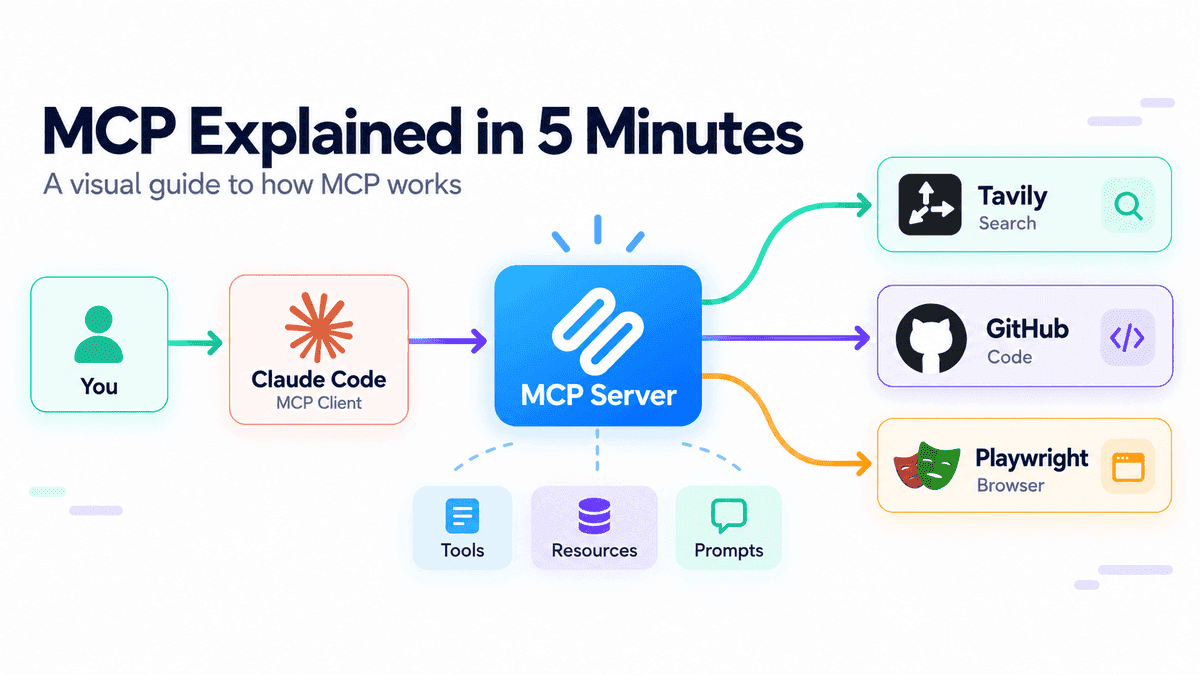
- It operates on a client-server model with three core components: MCP Hosts (AI applications like Claude Code), MCP Clients (within hosts, managing connections), and MCP Servers (external services exposing capabilities).
- MCP significantly enhances AI capabilities by allowing integration with tools like Claude Code, Tavily for web search, GitHub for repository operations, and Playwright for browser automation, fostering more dynamic and context-aware AI agents.
Unlocking AI's Full Potential: A Deep Dive into the Model Context Protocol (MCP)
In the rapidly evolving world of artificial intelligence, Large Language Models (LLMs) are becoming increasingly powerful. However, their true utility often hinges on their ability to interact with the real world – to access current information, execute actions, and integrate seamlessly with existing software ecosystems. This is where the Model Context Protocol (MCP) steps in, offering a standardized, open-source framework that bridges the gap between AI and external systems. If you've heard the buzz around AI agents, coding assistants, and advanced tool use, then understanding MCP is key to grasping the future of AI development.What is the Model Context Protocol (MCP)?
The Model Context Protocol (MCP) is an open standard and open-source framework, initially introduced by Anthropic in November 2024. Its primary goal is to standardize the way AI systems, especially Large Language Models (LLMs), integrate with and share data with external tools, systems, and diverse data sources. Think of MCP as a universal connector, akin to a USB-C port for AI applications. Instead of developers needing to build custom connectors for every single data source or tool – a challenge often referred to as the "N×M data integration problem" – MCP provides a common, plug-and-play system. This allows AI models to access live, real-world data, perform actions, and tap into specialized features that weren't part of their original training data. MCP is not just about tool execution; it creates a structured architecture that enables true interoperability between AI models, AI applications, and external systems, all while preserving the underlying APIs and business logic of those systems. It defines a standardized interface for various operations, including reading files, executing functions, and handling contextual prompts. Following its announcement, MCP quickly gained traction and was adopted by major AI providers, including OpenAI and Google DeepMind, cementing its role as a de facto standard for integrating LLMs with external systems.Why Does MCP Matter for AI Practitioners?
Before MCP, integrating an AI model with various external services often meant a complex, custom-built integration for each pairing. This created significant fragmentation and duplicated effort, making it difficult to scale truly connected AI systems. MCP addresses this by providing a universal protocol, allowing developers to implement MCP once in their AI agent and unlock an entire ecosystem of integrations. Here's why MCP is a game-changer for AI practitioners and developers:- Enhanced AI Utility and Automation: By enabling AI to connect to real-world services, MCP transforms AI from a static knowledge base into a dynamic, context-aware agent capable of complex actions. This includes tasks like updating customer records, querying databases with plain language, or running financial calculations.
- Improved Scalability and Maintainability: MCP eliminates the need for custom integrations, solving the "M x N problem." This reduces development overhead, simplifies maintenance, and makes it easier to scale AI applications across different tools and models.
- Reduced Hallucinations: By giving AI access to current, real-world data and tools, MCP significantly reduces the likelihood of AI "hallucinations" – instances where AI generates incorrect or fabricated information due to outdated or insufficient training data.
- Standardization and Interoperability: MCP provides a common language built on JSON-RPC 2.0 for LLMs to request data or trigger actions from any external service. This fosters interoperability, allowing AI agents built with different frameworks and by different providers to communicate and collaborate.
- Faster Development: Developers can focus on building core AI functionalities rather than wrestling with complex integration logic. MCP abstracts away these complexities, making it quicker to build multi-agent systems.
- Support for Stateful Workflows: Unlike traditional APIs that often handle isolated request-response interactions, MCP's client-server architecture supports bidirectional, stateful communication with streaming semantics. This enables AI tools to run multi-step workflows and allows servers to push updates directly into an AI agent's context loop, supporting partial results and more sophisticated tool usage patterns.
How Does MCP Work? The Client-Server Model
MCP's architecture is designed to be modular, scalable, and adaptable across various LLM applications and environments. At its core, MCP operates on a client-server model, facilitating secure access for LLMs to external context and tools without hard-wired integrations. The protocol distinguishes between three primary roles:- MCP Host: This is the environment where an AI model or agent operates. Examples include AI assistants, enterprise AI applications, integrated development environments (IDEs), or agent platforms like Claude Desktop or Claude Code. The host manages the overall session context and user interaction. It determines when external capabilities are needed and coordinates communication with MCP resources.
- MCP Client: A lightweight protocol client embedded within the MCP host. For each MCP server it needs to interact with, the MCP host creates a dedicated MCP client. This client maintains a one-to-one connection with its corresponding server and converts user requests into a structured format that the protocol can process. Typically, the client and host run on the same machine.
- MCP Server: This is the external service that provides context, data, or capabilities to the LLM. MCP servers expose a defined set of tools and resources that AI models can discover and call directly. These servers can be local or remote and can represent anything from a file system, a database, an API, or even another AI agent.
MCP in Action: Integrating with AI Tools
The true power of MCP becomes evident when you see how it integrates with popular tools and platforms, enabling AI agents to perform complex, real-world tasks. The feed item specifically highlights its use with Claude Code, Tavily, GitHub, and Playwright.Claude Code (LLM Integration)
Claude Code, an AI coding assistant, acts as an MCP host. With MCP, Claude Code can leverage external tools and data sources to enhance its coding capabilities. Instead of relying solely on its internal training data, it can dynamically access current information and execute actions. For example, Claude Code can use MCP to:- Generate more accurate code: By pulling live context from your development environment.
- Debug and test: By interacting with a live browser instance via Playwright MCP.
- Understand project specifics: By reading repository information from GitHub.
Tavily for Web Search and Retrieval
Language models often lack access to the most current information, as their training data has a cutoff. Tavily, an AI search API, solves this by providing tools for live web search, extraction, crawling, and research. When integrated via an MCP server, Claude Code (or any MCP-enabled AI) can use Tavily to:- Perform real-time web searches: For example, searching for the latest release notes of a library or summarizing recent industry news.
- Access up-to-date information: Allowing the AI to provide answers based on current events or rapidly changing data.
- Extract specific data: From web pages for analysis or summarization.
GitHub for Repository Workflows
GitHub, the ubiquitous platform for version control and collaboration, can also be integrated with MCP. An official GitHub MCP server transforms GitHub into a set of tools that an AI agent like Claude can directly interact with. Depending on permissions, an AI can use this integration to:- Read repositories: Accessing code, documentation, and project files.
- Search code: Finding specific functions, classes, or patterns within a codebase.
- Inspect commits, issues, and pull requests: Helping with code reviews, bug tracking, and understanding project history.
- Perform repository operations: Such as summarizing changes, creating branches, committing code, and submitting pull requests.
Playwright for Browser Automation and Testing
Some tasks require more than just API calls; they need direct browser interaction. Playwright, a powerful browser automation library, offers an MCP server that allows coding agents to drive a real browser instance. This is particularly impactful for testing and UI automation. With Playwright MCP, an AI can:- Navigate web pages: Opening URLs and moving between different sections of a website.
- Interact with elements: Clicking buttons, typing into input fields, and selecting options from dropdowns.
- Read the Document Object Model (DOM): Understanding the structure and content of a web page.
- Take screenshots: Capturing visual states of the browser.
- Generate and execute test actions: For example, generating a first draft of a test from a live page or debugging a broken selector.
Key Features and Concepts of MCP
Beyond the core client-server architecture, MCP brings several important features and concepts:- Capability Discovery: MCP allows AI agents to dynamically discover the tools and capabilities exposed by various MCP servers. This means an AI doesn't need to be pre-programmed with every possible tool; it can inquire and learn what's available.
- Structured Context Management: MCP provides a standardized way for applications to provide structured context to LLMs. This ensures that the information shared is relevant and optimized for AI reasoning, reducing serialization complexity.
- Bidirectional, Stateful Communication: Unlike simple request-response APIs, MCP supports persistent communication channels and stateful interactions, crucial for multi-step workflows where context needs to be maintained across multiple turns.
- Security and Governance: MCP is designed with security in mind, enabling secure connections and allowing for programmable policy enforcement that can account for geographic boundaries, regulatory requirements, and data classifications.
- Tool Composition and Code Execution: MCP allows for more efficient tool usage by enabling agents to write code to call tools. This means loops, conditionals, and error handling can be done with familiar code patterns, rather than chaining individual tool calls, which can consume excessive tokens.
What's New in MCP?
Since its introduction in November 2024, MCP has seen continuous development and adoption. The "what is new" aspect often refers to ongoing refinements that make connections easier to scale and better suited for production environments. This includes:- Improved Token Efficiency: Techniques like code execution with MCP help agents use context more efficiently by loading tools on demand and filtering data before it reaches the model, reducing token consumption.
- Enhanced Multi-Agent Orchestration: MCP is increasingly serving as the execution backbone for multi-agent AI systems, enabling complex collaborations where multiple specialized agents work together, delegate tasks, and share context. This often involves orchestrator agents planning execution logic and agents calling other agents as if they were tools.
- Broader Framework Support: Many popular AI agent frameworks now offer MCP support, including LangChain, AutoGen, CrewAI, Haystack, LlamaIndex, Semantic Kernel, and OpenAI Agents SDK. This indicates a growing ecosystem and easier adoption for developers.
- Specialized MCP Servers: Beyond general-purpose integrations, specific MCP servers are emerging for niche tasks, such as solving combinatorial optimization problems with various solvers (Z3, CVXPY, HiGHS, OR-Tools).
Who Can Benefit from MCP?
MCP is particularly beneficial for:- Software Developers: Those building AI-powered applications, coding assistants, or agentic workflows will find MCP invaluable for streamlining integrations and expanding AI capabilities.
- AI Engineers and Researchers: For those working on complex multi-agent systems, MCP provides a standardized layer for communication and context sharing, simplifying orchestration.
- QA Engineers and Testers: With tools like Playwright MCP, QA teams can leverage AI to assist with browser automation, exploratory testing, and test code generation, making the testing process more efficient.
- Enterprises: Organizations looking to deploy scalable, governed, and interoperable AI solutions across their existing business tools and data sources will find MCP an essential architectural component.
Conclusion
The Model Context Protocol (MCP) marks a significant step forward in the journey towards more capable, versatile, and integrated AI systems. By standardizing the way AI models connect with external tools and data, MCP transforms AI from a confined intelligence into a dynamic, context-aware agent that can truly interact with and act upon the real world. For developers and organizations building the next generation of AI applications, understanding and adopting MCP is not just an advantage – it's becoming a necessity. It simplifies complex integrations, reduces development overhead, and ultimately unlocks a much broader range of possibilities for AI to assist, automate, and innovate.Frequently Asked Questions
What problem does MCP solve for AI development?
MCP solves the "N×M integration problem" by providing a standardized, open protocol for AI models to connect with external tools and data sources. Before MCP, developers had to build custom integrations for each distinct service, leading to complex, unscalable, and difficult-to-maintain AI applications. MCP acts as a universal adapter, simplifying these connections.
Who developed the Model Context Protocol?
The Model Context Protocol (MCP) was introduced by Anthropic in November 2024. It was created by engineers David Soria Parra and Justin Spahr-Summers.
Is MCP only for specific AI models like Claude?
No, while Claude Code is a prominent example of an MCP host, MCP is an open standard designed for broad adoption. It has been adopted by major AI providers, including OpenAI and Google DeepMind, and is supported by various AI agent frameworks like LangChain, AutoGen, and Semantic Kernel. This means any AI model or agent framework can leverage MCP for external tool and data integration.
How does MCP improve AI testing with tools like Playwright?
MCP significantly improves AI testing by allowing AI agents to directly control and interact with a real browser via a Playwright MCP server. This enables AI models to navigate pages, click elements, read the DOM, and generate/execute test actions in real-time. Crucially, Playwright MCP uses structured accessibility snapshots, making interactions faster, more token-efficient, and more reliable than traditional screenshot-based methods for AI.