Key Takeaways
- Scikit-LLM seamlessly integrates large language models (LLMs) into the familiar scikit-learn framework.
- It allows AI practitioners to use LLMs for text classification, summarization, vectorization, and more, with scikit-learn's estimator API.
- The library supports various LLM backends, including OpenAI, Azure OpenAI, Google Vertex AI, and local GGUF models.
- Scikit-LLM is open-source and free, but using commercial LLMs requires their respective API keys and incurs usage costs.
The world of machine learning and artificial intelligence is always moving forward. One of the most exciting developments lately has been the rise of Large Language Models (LLMs). These powerful AI systems can understand and generate human-like text, opening up new possibilities for many tasks. However, bringing these advanced LLMs into existing machine learning workflows hasn't always been straightforward.
That's where Scikit-LLM comes in. It's a clever Python library designed to bridge the gap between cutting-edge LLMs and the well-loved scikit-learn framework. If you're a software developer or an AI practitioner already comfortable with scikit-learn's way of doing things, Scikit-LLM lets you tap into the power of LLMs without learning a whole new system.
What is Scikit-LLM and Why Does it Matter?
Scikit-LLM is a Python package that allows you to use large language models like OpenAI's GPT series, Google's Vertex AI, and even local models within the structure of scikit-learn. Think of it as a translator that speaks both "LLM" and "scikit-learn" fluently. This integration means you can treat powerful language models as if they were just another type of estimator in your machine learning toolkit.
For years, scikit-learn has been the go-to library for many machine learning tasks in Python, thanks to its consistent API, robust algorithms, and ease of use. It provides a standardized way to build, train, and evaluate models. However, when it came to advanced natural language processing (NLP) tasks that benefit from deep language understanding, scikit-learn often relied on older methods like TF-IDF or simple frequency counts.
LLMs have changed the game for NLP. They can perform tasks like text classification, summarization, and translation with remarkable accuracy, even with little to no specific training data (known as "zero-shot" learning). The challenge was how to seamlessly incorporate these capabilities into existing, well-structured ML pipelines.
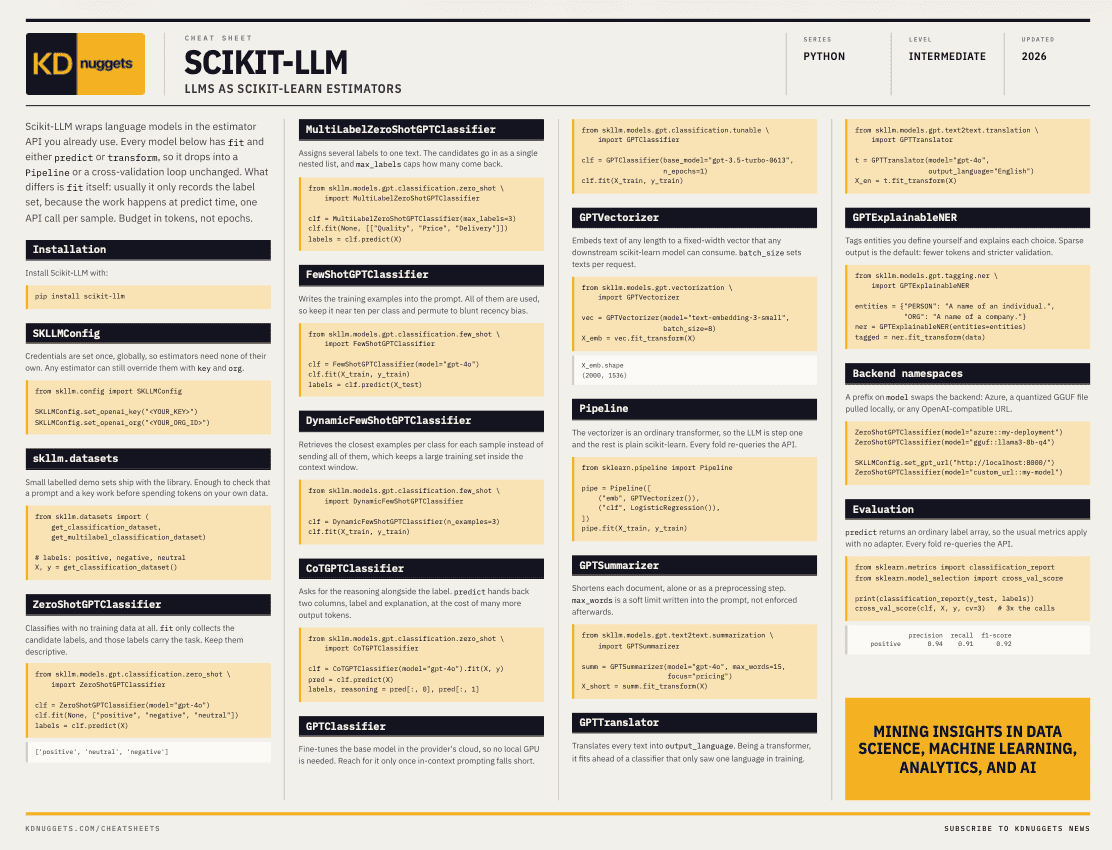
Scikit-LLM solves this by wrapping LLMs in the familiar scikit-learn estimator API. This means if you know how to use .fit() and .predict() or .transform() with a scikit-learn model, you already know the basics of using an LLM through Scikit-LLM. This greatly simplifies integrating LLMs into complex workflows, allowing them to drop directly into a Pipeline or a cross-validation loop.
How Scikit-LLM Works: The Estimator API Explained
At the heart of scikit-learn's design is the concept of an "estimator." An estimator is essentially any object that learns from data. It usually has a .fit() method to train the model and either a .predict() method for making predictions (for classifiers or regressors) or a .transform() method for modifying data (for preprocessors).
Scikit-LLM adopts this exact pattern. When you use a Scikit-LLM class, like ZeroShotGPTClassifier, it behaves just like any other scikit-learn estimator. You instantiate it, set its parameters, and then call .fit() and .predict().
What's different under the hood, especially for zero-shot tasks, is how .fit() works. Instead of training on a large dataset, for many Scikit-LLM estimators, the .fit() method might simply record the available labels or task specifications. The real "work" of understanding and processing text often happens during the .predict() or .transform() step, where the LLM makes an API call for each piece of data.
This approach has a significant implication: cost. While traditional scikit-learn models run locally without direct monetary cost per prediction, LLM-based estimators often involve API calls to commercial services. This means you're paying for tokens used by the LLM. Scikit-LLM helps you manage this by making it clear that you need to budget in "tokens, not epochs" when designing your experiments.
Key Features and Estimators
Scikit-LLM offers a range of estimators categorized by the type of task they perform and the LLM backend they use. These are typically grouped into "backend families" based on their API format, such as the GPT family (for OpenAI-compatible models) or the Vertex family (for Google Vertex AI).
- Text Classification:
ZeroShotGPTClassifier: This is one of the most popular features, allowing you to classify text into categories without needing any training data, just a list of descriptive labels. For example, you can classify sentiment as "positive," "negative," or "neutral."MultiLabelZeroShotGPTClassifier: For scenarios where a single text might belong to multiple categories.- Few-Shot, Dynamic Few-Shot, Chain-of-Thought, Tunable Classifiers: These advanced classification methods offer more control and potentially better performance by providing examples or guiding the LLM's reasoning.
- Text-to-Text Modeling:
- Text Summarization: LLMs are excellent at condensing information. Scikit-LLM provides estimators for summarization, which can be used as standalone tools or as preprocessors in a pipeline.
- Text Translation (`GPTTranslator`): Translate text between languages. This is particularly useful as a preprocessing step for classifiers trained only on a specific language.
- Tunable Text-to-Text: Customizable estimators for various text generation tasks, where you can fine-tune the LLM's output.
- Text Vectorization (`GPTVectorizer`):
- This estimator converts input text of any length into a fixed-dimensional numerical vector. These vectors, or "embeddings," capture the semantic meaning of the text and can then be fed into traditional machine learning models (like logistic regression or clustering algorithms) as the first step in a pipeline.
- Tagging (Named Entity Recognition):
- Scikit-LLM also supports tasks like Named Entity Recognition (NER), which involves identifying and classifying entities (like names of people, organizations, locations) in text.
Getting Started with Scikit-LLM
Using Scikit-LLM is designed to be straightforward for anyone familiar with Python and scikit-learn. Here's a quick overview of the typical steps:
1. Installation
You can install Scikit-LLM using pip, the Python package installer:
pip install scikit-llmFor specific LLM backends or advanced features like GGUF model support, you might need to install additional submodules (e.g., pip install "scikit-llm[gpt4all]").
2. Configuration
Since Scikit-LLM interacts with various LLM providers, you'll need to configure your API keys. This is usually done once, globally, using the SKLLMConfig module.
from skllm.config import SKLLMConfig
# For OpenAI models:
SKLLMConfig.set_openai_key("YOUR_OPENAI_API_KEY")
SKLLMConfig.set_openai_org("YOUR_OPENAI_ORGANIZATION_ID")

# For Google Vertex AI:
# SKLLMConfig.set_google_project("YOUR_GOOGLE_CLOUD_PROJECT_ID")
# (Requires gcloud auth application-default login)
It's important to remember that while Scikit-LLM is free, the use of commercial LLM APIs like OpenAI or Google Vertex AI incurs costs based on token usage. Free trial accounts might have rate limits, so a "pay-as-you-go" plan is often recommended for serious work.
3. Using Estimators
Once configured, you can import and use Scikit-LLM estimators just like you would with scikit-learn.
from skllm.models.gpt.classification.zero_shot import ZeroShotGPTClassifier
from skllm.datasets import get_classification_dataset # Sample dataset

# Load a demo sentiment analysis dataset
X, y = get_classification_dataset() # Labels: positive, negative, neutral

# Initialize the classifier
# You can specify the model, e.g., "gpt-4o", "gpt-3.5-turbo", etc.
clf = ZeroShotGPTClassifier(model="gpt-4")

# Fit the model (for zero-shot, this often just sets up the labels)
clf.fit(X, y)

# Make predictions
predictions = clf.predict(X)

print(predictions)
This example demonstrates a zero-shot text classification, where the LLM classifies text based on provided labels without explicit training data.
Who is Scikit-LLM For?
Scikit-LLM is a powerful tool for:
- Software Developers and Data Scientists: Especially those already working with Python and scikit-learn. It allows them to quickly add advanced NLP capabilities to their projects without a steep learning curve for new LLM-specific frameworks.
- AI Practitioners: Who need to integrate LLMs into existing machine learning pipelines for tasks like text analysis, sentiment analysis, document processing, and more.
- Researchers: Who want to experiment with LLMs within a structured, reproducible machine learning environment.
The Future of LLMs in Traditional ML Workflows
Scikit-LLM represents a significant step towards making LLMs more accessible and integrated into the broader machine learning ecosystem. By adhering to the established scikit-learn API, it lowers the barrier to entry for many practitioners who might otherwise find LLM integration complex. This approach allows for the best of both worlds: the robust framework of scikit-learn combined with the nuanced understanding of large language models. As LLMs continue to evolve, tools like Scikit-LLM will be crucial in ensuring they can be widely adopted and applied to real-world problems effectively.
Frequently Asked Questions
What is Scikit-LLM?
Scikit-LLM is a Python library that integrates large language models (LLMs) into the familiar scikit-learn framework, allowing developers and data scientists to use LLMs for various text analysis tasks with a consistent API.
Is Scikit-LLM free to use?
Yes, Scikit-LLM itself is an open-source Python library and is free to install and use. However, it relies on external LLM services (like OpenAI's GPT models or Google Vertex AI), which typically require API keys and incur usage-based costs from those providers.
What types of LLMs does Scikit-LLM support?
Scikit-LLM supports various LLM backends, including those compatible with the OpenAI API (e.g., GPT-3.5, GPT-4), Azure OpenAI Service, Google Vertex AI, and locally hosted open-source models in GGUF/GGML formats.
Can I use Scikit-LLM with scikit-learn pipelines?
Absolutely. One of Scikit-LLM's core strengths is its seamless integration with scikit-learn pipelines and cross-validation loops. Its estimators follow the same .fit() and .predict()/.transform() API, making them compatible with existing scikit-learn workflows.