Key Takeaways
- Building a custom AI assistant offers unparalleled control over functionality, data privacy, and integration with specific workflows, surpassing general-purpose tools.
- The core architecture typically involves an LLM, a data retrieval mechanism (RAG), tool use for external actions, and an orchestration layer.
- Key technologies include LLM APIs (OpenAI, Google Gemini, Anthropic), vector databases (Pinecone, Weaviate), and frameworks like LangChain or LlamaIndex.
- While complex, a custom AI assistant can significantly boost productivity, offer tailored solutions, and provide a deeper understanding of AI development.
Building Your Own AI Assistant: A Deep Dive into Custom Solutions
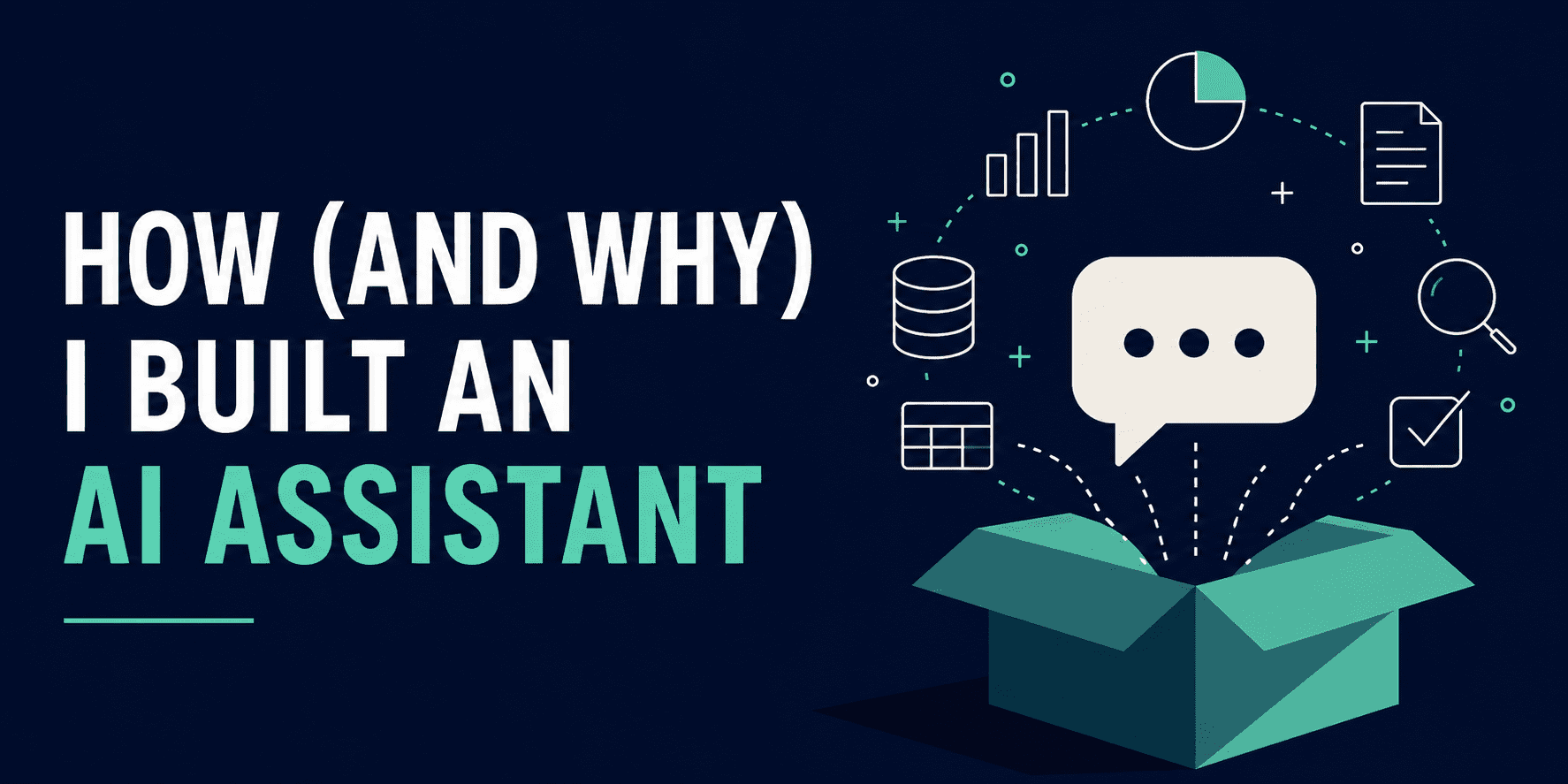
In today's fast-paced digital world, the idea of an AI assistant is no longer science fiction. From scheduling meetings to drafting emails and crunching data, these intelligent tools promise to streamline our lives and boost productivity. While off-the-shelf options like ChatGPT, Google Gemini, and Microsoft Copilot are powerful, a growing number of tech professionals are choosing a different path: building their own custom AI assistants. Why take on such a complex project when readily available solutions exist? The answer lies in control, tailored functionality, and a deeper understanding of the underlying technology. This article explores the "how" and "why" behind building a custom AI assistant, offering a technical deep-dive into its architecture, key components, and the development process. This is for anyone who's ever felt the limitations of a general-purpose AI and wondered if a bespoke solution could unlock a new level of efficiency.What Exactly is a Custom AI Assistant?
A custom AI assistant is an intelligent software agent designed and built to address specific needs and workflows that generic AI tools cannot. Unlike broad AI models, a custom assistant is trained or configured with your unique context, data, and operational requirements in mind. It's an AI that understands your business, your data, and your preferred way of working. These assistants can range from simple chatbots that answer company-specific FAQs to sophisticated agents that automate complex, multi-step tasks across various platforms. They leverage large language models (LLMs) but augment them with specialized knowledge, tools, and decision-making capabilities to perform truly valuable, context-aware actions.Why Go Custom? The Power of Tailored AI
The primary motivation for building a custom AI assistant often boils down to a need for greater control and customization. While consumer-grade AI offers convenience, it inherently makes compromises to serve a broad audience. Custom solutions, on the other hand, can offer several distinct advantages:- Specificity to Use Cases: A custom assistant can be precisely engineered to solve unique, niche problems within a specific domain or workflow. It knows your context, your tone, and your specific tools.
- Data Privacy and Security: When using third-party AI, your data passes through their infrastructure. Building your own gives you full control over where your sensitive information lives and how it's processed, which is crucial for client-related or commercially sensitive tasks.
- Seamless Integration: Generic tools might struggle to connect with proprietary systems or specialized software. A custom assistant can be integrated directly into your existing tech stack, automating tasks across different applications.
- Cost Optimization: While initial development requires investment, custom solutions can be more cost-effective in the long run, especially for high-volume or specific tasks, by allowing you to choose the most efficient models and infrastructure.
- Competitive Advantage: Tailored AI tools can enhance customer satisfaction, improve employee productivity by automating repetitive tasks like data entry, and enable data-driven decision-making, giving businesses an edge.
- Learning and Expertise: The process of building a custom AI assistant provides invaluable hands-on experience and a deeper understanding of AI principles and development, which is increasingly becoming a foundational skill.
The Core Architecture of a Custom AI Assistant
Building an AI assistant involves several key architectural components working together. Think of it as a layered system, each part playing a crucial role in enabling the AI to understand, reason, and act.1. Large Language Model (LLM) Integration: The Brain
At the heart of any AI assistant is a Large Language Model. This is the "brain" that understands natural language, generates responses, and performs complex reasoning. Instead of training an LLM from scratch (a monumental task), developers typically integrate with existing LLM providers via their APIs. Popular LLM API providers include:- OpenAI: Offers models like GPT-5.5, GPT-5.4, and GPT-5.4 Mini/Nano. Pricing for GPT-5.5 is around $5.00 per million input tokens and $30.00 per million output tokens, with cheaper options for less complex models and discounts for cached input or batch processing.
- Google AI: Provides access to Gemini models (e.g., Gemini 3.5 Flash, Gemini 3.1 Pro, Gemini 2.5 Flash-Lite). Gemini 3.5 Flash, launched in May 2026, costs about $1.50 per million input tokens and $9.00 per million output tokens. Google also offers generous free tiers for many models.
- Anthropic: Known for its Claude family of models (e.g., Claude Opus 4.8, Sonnet 4.6, Haiku 4.5). Claude Haiku 4.5 is the cheapest, starting at $1 per million input tokens and $5 per million output tokens, while Opus 4.8 is $5 per million input tokens and $25 per million output tokens.
- Hugging Face: Offers a vast array of open-source models and a paid Inference API that allows developers to use pre-trained models without managing infrastructure.
2. Data Retrieval and Knowledge Base (RAG): Giving the AI Context
LLMs are powerful but often lack up-to-date or specific proprietary knowledge. This is where Retrieval Augmented Generation (RAG) comes in. RAG allows the AI assistant to fetch relevant information from external knowledge bases before generating a response. This "grounds" the AI's answers in factual, domain-specific data, reducing hallucinations and making responses more accurate. Key components for RAG include: Embeddings: Text from your documents (and user queries) is converted into numerical representations called embeddings. Vector Databases: These specialized databases store and index these embeddings, allowing for fast similarity searches. When a user asks a question, its embedding is compared to those in the database to retrieve the most relevant document chunks. Popular vector databases include:- Pinecone: A fully managed, cloud-native vector database known for scalability and ease of use.
- Weaviate: An open-source, graph-based vector store with a GraphQL API.
- Qdrant: An open-source Rust vector database excelling at real-time embedding search with rich filtering.
- Milvus (and Zilliz): Open-source, scalable vector databases optimized for large embedding collections and high-volume workloads.
- Chroma: An open-source option for building AI applications that learn and search intelligently.
- PostgreSQL with pgvector: A good option for "good enough" similarity search within an existing PostgreSQL setup.
3. Tool Use and Function Calling: Enabling Action
What separates a mere chatbot from a true assistant is its ability to act. Tools (also known as function calling or agents) allow the LLM to interact with external services and perform real-world actions. This could include: Searching the web (e.g., via SerpAPI) Accessing a calendar (e.g., Google Calendar API) Sending emails (e.g., Gmail API) Querying a database Running custom scripts Generating images The LLM decides which tool to use based on the user's request, executes the tool, and then uses the tool's output to formulate a response or take further action. This "Reasoning + Acting" (ReAct) pattern is crucial for complex tasks.4. Orchestration Layer: The Glue
The orchestration layer is the framework that ties all these components together. It manages the flow of information, handles prompts, coordinates tool calls, and maintains conversational memory. Key orchestration frameworks: LangChain: An open-source framework (with over 120,000 GitHub stars) for building LLM applications. It provides modular components for prompt management, chains (multi-step workflows), agents (dynamic decision-making), and memory (retaining context). LangChain simplifies connecting LLMs to external data sources and computational tools. It also pairs with LangGraph for stateful multi-agent orchestration and LangSmith for observability. LlamaIndex: An open-source framework that focuses on data ingestion, indexing, and querying to connect LLMs with private or domain-specific data. It offers various index types (vector, tree, list, keyword) and data connectors (LlamaHub) for diverse data formats like PDFs, databases, and APIs. LlamaIndex Workflows is an event-driven orchestration layer for multi-agent systems. Other emerging frameworks for agent orchestration include CrewAI (role-based multi-agent systems), Pydantic AI (type-safe agent workflows), and Microsoft Agent Framework.5. User Interface (UI): The Interaction Point
Finally, how users interact with the assistant is critical. This could be: A web application (e.g., built with Flask, Next.js, Streamlit) A chat interface (e.g., integrating with Telegram, Slack, WhatsApp) A desktop application Voice interface The UI needs to be intuitive and effectively communicate the AI's capabilities and limitations.The Development Process: What to Expect
Building a custom AI assistant is an iterative process, much like any software development. Here's a general outline: 1. Define the "Why" and Use Cases: Clearly articulate the problem you're solving and the specific tasks the AI assistant will perform. This guides all subsequent decisions. 2. Choose Your Tech Stack: Select your LLM provider, vector database, orchestration framework, and any necessary tools or APIs. Python is a dominant language in this space, with frameworks like LangChain and LlamaIndex being popular choices. 3. Design the System Prompt: This is crucial. The system prompt defines the assistant's personality, constraints, and how it handles ambiguous situations. It acts as the "standing instructions" sent at the start of every conversation. 4. Data Ingestion and Indexing: Collect and process your proprietary data. Convert it into embeddings and store it in your chosen vector database. Establish a pipeline to keep this data updated. 5. Implement Tools: Develop or integrate the functions that allow your AI to perform actions (e.g., API calls, database queries). 6. Build the Orchestration Logic: Use a framework like LangChain or LlamaIndex to connect the LLM, RAG system, and tools into coherent workflows. This involves defining chains, agents, and memory management. 7. Develop the User Interface: Create the front-end through which users will interact with the assistant. 8. Test, Debug, and Iterate: Expect things to break. AI systems can be non-deterministic, so thorough testing, debugging, and continuous refinement are essential. Observability tools can help diagnose issues. 9. Deployment and Monitoring: Deploy your assistant to a cloud platform (AWS, GCP, Azure) and continuously monitor its performance, cost, and accuracy.Real-World Use Cases for Custom AI Assistants
Custom AI assistants can be applied across numerous domains: Personal Productivity: Managing calendars, summarizing documents, drafting emails, and organizing research. Customer Support: Providing instant, accurate answers to FAQs based on internal knowledge bases, triaging requests, and guiding users. Internal Knowledge Management: Allowing employees to query internal documents, policies, and data using natural language. Content Creation and Research: Generating summaries from large volumes of text, assisting with report drafting, and performing targeted web searches. Data Analysis: Extracting structured data from unstructured text, summarizing data insights, or even generating code for analysis. Business Automation: Automating repetitive administrative tasks, such as scheduling, reminders, and managing emails, boosting operational efficiency.Challenges and Considerations
While the benefits are clear, building a custom AI assistant comes with challenges: Complexity: Integrating multiple technologies (LLMs, vector databases, APIs, frameworks) requires significant technical expertise. Cost Management: LLM API calls, especially for powerful models or high-volume usage, can quickly accumulate costs. Careful cost optimization strategies are needed, such as using cheaper models for simpler tasks, prompt caching, and batch processing. Data Quality and Governance: The performance of your RAG system heavily depends on the quality and relevance of your input data. Ensuring data cleanliness, privacy, and security is paramount. Evolving Landscape: The AI field is moving rapidly. Keeping up with new models, frameworks, and best practices requires continuous learning.• Debugging Non-Deterministic Systems: Unlike traditional software, AI behavior can be less predictable, making debugging more challenging. Specialized observability tools are often necessary.
Conclusion
Building a custom AI assistant is a significant undertaking, but the rewards can be substantial. It offers a level of control, customization, and integration that off-the-shelf solutions simply cannot match. For tech practitioners, developers, and businesses looking to leverage AI in a truly bespoke and powerful way, the journey of building a custom assistant provides not just a unique tool but also an invaluable education in the rapidly evolving world of artificial intelligence. It's a testament to the idea that sometimes, the best solution is the one you build yourself.Frequently Asked Questions
What is the main difference between a custom AI assistant and a general-purpose AI like ChatGPT?
The main difference is specificity and control. A general-purpose AI is designed to handle a wide range of tasks for a broad audience, making compromises in depth and integration. A custom AI assistant is built to address specific needs, workflows, and proprietary data, offering tailored functionality, greater data privacy, and seamless integration with existing systems.
What are the essential technical components required to build a custom AI assistant?
The core components typically include a Large Language Model (LLM) (e.g., via OpenAI or Google Gemini APIs), a Retrieval Augmented Generation (RAG) system for context (often involving embeddings and a vector database like Pinecone or Weaviate), tools for performing actions (integrating with external APIs), and an orchestration framework (like LangChain or LlamaIndex) to manage the workflow.
How can I manage the costs associated with using LLM APIs for my custom AI assistant?
Managing LLM API costs involves several strategies: choosing cost-effective models for specific tasks (e.g., cheaper 'mini' or 'flash' models for simpler operations), implementing prompt caching for repeated input, utilizing batch processing for non-urgent workloads, and optimizing your context length to avoid unnecessary token consumption. Most providers offer detailed pricing tiers and optimization tips.
What are some common challenges faced when developing a custom AI assistant?
Common challenges include the complexity of integrating diverse technologies, managing and ensuring the quality of proprietary data for RAG, controlling and optimizing API costs, keeping up with the rapid pace of AI advancements, and debugging the often non-deterministic behavior of AI systems.