Key Takeaways
- LFM2.5-VL-3B is a 3.1 billion parameter vision-language model by Liquid AI, specifically designed for fast and efficient AI processing directly on edge devices.
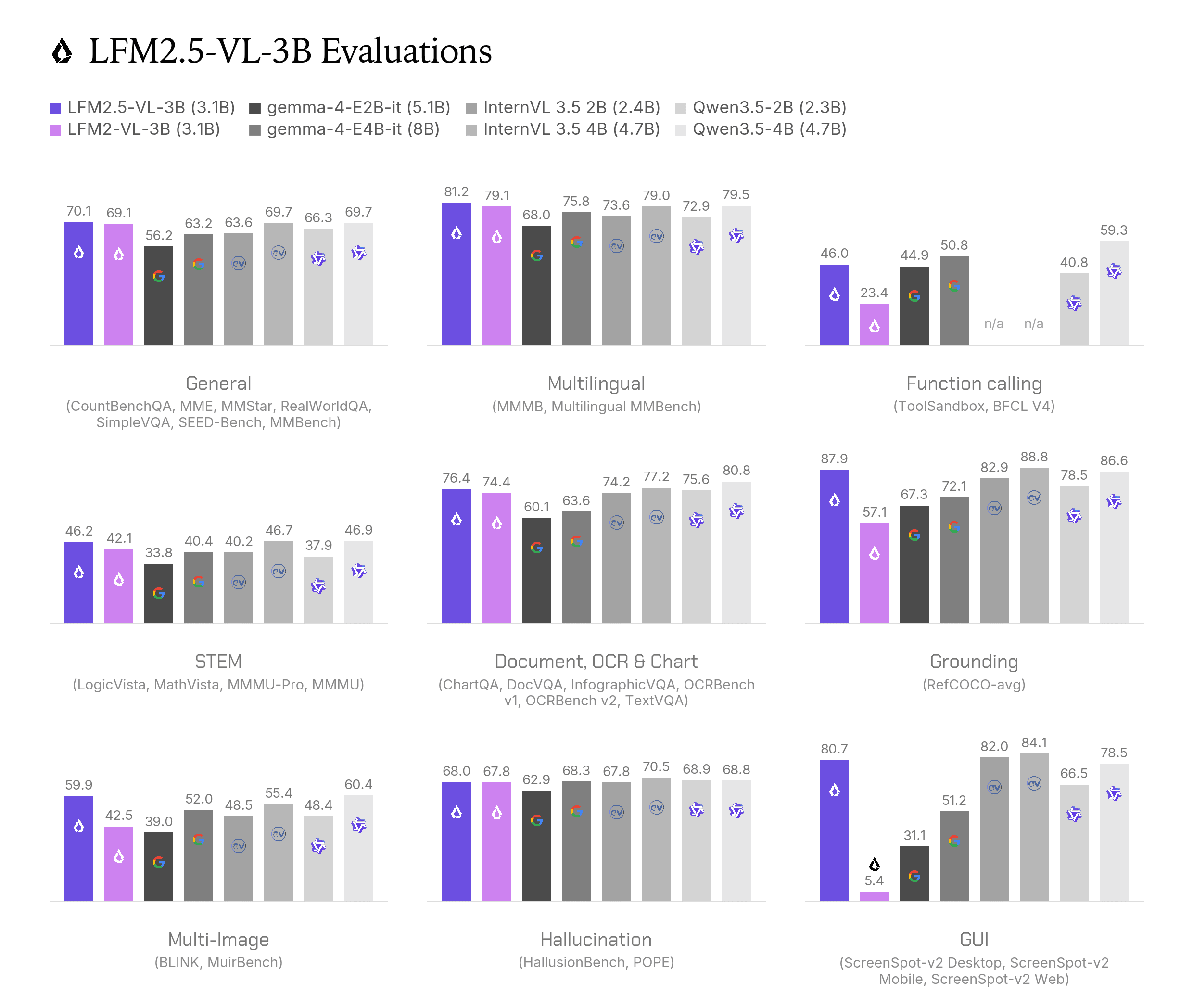
- It excels in understanding digital screens, improving object detection with natural language, processing multiple images, and robust function calling.
- The model's hybrid architecture and efficient token mapping allow it to deliver high performance on resource-constrained hardware, addressing key challenges in edge AI like latency and privacy.
- Available under the LFM Open License on Hugging Face, it empowers developers to build real-time, on-device AI applications for various industries.
The world of Artificial Intelligence is constantly pushing boundaries, and one of the most exciting frontiers is "edge AI" – bringing powerful AI capabilities directly to devices like smartphones, smart cameras, and vehicles, rather than relying solely on cloud servers. This shift is crucial for applications that demand real-time responses, enhanced privacy, lower costs, and offline functionality. Enter LFM2.5-VL-3B, Liquid AI's latest offering, which promises better and faster vision capabilities specifically for these edge environments.
This article will take a deep dive into LFM2.5-VL-3B, exploring what it is, why it's a significant development for AI practitioners and developers, how its underlying technology works, and what its emergence means for the future of on-device AI.
What is LFM2.5-VL-3B? A Glimpse into Edge-Optimized Vision-Language AI
LFM2.5-VL-3B stands for Liquid Foundation Model 2.5 - Vision Language - 3 Billion parameters. As the name suggests, it's a vision-language model (VLM) developed by Liquid AI, designed to understand and process both visual and textual information. What makes it particularly noteworthy is its explicit focus on "edge" deployment. This means the model is optimized to run efficiently on devices with limited computational power and memory, rather than requiring powerful data centers or cloud infrastructure.
Released around August 12, 2026, LFM2.5-VL-3B builds upon its predecessor, LFM2-VL-3B (released in October 2025), by enhancing its vision-language capabilities with several key improvements. It's part of Liquid AI's broader strategy to create highly efficient foundation models that can operate effectively even on smaller devices, making advanced AI more accessible and practical for a wider range of real-world applications.
Why LFM2.5-VL-3B Matters: Addressing the Edge AI Challenge
Deploying powerful AI models on edge devices comes with a unique set of challenges. Traditional large language models (LLMs) and VLMs often require immense computational resources, making them unsuitable for devices like smartphones, drones, or in-car systems. This is where LFM2.5-VL-3B steps in, specifically addressing these pain points:
- Latency: Cloud-based AI introduces delays due to data transmission to and from servers. For applications like real-time object detection in autonomous vehicles or instant translation, sub-second response times are critical. LFM2.5-VL-3B's on-device processing eliminates these network latencies.
- Privacy: Many applications, especially those handling sensitive visual data (e.g., security cameras, personal devices), benefit from local processing. Keeping data on the device enhances user privacy and helps meet regulatory compliance requirements.
- Cost: Continuously sending vast amounts of data to cloud APIs for processing can become prohibitively expensive, especially for large-scale deployments or continuous monitoring. Edge inference significantly reduces these operational costs.
- Reliability: Edge devices often operate in environments with inconsistent or no internet connectivity. An on-device model can function reliably offline, ensuring continuous service regardless of network availability.
- Efficiency: While smaller, LFM2.5-VL-3B aims to deliver competitive performance, proving that enterprise-grade capabilities don't always require massive models and their associated computational overhead.
By tackling these challenges, LFM2.5-VL-3B opens up new possibilities for AI applications that were previously impractical or impossible for edge environments.
How LFM2.5-VL-3B Works: A Look Under the Hood
The efficiency and performance of LFM2.5-VL-3B stem from its carefully designed architecture and training methodology. It's not just a shrunk-down version of a larger model; it's engineered from the ground up for the edge.
Hybrid Architecture for Optimal Performance
At its core, LFM2.5-VL-3B employs a hybrid architecture. It pairs a SigLIP2 400M NaFlex vision encoder with the same pre-trained backbone as Liquid AI's LFM2.5-2.6B text model. This combination is key:
- Vision Encoder (SigLIP2 400M NaFlex): This component is responsible for processing images. The "NaFlex" part is crucial as it allows for native resolution processing up to 512x512 pixels and preserves variable aspect ratios without distortion. This is a significant advantage over traditional vision encoders that might upscale or crop images, potentially losing important details.
- Language Backbone (LFM2.5-2.6B): This is the text-understanding part of the model. The LFM2.5 series itself incorporates a hybrid approach, combining short-range convolution blocks with grouped query attention blocks. This unique blend contributes to faster inference and a lower memory footprint compared to pure transformer architectures.
This hybrid design allows the model to handle complex multimodal inputs (text + images) while remaining highly efficient.
Efficient Token Mapping and Tiling Strategy
A major bottleneck for VLMs on edge devices is the sheer number of tokens generated from images. LFM2.5-VL-3B addresses this with:
- Pixel Unshuffle & MLP Projector: A 2-layer Multi-Layer Perceptron (MLP) with pixel unshuffle compresses image tokens before they are integrated with the language space. This aggressive compression is vital for real-time edge inference. For example, a 256x384 image can be mapped to just 96 tokens, keeping the token count low even for high-resolution inputs.
- Tiling Strategy: For images larger than 512x512, the model intelligently splits them into non-overlapping patches. It also includes a "thumbnail pathway" to maintain global context across these patches, ensuring the model doesn't lose sight of the bigger picture while processing smaller segments.
Training for Robustness and Multilinguality
LFM2.5-VL-3B was pre-trained on a massive dataset of approximately 34 trillion tokens, incorporating four times more vision data than previous versions. This extensive training ensures a robust understanding of diverse visual and textual information. Furthermore, to support global applications, its vocabulary was doubled to 128,000 tokens by extending the existing tokenizer, specifically to handle non-Latin scripts effectively.
The post-training process involves two critical stages: supervised fine-tuning (SFT) with knowledge distillation from a larger teacher model and multi-reward reinforcement learning (RL). This sophisticated training regimen helps LFM2.5-VL-3B refine its responses and improve its overall performance.
Key Capabilities and Features
LFM2.5-VL-3B brings a suite of powerful vision-language capabilities to the edge, making it suitable for a wide array of applications:
- Enhanced Screen/UI Understanding: The model shows a strong ability to understand digital screens across different devices, which is critical for applications involving user interfaces, accessibility, or automated testing.
- Improved Grounding and Object Detection: It offers better grounding and object detection using natural language queries. This means you can ask the model to "find the red car" or "identify all chairs" and it will accurately locate and identify those objects within an image.
- Multi-Image Input and Reasoning: LFM2.5-VL-3B has improved capabilities for reasoning across multiple images, allowing it to understand relationships or sequences depicted in a series of visuals.
- Stronger Function Calling: The model is significantly better at function calling, both in text-only and vision-text scenarios. This feature is vital for building agentic AI systems that can interact with external tools or APIs based on visual and textual cues.
- Direct Answering for Low Latency: Unlike some reasoning models that generate elaborate chains of thought, LFM2.5-VL-3B is designed to answer directly. This design choice prioritizes speed, making it ideal for single-turn, high-throughput, low-latency tasks where immediate responses are paramount.
- Multilingual Support: Beyond English, the model supports visual understanding in several languages, including Japanese, French, Spanish, German, Italian, Portuguese, Arabic, Chinese, and Korean, broadening its applicability globally.
Benchmarks and Real-World Performance
LFM2.5-VL-3B is engineered to lead its size class on real-world image tasks and effectively interpret digital content, ranging from documents and charts to on-screen UI elements.
Its predecessor, LFM2-VL-3B, demonstrated competitive results across open-source evaluations. For instance, it achieved an impressive 51.8% on MM-IFEval and 71.4% on RealWorldQA. Notably, it showed performance comparable to models more than three times its size, such as Qwen3-VL-4B, while maintaining the crucial advantage of running smoothly on edge devices. This highlights Liquid AI's success in finding the "sweet spot where capability meets deployability" for edge AI.
Real-world testing, such as analyzing dashcam footage on a mobile device, showcased LFM2-VL-3B's ability to not just detect objects but also provide contextual understanding of the driving environment, all with sub-second response times and without cloud dependency. This level of detail from a 3-billion parameter model running locally is quite remarkable.
Implications for AI Practitioners and Developers
For AI practitioners, developers, and even tech-savvy freelancers, LFM2.5-VL-3B represents a significant step forward in making advanced AI more accessible and practical. Here's what it means:
- New Application Opportunities: Developers can now build real-time, privacy-preserving AI applications for edge devices across various sectors. Think smart security systems with on-device anomaly detection, augmented reality apps that understand their surroundings instantly, mobile apps with advanced visual search, or industrial IoT devices performing complex visual inspections locally.
- Reduced Development Complexity: By offering a capable model optimized for edge deployment, Liquid AI simplifies the engineering effort required to integrate advanced vision-language AI into resource-constrained environments.
- Cost-Effective Solutions: Freelancers and small businesses can leverage powerful AI without incurring high cloud computing costs, making sophisticated AI solutions more budget-friendly.
- Focus on User Experience: The low latency and offline capabilities directly translate to a better user experience, offering instant feedback and reliable performance regardless of network conditions.
- Open Access for Innovation: LFM2.5-VL-3B is available on Hugging Face under the LFM Open License, and also through Liquid AI's LEAP platform. This open approach encourages experimentation, fine-tuning for specific use cases, and broader community innovation. Liquid AI also provides a cookbook on GitHub with examples and tutorials for their foundation models, including LFM2-VL-3B, aiding developers in getting started.
The ability to fine-tune these models for narrow use cases is also emphasized, allowing developers to maximize performance for their specific application needs.
Conclusion
LFM2.5-VL-3B is more than just another AI model; it's a testament to the ongoing progress in making powerful AI truly ubiquitous. By focusing on the unique demands of edge computing, Liquid AI has delivered a vision-language model that is not only fast and efficient but also highly capable. Its strengths in screen understanding, grounding, multi-image processing, and function calling, combined with its optimized architecture, position it as a critical tool for developers looking to build the next generation of intelligent, on-device applications. As AI continues to evolve, LFM2.5-VL-3B demonstrates that smaller, purpose-built models will play an increasingly vital role in bringing advanced capabilities to where they matter most: at the very edge of our digital world.
Frequently Asked Questions
What is "edge AI" and why is LFM2.5-VL-3B important for it?
Edge AI refers to running AI computations directly on local devices (like phones, cameras, or cars) instead of sending data to a central cloud server. LFM2.5-VL-3B is important because it's specifically designed to be highly efficient and fast on these resource-constrained edge devices, addressing challenges like latency, privacy, cost, and reliability that cloud-based AI often faces.
Who developed LFM2.5-VL-3B?
LFM2.5-VL-3B was developed by Liquid AI, a company focused on creating efficient foundation models for various AI applications.
What are the main improvements in LFM2.5-VL-3B compared to previous versions?
LFM2.5-VL-3B offers four major improvements: enhanced understanding of digital screens/UIs, better grounding and object detection with natural language, improved reasoning across multiple images, and significantly stronger function calling capabilities in both text and vision-text scenarios.
How can developers access and use LFM2.5-VL-3B?
Developers can access LFM2.5-VL-3B on Hugging Face under the LFM Open License. It's also available through Liquid AI's LEAP platform. Liquid AI provides resources like a GitHub cookbook with examples to help developers integrate and fine-tune the model for their specific needs.