Key Takeaways
- The integration of Strands Agents, LeRobot, and Hugging Face Storage Buckets provides a unified workflow for AI robotics, covering data recording, model training, and deployment.
- Strands Agents, an open-source SDK by AWS, simplifies building autonomous AI agents with a model-first approach, leveraging LLMs for reasoning and tool use.
- LeRobot, developed by Hugging Face, is an open-source PyTorch library for real-world robotics, offering a standardized dataset format and state-of-the-art policies.
- Hugging Face Storage Buckets offer S3-like object storage on the Hugging Face Hub, optimized with Xet deduplication for mutable, high-throughput ML artifacts like checkpoints and datasets, with simple per-TB pricing.
The world of artificial intelligence, especially in robotics, often feels like a puzzle with pieces scattered across different tools and platforms. From capturing real-world data to training complex models and finally deploying them onto physical robots, each step traditionally involves a distinct set of technologies and workflows. This fragmentation can slow down development, introduce inconsistencies, and make it tough for AI practitioners and developers to build and iterate efficiently.
But what if you could streamline this entire process? Imagine a single, cohesive environment where you record robot demonstrations, store massive datasets, train advanced AI policies, and prepare them for deployment—all from one place. This is precisely the vision behind integrating Strands Agents, LeRobot, and Hugging Face Storage Buckets.
This article dives deep into how these three powerful components come together to create a more efficient, integrated, and accessible ecosystem for robotics AI development. We'll explore what each tool brings to the table and how their combined strengths offer a significant leap forward for anyone working with embodied AI.
What is Strands Agents?
Strands Agents is an open-source SDK initially released by AWS, designed to simplify the creation of autonomous AI agents. It takes a "model-first" approach, meaning it centers the foundation model as the core intelligence of the agent. Instead of requiring developers to hardcode complex task flows, Strands leverages the reasoning abilities of large language models (LLMs) to handle planning and tool usage autonomously.
Key Features of Strands Agents:
- Model-First Design: Built around the idea that the foundation model drives the agent's intelligence, enabling sophisticated autonomous reasoning.
- LLM Flexibility: Supports various foundation models, including those on Amazon Bedrock (like Anthropic Claude), OpenAI, Ollama, and Meta, allowing developers to choose the best model for their needs.
- Tool Integration: Agents can use a wide array of tools (functions or APIs) to perform real actions. Strands provides over 20 pre-built example tools, and developers can easily turn any Python function into a tool using a simple decorator. It also supports the Model Context Protocol (MCP) for standardized context provision to LLMs.
- Multi-Agent Collaboration: Includes built-in coordination models such such as Swarm, Graph, and Workflow patterns, enabling scalable collaboration across distributed agent networks.
- AWS Service Integration: Seamlessly connects with AWS services like Amazon Bedrock, AWS Lambda, and AWS Step Functions, making it ideal for organizations building on AWS infrastructure.
- Observability: The SDK has built-in metrics, providing token counts, cycle durations, and per-tool performance data for agent invocations, which helps in identifying waste and verifying improvements.
- Open Source: Available as an open-source SDK, encouraging community contributions and broader adoption.
Strands Agents is particularly well-suited for autonomous agent scenarios that require enterprise-grade security, scalability, and compliance features, and for projects needing flexibility in model selection across different providers.
Pricing for Strands Agents:
Strands Agents is an open-source SDK, and its core framework is free to use. However, while the SDK itself is free, the cost comes from the underlying LLM calls and other cloud resources (like storage and compute) it utilizes. Users may incur costs from third-party LLM providers (e.g., Anthropic, OpenAI) or AWS services (like Amazon Bedrock, Lambda, S3) that the agents interact with.
What is LeRobot?
LeRobot is an open-source machine learning library for real-world robotics, built by Hugging Face. Its main goal is to democratize physical AI by lowering the barrier to entry for robotics, enabling everyone to contribute to and benefit from shared datasets and pre-trained models.
Key Features of LeRobot:
- Unified Robot Interface: Provides a hardware-agnostic, Python-native interface that standardizes control across diverse robotic platforms, from low-cost arms (like SO-100/101) to humanoids.
- Standardized LeRobotDataset Format: Addresses the data fragmentation problem in robotics by introducing a unified dataset format. This format uses synchronized MP4 videos (or images) for vision and Parquet files for state/action data, enabling efficient storage, streaming, and visualization of large robotic datasets on the Hugging Face Hub.
- State-of-the-Art Policies: Implements cutting-edge policies in pure PyTorch, covering imitation learning, reinforcement learning, Vision-Language-Action (VLA) models, and more. It also provides tools to instrument and inspect the training process.
- Comprehensive Ecosystem: Offers full support for data collection, training, evaluation, and deployment, with seamless integration into the Hugging Face Hub.
- Simulation and Real-World Control: Designed to work with both simulation environments (e.g., Gymnasium environments) and real robotic hardware.
- Open-Source Hardware Initiatives: Hugging Face has also released open, low-cost humanoid robot projects like the LeRobot Humanoid, built from 3D-printed and off-the-shelf parts, prioritizing affordability and reproducibility in research.
LeRobot aims to cover the entire robot learning stack, from low-level motor interfaces to large-scale data collection, dataset streaming, optimized inference, and scalable implementations of state-of-the-art algorithms.
Pricing for LeRobot:
LeRobot itself is an open-source library and is free to use. However, if you're working with physical robots, there are costs associated with the hardware. For example, LeRobot-compatible open-source robotic arms like the SO-ARM100/101 can range from around $269.00 to over $400.00, depending on the kit. The LeRobot Humanoid project aims for a parts cost of around $2,500. Additionally, leveraging the Hugging Face Hub for datasets and models might involve costs associated with Hugging Face's platform plans, especially for private storage or dedicated compute.
What are Hugging Face Storage Buckets?
Hugging Face Storage Buckets are a type of repository on the Hugging Face Hub that provide S3-like object storage, powered by the Xet storage backend. Unlike Git-based repositories (for models, datasets, or Spaces) that track file history, Buckets are non-versioned and mutable. They are specifically designed for use cases requiring simple, fast storage of large-scale files that change frequently and don't need traditional version control.
Key Features of Hugging Face Storage Buckets:
- Optimized for ML Artifacts: Ideal for storing mutable, high-throughput machine learning artifacts such as training checkpoints, optimizer states, processed data, agent traces, logs, and intermediate files.
- Xet Deduplication: Built on Xet, Hugging Face's chunk-based storage backend. This technology breaks files into byte-level chunks and deduplicates across the entire bucket, leading to faster transfers, less bandwidth usage, and more efficient storage, especially for related ML artifacts where only small parts change between versions.
- S3-like Object Storage: Provides familiar object storage capabilities, allowing users to browse contents on the Hub web interface, script from Python using
HfFileSystem, or manage with thehf CLI. It also offers an S3-Compatible API for existing S3 tooling. - CDN Integration: Every bucket includes a Content Delivery Network (CDN) for fast access, providing warm localized caches close to compute resources for ultra-fast streaming and downloads.
- Flexible Permissions: Inherits standard Hugging Face permissions, allowing buckets to be private or public and supporting fine-grained access control through Resource Groups.
- Data Residency Options: Users can choose where their data lives when creating a bucket, with data stored in US and EU regions, and pre-warming capabilities to cache data closer to compute.
Storage Buckets fill a critical gap in the Hugging Face ecosystem by providing a Hub-native place for intermediate, mutable data that is constantly in motion during the ML development lifecycle.
Pricing for Hugging Face Storage Buckets:
Hugging Face Storage Buckets offer transparent, volume-based pricing. The cost is typically a simple per-TB monthly rate that scales with usage. Egress and CDN are included up to a generous 8:1 ratio of total storage. For example, the base rate can be around $12/TB/month for public repositories and $18/TB/month for private repositories. Enterprise plans may offer billing that benefits further from Xet's deduplicated footprint.
While the Hugging Face Hub offers a free tier with 100 GB of private repository storage, and paid plans like PRO ($9/month) and Team ($20/user/month) increase private storage to 1 TB and 12 TB (base) respectively, Storage Buckets are typically billed separately based on usage.
The Power of Integration: Record, Train, and Deploy from One Place
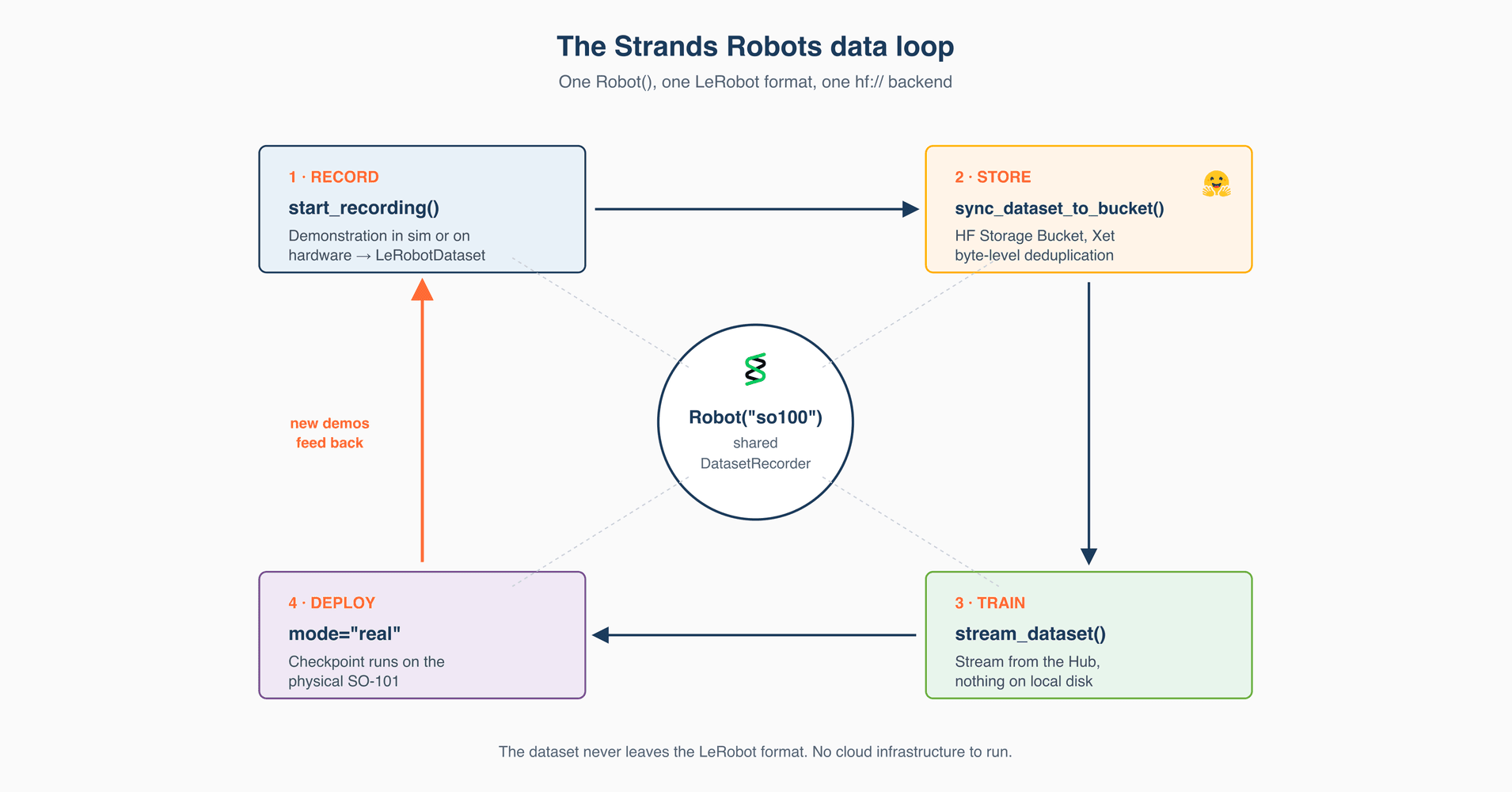
The true strength lies in bringing Strands Agents, LeRobot, and Hugging Face Storage Buckets together. This combination addresses the fragmented workflow common in robotics AI development, creating a powerful, unified pipeline:
-
Recording Data with Strands Agents:
Strands Agents, with its focus on autonomous agent development and tool integration, can be adapted to control robotic hardware and record human demonstrations. LeRobot itself provides a unified
Robotclass interface for controlling various robots and teleoperation devices, along with tools to record demonstrations. By integrating Strands with LeRobot's robot control capabilities, developers can leverage LLM-driven agents to orchestrate complex data collection scenarios or even generate synthetic demonstrations. The output of these recording sessions—raw sensor data, synchronized video feeds, and action logs—can then be directly streamed to a centralized storage solution. -
Storing Data in Hugging Face Storage Buckets:
This is where Storage Buckets become crucial. The vast amounts of multi-modal data generated during robot demonstrations (high-resolution video, sensor readings, joint states) require a scalable, efficient storage solution. Hugging Face Storage Buckets, with their S3-like interface and Xet deduplication, are perfectly suited for this. They can store the raw LeRobotDataset format (Parquet + MP4) efficiently, handling the mutable nature of ongoing data collection and avoiding the overhead of Git for frequently changing large files. This centralizes all experimental data, making it easily accessible for subsequent training phases.
-
Training Models with LeRobot:
Once the demonstration data is securely stored in Hugging Face Storage Buckets, LeRobot steps in for the training phase. LeRobot is designed to work seamlessly with datasets hosted on the Hugging Face Hub, including those in its standardized
LeRobotDatasetformat. Developers can use LeRobot's implementations of state-of-the-art policies (like imitation learning or reinforcement learning models) to train AI agents directly from the data stored in the Buckets. The training process can generate numerous checkpoints and intermediate artifacts, which can also be efficiently saved back into the same Storage Buckets, leveraging Xet's deduplication to minimize storage costs and transfer times. -
Deploying Trained Policies:
After training, the optimized models can be prepared for deployment. LeRobot supports the deployment of trained policies onto real robotic hardware. The integrated workflow means that the models, now ready for inference, can be easily retrieved from the Hugging Face Hub (potentially from versioned model repositories, with Buckets serving as the staging area for artifacts before promotion) and loaded onto the robots controlled by LeRobot's unified interface. Strands Agents can then potentially be used for higher-level orchestration of these deployed policies, allowing for more complex autonomous behaviors.
Why This Matters for AI Practitioners and Developers
This integrated approach offers several significant benefits for those working in AI and robotics:
- Streamlined Workflow: Eliminates the need to juggle multiple disparate tools and platforms for data collection, storage, training, and deployment. This reduces friction and allows for faster iteration cycles.
- Reproducibility: By standardizing data formats (LeRobotDataset) and centralizing storage (Hugging Face Storage Buckets), it becomes easier to reproduce experiments, share results, and collaborate effectively.
- Scalability and Efficiency: Hugging Face Storage Buckets, with Xet deduplication and CDN, provide a highly scalable and efficient way to handle large, mutable datasets and model artifacts, crucial for robotics.
- Accessibility: LeRobot's open-source nature and hardware-agnostic interface, combined with Hugging Face's platform, democratize access to advanced robotics AI, making it more feasible for researchers and developers with varying budgets.
- Leveraging LLM Intelligence: Strands Agents brings advanced LLM reasoning capabilities to the forefront of agent development, allowing for more flexible and autonomous data collection and task execution.
- Reduced MLOps Friction: Consolidating storage and workflows directly on the Hugging Face Hub simplifies artifact management and accelerates the entire machine learning lifecycle from experimentation to deployment.
Getting Started: A High-Level Overview
For developers eager to explore this integrated workflow, here's a high-level conceptual path:
- Set up Strands Agents: Install the Strands Agents SDK (
pip install strands-agents) and familiarize yourself with its model-driven approach to building agents and integrating tools. Start with simple agents to understand how LLMs can orchestrate tasks. - Prepare LeRobot Environment: Install LeRobot (
pip install lerobot) and, if working with physical hardware, ensure your robot is compatible and configured with LeRobot's unified interface. Explore its data collection tools. - Create Hugging Face Storage Bucket: On the Hugging Face Hub, create a new Storage Bucket. Configure its visibility (public or private) and note its unique handle (e.g.,
hf://buckets/username/my-robot-data). - Connect and Record: Use LeRobot's data collection capabilities (potentially orchestrated by a Strands Agent) to record demonstrations. Configure the output to directly save the
LeRobotDatasetinto your Hugging Face Storage Bucket using thehf CLIorHfFileSystemAPI. - Train Your Policy: Utilize LeRobot's training scripts, pointing them to the datasets stored in your Hugging Face Storage Bucket. Experiment with different state-of-the-art policies and save your trained model checkpoints back into the Storage Bucket.
- Deploy and Iterate: Once trained, load your policy using LeRobot and deploy it onto your robotic hardware. Use the centralized data and model storage to quickly iterate on improvements, collect more data, retrain, and redeploy.
This unified approach promises to accelerate research and development in robotics AI, making it more accessible and efficient for the broader developer community.
Frequently Asked Questions
What problem does the integration of Strands Agents, LeRobot, and Hugging Face Storage Buckets solve?
This integration solves the problem of fragmented workflows in robotics AI development. Traditionally, recording data, storing large datasets, training models, and deploying them required separate tools and platforms. This combined approach creates a single, streamlined pipeline for these processes.
Is Strands Agents a paid tool?
Strands Agents is an open-source SDK from AWS and is free to use. However, costs may arise from the underlying Large Language Models (LLMs) and cloud services (like AWS services or third-party LLM providers) that the agents utilize for their operations, which are billed separately.
What is the main benefit of using Hugging Face Storage Buckets for robotics data?
Hugging Face Storage Buckets provide scalable, efficient, and mutable S3-like object storage optimized for machine learning artifacts. Their key benefit for robotics data is the Xet deduplication technology, which significantly reduces storage costs and transfer times for large, frequently changing datasets and model checkpoints by only storing unique data chunks.
Can LeRobot be used with any robotic hardware?
LeRobot provides a hardware-agnostic, Python-native interface that standardizes control across a wide range of diverse robotic platforms, from low-cost arms to humanoids. While it natively integrates with several supported devices, it is also designed to be extensible, allowing developers to implement the Robot interface for their custom robots.