Key Takeaways
- DeepSeek Harness is an open-source, MIT-licensed AI agent runtime designed with an "everything is a plugin" architecture.
- It allows developers to deeply customize and swap out core components like models, tools, sessions, and even the agent loop itself.
- Released by DeepSeek AI in August 2026, it aims to provide a flexible framework for building autonomous AI agents.
- The Harness works with DeepSeek's own cost-effective LLMs and can integrate with other models, offering a highly transparent and traceable development environment.
Deep Dive into DeepSeek Harness: The "Everything is a Plugin" AI Agent Runtime
The world of AI development is moving at an incredible pace, and one of the most exciting areas right now is the rise of AI agents. These intelligent systems go beyond simple chatbots, capable of planning, executing multi-step tasks, and interacting with the real world through tools. But building robust AI agents often comes with complexities, demanding flexible infrastructure. This is where DeepSeek Harness steps in, offering a fresh perspective on how we construct and manage AI agent workflows. Recently, Shittu Olumide from the KDnuggets team took a close look at DeepSeek Harness, and the insights highlight a powerful, open-source framework that's quickly gaining traction among developers. Let's break down what DeepSeek Harness is, why its unique architecture matters, and what it means for anyone working with AI.Who is DeepSeek AI? The Innovators Behind the Harness
Before diving into the Harness itself, it's helpful to understand the company behind it. DeepSeek AI is a Chinese artificial intelligence company that was founded in July 2023 by Liang Wenfeng. Based in Hangzhou, Zhejiang, DeepSeek is known for its work in developing open-weight large language models (LLMs) and is funded by High-Flyer, a Chinese hedge fund. DeepSeek AI gained international attention in early 2025 with the release of its DeepSeek-R1 model and a mobile chatbot application, which quickly became a top download. The company has been lauded for its focus on efficiency, affordability, and transparency in its models, often competing with offerings from major players like OpenAI, Google, and Anthropic. Their commitment to open-source initiatives is a significant part of their strategy, making their technologies accessible to a wider developer community.What Exactly is DeepSeek Harness?
DeepSeek Harness, often referred to as `dsh` in its command-line interface, is an open-source agent harness developed by DeepSeek AI. It's essentially a runtime layer that wraps around a language model, providing the necessary tools, sandboxes, sessions, and orchestration capabilities that allow the model to function as an autonomous agent. Think of it as the operating system for your AI agent, enabling it to perform complex, multi-step tasks that a raw language model couldn't handle on its own. The project was officially open-sourced and released as a developer preview on August 13, 2026, alongside DeepSeek's V4 Pro model. Its rapid adoption on GitHub, garnering over 95,000 stars in just two days, clearly indicates the developer community's keen interest in its unique approach. You can find the official repository on GitHub: deepseek-ai/deepseek-harness.The Core Concept: "Everything is a Plugin"
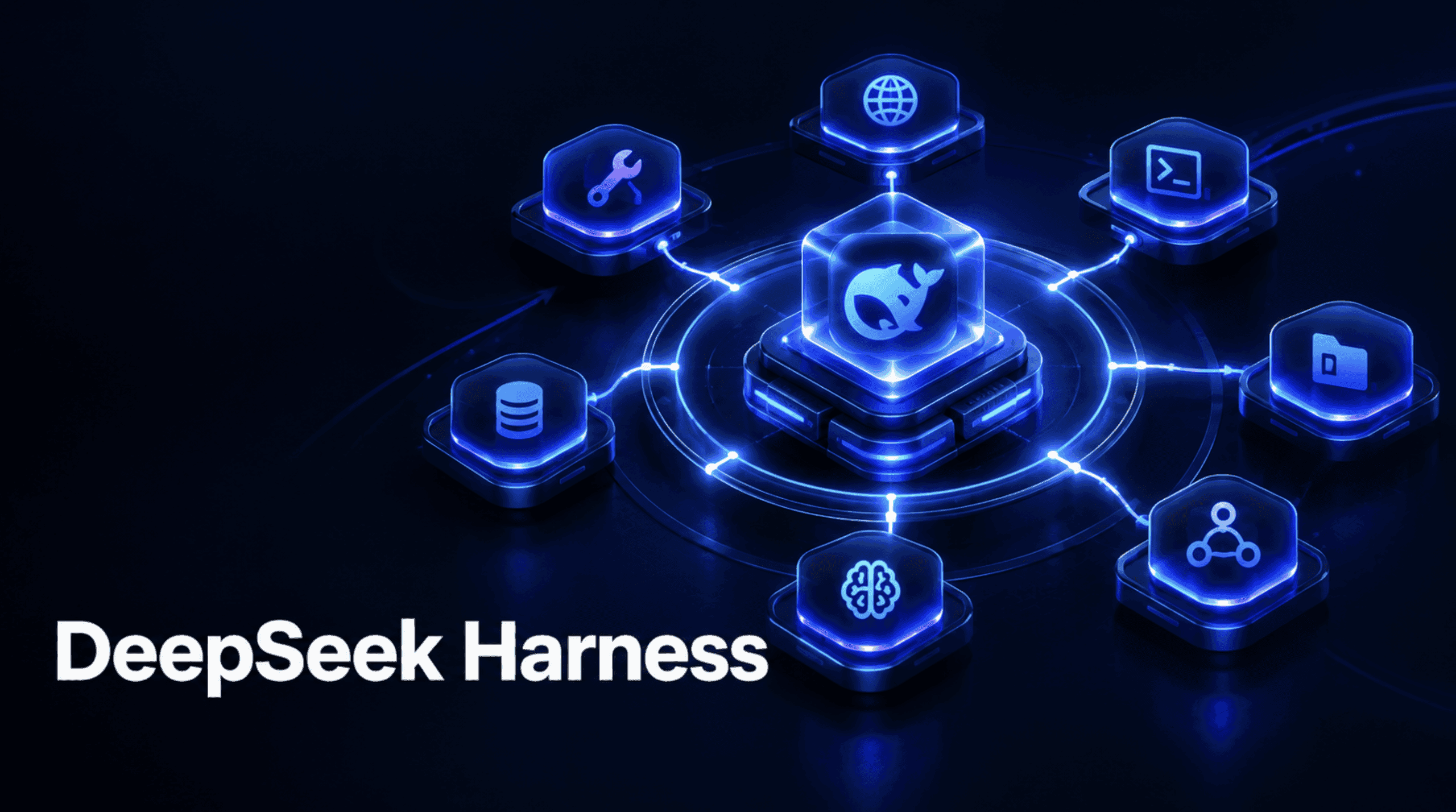
The standout feature and fundamental philosophy of DeepSeek Harness is its "everything is a plugin" architecture. Unlike many other agent frameworks that come with fixed workflows or hardcoded components, DeepSeek Harness treats nearly every part of the system as an interchangeable plugin. This includes:- Models: The underlying Large Language Model itself.
- Tools: Capabilities like file editing, shell commands, and web search.
- Skills: Reusable actions or capabilities the agent can invoke.
- Sessions: The conversation history and run state.
- Sandboxes: Isolated environments for executing code.
- Storage/Filesystems: Where state and artifacts are stored.
- Loops & Scheduling: The agent's control flow and how sub-agents are managed.
- UI: Even the user interface can be a plugin.
How DeepSeek Harness Works at a High Level
At its core, DeepSeek Harness acts as the orchestrator for your AI agent. When you give an agent a task, the Harness provides the environment and the means for the underlying language model to interact with the "real world." 1. Task Initiation: A user provides a task or prompt to the DeepSeek Harness, typically through its local web interface or command-line interface. 2. Model Reasoning: The Harness passes the task to the chosen language model (e.g., DeepSeek V4 Pro, or another integrated LLM). The model then uses its reasoning capabilities to break down the task into smaller steps and decide which tools or skills are needed. 3. Tool Execution: Based on the model's reasoning, the Harness invokes the necessary plugins. This could involve using a file editing tool to modify code, running a shell command to execute tests, or performing a web search to gather information. 4. Sandbox Environment: For code execution or sensitive operations, the Harness can utilize sandboxed environments to ensure safety and isolation. 5. Session Management: All interactions, reasoning traces, tool calls, and results are meticulously recorded in an append-only session log. This log is persistent and allows for features like "Trajectory view," where users can inspect, resume, fork, search, and replay entire sessions. This level of traceability is invaluable for debugging, understanding agent behavior, and iterating on agent designs. 6. Iterative Loop: The agent operates within an iterative loop, continually reasoning, acting, and observing until the task is completed or a defined stopping condition is met. The plugin architecture even allows for customizing this agent loop itself. 7. Output and Feedback: Once the task is done, the Harness presents the results to the user. Throughout the process, it also exposes live statistics like tokens per second, cache hit rate, and running time, giving developers deep visibility into performance and cost.Key Features and Capabilities in Detail
DeepSeek Harness offers a rich set of features that empower AI practitioners:- Plug-in Composability: As highlighted, this is the main differentiator. It means you can integrate different LLMs (DeepSeek's own, self-hosted, or even commercial models like Claude Code or Codex as sub-agents) and swap out tools, skills, and other components with ease.
- Open-Source and MIT Licensed: The entire project is open-source under the MIT license, fostering transparency, community contributions, and allowing for extensive customization without licensing restrictions.
- Local Web UI: A built-in local web application interface (accessible at `http://127.0.0.1:3080` by running `npx @deepseek-ai/dsh web`) provides a user-friendly way to interact with and manage your agents. There's also a desktop application wrapper available for a more integrated experience.
- Comprehensive Session Logging and "Trajectory View": Every single action, thought process, and tool call is logged. The "Trajectory view" allows for detailed post-mortem analysis, enabling developers to understand exactly how an agent arrived at a solution, debug failures, and even "fork" a session to try different approaches from a specific point.
- Multiple Operating Modes: The Harness ships with various modes to suit different needs, including a full coding agent mode (with file editing, shell access, and web search), a leaner code mode, a minimal mode, and a "creator mode" for building custom agent profiles.
- Flexible Model Integration: While it naturally supports DeepSeek's own V4 Flash and Pro models (requiring an API key), its plugin architecture allows for easy integration of other language models, including locally hosted ones or those from other providers, through simple YAML configuration.
- Performance Transparency: Developers get real-time feedback on metrics like tokens per second, cache hit rate, and running time, which is crucial for optimizing agent performance and managing costs.
- Local-First Design: By default, session content, tool records, and settings are stored locally, offering a degree of privacy and control over your data.
Benchmarks and Cost-Efficiency
DeepSeek AI models are generally known for their cost-effectiveness. For instance, some comparisons suggest DeepSeek models can be significantly cheaper to run than competitors. Regarding DeepSeek Harness specifically, DeepSeek reports benchmarks for its V4-Pro-0813 model when used with the Harness in minimal mode. These include scores of 87.9 on Terminal Bench 2.1, 74.1 on Toolathlon-Verified, and 71.1 on DSBench-FullStack. Other independent evaluations, such as those comparing various harnesses running models like Fable 5, indicate that DeepSeek Harness can be very token-efficient, potentially leading to lower costs, though sometimes with a trade-off in accuracy compared to other harnesses for certain benchmarks. This suggests that while the Harness itself is a powerful framework, the performance ultimately depends heavily on the chosen underlying LLM and the specific task.Why DeepSeek Harness Matters for AI Practitioners and Freelancers
For anyone building or using AI agents, DeepSeek Harness brings several significant advantages:- Unparalleled Customization: The "everything is a plugin" approach means developers are no longer constrained by a vendor's predefined agent architecture. This is huge for tailoring agents to very specific tasks, integrating proprietary tools, or experimenting with novel agentic designs. Freelancers can build highly specialized agents for clients without hitting architectural roadblocks.
- Enhanced Transparency and Debugging: The detailed session logging and "Trajectory view" are game-changers for understanding agent behavior. Debugging complex, multi-step AI agent workflows has traditionally been challenging. DeepSeek Harness provides a clear window into the agent's thought process, making it easier to identify issues, improve prompts, and refine tool usage. This transparency builds trust and allows for faster iteration.
- Future-Proofing Agent Development: As the field of AI agents evolves, new models, tools, and techniques will emerge. DeepSeek Harness's modular design means it can readily adapt to these changes. Developers can swap in newer, more capable LLMs or integrate cutting-edge tools as they become available, without having to rebuild their entire agent system.
- Cost-Effective Experimentation: Being open-source and capable of integrating with DeepSeek's own cost-efficient models (and even local models), DeepSeek Harness lowers the barrier to entry for experimentation. Freelancers and small teams can explore complex agentic architectures without incurring prohibitive API costs.
- Community-Driven Innovation: The open-source nature encourages a vibrant community to develop and share plugins, tools, and best practices. This collective effort can accelerate the development of sophisticated AI agents and provide a rich ecosystem of resources for practitioners.
Conclusion
DeepSeek Harness represents a significant step forward in the infrastructure for AI agent development. By embracing an "everything is a plugin" philosophy powered by the Cordis framework, DeepSeek AI has delivered an open-source, highly customizable, and transparent runtime. Its rapid adoption by the developer community underscores the demand for more flexible tools in this fast-evolving space. For AI practitioners, researchers, and freelancers looking to build sophisticated, adaptable, and understandable AI agents, DeepSeek Harness offers a compelling platform. It empowers you to move beyond generic agent capabilities and craft truly specialized solutions, paving the way for a new generation of intelligent automation.Frequently Asked Questions
What is the main purpose of DeepSeek Harness?
DeepSeek Harness is an open-source agent runtime designed to connect a language model with external tools, file systems, and execution environments. Its main purpose is to enable language models to act as autonomous agents, capable of planning and executing complex, multi-step tasks.
Is DeepSeek Harness free to use?
Yes, DeepSeek Harness itself is open-source and released under the MIT license, meaning it is free to use and modify. However, if you choose to integrate it with DeepSeek's proprietary LLMs (like V4 Pro/Flash) via their API, there will be associated API usage costs, though DeepSeek models are generally known for being cost-effective.
What does "everything is a plugin" mean in DeepSeek Harness?
The "everything is a plugin" architecture means that almost every component of DeepSeek Harness, including the language models, tools, skills, session management, sandboxes, and even the user interface, can be swapped out or customized. This modular design, powered by the Cordis framework, offers immense flexibility for developers to tailor the agent's behavior and capabilities.
Can DeepSeek Harness work with other AI models besides DeepSeek's own?
Yes, DeepSeek Harness is designed to be model-agnostic thanks to its plugin architecture. While it seamlessly integrates with DeepSeek's own V4 Flash and Pro models, it also allows users to add other model providers, including self-hosted or local models, and can even orchestrate other commercial agents like Claude Code or Codex as sub-agents.