Key Takeaways
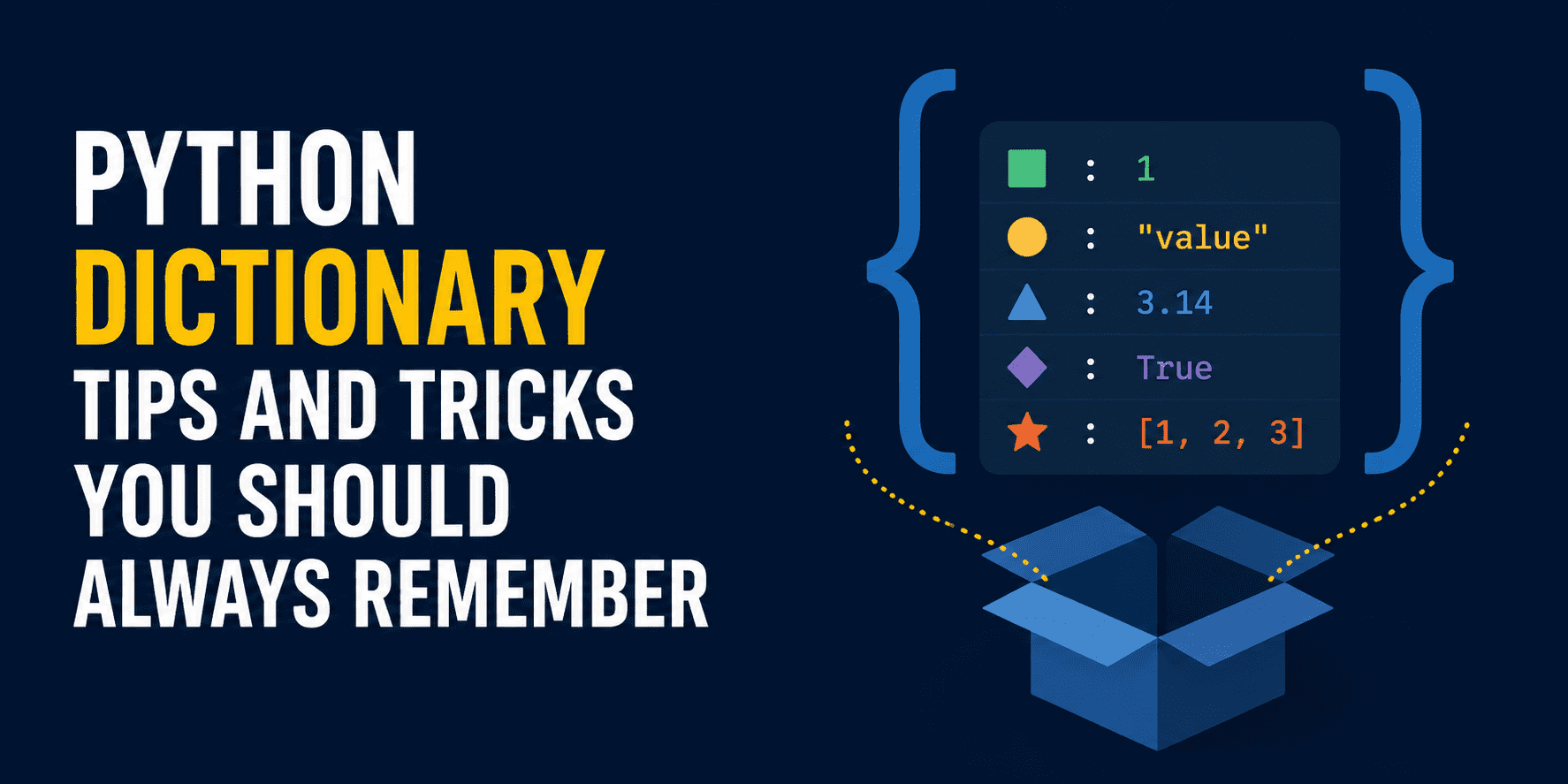
- Python dictionaries store data in key-value pairs, offering efficient data retrieval and manipulation.
- Leverage methods like
.get()and.setdefault()for safer access and automatic initialization of dictionary values. - Master dictionary comprehensions for creating dictionaries concisely and efficiently.
- Utilize the
collectionsmodule'sdefaultdictandCounterfor advanced data handling and cleaner code.
Mastering Python Dictionaries: Essential Tips for Cleaner, Safer, and Shorter Code
Python dictionaries are a fundamental data structure, playing a crucial role in almost every Python application, from simple scripts to complex AI and data science projects. They allow you to store data in key-value pairs, providing a flexible and efficient way to organize and retrieve information. As a developer, understanding how to effectively use and optimize your dictionary operations can significantly improve your code's readability, safety, and performance. This tutorial will walk you through essential Python dictionary tips and tricks that every developer should know. By mastering these techniques, you'll write more Pythonic code that is easier to maintain and less prone to common errors.What are Python Dictionaries? A Quick Refresher
Before diving into advanced tips, let's quickly review the basics. A Python dictionary, or `dict`, is a mutable collection of key-value pairs. Each key in a dictionary must be unique and immutable (like strings, numbers, or tuples), while values can be of any data type and can be duplicated. Dictionaries are defined using curly braces `{}` with key-value pairs separated by colons, and individual pairs separated by commas.
# Creating a simple dictionary
user_profile = {
    "name": "Alice",
    "age": 30,
    "city": "New York",
    "is_active": True
}

print(user_profile)
# Output: {'name': 'Alice', 'age': 30, 'city': 'New York', 'is_active': True}
Basic Dictionary Operations
Accessing Values: You can access a value by referring to its key inside square brackets.
    print(user_profile["name"])
    # Output: Alice
    user_profile["email"] = "alice@example.com" # Add new item
    user_profile["age"] = 31 # Update existing item
    print(user_profile)
    # Output: {'name': 'Alice', 'age': 31, 'city': 'New York', 'is_active': True, 'email': 'alice@example.com'}
    del user_profile["city"] # Delete an item
    print(user_profile)
    # Output: {'name': 'Alice', 'age': 31, 'is_active': True, 'email': 'alice@example.com'}

    status = user_profile.pop("is_active") # Pop and get the value
    print(status)
    # Output: True
    print(user_profile)
    # Output: {'name': 'Alice', 'age': 31, 'email': 'alice@example.com'}
Python Dictionary Tips and Tricks
Let's explore techniques that will make your dictionary code more robust and concise.1. Safer Key Access with .get() and .setdefault()
Directly accessing a dictionary key using `[]` can lead to `KeyError` if the key doesn't exist. Python provides better ways to handle this.
.get(key, default_value): This method returns the value for a given key. If the key is not found, it returns `None` by default, or the `default_value` you provide. It's a read-only operation and does not modify the dictionary.
    config = {"timeout": 30, "retries": 5}

    # Safer access - returns default if key not found
    timeout = config.get("timeout", 60)
    print(f"Timeout: {timeout}") # Output: Timeout: 30

    log_level = config.get("log_level", "INFO")
    print(f"Log Level: {log_level}") # Output: Log Level: INFO

    # Dictionary remains unchanged
    print(config)
    # Output: {'timeout': 30, 'retries': 5}
.setdefault(key, default_value): This method is similar to `get()`, but with a key difference: if the key is not in the dictionary, it inserts the key with the `default_value` and returns that value. If the key does exist, it simply returns its current value without modifying it. This is incredibly useful for initializing values only if they don't already exist, avoiding explicit `if key not in dict` checks.
    user_settings = {"theme": "dark"}

    # If 'language' doesn't exist, set it to 'en' and return 'en'
    current_language = user_settings.setdefault("language", "en")
    print(f"Current language: {current_language}") # Output: Current language: en
    print(user_settings) # Output: {'theme': 'dark', 'language': 'en'}

    # If 'theme' exists, return its value ('dark') without changing it
    current_theme = user_settings.setdefault("theme", "light")
    print(f"Current theme: {current_theme}") # Output: Current theme: dark
    print(user_settings) # Output: {'theme': 'dark', 'language': 'en'}
2. Merging Dictionaries Efficiently
Combining dictionaries is a common task. Python offers several elegant ways to do this. Using.update(): This method merges one dictionary into another. If keys overlap, values from the dictionary passed to `update()` will overwrite existing values.
    dict1 = {"a": 1, "b": 2}
    dict2 = {"b": 3, "c": 4}

    dict1.update(dict2)
    print(dict1) # Output: {'a': 1, 'b': 3, 'c': 4}
    dict_a = {"name": "John", "age": 25}
    dict_b = {"age": 30, "city": "London"}

    merged_dict = {dict_a, dict_b}
    print(merged_dict) # Output: {'name': 'John', 'age': 30, 'city': 'London'}
    dict_x = {"fruit": "apple", "color": "red"}
    dict_y = {"color": "green", "taste": "sweet"}

    # Merge operator (|) - creates a new dictionary
    new_merged_dict = dict_x | dict_y
    print(f"New merged dict: {new_merged_dict}")
    # Output: New merged dict: {'fruit': 'apple', 'color': 'green', 'taste': 'sweet'}

    # In-place update operator (|=)
    dict_x |= dict_y
    print(f"dict_x after update: {dict_x}")
    # Output: dict_x after update: {'fruit': 'apple', 'color': 'green', 'taste': 'sweet'}
3. Concise Dictionary Creation with Dictionary Comprehensions
Just like list comprehensions, dictionary comprehensions offer a compact way to create dictionaries from iterables. They are powerful for transforming existing dictionaries or generating new ones based on specific logic.
# Create a dictionary of squares
squares = {num: num4. Efficient Iteration over Dictionaries
When looping through a dictionary, it's important to choose the most efficient method for your needs. Iterating over Keys (Default): When you loop directly over a dictionary, you get its keys.
    my_dict = {"a": 1, "b": 2, "c": 3}
    for key in my_dict:
        print(key)
    # Output: a, b, c (each on a new line)
.keys(): Explicitly returns a view object that displays a list of all the keys.
    for key in my_dict.keys():
        print(key)
.values(): Returns a view object that displays a list of all the values.
    for value in my_dict.values():
        print(value)
    # Output: 1, 2, 3 (each on a new line)
.items(): Returns a view object that displays a list of a dictionary's key-value tuple pairs. This is usually the most efficient way to iterate when you need both keys and values.
    for key, value in my_dict.items():
        print(f"{key}: {value}")
    # Output:
    # a: 1
    # b: 2
    # c: 3
5. Checking for Key Existence with in
The `in` operator is the most Pythonic and efficient way to check if a key exists in a dictionary.
product = {"id": "P101", "name": "Laptop", "price": 1200}

if "name" in product:
    print("Product name exists.")

if "stock" not in product:
    print("Stock information is missing.")
6. Using collections.defaultdict for Automatic Default Values
The `collections` module provides `defaultdict`, a specialized dictionary subclass that calls a factory function to supply missing values. This is incredibly powerful when you need to group items or count occurrences without manually checking if a key exists and initializing it.
from collections import defaultdict

# Grouping words by their first letter
words = ["apple", "banana", "apricot", "berry", "cherry"]
grouped_by_first_letter = defaultdict(list)

for word in words:
    grouped_by_first_letter[word].append(word)

print(grouped_by_first_letter)
# Output: defaultdict(<class 'list'>, {'a': ['apple', 'apricot'], 'b': ['banana', 'berry'], 'c': ['cherry']})

# Counting occurrences
word_counts = defaultdict(int) # int() returns 0
sentence = "the quick brown fox jumps over the lazy dog the quick brown fox"
for word in sentence.split():
    word_counts[word] += 1

print(word_counts)
# Output: defaultdict(<class 'int'>, {'the': 3, 'quick': 2, 'brown': 2, 'fox': 2, 'jumps': 1, 'over': 1, 'lazy': 1, 'dog': 1})
7. Counting Hashable Objects with collections.Counter
For specific counting tasks, `collections.Counter` (also from the `collections` module) is even more specialized and efficient than `defaultdict(int)`. It's a subclass of `dict` that's designed for counting hashable objects.
from collections import Counter

data = ["apple", "banana", "apple", "orange", "banana", "apple"]

# Count occurrences of elements
fruit_counts = Counter(data)
print(fruit_counts)
# Output: Counter({'apple': 3, 'banana': 2, 'orange': 1})

# Access counts
print(fruit_counts["apple"]) # Output: 3
print(fruit_counts["grape"]) # Output: 0 (returns 0 for missing keys, not KeyError)

# Find most common elements
print(fruit_counts.most_common(2)) # Output: [('apple', 3), ('banana', 2)]
8. Shallow vs. Deep Copying Dictionaries
When you assign one dictionary to another, you're not creating a new independent copy; you're just creating a new reference to the same dictionary. This is called a shallow copy.
original_dict = {"a": 1, "b": 2}
another_ref = original_dict
another_ref["a"] = 100

print(original_dict) # Output: {'a': 100, 'b': 2} - original_dict was also changed!
.copy() (Shallow Copy): Creates a new dictionary, but if the original dictionary contains mutable objects (like lists or other dictionaries) as values, the new dictionary will still reference those same mutable objects.
    original = {"name": "Alice", "data":}
    shallow_copy = original.copy()

    shallow_copy["name"] = "Bob"
    shallow_copy["data"].append(4) # Modifies the list in both dictionaries!

    print(original)     # Output: {'name': 'Alice', 'data':}
    print(shallow_copy) # Output: {'name': 'Bob', 'data':}
copy.deepcopy() (Deep Copy): If your dictionary contains nested mutable objects, and you want a completely independent copy, use `copy.deepcopy()`. This creates new copies of all nested objects recursively.
    import copy

    original = {"name": "Alice", "data":, "details": {"id": 1}}
    deep_copy = copy.deepcopy(original)

    deep_copy["name"] = "Bob"
    deep_copy["data"].append(4)
    deep_copy["details"]["id"] = 2

    print(original)   # Output: {'name': 'Alice', 'data':, 'details': {'id': 1}}
    print(deep_copy)  # Output: {'name': 'Bob', 'data':, 'details': {'id': 2}}
Conclusion
Python dictionaries are incredibly versatile and powerful, forming the backbone of many programming tasks. By integrating these tips and tricks into your daily coding, you can write Python code that is not only more efficient but also easier to read, understand, and maintain. From safely handling missing keys with `.get()` and `.setdefault()`, to concisely creating dictionaries with comprehensions, and leveraging specialized tools like `defaultdict` and `Counter`, these techniques will elevate your dictionary mastery. Keep practicing them, and you'll find your Python code becoming significantly cleaner and more robust.Frequently Asked Questions
What is the main difference between .get() and .setdefault()?
The .get(key, default) method retrieves a value for a key, returning None or a specified default if the key isn't found, without modifying the dictionary. In contrast, .setdefault(key, default) also retrieves the value but will insert the key with the specified default value into the dictionary if the key is missing, then return that value.
When should I use dictionary comprehensions?
Dictionary comprehensions are best used when you need to create a new dictionary based on an existing iterable (like a list, tuple, or another dictionary) with concise transformation or filtering logic. They make your code more readable and often more efficient than traditional for loops for dictionary creation.
Why is collections.defaultdict useful?
collections.defaultdict is useful when you want to simplify code that deals with keys that might not exist yet, especially when grouping items or accumulating counts. Instead of manually checking if a key exists and then initializing its value, defaultdict automatically creates a default value (e.g., an empty list, a zero integer) when a missing key is accessed, leading to cleaner and more concise code.
What is the purpose of the | operator for dictionaries in Python 3.9+?
The | (merge) operator, introduced in Python 3.9, provides a clean and direct way to combine two dictionaries into a new one. It merges the key-value pairs, with values from the right-hand dictionary overwriting those from the left if keys overlap. It's a more modern and often preferred alternative to {dict1, dict2} for creating a new merged dictionary.