Key Takeaways
- DSpark Speculative Decoding, developed by DeepSeek, significantly boosts local LLM inference speed by 60-85% on the same GPU.
- It intelligently combines parallel and sequential drafting with confidence-scheduled verification to optimize token generation quality and efficiency.
- When integrated with `llama.cpp` and leveraging CUDA, DSpark allows models like Qwen3-8B to run much faster on local hardware.
- This technology is a game-changer for AI practitioners and developers looking to maximize performance from their existing local GPU setups.
Supercharge Your Local LLM: Deep Dive into DSpark Speculative Decoding
Large Language Models (LLMs) have taken the tech world by storm, powering everything from advanced chatbots to sophisticated code assistants. While cloud-based LLMs offer immense power, running these models locally on your own hardware has become increasingly popular, offering greater privacy, control, and often, cost savings. However, a common hurdle for local LLM enthusiasts and developers is inference speed—how quickly the model can generate responses. Even with powerful GPUs, waiting for token after token to appear can be a drag.
This is where cutting-edge techniques like speculative decoding come into play, and one of the most promising recent advancements is DSpark speculative decoding. This innovative approach promises to significantly boost the generation speed of local LLMs, even when using the same GPU, by intelligently optimizing how tokens are produced and verified. In this deep dive, we'll break down DSpark, understand its underlying mechanics, and explore how it integrates with popular tools like Qwen3-8B, llama.cpp, and CUDA to deliver a snappier local LLM experience.
Understanding the LLM Inference Challenge
Before we jump into DSpark, let's quickly touch on why LLM inference can be slow. When an autoregressive LLM generates text, it typically produces one token at a time. After generating a token, the model needs to re-evaluate the entire sequence (input prompt + generated tokens so far) to predict the next single token. This sequential nature means that for every new word or sub-word (token) the model outputs, it performs a full forward pass. This process, especially for large models, is often "bandwidth-limited," meaning the GPU's arithmetic units spend a lot of time waiting for model parameters to be loaded from memory, rather than actively computing.
For local setups, this can be particularly challenging. While powerful GPUs offer high computational throughput, the memory bandwidth required to constantly load and unload billions of parameters for each token can become a bottleneck, leading to slower generation speeds.
What is Speculative Decoding? The Core Idea
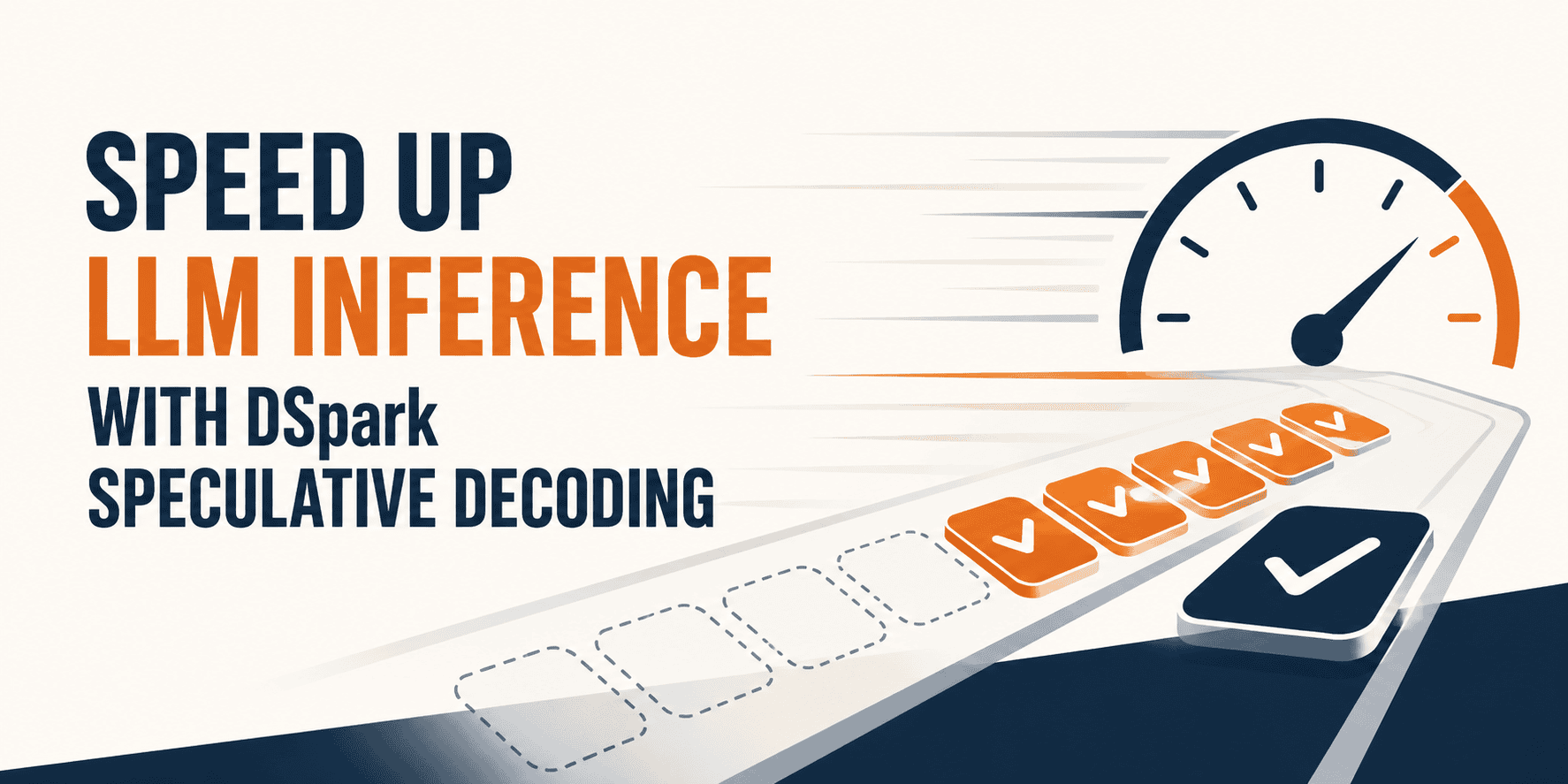
Speculative decoding is a clever technique designed to bypass the token-by-token bottleneck. The core idea is simple yet effective: instead of waiting for the main, large LLM to generate one token at a time, a smaller, faster "draft model" (sometimes called a "speculator") is used to predict a sequence of several future tokens.
Once the draft model generates this speculative sequence, the larger, more accurate main model then verifies these proposed tokens in a single, parallel pass. The main model checks which of the drafted tokens are correct and accepts the longest prefix of matching tokens. If a token is rejected, the main model generates the correct token from that point onward, and the process repeats. This way, if the draft model is accurate, the main model can effectively generate multiple tokens in the time it would normally take to generate just one, leading to significant speedups.
The beauty of speculative decoding is that it doesn't change the final output quality of the main model. The main model's outputs are always the authoritative ones; the draft model just helps it get there faster.
DSpark: Elevating Speculative Decoding for Local LLMs
DSpark takes the concept of speculative decoding and supercharges it with intelligent optimizations, making it particularly effective for improving local LLM generation speed. Developed by Xin Cheng and colleagues at Peking University and DeepSeek, DSpark is an open-source speculative decoding framework.
How DSpark Works Under the Hood
Traditional parallel drafters in speculative decoding can predict a block of tokens quickly. However, a challenge arises: later predictions in such a block might become less accurate because they don't fully depend on the tokens predicted earlier within the same block, leading to what's called "suffix decay."
DSpark addresses this by combining a parallel backbone with a lightweight sequential component. This "semi-autoregressive architecture" allows DSpark to introduce intra-block dependency modeling, meaning later draft tokens can incorporate information from earlier predictions within the same block. This helps to maintain the quality of the drafted sequence while still retaining much of the speed advantage of parallel generation.
Beyond improving draft quality, DSpark also employs confidence-scheduled verification. This is a crucial innovation. DSpark can estimate how likely drafted tokens are to survive the main model's verification. Based on these confidence estimates and the inference engine's throughput profile, it dynamically adjusts the length of the sequence sent for verification. This intelligent scheduling means that low-confidence parts of a draft block can be dropped before verification, preventing wasted computational resources on tokens that are likely to be rejected. This is especially important in high-concurrency serving systems where batch capacity is a shared, finite resource.
DeepSeek's implementation of DSpark involves training only a few specific parts—a drafting backbone, a small sequential component, and a confidence head—while efficiently reusing the target model's existing embedding layer and output head.
The DSpark Advantage: Real-World Impact
The results of DSpark are compelling. When applied to DeepSeek's production models, DSpark has been shown to speed up text generation by more than 50% without compromising accuracy. In a live user traffic scenario within the DeepSeek-V4 serving system, DSpark accelerated per-user generation speeds by 60 to 85 percent at matched throughput levels, compared to a baseline using Multi-Token Prediction (MTP-1).
Crucially, DSpark achieves these speed improvements without requiring additional GPUs, making it an incredibly valuable optimization for local LLM users who want to get more out of their existing hardware.
Qwen3-8B: A Powerful Partner for DSpark
The feed item specifically mentions testing DSpark with Qwen3-8B. This is a dense 8-billion-parameter causal language model developed by Alibaba, part of their broader Qwen3 series. Qwen3-8B is known for its efficiency and strong performance across various natural language processing tasks.
Key features of Qwen3-8B include:
- Unified "Thinking" and "Non-Thinking" Modes: It can seamlessly switch between a complex reasoning mode (for tasks like math and coding) and a rapid, general-purpose dialogue mode.
- Grouped Query Attention (GQA): This architectural choice optimizes KV cache throughput and memory efficiency, which is beneficial for inference speed.
- Rotary Positional Embeddings (RoPE): Enables robust handling of long contexts, natively supporting up to 32,768 tokens and extendable to 131,072 tokens with methods like YaRN.
- Extensive Multilingual Training: Pretrained on tens of trillions of tokens across 119 languages, giving it broad language proficiency.
- Enhanced Capabilities: Offers improved reasoning, human preference alignment, and agent capabilities, making it versatile for many applications.
Qwen3-8B's efficient architecture makes it a strong candidate for local deployment, and when combined with DSpark, its generation capabilities can be significantly enhanced.
Llama.cpp and CUDA: The Local LLM Ecosystem
To run LLMs like Qwen3-8B with DSpark on local hardware, developers often turn to `llama.cpp`. This project, originally designed for efficient CPU inference, has evolved into a robust framework for running various LLMs, including those in the GGUF format, and offers strong GPU acceleration.
Llama.cpp as the Inference Engine
The `llama.cpp` project is a popular choice for local LLM inference due to its optimization for consumer hardware. It supports speculative decoding, and importantly, it exposes the DSpark implementation. This means developers can build `llama.cpp` from source and enable DSpark to take advantage of its speed improvements.
Using `llama.cpp`, you typically work with GGUF model files, which are quantized versions of LLMs optimized for efficient local execution. You download both the main model (e.g., Qwen3-8B in GGUF format) and a smaller, matching draft model for DSpark.
Leveraging CUDA for GPU Acceleration
While `llama.cpp` can run on CPUs, the true power for LLM inference often comes from GPUs, especially NVIDIA GPUs. This is where CUDA comes in. CUDA is NVIDIA's parallel computing platform and programming model, allowing software developers to use a GPU's processing power for general-purpose computing. For LLMs, CUDA enables highly optimized operations, dramatically speeding up the complex matrix multiplications involved in inference.
When you build `llama.cpp` with CUDA acceleration enabled, it can offload model layers to your NVIDIA GPU, leveraging its parallel processing capabilities. DSpark, when implemented within `llama.cpp` and combined with CUDA, ensures that the speculative decoding process itself is highly optimized and can fully utilize your GPU for maximum speed gains.
What DSpark Means for AI Practitioners and Developers
For anyone working with or experimenting with local LLMs, DSpark speculative decoding is a significant development:
- Faster Local Development & Prototyping: Quicker response times mean a more fluid and efficient workflow for testing prompts, iterating on applications, and developing new features with LLMs.
- Enhanced User Experience: For local applications powered by LLMs, faster generation directly translates to a better experience for end-users, reducing waiting times and making interactions feel more natural.
- Maximized Hardware Utilization: DSpark helps you squeeze more performance out of your existing GPU, potentially delaying the need for expensive hardware upgrades. This is crucial for developers and small businesses operating on a budget.
- Accessibility: By making powerful LLMs more responsive on consumer-grade hardware, DSpark lowers the barrier to entry for local AI development and deployment.
- Efficiency in Serving: While the focus here is local, DSpark's principles of confidence-scheduled verification also have profound implications for efficient LLM serving in high-concurrency environments, minimizing wasted computation.
While some early speculative decoding implementations on certain consumer GPUs and specific MoE models showed mixed results, DSpark's sophisticated approach to draft quality and adaptive verification aims to overcome these limitations, making it a more robust solution for a wider range of models and hardware.
Getting Started (High-Level)
If you're interested in trying DSpark with Qwen3-8B and `llama.cpp`, the general steps involve:
- Building `llama.cpp` with CUDA Support: You'll need to compile the latest `llama.cpp` from its official GitHub repository, ensuring CUDA acceleration is enabled for your NVIDIA GPU. You can find detailed instructions on the llama.cpp GitHub page.
- Downloading Models: Obtain the GGUF files for your desired main model (e.g., Qwen3-8B) and a suitable, smaller draft model. These are typically available on platforms like Hugging Face.
- Running Inference with DSpark: Execute `llama.cpp`'s inference command, specifying both the main model and the draft model, along with parameters to enable DSpark and offload layers to the GPU. The exact command-line arguments can be found in the llama.cpp documentation on speculative decoding.
Benchmarking your baseline speed without DSpark and then comparing it to the DSpark-enabled run will clearly illustrate the performance gains.
Conclusion
DSpark speculative decoding represents a significant leap forward in optimizing LLM inference, particularly for local deployments. By intelligently combining parallel drafting with sequential refinement and adaptive verification, it offers substantial speedups without compromising output quality. For developers and AI practitioners leveraging tools like Qwen3-8B, llama.cpp, and CUDA, DSpark unlocks a new level of efficiency and responsiveness, making local LLM experiences faster, smoother, and more enjoyable. As the local AI ecosystem continues to grow, innovations like DSpark will be crucial in democratizing access to powerful language models and expanding their practical applications.
Frequently Asked Questions
What is DSpark speculative decoding?
DSpark speculative decoding is an advanced technique developed by DeepSeek that significantly speeds up Large Language Model (LLM) inference. It works by using a smaller, faster "draft model" to predict multiple tokens in parallel, which are then efficiently verified by the main, larger LLM. DSpark enhances this by adding a lightweight sequential component to improve draft quality and uses "confidence-scheduled verification" to dynamically adjust the verification length, preventing wasted computation.
How much faster can DSpark make LLM inference?
DSpark has been shown to accelerate per-user generation speeds by 60 to 85 percent in DeepSeek's production systems compared to a baseline. For local LLM inference, it can provide significant speedups, often making models run much faster on the same GPU without needing additional hardware.
Does DSpark compromise the accuracy of the LLM's output?
No, DSpark does not compromise the accuracy of the LLM's output. The larger, main LLM is always responsible for verifying and ultimately generating the final tokens. The draft model merely proposes tokens, and only those verified by the main model are accepted. This ensures the output quality remains consistent with the original LLM.
What models and tools are compatible with DSpark?
DSpark is an open-source technique. It's designed to work with various LLMs, and its implementation is exposed in frameworks like `llama.cpp`. The article discusses its use with Qwen3-8B, a dense 8-billion-parameter model, leveraging CUDA for GPU acceleration. Generally, any LLM that can be run with `llama.cpp` and has a suitable smaller draft model can potentially benefit from DSpark.