Key Takeaways
- Small Language Models (SLMs) offer cost-effective, private, and efficient AI solutions, making them crucial for specialized applications and local deployment.
- Understanding foundational architectures like Llama 2 is essential for building and optimizing SLMs for specific tasks.
- Tools like Hugging Face PEFT enable efficient fine-tuning of SLMs, drastically reducing the computational resources needed.
- Frameworks such as LangChain empower data professionals to build sophisticated AI agents using SLMs, creating specialized, adaptable workflows.
- Ollama simplifies the local deployment of SLMs, bringing powerful AI capabilities directly to your hardware with ease.
- The Hugging Face ecosystem provides a comprehensive hub for learning, sharing, and deploying SLMs, fostering community growth and practical application.
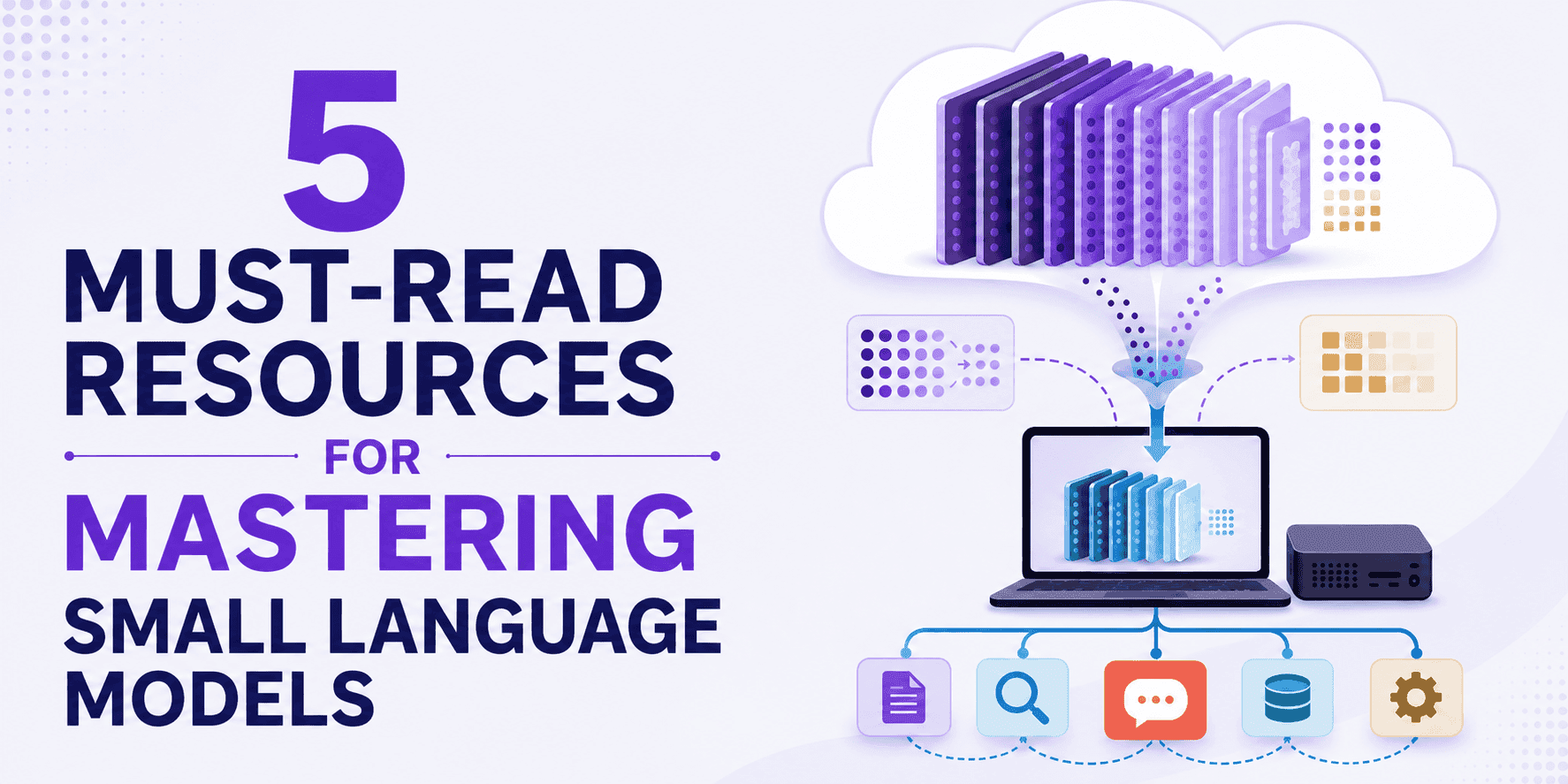
The world of Artificial Intelligence moves fast, and while Large Language Models (LLMs) often grab the headlines, a quieter, equally powerful revolution is happening with Small Language Models (SLMs). These compact, efficient models are changing how data professionals approach AI, offering a sweet spot between capability and practicality. They're not just scaled-down LLMs; they represent a strategic shift towards more focused, cost-effective, and privacy-preserving AI solutions.
Mastering SLMs means understanding their architecture, knowing how to fine-tune them for specific tasks, integrating them into intelligent workflows, and deploying them efficiently on local hardware. This article dives deep into five essential resources that can help any data professional or AI enthusiast gain a solid grasp of these critical areas. We'll explore foundational models, powerful fine-tuning libraries, agent-building frameworks, and local deployment tools, all culminating in a holistic view of the SLM ecosystem.
The Rise of Small Language Models (SLMs): Why They Matter Now
For a long time, the narrative in AI centered around "bigger is better" when it came to language models. The sheer scale of models like GPT-4 or Claude has indeed led to impressive generalized capabilities. However, this scale comes with significant drawbacks: immense computational costs for training and inference, high energy consumption, privacy concerns when sending data to external APIs, and a lack of specialization for niche tasks.
This is where SLMs step in. Typically ranging from a few hundred million to tens of billions of parameters (compared to hundreds of billions or trillions for LLMs), SLMs are designed to be:
- Cost-Effective: Cheaper to train, fine-tune, and run, both in terms of cloud compute and energy.
- Faster: Quicker inference times, allowing for more responsive applications.
- Private: Can be deployed locally or on-premise, keeping sensitive data within an organization's control.
- Specialized: Easier to fine-tune for specific domains or tasks, leading to higher accuracy and relevance in those areas than a general-purpose LLM.
- Accessible: Can run on more modest hardware, including consumer-grade GPUs or even CPUs, democratizing AI access.
For AI practitioners and freelancers, understanding and utilizing SLMs means unlocking new possibilities for custom AI solutions, from intelligent chatbots for small businesses to specialized data analysis tools, all without breaking the bank or compromising data security. Let's explore the resources that will guide you on this journey.
Resource 1: Understanding SLM Architecture with Llama 2's Foundations
To truly master SLMs, you need to understand what makes them tick. The underlying architecture dictates a model's capabilities, efficiency, and how it processes information. One of the most influential open-source SLMs that has significantly impacted the field is Llama 2 by Meta AI. While Llama 2 comes in various sizes, its 7B and 13B parameter versions are prime examples of powerful SLMs.
The official Llama 2 research paper, published by Meta AI in July 2023, is an invaluable resource for anyone looking to grasp the architectural nuances that contribute to SLMs' performance. It details the model's structure, pre-training methodologies, and fine-tuning strategies. Key architectural components discussed include:
- Transformer Architecture: Like many modern LLMs, Llama 2 is built on the transformer architecture, relying on self-attention mechanisms.
- Grouped-Query Attention (GQA): This innovation is particularly important for efficiency in larger Llama 2 models (like 70B, but concepts apply to understanding efficiency in smaller variants too) as it allows multiple attention heads to share key and value projections, speeding up inference without significantly compromising quality.
- RMSNorm: Instead of LayerNorm, Llama 2 uses Root Mean Square Normalization for stability and performance.
- SwiGLU Activation Function: This gating mechanism provides better performance compared to standard ReLU or GeLU activations.
By studying the Llama 2 paper, you gain insights into the design choices that make these models performant yet relatively efficient. It explains not just what was built, but why—providing a solid foundation for evaluating other SLMs or even developing your own custom architectures. This resource is fundamental for anyone serious about the technical underpinnings of SLMs.
Resource 2: Precision Tuning with Hugging Face PEFT
Once you understand an SLM's architecture, the next step is often to adapt it for your specific needs. This process, known as fine-tuning, can be resource-intensive. Traditional fine-tuning involves updating all of a model's parameters, which requires significant computational power and storage, even for SLMs.
Enter the Hugging Face PEFT (Parameter-Efficient Fine-Tuning) library. Developed by Hugging Face, PEFT is an open-source library that provides various methods to fine-tune pre-trained language models more efficiently. It significantly reduces the computational and memory footprint, making fine-tuning SLMs accessible even on consumer-grade GPUs. The library has been continuously updated since its initial release around late 2022/early 2023.
Key techniques within PEFT include:
- LoRA (Low-Rank Adaptation): This method injects small, trainable matrices into the transformer layers. Instead of fine-tuning all parameters, you only train these much smaller matrices, drastically reducing the number of trainable parameters. This makes the fine-tuning process much faster and requires less memory.
- QLoRA (Quantized Low-Rank Adaptation): An extension of LoRA that quantizes the pre-trained model to 4-bit precision, further reducing memory usage while maintaining performance. This allows fine-tuning even larger SLMs on hardware with limited VRAM.
- Prompt Tuning, P-Tuning, Prefix Tuning: These methods focus on optimizing specific "soft prompts" or prefixes that guide the model's behavior, rather than modifying the model's weights directly.
For data professionals, PEFT is a game-changer. It means you can take a general-purpose SLM like Mistral 7B or Llama 2 7B and quickly adapt it to specialized tasks—like legal document summarization, medical question answering, or customer support—with minimal resources. The official PEFT documentation provides clear guides and examples, making it an indispensable resource for practical SLM application.
Resource 3: Building Smart Agents with LangChain
Beyond simple text generation, the true power of language models, including SLMs, often shines when they are integrated into agentic workflows. An AI agent is a system that can perceive its environment, make decisions, and take actions to achieve a specific goal. Building such agents requires orchestrating various components, and this is where frameworks like LangChain excel.
LangChain, developed by Harrison Chase and LangChain Inc., first publicly released in October 2022, is an open-source framework designed to simplify the creation of applications powered by language models. It provides a structured way to connect LLMs (and SLMs) with other data sources and tools, enabling them to act intelligently and autonomously.
For SLM practitioners, LangChain is crucial because it allows you to leverage the specialized capabilities of a fine-tuned SLM within a broader, goal-oriented system. Instead of relying on a massive, general-purpose LLM for every step, you can use a smaller, more efficient SLM for specific sub-tasks where it excels. Key features of LangChain include:
- Chains: Combine LLMs/SLMs with other components (like prompt templates or output parsers) in a sequence.
- Agents: Allow models to choose a sequence of actions, using tools (like search engines, calculators, or custom APIs) to achieve a goal.
- Memory: Give agents the ability to remember past interactions.
- Document Loaders & Retrievers: Easily ingest and search through custom data, enabling models to interact with your specific knowledge base.
By using LangChain with SLMs, you can build cost-effective and highly specialized agents for tasks such as automated customer service, data extraction from proprietary documents, or intelligent content generation for specific niches. The LangChain Python documentation is an excellent starting point for learning how to build these complex, intelligent applications.
Resource 4: Deploying SLMs Locally with Ollama
One of the most compelling advantages of SLMs is their ability to run efficiently on local hardware. This opens doors for enhanced privacy, reduced cloud costs, and offline accessibility. However, setting up and managing these models locally can sometimes be complex, requiring specific dependencies and configurations.
Ollama, first publicly released in October 2023 by Ollama, Inc., has emerged as a fantastic tool that simplifies this process dramatically. It's an open-source platform that allows you to easily download, run, and even create your own SLMs on your personal computer, leveraging GPU acceleration where available.
Ollama streamlines local deployment by:
- Bundling Models: It provides a command-line interface (CLI) to download popular SLMs like Mistral, Llama 2, Gemma, and many others, pre-packaged for optimal local performance.
- Easy Running: With a simple command, you can run a model and interact with it via a local API or directly in your terminal.
- Modelfiles: Ollama introduces "Modelfiles," which are simple text files allowing you to customize existing models (e.g., changing system prompts, adjusting parameters) or create new ones by bundling weights.
- Cross-Platform Support: Available for macOS, Linux, and Windows, making local AI accessible to a broad audience.
Under the hood, Ollama often utilizes optimizations like GGUF (GPT-Generated Unified Format) and relies on the principles established by projects like Llama.cpp for efficient CPU/GPU inference. For data professionals, Ollama means you can experiment with, prototype, and deploy SLM-powered applications without relying on cloud infrastructure, ensuring data privacy and reducing operational costs. The Ollama website offers comprehensive guides to get you started in minutes.
Resource 5: The Hugging Face Ecosystem - Your SLM Learning Hub
While we've highlighted specific tools, a holistic approach to mastering SLMs requires a vibrant community and a wealth of resources. The broader Hugging Face ecosystem stands out as the ultimate hub for AI practitioners. Founded in 2016, Hugging Face has continuously evolved into a central platform for machine learning, particularly for natural language processing and generative AI.
For SLM enthusiasts, Hugging Face offers:
- Model Hub: A vast repository of thousands of pre-trained models, including countless SLMs (e.g., variants of Llama, Mistral, Gemma, Phi), often with different sizes, fine-tuned versions, and quantization levels. Each model card provides details on architecture, training data, benchmarks, and usage examples.
- Datasets Hub: A collection of datasets essential for pre-training, fine-tuning, and evaluating SLMs.
- Spaces: A platform to host and share interactive machine learning demos, often featuring SLMs in action.
- Transformers Library: The foundational library for working with transformer models, providing easy-to-use APIs for loading, fine-tuning, and inferencing SLMs.
- Free Courses: Hugging Face offers comprehensive, free courses on topics like "Natural Language Processing," "Diffusion Models," and "Reinforcement Learning," which often include sections relevant to smaller, more efficient models. The Hugging Face Learn section is a treasure trove of educational content.
- Community: A thriving community of researchers, developers, and practitioners who share knowledge, collaborate on projects, and provide support.
Whether you're looking for a specific SLM, a dataset to fine-tune it, a tool to optimize its performance, or a course to deepen your understanding, Hugging Face is the go-to resource. It's not just a collection of tools; it's a dynamic environment that supports continuous learning and practical application in the SLM space.
Bringing It All Together: A Holistic Approach to Mastering SLMs
Mastering Small Language Models isn't about knowing one tool or one concept; it's about understanding the entire lifecycle, from foundational architecture to efficient deployment. The resources we've explored provide a comprehensive toolkit for any data professional looking to specialize in this exciting field.
- The Llama 2 paper gives you the theoretical bedrock for understanding SLM design.
- Hugging Face PEFT empowers you to efficiently adapt these models to your unique data and tasks.
- LangChain provides the framework to weave SLMs into intelligent, agentic workflows that solve real-world problems.
- Ollama makes local, private, and cost-effective deployment a reality for everyone.
- And the broader Hugging Face ecosystem serves as your continuous learning partner, offering models, datasets, tools, and educational content.
By leveraging these five resources, you're not just passively consuming information; you're actively engaging with the tools and knowledge that define the cutting edge of practical AI with Small Language Models. This integrated approach ensures you're well-equipped to build, deploy, and innovate with SLMs, delivering powerful AI solutions that are both effective and accessible.
Frequently Asked Questions
What are Small Language Models (SLMs) and how are they different from LLMs?
Small Language Models (SLMs) are AI models with fewer parameters (typically billions rather than hundreds of billions or trillions) than Large Language Models (LLMs). This makes them more efficient, faster, cheaper to run, and easier to deploy locally, often with better privacy controls. While LLMs aim for broad general intelligence, SLMs are frequently fine-tuned for specialized tasks.
Why should data professionals focus on mastering SLMs?
Mastering SLMs allows data professionals to build and deploy AI solutions that are cost-effective, maintain data privacy, can run on more accessible hardware, and are highly specialized for specific business needs. This opens up opportunities for custom AI applications in scenarios where large, general-purpose LLMs might be overkill or too expensive.
Can SLMs be used to build AI agents, and if so, how?
Yes, SLMs can absolutely be used to build AI agents. Frameworks like LangChain allow you to integrate SLMs as the "brain" of an agent, connecting them with various tools and data sources. This enables SLMs to perform specific tasks within a broader workflow, making decisions and taking actions based on their specialized training, often more efficiently than a large, general-purpose model.
Is it possible to run SLMs on my personal computer, and what tools help with this?
Yes, it's increasingly possible to run many SLMs on personal computers, especially those with dedicated GPUs. Tools like Ollama simplify this process significantly. Ollama allows you to easily download, run, and manage various SLMs on your local machine, providing a user-friendly interface and API for interaction, often leveraging efficient formats like GGUF for optimal performance.