Key Takeaways
- Outlines is an open-source Python library that brings deterministic, structured output generation to Large Language Models (LLMs).
- It guarantees LLM outputs will conform to defined structures like JSON schemas, regular expressions, or context-free grammars, eliminating parsing errors.
- Developed and maintained by .txt, Outlines integrates with various LLM backends (OpenAI, Hugging Face Transformers, vLLM, etc.) with minimal inference overhead.
- Ideal for developers building robust, production-ready AI applications requiring reliable data extraction, API interactions, and agentic workflows.
Outlines: Bringing Deterministic Structure to LLM Outputs for Robust AI Applications
Large Language Models (LLMs) have taken the tech world by storm, offering incredible capabilities for generating human-like text, answering questions, and even writing code. However, a persistent challenge for developers integrating LLMs into real-world applications has been the unpredictable nature of their outputs. Imagine asking an LLM for a user's profile in JSON format, only to receive a slightly malformed string that breaks your parsing logic. This is where "Outlines" steps in. Outlines is an open-source Python library designed to solve this exact problem: it introduces deterministic certainty into the LLM output generation process, ensuring that models produce structured outputs that adhere to predefined formats. For any AI practitioner or software developer working with LLMs, this library is a game-changer for building reliable, production-ready AI systems.What Exactly is Outlines?
At its core, Outlines is a library for neural text generation that acts as a more flexible and powerful replacement for standard generation methods found in libraries like Hugging Face's `transformers`. Its primary purpose is to help developers structure text generation to build robust interfaces with external systems. Instead of hoping an LLM will generate the correct format, Outlines guarantees it. The problem Outlines addresses is fundamental: LLMs are inherently designed to generate free-form text. While they can often follow instructions to produce structured data, there's always a chance of deviation, leading to parsing errors, broken workflows, and a need for costly post-processing or retry mechanisms. Outlines tackles this by enforcing constraints during the generation process, not after.Why Outlines Matters: The Need for Structured Outputs
In the world of software development, predictability and reliability are paramount. When integrating an LLM into an application, whether it's for data extraction, API interaction, or orchestrating complex agentic workflows, receiving consistent, valid output is critical. Unstructured or malformed outputs can lead to:- Parsing Headaches: Developers spend significant time writing intricate parsing logic and error handling for LLM outputs, which can still fail.
- Broken Workflows: If an LLM's output is meant to feed into another system (e.g., a database, another API), an invalid format can halt the entire process.
- Increased Latency and Cost: Implementing retry mechanisms or post-generation validation adds computational overhead and can increase API call costs.
- Poor User Experience: Applications that break due to unpredictable AI responses frustrate users.
How Outlines Works: A High-Level Look
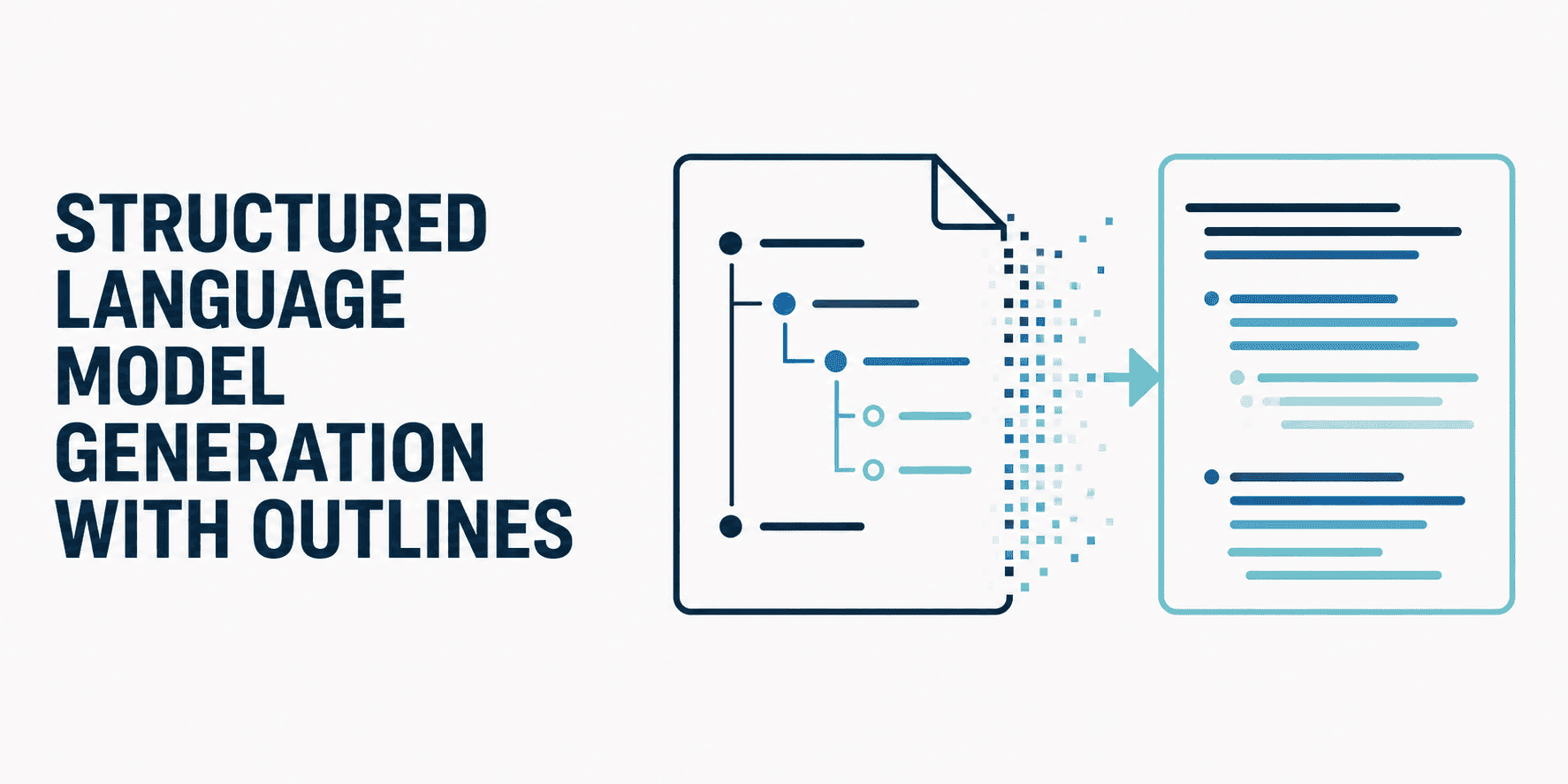
Outlines enforces structured generation through a clever mechanism that interacts with the LLM's token generation process. Rather than letting the LLM generate tokens freely and then validating the complete output, Outlines constrains the next token selection at each step. Here's a simplified breakdown of the process: 1. Define Your Structure: You provide Outlines with a definition of your desired output structure. This can be a JSON Schema, a regular expression, or even a Python type (like `int`, `bool`, or a Pydantic model). 2. Grammar Compilation: Outlines takes your structure definition and compiles it into a finite-state machine (FSM) or a similar mechanism. This FSM knows exactly which tokens are valid at any given point in the generation process to maintain the desired structure. 3. Logits Processing: As the LLM generates the next token, it produces a distribution of probabilities (logits) for all possible tokens in its vocabulary. Outlines' logits processor intercepts these probabilities. 4. Token Masking: Based on the current state of the FSM and the tokens already generated, Outlines sets the probability of any "illegal" tokens (those that would violate the defined structure) to zero. 5. Constrained Sampling: The LLM then samples the next token only from the set of legal tokens. This process repeats, token by token, ensuring that the entire output adheres to the specified format from start to finish. This "constrain-during-generation" approach is what makes Outlines so powerful and efficient, adding virtually no computational overhead during inference.Key Features of Outlines
Outlines offers a robust set of features that make it an essential tool for developers:- Guaranteed Valid JSON Output: This is one of its standout features. You can define a Pydantic model or a JSON Schema, and Outlines will ensure the LLM generates JSON that is 100% compliant with that schema, eliminating common parsing errors.
- Regular Expression (Regex) Guidance: For outputs that need to match specific patterns (e.g., email addresses, dates, specific IDs), Outlines can guide the LLM to generate text that strictly follows a provided regular expression.
- Context-Free Grammars (CFGs): For more complex structured outputs, such as code snippets, mathematical expressions, or domain-specific languages, Outlines supports generation based on context-free grammars defined in EBNF format.
- Wide Model Compatibility: Outlines is designed to work with a broad range of LLMs and inference frameworks. It supports OpenAI models, Hugging Face Transformers models, vLLM, llama.cpp, Ollama, MLX-LM, SgLang, TGI, Anthropic, and Gemini. This provider independence allows developers to switch models without changing their core generation logic.
- Minimal Inference Overhead: Unlike solutions that rely on retries or post-processing, Outlines' method of constraining token generation adds only microseconds of latency, making it highly efficient for production environments.
- Powerful Prompt Templating: The library provides primitives for better managing prompt complexity, facilitating implementations of few-shot generations, ReAct, meta-prompting, and agents.
- Low Abstraction: Outlines is designed as a low-abstraction library, allowing developers to write code in a familiar way without needing complex agent frameworks.
Who is Behind Outlines?
Outlines was originally developed at Normal Computing by @remilouf and @BrandonTWillard. It is now developed and maintained by .txt, a VC-backed company focused entirely on structured generation for LLMs. .txt is committed to open-source collaboration and also offers enterprise-grade solutions built on their expertise in structured output generation.What It Means for AI Practitioners and Developers
For anyone building with LLMs, Outlines offers significant advantages:Building More Reliable AI Agents and Systems
Developers can create agentic workflows where each step consumes validated inputs and produces correctly formatted outputs. This is crucial for tasks like tool calling and function execution, where an LLM needs to invoke external functions with precisely typed parameters.Streamlined Data Extraction and Capture
Extracting specific entities from unstructured text (like invoices, contracts, or medical records) becomes much more robust. Outlines ensures that extracted data, such as vendor names, amounts, or dates, conforms to predefined schemas, enabling true automation of data entry.Seamless API Integration
When an LLM needs to interact with an API by generating JSON payloads, Outlines ensures these payloads are always valid, preventing API errors and simplifying the integration process.Faster Development and Reduced Debugging
By eliminating the need for extensive post-processing validation and error handling, developers can build LLM-powered applications faster and spend less time debugging issues related to malformed outputs.Improved Performance and Efficiency
The zero inference overhead and the reduction in retries mean applications built with Outlines can be faster and more resource-efficient, especially in high-throughput production environments.Getting Started with Outlines
Using Outlines is straightforward for Python developers. You can install it via pip:pip install outlinesFor more detailed information, examples, and to contribute to the project, visit the Outlines GitHub repository and the Official Documentation.
Conclusion
Outlines addresses one of the most critical challenges in deploying Large Language Models: the unpredictability of their outputs. By providing a robust, efficient, and open-source solution for deterministic structured generation, it empowers developers to build more reliable, performant, and maintainable AI applications. Whether you're extracting data, interacting with APIs, or orchestrating complex AI agents, Outlines is an invaluable tool that brings much-needed certainty to the world of LLM development.Frequently Asked Questions
What problem does Outlines solve for LLMs?
Outlines solves the problem of unpredictable and often malformed outputs from Large Language Models. It ensures that LLMs generate text that strictly adheres to predefined structures like JSON schemas, regular expressions, or context-free grammars, eliminating parsing errors and improving reliability.
Is Outlines compatible with various LLM providers and models?
Yes, Outlines is designed for broad compatibility. It works with popular LLM APIs like OpenAI, Anthropic, and Gemini, as well as open-source models and inference frameworks such as Hugging Face Transformers, vLLM, llama.cpp, Ollama, and MLX-LM.
Does using Outlines slow down LLM generation?
No, Outlines is engineered for efficiency. Its structured generation technique introduces virtually no computational overhead during inference, often adding only microseconds of latency. This makes it significantly faster and more efficient than post-generation validation or retry mechanisms.
Who developed and maintains the Outlines library?
Outlines was initially developed at Normal Computing by @remilouf and @BrandonTWillard. It is now actively developed and maintained by .txt, a company specializing in structured output generation for LLMs.