Key Takeaways
- Google engineers find "indispensable prompts" are less about magic words and more about using AI as an "adversarial second opinion" rather than just an agreeable assistant.
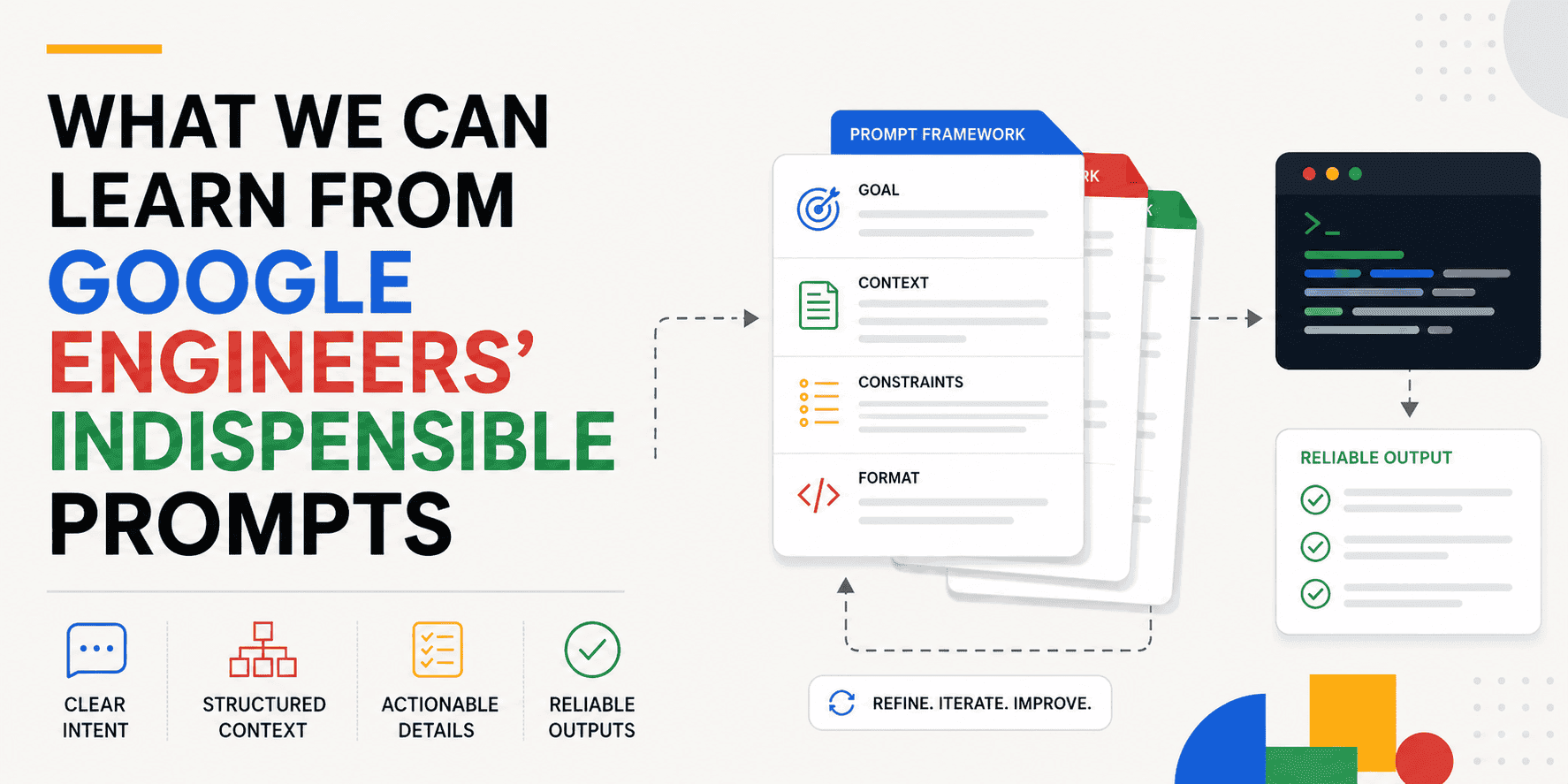
- Effective prompts leverage clarity, context, constraints, and examples to guide AI models to precise, reliable, and contextually relevant outputs.
- Iterative refinement is a core technique, involving continuous adjustment of prompts based on AI's responses to achieve desired outcomes.
- Role-playing and system prompts are powerful for setting the AI's persona and defining the interaction's ground rules, leading to more targeted and useful results.
In the fast-paced world of artificial intelligence, a well-crafted prompt can be the difference between a generic response and a truly groundbreaking insight. It's no secret that professionals across industries are learning to "talk" to AI models more effectively. But what if we could peek behind the curtain and learn from the best? Recently, a fascinating question was posed to Google engineers: "What prompt do you personally refuse to work without, and why?" The answers offer a goldmine of wisdom for anyone looking to master prompt engineering.
This isn't just about finding a few clever phrases. The insights shared by Google's engineering team reveal a deeper philosophy: treating AI less as a simple assistant and more as a sophisticated tool for critical thinking and problem-solving, even an "adversarial second opinion." This approach transforms AI from a mere output generator into a dynamic partner in your workflow.
The Essence of an "Indispensable" Prompt
An "indispensable" prompt isn't just one that gets the job done; it's one that consistently delivers high-quality, reliable, and actionable results. It’s a prompt that empowers the AI to go beyond surface-level information and truly assist in complex tasks like debugging, code generation, summarization, and creative problem-solving. The core idea is to guide the AI with such precision that its output becomes genuinely valuable and hard to work without.
The quality of a prompt directly influences the relevance, accuracy, and coherence of the model's responses. This means moving beyond vague questions and adopting strategies that provide the AI with the necessary scaffolding to produce excellent work.
Core Pillars of Powerful Prompt Engineering
Based on the collective wisdom, several key principles emerge that make prompts truly indispensable:
1. Clarity and Specificity: Leave No Room for Ambiguity
One of the most fundamental rules of prompt engineering is to be clear and specific. Vague instructions lead to vague results. Think of it like briefing a new team member: the more precise your direction, the sharper the outcome. Instead of asking "What do you know about coding?", a more effective prompt would be "Summarize my framework options for developing a web application."
- Define the Task Clearly: State exactly what you want the AI to do. Is it to summarize, explain, generate code, brainstorm, or debug?
- Specify Output Format: If you need JSON, bullet points, a table, or a specific writing style, explicitly ask for it.
- Set the Scope: Clearly define the boundaries of the task. What should the AI focus on, and what should it ignore?
2. Contextual Information: The AI's Background Briefing
Context is king in prompt engineering. Providing relevant background information allows the AI to generate responses that are not just accurate but also tailored to your specific needs and situation. This can include your industry, team structure, audience, or even the purpose of the final deliverable. A contextual prompt enriches a directive with extra information or background so the resulting output is more relevant and accurate.
- Audience Information: Who will read this? What do they know? What do they care about?
- Relevant Constraints: Mention budget limitations, technical requirements, timeframes, or specific criteria.
- Situational Factors: Provide any background story or current conditions that influence the task.
- Domain Knowledge: Tell the model to operate as an expert in a specific field to activate more relevant knowledge.
For example, instead of "Explain the symptoms of diabetes," align with the model's capabilities by asking, "For a model trained on medical data, explain the symptoms of diabetes."
3. Role-Playing: Giving the AI a Persona
A powerful technique is to instruct the AI to "act as" or "pretend you are" a specific persona. This approach fine-tunes the AI's responses, giving you more targeted insights. For instance, you could say, "You are a product analytics expert who..." or "You are an experienced wildlife biologist specializing in trees."
- Expert Persona: Ask the AI to act as a senior developer, a marketing strategist, a critical editor, or a legal expert. This helps the AI frame its responses from that specific viewpoint, leading to more nuanced and useful advice.
- Target User Persona: If you need content for a specific audience, ask the AI to generate it as if it were writing for them (e.g., "explain this to a beginner," or "write this for an executive").
4. Iterative Refinement: The Art of Conversation
Rarely does a single prompt yield the perfect result. Google engineers, like many AI practitioners, understand that prompt engineering is an iterative process. This means systematically refining your prompts across multiple attempts, with each response informing the next, sharper question. It's like a conversation with a sharp colleague: you share what you need, they give a first take, and you redirect until the output matches your vision.
- Start Focused, Then Refine: Begin with a clear initial prompt and then evaluate the AI's output against your criteria.
- Add Constraints and Examples: If the output isn't quite right, add more context, specific constraints, or even examples of the desired output.
- Ask the AI to Critique Itself: A highly effective technique is to ask the AI to review or improve its own response, pushing it to reason in steps and self-review. For example, "Re-evaluate your summary. Are there emotional insights you missed?"
- Test and Repeat: Continuously adjust and test your prompts, documenting changes and comparing results to fine-tune for production-ready outputs.
5. Adversarial Thinking: AI as a Critical Partner
Perhaps one of the most profound takeaways from Google engineers is the idea of using AI as an "adversarial second opinion" rather than an agreeable assistant. This means actively challenging the AI, asking it to find flaws, identify edge cases, or present counterarguments. This approach helps de-risk development processes and ensures more robust solutions.
- Identify Weaknesses: "Given this code snippet, what are its potential security vulnerabilities?"
- Propose Alternatives: "I've drafted a marketing strategy. What are three alternative approaches, and what are the pros and cons of each?"
- Challenge Assumptions: "This is my hypothesis. What evidence or arguments could disprove it?"
- Debug and Optimize: "You are a performance optimization expert. Analyze my code for bottlenecks and suggest specific optimizations with before/after examples."
Practical Applications for AI Practitioners and Developers
These prompt engineering strategies are not just theoretical; they have direct, tangible benefits for anyone working with AI:
- Code Generation and Debugging: Developers can use highly specific prompts to generate boilerplate code, explain unfamiliar code, or pinpoint and fix tricky bugs. For example, providing context like language, current performance issues, expected load, and hardware constraints can help the AI identify bottlenecks and suggest improvements.
- Content Creation: Freelancers and content creators can leverage role-playing prompts to generate content in a specific tone, style, or for a particular audience. This ensures consistency and relevance across various projects.
- Data Analysis and Summarization: By defining context and constraints, AI can summarize complex data, highlight key insights, and even group information by themes.
- Learning and Exploration: AI can act as an interactive tutor, guiding users step-by-step through new concepts by asking clarifying questions and building on prior knowledge.
- Strategic Planning: Asking the AI to act as a strategic consultant can help brainstorm ideas, evaluate tradeoffs for different solutions, or even define project scope and requirements.
The Future of Prompting: Beyond Simple Queries
As AI models become more sophisticated, so too will prompt engineering. Techniques like "chain-of-thought" prompting, where you break a task into logical steps and ask the AI to work through each one, allow the AI to reason more effectively. "Reflection prompting" encourages the AI to review and improve its own responses, leading to deeper, more grounded analysis.
The lessons from Google engineers underscore that effective prompting is a skill that blends technical understanding with creative communication. It's about designing inputs that not only tell the AI what to do but also how to think about the task, who to be, and how to challenge itself. By embracing these principles, you can transform your interactions with AI, making it an indispensable partner in your daily work.
Frequently Asked Questions
What is prompt engineering?
Prompt engineering is the practice of crafting effective instructions, known as "prompts," to guide large language models (LLMs) to generate desired outputs. It involves selecting the right words, phrases, symbols, and formats to get the best possible results from AI models.
Why is context so important in AI prompts?
Context is crucial because it provides the AI with relevant background information, specific instructions, tone, and objectives. This ensures the AI generates responses that are not just accurate but also highly tailored to your specific needs and situation, reducing ambiguity and improving relevance.
What does "iterative prompting" mean?
Iterative prompting is a systematic process of refining the prompts you give to a generative AI tool across multiple rounds. Instead of expecting a perfect answer from one input, you review each response, identify what's missing or off-target, and submit a better follow-up prompt, treating each AI response as a starting point for improvement.
How can I use AI as an "adversarial second opinion"?
Using AI as an "adversarial second opinion" means actively prompting the AI to challenge your ideas, find flaws, identify potential risks, or present alternative viewpoints. This approach helps you critically evaluate your own work, uncover blind spots, and develop more robust solutions by leveraging the AI's analytical capabilities. For example, you might ask it to identify security vulnerabilities in code or propose counterarguments to a strategy.