Key Takeaways
- Master modern AI and LLMs with five free, expert-led courses covering foundational concepts to advanced application development.
- Learn practical skills like prompt engineering, building RAG and agentic applications with LangChain, and fine-tuning LLMs with cutting-edge techniques.
- Explore the powerful Hugging Face ecosystem for NLP and model deployment, enhancing your ability to prototype AI products.
- These courses are designed for developers, AI practitioners, and tech-savvy individuals looking to apply AI in real-world scenarios without cost.
Unlock Your AI Potential: 5 Free Courses to Master Modern AI and LLMs
The world of Artificial Intelligence, especially Large Language Models (LLMs), is moving at an incredible pace. Staying current with the latest tools and techniques is crucial for anyone looking to build, deploy, or even just understand AI-powered applications. Whether you're a seasoned developer, a budding AI enthusiast, or a freelancer aiming to integrate generative AI into your work, free, high-quality educational resources are more valuable than ever.
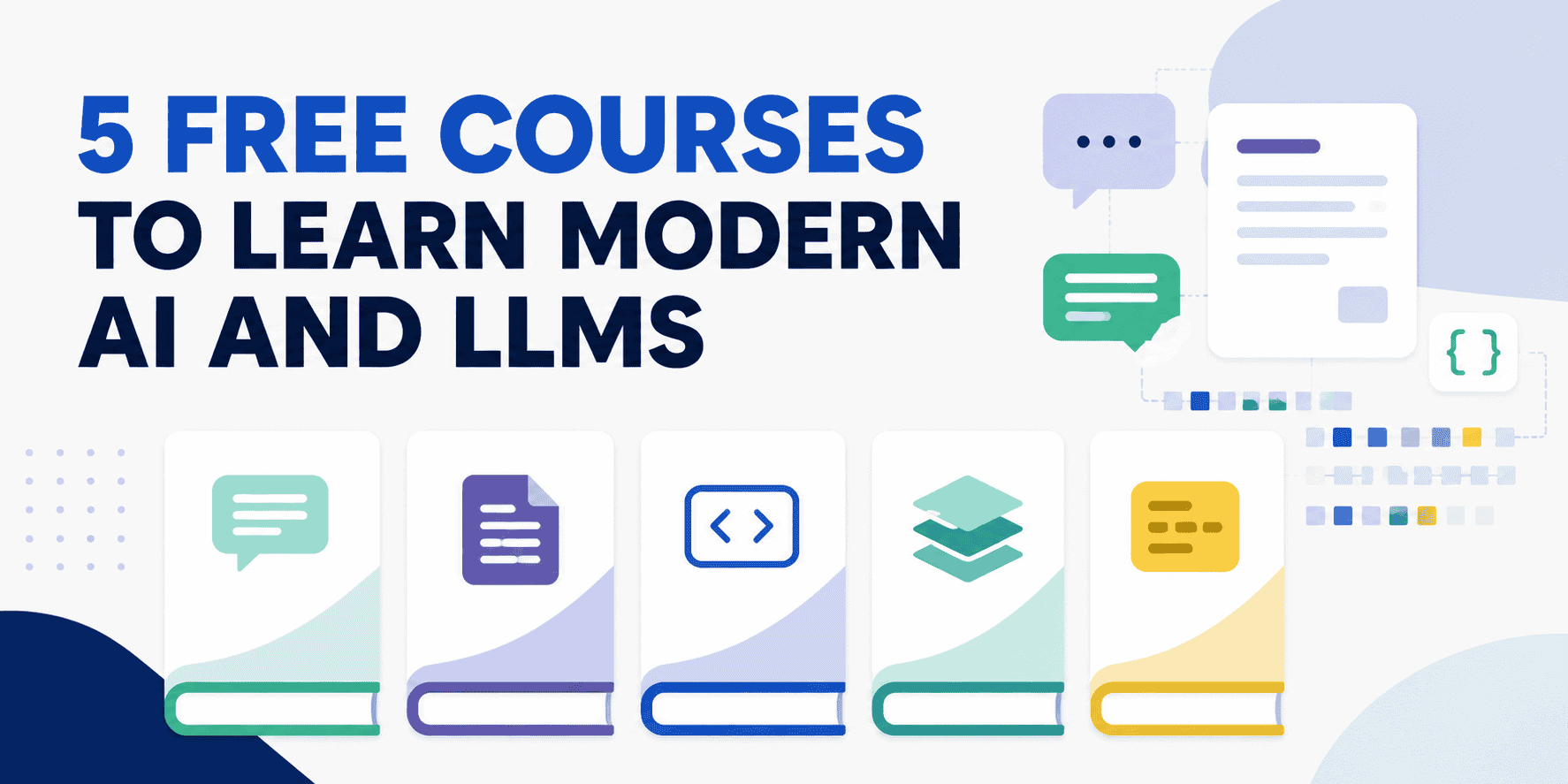
This article dives into five excellent free courses that will equip you with the knowledge and hands-on experience to navigate modern AI and LLMs. From understanding the basics of generative AI to building complex agentic systems and fine-tuning models, these resources offer a comprehensive learning path from some of the leading names in AI education.
1. Introduction to Generative AI (Google Cloud)
What it is: This course provides a foundational understanding of generative AI, its core concepts, and how it differs from traditional machine learning models. It’s part of a broader Generative AI learning path offered by Google Cloud.
Why it matters: Generative AI is rapidly transforming industries, and a solid grasp of its principles is essential for anyone working with or planning to implement AI solutions. This course demystifies the technology, making it accessible even for those with limited prior AI experience. It helps learners understand the unique capabilities of generative models and their potential applications in various fields.
How it works: The course is designed to be beginner-friendly and non-technical, taking approximately 45 minutes to complete. It covers the relationship between AI, Machine Learning (ML), and Deep Learning (DL), distinguishes between supervised and unsupervised learning, and explores generative versus discriminative models. Key topics include defining generative AI, understanding its inner workings, and exploring prompt design as a fundamental interaction method. It also briefly touches on Google tools for building generative AI applications. Upon completion, you can continue with other no-cost courses like "Introduction to Large Language Models" and "Introduction to Responsible AI" to earn the Generative AI Fundamentals skill badge.
For AI Practitioners/Freelancers: This course is an ideal starting point for freelancers, project managers, and tech-adjacent professionals who need to understand the "what" and "why" of generative AI without diving deep into complex code. It provides the necessary vocabulary and conceptual framework to engage effectively in AI-related discussions and identify opportunities for applying generative AI in business contexts. For developers, it serves as a quick, valuable refresher on foundational concepts.
Official Link: You can access this course through Google Cloud Skills Boost or Udacity.
Developers/Company: Developed by Google Cloud.
2. ChatGPT Prompt Engineering for Developers (DeepLearning.AI)
What it is: This popular short course teaches developers practical prompt engineering techniques to effectively interact with Large Language Models (LLMs) like ChatGPT's API.
Why it matters: Prompt engineering is a critical skill for anyone building applications with LLMs. It allows you to guide the model's behavior, extract desired information, and achieve specific outcomes. This course moves beyond basic prompting, focusing on best practices for developers to build robust AI applications.
How it works: Taught by Isa Fulford from OpenAI and Andrew Ng from DeepLearning.AI, this approximately 1.5 to 2-hour course covers essential strategies for prompt engineering. It includes common use cases such as summarizing text, inferring information (like sentiment or keywords), transforming text (translation, grammar correction), and expanding ideas from short prompts. The course emphasizes building multi-step systems using LLMs and provides hands-on experience with built-in Jupyter notebooks, allowing learners to experiment with code and prompts directly. You'll learn how to construct API calls and even build a custom chatbot, like a pizza ordering bot, through practical examples.
For AI Practitioners/Freelancers: For developers and freelancers, this course is a game-changer. It shows how to leverage LLM APIs to perform complex tasks in minutes that might otherwise take weeks with traditional machine learning approaches. This includes robotic process automation, text processing, content generation, and building custom chatbots. The ability to efficiently develop multi-step systems and evaluate LLM inputs/outputs for safety and accuracy is invaluable for creating reliable AI solutions.
Official Link: Enroll for free on DeepLearning.AI.
Developers/Company: A collaboration between OpenAI (Isa Fulford) and DeepLearning.AI (Andrew Ng).
3. LangChain for LLM Application Development (DeepLearning.AI)
What it is: This course provides essential skills for expanding the use cases and capabilities of language models in application development using the LangChain framework.
Why it matters: LangChain is a powerful open-source framework that simplifies the process of building complex LLM applications by abstracting away much of the "glue code." It's crucial for creating applications that go beyond single-turn prompts, enabling features like conversational memory, interaction with external data sources (RAG), and autonomous agents.
How it works: Taught by Harrison Chase, the creator of LangChain, and Andrew Ng, this short course takes about an hour and is beginner-friendly, requiring basic Python knowledge. Key topics include:
- Models, Prompts, and Parsers: How to call LLMs, provide prompts, and parse their responses.
- Memories for LLMs: Storing conversations to maintain context in stateless LLMs.
- Chains: Creating sequences of operations when interacting with LLMs.
- Question Answering over Documents (RAG): Applying LLMs to your proprietary data using embeddings, vector stores, and retrievers to build specialized chatbots.
- Agents: Using LLMs as reasoning engines to interact with other tools and data sources.
- Evaluation: How to evaluate LLM-based applications.
For AI Practitioners/Freelancers: This course is indispensable for developers and AI practitioners looking to build sophisticated LLM-powered applications. It enables the creation of personal assistants, specialized chatbots that can query custom data, and agentic systems capable of multi-step reasoning. Mastering LangChain means you can quickly prototype and deploy robust AI solutions that address real-world business challenges.
Official Link: Access this free course on DeepLearning.AI.
Developers/Company: A collaboration between Harrison Chase (LangChain Co-Founder and CEO) and Andrew Ng (DeepLearning.AI).
4. Intro to Fine-Tuning Large Language Models (freeCodeCamp & LunarTech Academy)
What it is: This course introduces the fundamentals and advanced practices of fine-tuning LLMs, covering distinctions between pre-training, prompt engineering, and fine-tuning.
Why it matters: While powerful, general-purpose LLMs might not always perform optimally on specific tasks or with niche datasets. Fine-tuning allows you to adapt pre-trained models to particular tasks, improving their accuracy, efficiency, and domain-specific performance without the immense cost of training from scratch. This is a critical skill for customizing AI to specific business needs.
How it works: This free 2-hour course, taught by Tatev, CEO of LunarTech, and released by LunarTech Academy and freeCodeCamp, guides learners through various aspects of fine-tuning. It covers:
- The benefits of fine-tuning.
- Differences between pre-trained, fine-tuned, and prompt-engineered models.
- Powerful methods like supervised fine-tuning (SFT) and reinforcement learning with human feedback (RLHF).
- A highlight is QLoRA, a revolutionary technique that enables fine-tuning of large models (like Llama 70B) on consumer-grade hardware.
- Parameter-Efficient Fine-Tuning (PEFT) techniques like LoRA and QLoRA.
- Practical case studies and hands-on experience fine-tuning models like Llama2 and Google Gemma.
For AI Practitioners/Freelancers: For AI engineers and data scientists, this course is highly practical. It teaches how to take powerful, open-source LLMs and specialize them for unique datasets and tasks, leading to more accurate and relevant AI outputs. The focus on QLoRA means you can achieve impressive results even with limited computational resources, making advanced fine-tuning accessible for individual practitioners and small businesses. This skill is directly applicable to building custom chatbots, enhancing sentiment analysis, or generating domain-specific text.
Official Link: Watch the full course for free on the freeCodeCamp YouTube channel.
Developers/Company: A collaboration between LunarTech Academy and freeCodeCamp.org.
5. The Hugging Face Course (Hugging Face)
What it is: This official course from Hugging Face introduces Natural Language Processing (NLP) using the Hugging Face ecosystem, including the Transformers, Tokenizers, and Datasets libraries, and the Hugging Face Hub.
Why it matters: Hugging Face has become the central hub for open-source AI models, datasets, and tools, especially in NLP. Understanding its ecosystem is fundamental for anyone working with modern language models, as it provides easy access to state-of-the-art pre-trained models and simplifies the process of building, sharing, and deploying AI applications.
How it works: The Hugging Face course is community-driven and designed to take learners from foundational NLP concepts to hands-on experience with powerful models. It covers:
- Introduction to NLP and the evolution of neural networks to Transformers.
- Using the Transformers library for various NLP tasks like text generation, sentiment analysis, named entity recognition, and question answering.
- Working with the Datasets library for data preparation and the Tokenizers library for processing text.
- Model fine-tuning, evaluation, and deployment using the Hugging Face Hub and tools like Accelerate.
- Advanced topics such as embeddings, semantic search, masked language modeling, and zero-shot classification.
For AI Practitioners/Freelancers: This course is essential for developers, data scientists, and AI enthusiasts who want to leverage the vast resources of the Hugging Face ecosystem. It provides the skills to quickly implement cutting-edge NLP techniques, fine-tune models for specific applications, and deploy them. For freelancers, proficiency with Hugging Face means faster development cycles, access to a wide array of pre-trained models, and the ability to contribute to and benefit from the thriving open-source AI community.
Official Link: Access the course directly on the Hugging Face website.
Developers/Company: Developed by Hugging Face.
Frequently Asked Questions
What are LLMs, and why are they important to learn?
LLMs, or Large Language Models, are advanced AI models trained on massive amounts of text data, enabling them to understand, generate, and process human language with remarkable fluency. Learning about LLMs is crucial because they are the driving force behind many modern AI applications, from sophisticated chatbots and content creation tools to complex data analysis and automation. Mastering LLMs allows you to build powerful, intelligent systems that can interact with the world in human-like ways, offering significant professional opportunities in various industries.
Do I need strong coding skills to take these free courses?
While some courses, like "LangChain for LLM Application Development" and "ChatGPT Prompt Engineering for Developers," benefit from basic Python knowledge, others, such as "Introduction to Generative AI" from Google Cloud, are designed to be non-technical and beginner-friendly. Most free LLM courses from reputable providers aim to be accessible, often providing code snippets and interactive environments. If you're new to coding, starting with foundational courses or those explicitly labeled "beginner" is a good approach.
Can these free courses help me get a job in AI?
Yes, these free courses can significantly boost your resume and practical skills, making you more competitive for AI-related roles. They teach in-demand skills like prompt engineering, fine-tuning, and building AI applications with frameworks like LangChain and Hugging Face. While a certificate from a free course might not hold the same weight as a degree, the hands-on experience and demonstrated understanding of modern AI concepts are highly valued by employers. Combining several such courses and building a portfolio of projects can be a strong strategy for career advancement.
Are the tools and libraries taught in these courses free to use?
Yes, the courses primarily focus on free and open-source tools and libraries. For example, LangChain and Hugging Face's Transformers library are open-source. While using certain cloud APIs (like OpenAI's or Google Cloud's) might involve usage-based costs beyond a free tier, the core learning in these courses often leverages free access or local environments where possible. The objective is to teach you how to build with these technologies, many of which have generous free tiers or completely free components for development and learning.