Key Takeaways
- Vibe coding is an AI-assisted development approach where developers use natural language prompts to generate code, shifting focus from manual coding to guiding and refining AI output.
- Coined by Andrej Karpathy in February 2025, it emphasizes rapid prototyping and lowering the barrier to entry for software creation.
- While it boosts productivity and accelerates experimentation, concerns exist around code quality, security vulnerabilities, and potential technical debt in production systems.
- Effective vibe coding involves human oversight, thorough testing, and strategic application, rather than blindly accepting AI-generated solutions.
The world of software development is always changing, and right now, AI is pushing some big shifts. One of the newer ideas making waves is "vibe coding." This term, coined by AI researcher Andrej Karpathy in February 2025, describes a way of building software where you use AI to generate much of the code based on your natural language instructions. Instead of writing every line yourself, you describe what you want, and the AI handles the technical implementation.
But what does "vibe coding" really mean for developers? Is it a game-changer that makes coding easier and faster, or does it hide problems that could bite us later? Let's take a deep dive into what vibe coding gets right and what its potential downsides are, especially for software developers navigating the AI-driven landscape.
What Exactly is Vibe Coding?
"Vibe coding" is a software development method that relies heavily on large language models (LLMs) to generate code. Imagine telling an AI, "Build me a simple web application that tracks my daily tasks," and the AI starts creating the structure, UI components, and basic logic. That's the core idea. It's an approach where developers move from writing code line-by-line to guiding, testing, and refining AI-generated output. Andrej Karpathy, a co-founder of OpenAI and former AI leader at Tesla, introduced the term in February 2025, describing it as "a new kind of coding... where you fully give in to the vibes, embrace exponentials, and forget that the code even exists."
This shift represents an "intent-driven" development style. You focus on the "what" – the desired functionality or outcome – rather than the "how" – the intricate syntax and algorithms. The AI then translates that intent into executable code. While AI coding assistants have been around for a while (think GitHub Copilot), vibe coding pushes this further, often involving accepting AI-generated code with less thorough review, relying more on results and follow-up prompts to guide changes.
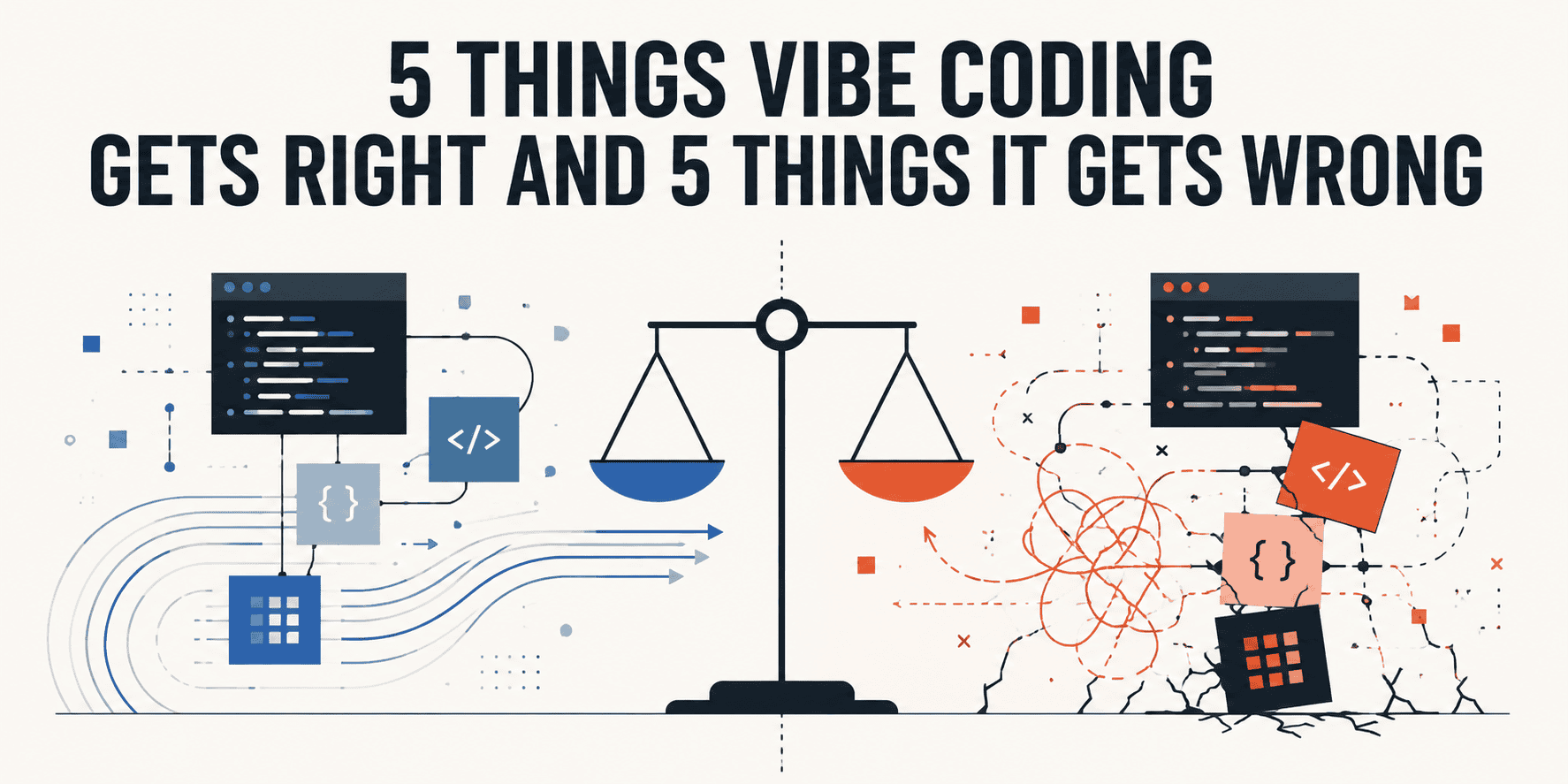
5 Things Vibe Coding Gets Right
1. Incredible Speed and Rapid Prototyping
One of the most obvious benefits of vibe coding is its ability to dramatically accelerate software development. Developers can generate initial implementations, UI components, and even entire application structures in a fraction of the time it would take to write them manually. This makes rapid prototyping a key strength, allowing teams to quickly turn ideas into functional applications and test concepts without significant upfront investment. For startups or projects needing quick validation, this speed is invaluable, lowering sunk costs and enabling faster pivots.
2. Lower Barrier to Entry for Development
Vibe coding makes programming more accessible to a wider range of individuals, including those without a formal computer science background. Since AI tools handle much of the syntax and logic, beginners can build software with less deep technical expertise. This democratization of coding can empower more people to bring their ideas to life, fostering innovation and allowing non-technical users to contribute more directly to software creation.
3. Enhanced Focus on High-Level Problem Solving
By automating the repetitive and boilerplate aspects of coding, vibe coding allows developers to shift their attention to higher-level concerns. Instead of getting bogged down in syntax, data tasks, or standard code patterns, developers can concentrate on design, architecture, user experience, and complex problem-solving. This can lead to more creative solutions, fresh insights, and ultimately, more meaningful improvements in how software is built.
4. Iterative and Conversational Workflow
The process of vibe coding is often described as iterative and conversational. Developers describe desired functionality, the AI generates code, and then humans review, test, and refine the output through additional prompts and edits. This back-and-forth interaction with the AI can feel more natural and less rigid than traditional coding. It allows for quick experimentation and continuous refinement, adapting to emerging requirements as the project evolves.
5. Boosted Productivity and Efficiency
Overall, vibe coding promises a significant boost in productivity and efficiency. By streamlining how user requirements are gathered and implemented, and by automating large chunks of code generation, developers can accomplish more in less time. This efficiency can translate into faster product launches, reduced development costs, and the ability to explore more ideas concurrently.
5 Things Vibe Coding Gets Wrong (or Where It Needs Caution)
1. Code Quality Concerns and Technical Debt
One of the most significant criticisms of vibe coding is the potential for lower code quality and increased technical debt. AI-generated code can sometimes be messy, inefficient, or difficult to understand and maintain. Over-reliance on AI without thorough human review can lead to codebases that are hard to debug, modify, or scale in the long term. This "vibe slop" can trade near-term productivity for longer-term problems, making future development and maintenance more challenging.
2. Security Vulnerabilities and Lack of Guardrails
AI-generated code may not always be optimized for security and can introduce critical vulnerabilities. Large language models, while powerful, might "hallucinate" or fail to incorporate the necessary guardrails, validations, and context-aware logic that experienced developers instinctively build in. This can lead to security risks like injection errors or improper authorization mechanisms, posing serious threats if the code is deployed in production environments without rigorous security assessments.
3. Erosion of Codebase Comprehension and Accountability
When developers rely heavily on AI to generate code, their deep understanding of the codebase can erode over time. If a developer hasn't written the code themselves, they might struggle to understand its syntax, concepts, or underlying logic, making debugging and maintenance more difficult. This also blurs accountability for code quality, as it becomes less clear who is responsible for flaws in AI-generated output.
4. Limited Control and Customization for Complex Systems
While vibe coding offers speed, it often comes at the cost of fine-grained control and customization. For simple projects or prototypes, this might be acceptable. However, for complex, mission-critical systems requiring precise control over every part of the system, AI-generated code might not meet specific performance, optimization, or architectural requirements. The flexibility of vibe coding is high in terms of generating code, but the control over its specific implementation details can be partial.
5. Challenges with Debugging and Scalability
Debugging AI-generated code can be more challenging than debugging manually written code, especially if the developer doesn't fully understand the AI's logic or the subtle issues it might introduce. Furthermore, the scalability and reliability of vibe-coded software are points of scrutiny. Code generated without deep understanding might function for small user bases but fail under increased load or complex scenarios, leading to performance issues or outages when scaled to fit business needs. Ensuring production-quality, scalable, and maintainable software still requires significant human engineering effort, including rigorous testing, dependency checking, and compliance verification.
What Vibe Coding Means for Developers
Vibe coding isn't about replacing developers; it's about changing their role. Developers are shifting from being primary code writers to becoming "orchestrators" and "validators" of AI-generated code. This means a greater emphasis on prompt engineering, understanding AI capabilities and limitations, and critically evaluating AI outputs. Developers still need strong engineering judgment to ensure logic, performance, maintainability, and security before anything moves toward production.
For AI practitioners and those building AI tools, vibe coding highlights the growing power of generative AI in practical applications. It underscores the need for AI models that can generate more robust, secure, and understandable code, along with better tools for auditing and refining AI outputs. Projects like Cursor, Replit Agent, and v0 are examples of platforms that embrace this AI-assisted, intent-driven development style.
The most effective approach, as many experts suggest, is often a hybrid one: using vibe coding to accelerate prototyping and early development, and then relying on traditional engineering practices to stabilize, secure, and scale the system. It's about leveraging AI's speed while maintaining human oversight and engineering rigor to build reliable software.
Frequently Asked Questions
What is the origin of the term "vibe coding"?
The term "vibe coding" was coined by prominent AI researcher Andrej Karpathy in a post on X (formerly Twitter) in February 2025. He described it as a new way of coding where developers "fully give in to the vibes" and let large language models generate the code based on natural language prompts.
Is vibe coding meant to replace human developers entirely?
No, vibe coding is not intended to replace human developers. Instead, it shifts the developer's role from writing code line-by-line to guiding, testing, and refining AI-generated code. Developers become orchestrators and validators, focusing on higher-level design, architecture, and ensuring the quality and security of the AI's output.
What are the main advantages of using vibe coding?
The main advantages of vibe coding include significantly increased development speed, rapid prototyping capabilities, a lower barrier to entry for new developers, and the ability for experienced developers to focus more on high-level problem-solving and design.
What are the biggest risks associated with vibe coding?
The biggest risks of vibe coding involve potential issues with code quality, the introduction of security vulnerabilities, increased technical debt, and a possible erosion of developers' deep understanding of the codebase. There's also a concern about limited control and customization for highly complex or critical systems.