Key Takeaways
- AI system design interviews are now common for senior tech roles, moving beyond traditional software design to focus on data, models, and MLOps.
- A structured framework is key: clarify requirements, design data pipelines, choose models, plan deployment, and consider scalability, monitoring, and ethics.
- Designing a system like ChatGPT involves handling massive data, complex transformer models, distributed training, real-time inference, and robust safety measures.
- Successful candidates communicate trade-offs, understand MLOps principles, and address ethical implications like bias and privacy.
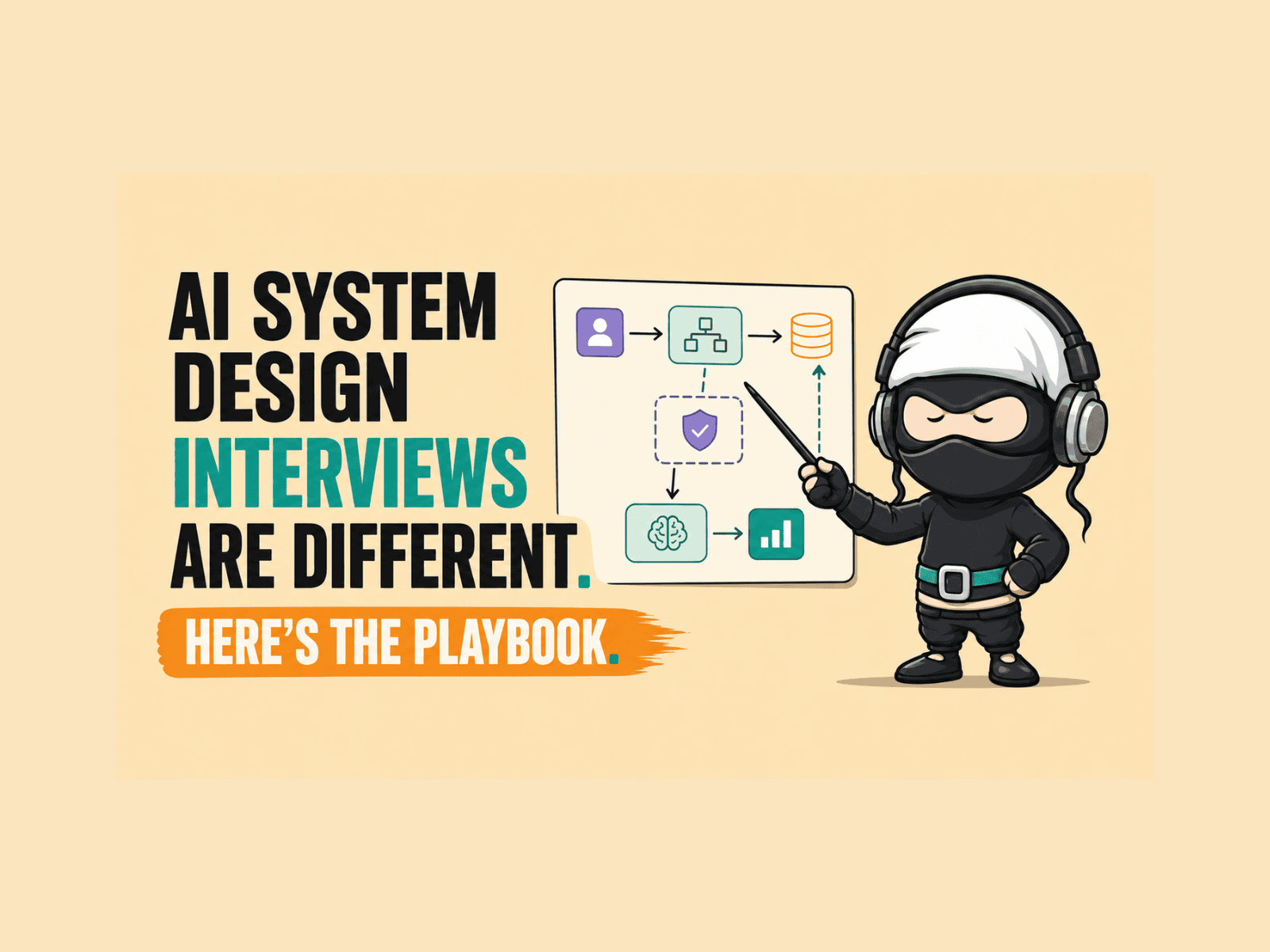
The tech interview landscape is always changing. Just a few years ago, system design questions often revolved around building services like YouTube or Netflix. Today, with Artificial Intelligence at the forefront of innovation, the focus has shifted dramatically. Now, you're more likely to be asked to design an AI-powered system, perhaps even something as complex as ChatGPT. This shift isn't just about knowing AI concepts; it's about understanding how to build, deploy, and maintain AI systems in the real world. For software developers and ML engineers targeting senior roles, mastering AI system design interviews is crucial.
This tutorial will walk you through a clear, structured framework to confidently tackle AI system design interview questions. We'll cover the essential components, considerations, and even use a high-level design of a ChatGPT-like system as a practical example.
What Exactly is an AI System Design Interview?
An AI system design interview evaluates your ability to conceptualize and architect a complete AI-driven solution. It goes beyond just discussing machine learning algorithms or model performance. Instead, it tests your understanding of the entire lifecycle of an AI product, from data ingestion to model deployment and ongoing maintenance.
Unlike traditional system design, AI system design introduces new layers of complexity:
- Data Pipelines: How raw data is collected, processed, stored, and fed into models.
- Model Lifecycle Management: Training, evaluation, versioning, and retraining of models.
- Inference Optimization: Serving predictions efficiently and at scale.
- Continuous Learning Workflows: How systems adapt and improve over time.
- Ethical Considerations: Addressing fairness, bias, privacy, and transparency.
Interviewers want to see that you can design systems that are not only scalable and reliable but also cost-efficient, maintainable, and ethically sound.
A Structured Framework for AI System Design Interviews
Approaching AI system design questions with a consistent framework can help you organize your thoughts and present a comprehensive solution. Here’s a step-by-step guide:
Step 1: Clarify the Problem and Requirements
This is arguably the most critical step. Many candidates jump straight into technical solutions without fully understanding the problem. Ask clarifying questions to define the scope, user needs, and business objectives.
- Functional Requirements: What should the system do? (e.g., "generate human-like text," "recommend products," "detect fraud").
- Non-Functional Requirements: How should the system perform?
- Scale: How many users? How many requests per second (RPS)? What's the data volume?
- Latency: How quickly should the system respond? (e.g., real-time, near real-time, batch processing). For AI systems, consider time to first token and inter-token latency.
- Availability: How much downtime is acceptable?
- Reliability: How accurate or robust must the predictions be?
- Cost: Are there budget constraints for infrastructure or model training?
- Maintainability: How easy is it to update or debug the system?
- Success Metrics: How will you measure if the system is successful? (e.g., accuracy, precision, recall, F1-score, user engagement, conversion rates, hallucination rate, safety policy compliance).
- Constraints: Are there any limitations on data, compute, or existing infrastructure?
For example, if asked to design a "smart" product feature, clarify what "smarter" means in terms of user experience or business value.
Step 2: Design the Data Pipeline
AI systems are data-hungry. A robust data pipeline is fundamental.
- Data Sources: Where does the data come from? (e.g., user logs, databases, external APIs, sensors).
- Data Ingestion: How is data collected? (e.g., streaming via Kafka, batch processing via ETL jobs).
- Data Storage: Where is the data stored? (e.g., data lakes for raw data, data warehouses for structured data, vector databases for embeddings).
- Data Preprocessing & Feature Engineering: How is raw data transformed into usable features for models? This includes cleaning, normalization, tokenization, and creating new features. Consider tools like Spark or Flink for large-scale processing. Feature stores (e.g., Feast, Tecton) are crucial for ensuring consistency between training and inference.
- Data Governance: How are data quality, privacy, and security handled? (e.g., anonymization, access control, compliance with GDPR/CCPA).
Step 3: Select and Train the Model
This layer focuses on the core intelligence of your system.
- Model Selection: What type of model is appropriate for the task? (e.g., supervised, unsupervised, reinforcement learning, deep learning like Transformers, CNNs, RNNs, traditional ML like Gradient Boosting). Justify your choice based on data characteristics and requirements.
- Model Architecture: Briefly discuss the high-level architecture. For LLMs, this would involve Transformer-based models.
- Training Strategy:
- Dataset: How will you split data for training, validation, and testing?
- Training Environment: Cloud-based (AWS SageMaker, Google AI Platform, Azure ML) or on-premise GPU clusters? Distributed training strategies?
- Hyperparameter Tuning: How will you optimize model performance?
- Evaluation Metrics: Which metrics will you use to assess model performance during training and validation? (e.g., accuracy, F1, BLEU, ROUGE, perplexity).
- MLOps Considerations: How will you manage the model lifecycle?
- Experiment Tracking: Tools like MLflow for tracking experiments.
- Model Versioning: Storing different model iterations.
- Model Registry: Centralized repository for models.
- Continuous Integration/Continuous Delivery (CI/CD): Automating model testing and deployment.
Step 4: Deployment and Inference
This covers how your trained model makes predictions in a production environment.
- Serving Layer: How will the model be exposed? (e.g., REST API, gRPC, batch inference).
- Inference Engine: Technologies for running predictions (e.g., TensorFlow Serving, PyTorch Serve, custom inference servers).
- Scalability:
- Horizontal Scaling: Adding more instances of your inference service.
- Load Balancing: Distributing requests across instances.
- Caching: Storing frequently requested predictions to reduce latency and compute costs.
- GPU Acceleration: For deep learning models, leveraging GPUs for faster inference.
- Batching: Grouping multiple requests to process them simultaneously on GPUs.
- Latency & Throughput Optimization: Techniques like model quantization, ONNX runtime, or custom kernels.
Step 5: Monitoring, Feedback, and Iteration
A deployed AI system isn't a "set it and forget it" solution.
- Model Monitoring: Track model performance in production.
- Data Drift: Changes in input data distribution.
- Model Drift: Decline in model performance over time.
- Performance Metrics: Monitor business metrics and AI-specific metrics (e.g., accuracy, latency, hallucination rate, relevance).
- Alerting: Set up alerts for anomalies.
- Feedback Loops: How will user feedback or new data be used to improve the model? (e.g., A/B testing, human-in-the-loop, continuous retraining).
- Retraining Strategy: When and how often will the model be retrained? (e.g., on a schedule, when performance drops, when new data is available).
Step 6: Address Cross-Cutting Concerns
- Security: Data encryption, access control, model intellectual property protection.
- Privacy: Anonymization, differential privacy.
- Ethical AI: Discuss bias detection and mitigation, fairness, transparency, and explainability. How would you ensure the system is fair and unbiased? How would you handle potential misuse?
- Error Handling & Resiliency: What happens if a component fails? Retry mechanisms, fallback strategies.
- Cost Optimization: Strategies to reduce infrastructure costs (e.g., using cheaper inference models for simpler queries, spot instances, scaling to zero).
Case Study: Designing a System Like ChatGPT (High-Level)
Let's apply this framework to a challenging, real-world scenario: designing a conversational AI system similar to OpenAI's ChatGPT. OpenAI released ChatGPT on November 30, 2022, and it quickly became the fastest-growing consumer application in history.
1. Clarify the Problem and Requirements
- Functional: Generate human-like text responses to user prompts, engage in multi-turn conversations, understand context, provide information, answer questions, and potentially perform tasks (e.g., summarization, translation, code generation).
- Non-Functional:
- Scale: Support millions of concurrent users, handle billions of requests daily.
- Latency: Real-time streaming responses (low time to first token, low inter-token latency).
- Availability: High availability (e.g., 99.99%).
- Reliability/Accuracy: High quality, coherent, and factually grounded responses, minimal hallucinations.
- Cost: Optimize for massive GPU compute costs.
- Security/Privacy: Protect user data, prevent data leakage.
- Success Metrics: User engagement (session duration, turns per conversation), response quality (human evaluations, perplexity), hallucination rate, safety policy compliance, latency.
2. Design the Data Pipeline
- Data Sources: Massive, diverse text datasets from the internet (books, articles, web pages, conversations, code), potentially augmented with proprietary data.
- Data Ingestion: Large-scale web scraping, data collection pipelines, continuous ingestion of new data.
- Data Storage: Distributed file systems (e.g., HDFS, S3), data lakes for raw text, specialized databases for conversation history and user preferences.
- Data Preprocessing:
- Cleaning: Remove noise, duplicates, personally identifiable information (PII).
- Tokenization: Convert text into numerical tokens.
- Filtering: Remove low-quality or harmful content.
- Alignment: Align prompts with desired responses for fine-tuning (e.g., Reinforcement Learning from Human Feedback - RLHF).
3. Select and Train the Model
- Model Selection: Large Language Models (LLMs) based on the Transformer architecture (specifically Generative Pre-trained Transformers or GPTs).
- Model Architecture: Multi-layered Transformer encoder-decoder architecture, though often simplified to decoder-only for generative tasks. Billions or trillions of parameters.
- Training Strategy:
- Pre-training: Unsupervised learning on massive text datasets to predict the next token. This requires immense computational resources (thousands of GPUs for months).
- Fine-tuning: Supervised fine-tuning on smaller, high-quality conversational datasets.
- RLHF (Reinforcement Learning from Human Feedback): Training a reward model from human preferences, then using reinforcement learning to further fine-tune the LLM to align with human values and instructions.
- Distributed Training: Utilizing frameworks like DeepSpeed or FSDP across large GPU clusters.
- MLOps: Robust systems for tracking model versions (e.g., GPT-3.5, GPT-4, GPT-5), managing training jobs, and storing checkpoints.
4. Deployment and Inference
- Serving Layer: Exposing the model via a highly scalable API gateway.
- Inference Engine: Optimized for LLM inference.
- GPU Clusters: Massive clusters of high-end GPUs (e.g., NVIDIA H100s).
- Load Balancing: Distribute incoming requests across inference servers.
- Caching: Cache common prompts or partial responses.
- Quantization & Pruning: Reduce model size and computational requirements.
- Streaming API: Implement Server-Sent Events (SSE) or WebSockets to stream tokens back to the user in real-time.
- Orchestration Service: Manages the conversation flow, retrieves context, applies safety policies, and dispatches requests to the LLM.
- Tools & Integrations: Ability to call external APIs (plugins/GPTs) for real-world actions or information retrieval.
5. Monitoring, Feedback, and Iteration
- Model Monitoring:
- Latency: Monitor time to first token and inter-token latency.
- Quality: Track user satisfaction, coherence, factual correctness, and hallucination rates using automated metrics and human reviews.
- Safety: Monitor for harmful, biased, or inappropriate outputs.
- Feedback Loops: User feedback mechanisms (e.g., thumbs up/down, "regenerate response"), human review of problematic outputs, A/B testing different model versions.
- Retraining: Continuous fine-tuning and updates based on new data, feedback, and performance metrics. OpenAI has continuously upgraded ChatGPT, with GPT-4 launching in March 2023, and GPT-5 generation models from 2025 onward.
6. Cross-Cutting Concerns
- Security: Secure API endpoints, protect user prompts and generated content.
- Privacy: Anonymize user data, adhere to strict data retention policies.
- Ethical AI: Implement robust safety and moderation layers to filter out harmful content. Address potential biases in training data and model outputs. Ensure transparency around AI usage.
- Cost Optimization: Smart routing of queries to different model sizes/capabilities, aggressive caching, efficient GPU utilization.
Tips for Success in AI System Design Interviews
Beyond the technical framework, how you approach the interview matters:
- Communicate Clearly: Talk through your thought process. Explain your assumptions, trade-offs, and design choices.
- Ask Clarifying Questions: Don't be afraid to ask for more details. This shows you're thorough and thoughtful.
- Structure Your Answer: Use a logical flow (like the framework above). Start high-level and then deep-dive into specific components.
- Think About Trade-offs: Every design decision has pros and cons (e.g., latency vs. cost, accuracy vs. interpretability). Discuss these trade-offs.
- Consider MLOps: Show that you understand how ML systems operate in production, including versioning, deployment, monitoring, and retraining. This is a key differentiator.
- Address Ethical Implications: Acknowledge and discuss potential biases, privacy concerns, and fairness in your design.
- Be Prepared for Follow-up Questions: Interviewers will often probe specific areas or introduce new constraints (e.g., "What if latency becomes a critical issue?").
The rise of AI has transformed system design interviews. By understanding the unique challenges of AI systems and applying a structured approach, you can effectively demonstrate your ability to build robust, scalable, and responsible AI solutions.
Frequently Asked Questions
What is the main difference between traditional system design and AI system design interviews?
The main difference is the added complexity of managing data pipelines, model training and evaluation, and continuous model deployment and monitoring (MLOps) in AI system design. Traditional system design focuses more on general software components like databases, caching, and load balancing, while AI system design integrates machine learning models and their unique lifecycle into the overall architecture.
How important are MLOps concepts in an AI system design interview?
MLOps concepts are extremely important. Interviewers want to see that you understand how to build and maintain AI systems reliably in production, not just experimental prototypes. Discussing aspects like model versioning, continuous integration/delivery for models, monitoring for data and model drift, and automated retraining demonstrates a strong grasp of real-world AI engineering.
Should I discuss specific AI algorithms in detail during the interview?
While it's good to know the types of algorithms suitable for a problem, the interview usually focuses on the system architecture surrounding the AI model, rather than the intricate details of the algorithm itself. You should be able to justify your choice of model (e.g., "a Transformer-based model for sequence-to-sequence tasks") and discuss its high-level characteristics, but avoid getting bogged down in mathematical specifics unless explicitly asked.
How do I prepare for ethical AI questions in a system design interview?
Prepare by understanding common ethical concerns in AI, such as bias, fairness, transparency, and data privacy. Be ready to discuss how you would design systems to mitigate these issues, for example, by ensuring diverse training data, implementing bias detection and mitigation strategies, providing explainability features, and adhering to privacy-by-design principles.