Key Takeaways
- Quantization-Aware Distillation (QAD) combines model quantization and knowledge distillation to create smaller, more efficient AI models.
- QAD models, like those using Q4_0 checkpoints, significantly reduce memory usage and speed up inference, making large models deployable on less powerful hardware.
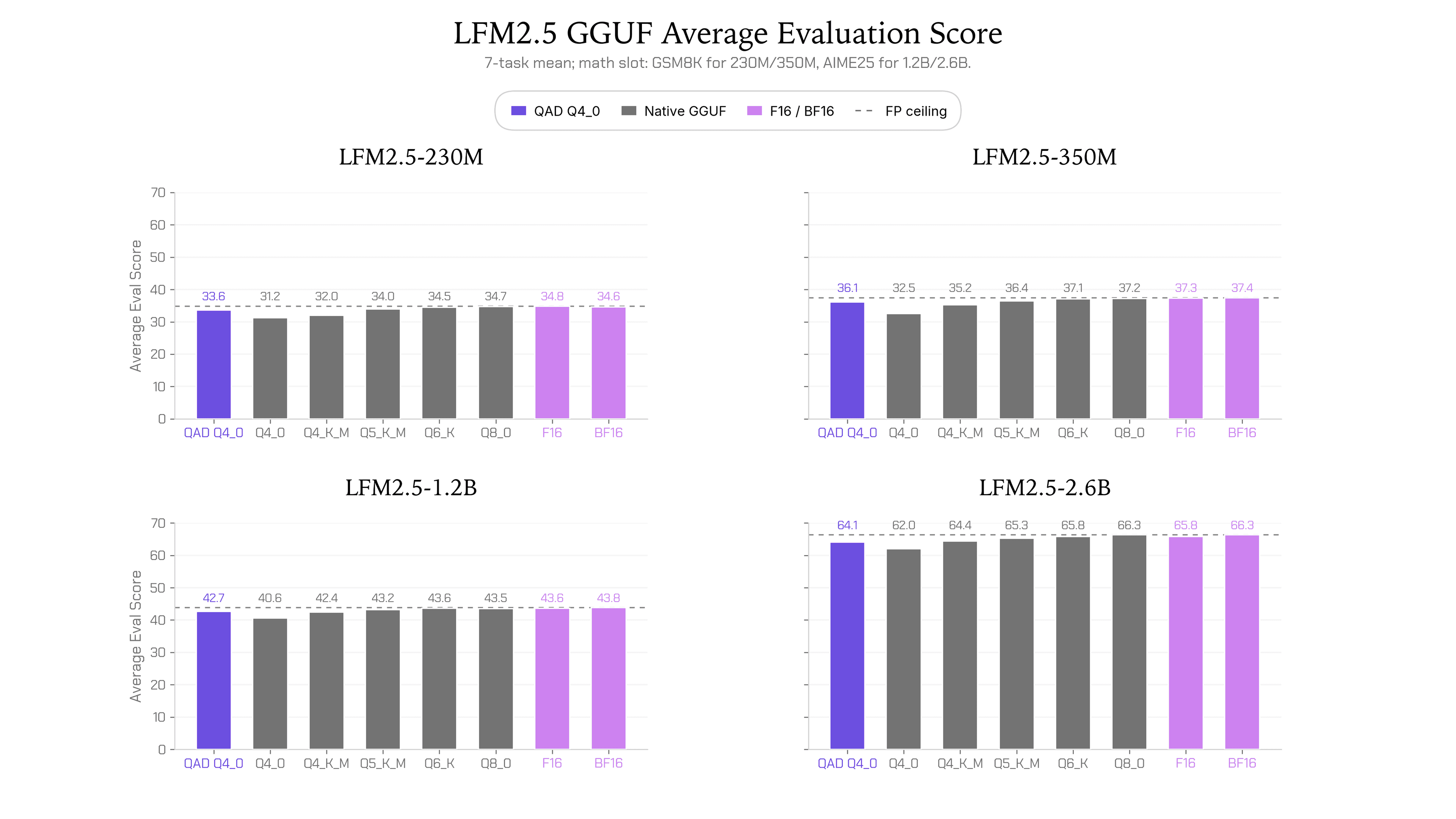
- Q4_0 refers to a 4-bit global quantization scheme, which offers simplicity and speed but might have slightly lower accuracy compared to more advanced grouped quantization methods like Q4_K_M.
- This technique is crucial for deploying powerful Large Foundation Models (LFMs) on edge devices, mobile applications, and for reducing cloud inference costs.
Understanding LFM2.5 Q4_0 Checkpoints from Quantization-Aware Distillation
The world of Artificial Intelligence is moving fast, with Large Foundation Models (LFMs) constantly pushing the boundaries of what's possible. These models, often with billions of parameters, deliver incredible performance across various tasks, from generating human-like text to creating images and understanding complex data. However, their sheer size and computational demands present a significant challenge for deployment, especially on devices with limited resources or for applications requiring real-time inference. This is where advanced optimization techniques like Quantization-Aware Distillation (QAD) become essential, leading to innovations such as "LFM2.5 Q4_0 Checkpoints." This deep dive will explore what these terms mean, why they are important, and how they contribute to making powerful AI more accessible and efficient for everyone.What are Large Foundation Models (LFMs)?
Foundation Models (FMs), often called Large x Models (LxM), are powerful machine learning models trained on vast, diverse datasets. They are designed to be general-purpose, meaning they can be adapted to a wide range of tasks rather than being built for a single, specific function. Think of them as highly versatile base models that can be fine-tuned for specialized applications, significantly reducing the time and cost of developing new AI solutions from scratch. Large Language Models (LLMs) like OpenAI's GPT series and Google's BERT are prime examples of foundation models. The "LFM2.5" in our discussion likely refers to a specific iteration or version of a Large Foundation Model, indicating ongoing development and refinement. Some organizations, like Liquid AI, are explicitly developing "Liquid Foundation Models" (LFMs) that are designed for memory efficiency and efficient inference across various hardware platforms and modalities, utilizing unique neural network architectures.The Challenge: Large Models, Limited Resources
While LFMs offer incredible capabilities, their size comes with trade-offs. Models with billions of parameters require substantial memory to store their weights and activations, and significant computational power (often multiple GPUs) to run. This makes them expensive to train, slow to infer, and difficult to deploy on resource-constrained environments like smartphones, edge devices, or even cost-effective cloud instances. For example, a 7-billion parameter model stored in 32-bit floating-point numbers (FP32) can require around 28 GB of storage just for its weights. Even with 16-bit floating-point (FP16), it still needs about 14 GB. This is often too much for consumer-grade hardware or even for optimizing cloud inference costs. To overcome these hurdles, AI practitioners turn to model compression techniques, and two of the most effective are quantization and distillation.Demystifying Quantization: Shrinking Models with Precision
Quantization is a technique that reduces the precision of a neural network's parameters (weights and activations), converting them from high-precision formats (like 32-bit or 16-bit floating points) to lower-precision formats (like 8-bit or 4-bit integers). Imagine you're describing a number. Instead of saying "7.892345678," you might just say "8." This is essentially what quantization does: it approximates values with fewer bits, leading to:- Reduced Memory Usage: A 4-bit integer takes up much less space than a 32-bit float. This significantly shrinks the model's footprint, allowing it to fit into smaller memory allocations. For instance, quantizing a 7B model to 4-bit can reduce its size from 14 GB (FP16) to around 3.5-4.5 GB (including metadata).
- Faster Inference: Lower-precision computations can be performed much faster by hardware, leading to quicker response times for AI applications.
- Lower Energy Consumption: Less data movement and simpler computations mean reduced power usage, which is crucial for battery-operated devices and sustainable AI.
- Increased Accessibility: Smaller, faster models can run on a wider range of devices, making powerful AI more broadly available.
Understanding Q4_0 Quantization
The "Q4_0" in "LFM2.5 Q4_0 Checkpoints" specifically refers to a type of 4-bit quantization.- Q4: This means each weight is stored using 4 bits. This offers a significant 8x reduction in size compared to FP32, or 4x compared to FP16.
- _0: This suffix indicates that global quantization is used. In this approach, a single scale and zero point are shared across the entire tensor or row of weights. While simpler and faster to implement, it means the full range of values must fit within the 4-bit limits, which can sometimes lead to higher reconstruction error and slightly less accuracy compared to more advanced grouped quantization methods (like Q4_K_M). However, for certain hardware constraints or specific use cases, Q4_0 can still be a viable and efficient option.
Unpacking Distillation: Learning from a Teacher
Knowledge Distillation is another model compression technique where a smaller, simpler "student" model is trained to mimic the behavior of a larger, more complex "teacher" model. The teacher model, usually a high-performing full-precision model, guides the student by providing "soft targets" (e.g., probability distributions for classifications) rather than just hard labels. This allows the student to learn the nuances and generalizations of the teacher, often achieving performance close to the larger model despite its smaller size.The Synergy: Quantization-Aware Distillation (QAD)
Quantization-Aware Distillation (QAD) brings these two powerful techniques together. It's an advanced neural network compression method that unifies knowledge distillation and quantization within a single training objective to improve the accuracy and deployment efficiency of deep models under low-precision constraints. Here's how it generally works: 1. Teacher Model: A pre-trained, high-precision (e.g., FP32) Large Foundation Model acts as the "teacher." 2. Student Model with Simulated Quantization: A smaller "student" model is trained. During its training, simulated quantization noise is deliberately introduced into the forward passes. This is also known as "fake quantization". 3. Distillation Loss: The student's training objective includes a distillation loss component. This loss measures how well the quantized student's outputs (like logits or class probabilities) align with the teacher's outputs. 4. Supervised Loss: Alongside the distillation loss, a standard supervised loss (e.g., cross-entropy) is used with ground-truth labels. 5. Composite Loss: By minimizing a composite loss function that combines both supervised and distillation components, the student model learns to adapt to low-precision arithmetic while recovering accuracy lost due to quantization. In essence, QAD teaches the student model to perform well even with the limitations of low-precision (like Q4_0) by having it learn from a highly accurate teacher that doesn't have those limitations. This process is more effective than simply quantizing a fully trained model afterward (Post-Training Quantization, or PTQ), as QAD allows the model to adjust its weights during training to be more resilient to quantization errors.What "LFM2.5 Q4_0 Checkpoints" Mean for AI Practitioners
When you see "LFM2.5 Q4_0 Checkpoints from Quantization-Aware Distillation," it signifies pre-trained model weights (checkpoints) of a Large Foundation Model (LFM, version 2.5) that have been optimized using the QAD technique, specifically targeting 4-bit global quantization (Q4_0). For AI practitioners, developers, and freelancers leveraging AI tools, this translates into several key benefits:- Efficient Deployment: These checkpoints enable the deployment of powerful LFMs on a much wider range of hardware, including edge devices, mobile phones, and embedded systems, which typically have limited memory and computational power.
- Reduced Operational Costs: Running smaller, faster models in the cloud means lower inference costs, as less compute and memory resources are required.
- Faster Real-time Applications: The increased inference speed makes these models suitable for real-time applications where latency is critical, such as intelligent assistants, real-time analytics, or autonomous systems.
- Broader Accessibility: By making powerful AI models more resource-friendly, they become accessible to more users and developers, fostering innovation.
- Balancing Performance and Efficiency: While Q4_0 might involve a slight accuracy trade-off compared to higher-precision or more complex quantization schemes, QAD ensures that this loss is minimized, providing a good balance between model performance and operational efficiency.
Frequently Asked Questions
What is the main purpose of Quantization-Aware Distillation (QAD)?
The main purpose of QAD is to create smaller, more efficient AI models that can run on resource-constrained hardware while minimizing the loss of accuracy. It achieves this by combining model quantization (reducing precision) with knowledge distillation (training a smaller model to mimic a larger one) within a single training process.
How does Q4_0 quantization differ from other quantization methods?
Q4_0 refers to a 4-bit global quantization scheme, meaning it uses 4 bits to store each weight and applies a single scale and zero point across the entire tensor or row. While simpler and faster, it can sometimes be less accurate than grouped quantization methods (like Q4_K_M) that use per-group scales and zero points for better precision at similar bit-depths.
Can I use LFM2.5 Q4_0 Checkpoints on any device?
LFM2.5 Q4_0 checkpoints are designed to be highly efficient, making them suitable for a wide range of devices, including edge devices, mobile phones, and consumer-grade PCs, even those without powerful GPUs. The reduced memory footprint and faster inference speeds allow these powerful models to run effectively on hardware that would otherwise be unable to handle full-precision versions.
What are the practical benefits of using quantized and distilled models for freelancers or small businesses?
For freelancers and small businesses, using quantized and distilled models means they can deploy powerful AI capabilities without needing expensive, high-end hardware. This reduces operational costs for cloud inference, enables local AI applications on standard devices, and allows for faster processing of AI tasks, making advanced AI more accessible and affordable.