Key Takeaways
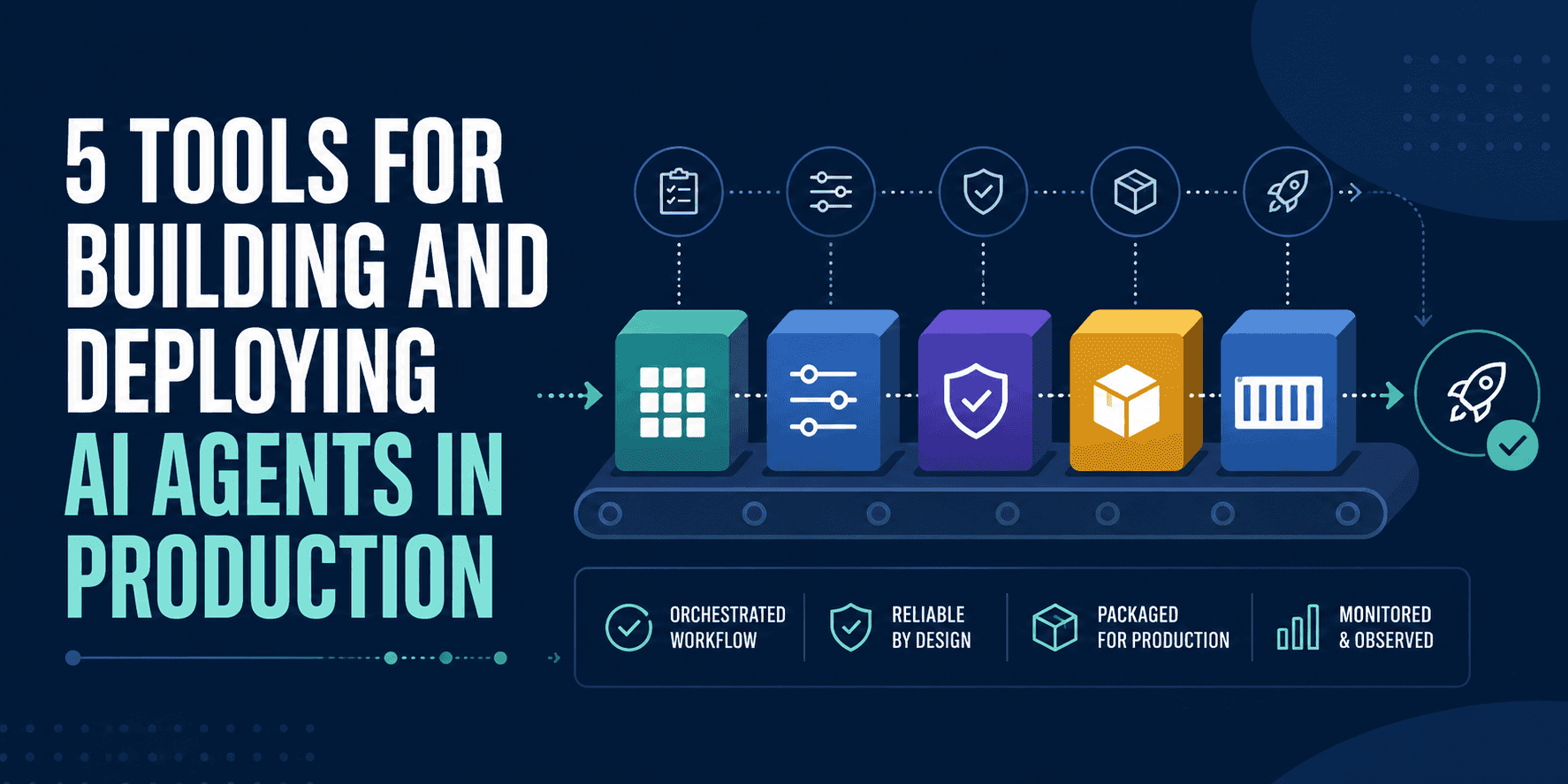
- Building and deploying AI agents in production requires a robust stack covering logic, memory, LLM interaction, workflow orchestration, and scalable deployment.
- Tools like LangChain, Pinecone, LiteLLM, Prefect, and Modal address different layers of this stack, simplifying complex development and operational challenges.
- LangChain provides the framework for agent logic, Pinecone offers scalable long-term memory, and LiteLLM standardizes LLM interactions.
- Prefect helps orchestrate and monitor complex agent workflows, while Modal provides a serverless platform for deploying and running agents at scale.
AI agents are transforming how we automate tasks and interact with technology. From intelligent chatbots that handle customer service to autonomous systems that manage complex workflows, these agents are becoming central to many applications. But building and, more importantly, deploying these agents reliably in a production environment is a multi-layered challenge. You need to define their logic, give them memory, manage their interactions with large language models (LLMs), orchestrate their tasks, and finally, run them efficiently at scale.
This article will walk you through five essential tools, each tackling a crucial layer of the AI agent stack. Think of this as a practical guide for software developers looking to move their AI agent projects from concept to a fully operational system. We’ll cover everything from building the agent’s core intelligence to ensuring it runs smoothly and cost-effectively in the real world.
1. LangChain: Building the Agent's Brain
When you think about giving an AI agent the ability to reason, interact with tools, and maintain context, LangChain is often the first name that comes to mind. It's a powerful framework designed to simplify the creation of applications powered by large language models, especially those involving complex chains of actions and interactions.
What It Is and What Core Problem It Solves
LangChain, developed by Harrison Chase and maintained by LangChain, Inc., provides a structured way to build sophisticated LLM applications. It solves the problem of connecting LLMs with external data sources and computational tools, enabling agents to go beyond simple text generation. It allows developers to create agents that can "think" by breaking down problems, using tools, and remembering past interactions.
The project was initially released in October 2022 and quickly gained traction in the developer community.
Key Features and Use Cases
- Chains: LangChain lets you combine LLMs with other components into sequences, or "chains." For example, an agent might first summarize a document, then extract entities, and finally answer questions based on those entities.
- Agents: This is where LangChain truly shines for agent development. Agents use an LLM as a "reasoning engine" to decide which actions to take and in what order. They can dynamically choose tools (like search engines, calculators, or custom APIs) based on user input and their current goal.
- Memory: Agents need to remember past interactions to have coherent conversations or maintain context over time. LangChain provides various memory types, from simple conversation buffers to more complex entity memory, allowing agents to retain relevant information.
- Retrieval: To access external, up-to-date, or proprietary information, agents need retrieval capabilities. LangChain integrates with vector databases and document loaders to enable Retrieval-Augmented Generation (RAG), letting agents fetch relevant data before generating a response.
- Tools: These are functions or APIs that an agent can call to interact with the outside world. LangChain offers a wide array of built-in tools (e.g., Google Search, Wikipedia) and makes it easy to define custom tools.
How to Get Started (Conceptual Steps)
To build an agent with LangChain, you typically:
- Choose an LLM: Select the LLM you want your agent to use for reasoning (e.g., OpenAI's GPT models, Anthropic's Claude, or open-source models).
- Define Tools: Identify the external actions your agent needs to perform. This could be searching a database, sending an email, or calling a custom API. Wrap these actions as LangChain tools.
- Initialize the Agent: Use one of LangChain's agent types (e.g.,
create_react_agent for ReAct-style reasoning) and provide it with the LLM and the list of tools.
- Run the Agent: Invoke the agent with a specific task or query. The agent will then use its LLM to decide which tools to use and in what order to achieve the goal.
You can find the official documentation and examples on the LangChain website and explore its open-source code on GitHub.
2. Pinecone: Giving Agents Long-Term Memory
AI agents often need to access vast amounts of information that wasn't part of their initial training data. This "long-term memory" is crucial for tasks like answering questions about specific documents, personalized recommendations, or maintaining knowledge across many interactions. This is where vector databases like Pinecone come in.
What It Is and What Core Problem It Solves
Pinecone, developed by Pinecone Systems, Inc., is a managed vector database designed for building and scaling AI applications that require real-time similarity search. It solves the challenge of efficiently storing, indexing, and querying high-dimensional vector embeddings, which are numerical representations of text, images, audio, and other data.
By using Pinecone, agents can quickly find and retrieve relevant information from massive datasets based on semantic similarity, rather than just keyword matching. This is fundamental for Retrieval-Augmented Generation (RAG) architectures.
Key Features and Use Cases
- Managed Service: Pinecone handles the underlying infrastructure, scaling, and maintenance, allowing developers to focus on building their applications rather than managing databases.
- Real-time Indexing and Querying: It offers low-latency vector search, essential for interactive AI applications.
- Metadata Filtering: You can attach metadata to your vectors and filter search results based on this metadata, adding an extra layer of precision to your retrieval.
- Hybrid Search: Pinecone supports combining vector similarity search with keyword search, often leading to more relevant results.
- Scalability: Designed to handle billions of vectors and high query throughput, making it suitable for production-grade applications.
How to Get Started (Conceptual Steps)
Integrating Pinecone with your AI agent typically involves:
- Generate Embeddings: Convert your raw data (text documents, images, etc.) into vector embeddings using an embedding model (e.g., OpenAI Embeddings, Sentence Transformers).
- Create a Pinecone Index: Set up an index in your Pinecone dashboard, specifying the dimension of your vectors.
- Ingest Data: Upload your vectors and their associated metadata to your Pinecone index.
- Query from Your Agent: When your agent needs external information, it converts the user's query into a vector embedding, sends it to Pinecone, and retrieves the most semantically similar results.
- Augment LLM Prompt: The retrieved information is then used to enrich the prompt given to the LLM, allowing it to generate more informed and accurate responses.
Pinecone offers a free tier for getting started, with paid plans scaling based on usage (pods, dimensions, data storage). You can find detailed documentation and sign up on the official Pinecone website.
3. LiteLLM: The Universal LLM Gateway
Working with large language models can quickly become complex. You might want to use different LLMs for different tasks, manage API keys, handle rate limits, track costs, or implement fallbacks if one API fails. LiteLLM simplifies all of this by providing a unified interface.
What It Is and What Core Problem It Solves
LiteLLM, an open-source project, offers a lightweight Python library that standardizes calls to various LLM providers. It solves the significant pain point of managing multiple LLM APIs, each with its own quirks and SDKs. Instead of writing custom code for OpenAI, Anthropic, Google Gemini, Hugging Face, etc., you use one consistent API call.
This allows developers to easily swap between models, implement robust error handling, and gain insights into their LLM usage, all through a single interface. LiteLLM was first released in 2023.
Key Features and Use Cases
- Unified API: Call any LLM provider (OpenAI, Anthropic, Google, Azure, Cohere, Hugging Face, etc.) with a single
completion() function.
- Fallbacks: Automatically switch to a backup LLM provider if the primary one fails or hits rate limits. This increases the reliability of your agent.
- Cost Tracking: Monitor and track token usage and costs across different LLM providers, giving you better control over your budget.
- Streaming Support: Seamlessly integrate streaming responses from LLMs into your agent applications for a more dynamic user experience.
- Logging & Observability: Easily log requests and responses to various monitoring tools like LangSmith, Helicone, or custom logging systems.
- Proxy Server: LiteLLM can also run as a proxy server, allowing you to route all your LLM calls through a single endpoint, simplifying API key management and adding features like caching and load balancing.
How to Get Started (Conceptual Steps)
Using LiteLLM with your agent involves:
- Install LiteLLM:
pip install litellm
- Set API Keys: Configure your LLM provider API keys as environment variables.
- Make Unified Calls: Replace direct LLM SDK calls with LiteLLM's
completion() function, specifying the model you want to use.
- Implement Fallbacks (Optional): Define a list of fallback models to ensure your agent remains operational even if one service is down.
- Track Costs (Optional): Utilize LiteLLM's built-in cost tracking features to monitor your LLM spending.
For more details and code examples, check out the LiteLLM documentation and its GitHub repository.
4. Prefect: Orchestrating Agent Workflows
AI agents, especially in production, rarely operate in isolation. They often need to be part of larger, more complex data pipelines that involve data ingestion, preprocessing, model inference, post-processing, and integration with other systems. Managing these multi-step, often scheduled, workflows requires a robust orchestration tool. Prefect is designed for just this.
What It Is and What Core Problem It Solves
Prefect, developed by Prefect Technologies, Inc., is an open-source workflow orchestration framework that helps data engineers and developers build, run, and monitor data pipelines and AI workflows. It solves the problem of unreliable, complex, and hard-to-manage data flows by providing a programmatic way to define workflows (called "flows"), handle retries, manage dependencies, and visualize execution.
For AI agents, Prefect ensures that all the necessary steps—from fetching data for RAG to running an agent's decision-making process and storing its outputs—are executed reliably, on schedule, and with clear visibility into their status.
Key Features and Use Cases
- Flows and Tasks: Define your workflow as a "flow" composed of individual "tasks." Each task represents a discrete unit of work (e.g., "fetch data," "generate embeddings," "run agent," "store results").
- Dynamic Workflows: Prefect allows for dynamic, data-aware workflows where the execution path can change based on previous task results.
- Retries and Caching: Built-in mechanisms for automatically retrying failed tasks and caching task results to optimize performance and resilience.
- Scheduling: Easily schedule your agent workflows to run at specific intervals (e.g., hourly, daily) or in response to external triggers.
- Observability (Prefect UI): The Prefect UI (part of Prefect Cloud or self-hosted) provides a dashboard to visualize runs, monitor task statuses, view logs, and debug failures, offering crucial insights into your agent's operational health.
- Parameterization: Pass parameters to your flows and tasks, making your agent workflows flexible and reusable.
How to Get Started (Conceptual Steps)
To orchestrate an AI agent workflow with Prefect:
- Install Prefect:
pip install prefect
- Define Tasks: Write Python functions for each step of your agent's operation (e.g., a task to retrieve relevant documents, a task to invoke the LangChain agent, a task to save the agent's output). Decorate them with
@task.
- Define a Flow: Create a Python function that calls your tasks in the desired order, representing the entire agent workflow. Decorate it with
@flow.
- Run the Flow: Execute your flow locally or deploy it to Prefect Cloud for scheduled and managed execution.
- Monitor: Use the Prefect UI to observe the execution of your flow, check logs, and troubleshoot any issues.
Prefect offers an open-source core with Prefect Cloud providing managed services and additional features for teams. You can find their extensive documentation on the Prefect website and the open-source code on GitHub.
5. Modal: Deploying Agents at Scale
Once your AI agent's logic is defined, its memory is in place, LLM interactions are streamlined, and workflows are orchestrated, the final step is to deploy it in a way that is scalable, cost-effective, and easy to manage. This is where cloud-native platforms like Modal excel.
What It Is and What Core Problem It Solves
Modal, developed by Modal Labs, is a serverless platform designed specifically for running Python code, especially computationally intensive AI/ML workloads, in the cloud. It solves the headache of managing infrastructure, setting up GPUs, handling Docker containers, and scaling applications.
With Modal, you can deploy your AI agents as serverless functions, webhooks, or scheduled jobs without worrying about servers, clusters, or complex DevOps. It provides instant access to GPUs and scales automatically based on demand, making it ideal for both rapid prototyping and production deployment of AI agents.
Key Features and Use Cases
- Serverless Functions: Run any Python function (including those that call LangChain agents, interact with Pinecone, or use LiteLLM) as a serverless endpoint.
- GPU Access: Easily provision and scale GPU resources for your LLM inference or agent computations.
- Persistent Storage: Attach persistent volumes to your applications, allowing agents to store and retrieve data across runs or for stateful operations.
- Webhooks and APIs: Expose your agents as HTTP endpoints, allowing them to be triggered by web requests or integrated into other applications.
- Scheduling: Schedule your agent functions to run periodically, similar to cron jobs but with cloud-native reliability.
- Containerization Made Easy: Modal abstracts away Docker complexities, automatically building and managing containers for your code and dependencies.
- Scalability: Automatically scales your agent deployments up and down to handle varying loads, ensuring high availability and cost efficiency.
How to Get Started (Conceptual Steps)
Deploying an AI agent on Modal typically involves:
- Install Modal:
pip install modal-client
- Define Your Agent as a Function: Wrap your AI agent's core logic (e.g., a LangChain agent invocation) within a Python function.
- Create a Modal App: Define a Modal application object and associate your agent function with it. Specify any necessary dependencies or GPU requirements.
- Deploy: Use the Modal CLI to deploy your application. Modal handles containerization, resource provisioning, and making your function accessible.
- Invoke: Call your deployed agent function via its API endpoint, a webhook, or a scheduled trigger.
Modal offers a usage-based pricing model, with a free tier for small projects and educational use. You can find detailed guides and sign up on the official Modal website and explore examples on their GitHub repository.
Conclusion
Building and deploying AI agents in production is a journey that spans multiple technical domains. By leveraging specialized tools for each layer of the stack, developers can streamline the process, build more robust applications, and ensure their agents perform reliably at scale.
LangChain gives your agents intelligence and the ability to act. Pinecone provides them with a vast, searchable memory. LiteLLM simplifies their interaction with various LLMs. Prefect ensures their complex workflows run smoothly and reliably. And finally, Modal offers a seamless way to deploy and scale these intelligent systems in the cloud. By combining these powerful tools, you can move your AI agent ideas from experimental prototypes to impactful, production-ready solutions.
Frequently Asked Questions
An AI agent is an autonomous program that uses an AI model (like an LLM) to understand goals, decide on actions, execute those actions (often using tools), and learn or adapt over time. Deploying them requires specialized tools because they involve complex interactions with LLMs, external data, and APIs, necessitating robust frameworks for logic, memory, workflow orchestration, and scalable, reliable infrastructure.
Many of these tools can be used independently for specific tasks. For example, you can use LangChain to build an agent without Prefect for orchestration if your workflow is simple, or use Pinecone for a RAG system without a complex LangChain agent. However, for a complete, production-grade AI agent that requires long-term memory, multi-LLM support, complex workflows, and scalable deployment, combining them often provides the most effective and robust solution.
Most of these tools offer flexible options suitable for both small projects and large-scale enterprise applications. LangChain, LiteLLM, and Prefect have open-source components that are free to use for any scale. Pinecone and Modal offer free tiers or generous usage-based pricing models that allow individuals and small teams to get started without significant upfront investment, scaling up as their needs grow.
For a Python developer familiar with cloud concepts and general software development, the learning curve for these tools is generally manageable. LangChain and LiteLLM integrate well with Python's ecosystem. Prefect and Modal introduce new concepts for defining and deploying workflows/applications but provide clear documentation and examples. While each tool has its specific API and best practices, a developer can typically get a basic agent up and running with these tools within a few days to weeks of dedicated effort.