Key Takeaways
- Web crawling is essential for AI, providing the vast datasets needed for training models, powering RAG systems, and enabling AI agents.
- Tools range from open-source Python libraries like Scrapy and Beautiful Soup for full control to powerful cloud platforms and APIs like Apify, Bright Data, and Zyte for managed, scalable solutions.
- Modern web crawling tools offer advanced features such as headless browser rendering, proxy rotation, anti-bot bypass, and AI-powered data extraction.
- Pricing models vary widely, from free open-source options to consumption-based and subscription plans, making cost a key factor in tool selection.
7 Best Web Crawling Tools and APIs in 2026 for AI Practitioners
In 2026, the landscape of Artificial Intelligence is more dynamic and data-hungry than ever. From training large language models (LLMs) to powering sophisticated AI agents and building robust Retrieval Augmented Generation (RAG) pipelines, the demand for clean, structured web data is skyrocketing. Web crawling, the automated process of collecting information from websites, is the backbone of this data acquisition. It allows AI practitioners to gather the specific content they need, transform it into usable formats, and feed it directly into their AI systems. This deep dive explores the top web crawling tools and APIs available in 2026, focusing on their features, pricing, and how they empower AI development. Whether you're a developer building custom solutions or a data scientist looking for managed services, understanding these tools is crucial for staying ahead in the AI race.What is Web Crawling and Why Does It Matter for AI?
Web crawling is essentially programming a "robot" to visit web pages, read their content, and follow links to discover new pages, much like a human browsing the internet. The goal is to systematically collect information. While often used interchangeably, web crawling refers to the discovery of pages, and web scraping refers to the extraction of specific data points from those pages. Both are vital for AI.
The Critical Role of Web Data in AI
For AI, web data is the lifeblood. Here's why it's so important:
- Training Data for LLMs: Large language models require enormous datasets to learn patterns, language nuances, and factual knowledge. Web crawlers can gather vast amounts of text from diverse sources, creating rich training corpora.
- Retrieval Augmented Generation (RAG): RAG systems enhance LLMs by providing them with up-to-date, relevant external knowledge. Web crawling allows for continuous ingestion of new information, ensuring RAG pipelines always have access to the latest data.
- AI Agent Powering: Autonomous AI agents often need to interact with the web to gather information, complete tasks, or monitor specific events. Crawling tools provide these agents with the ability to "see" and "understand" web content.
- Competitive Intelligence & Market Research: Businesses use AI to analyze market trends, competitor strategies, and customer sentiment. Web crawling collects this raw data, which AI can then process for insights.
- Dataset Creation: For specific AI tasks, custom datasets are often needed. Web crawlers can be tailored to extract very particular types of data (e.g., product details, job listings, research papers) to build these specialized datasets.
How Web Crawling Works (High-Level)
At a high level, a web crawler operates through a series of steps:
- Starting URLs: The crawler begins with a list of initial URLs.
- Fetching: It sends HTTP requests to these URLs to download the web page content (HTML, CSS, JavaScript).
- Parsing: The downloaded content is then parsed to extract relevant information and identify new links.
- Storing: Extracted data is stored in a structured format (e.g., JSON, CSV, database).
- Queueing: Newly discovered links are added to a queue to be fetched later, continuing the crawling process.
- Handling Challenges: Modern crawlers also manage complexities like JavaScript rendering, proxy rotation to avoid IP bans, CAPTCHA solving, and dealing with website structure changes.
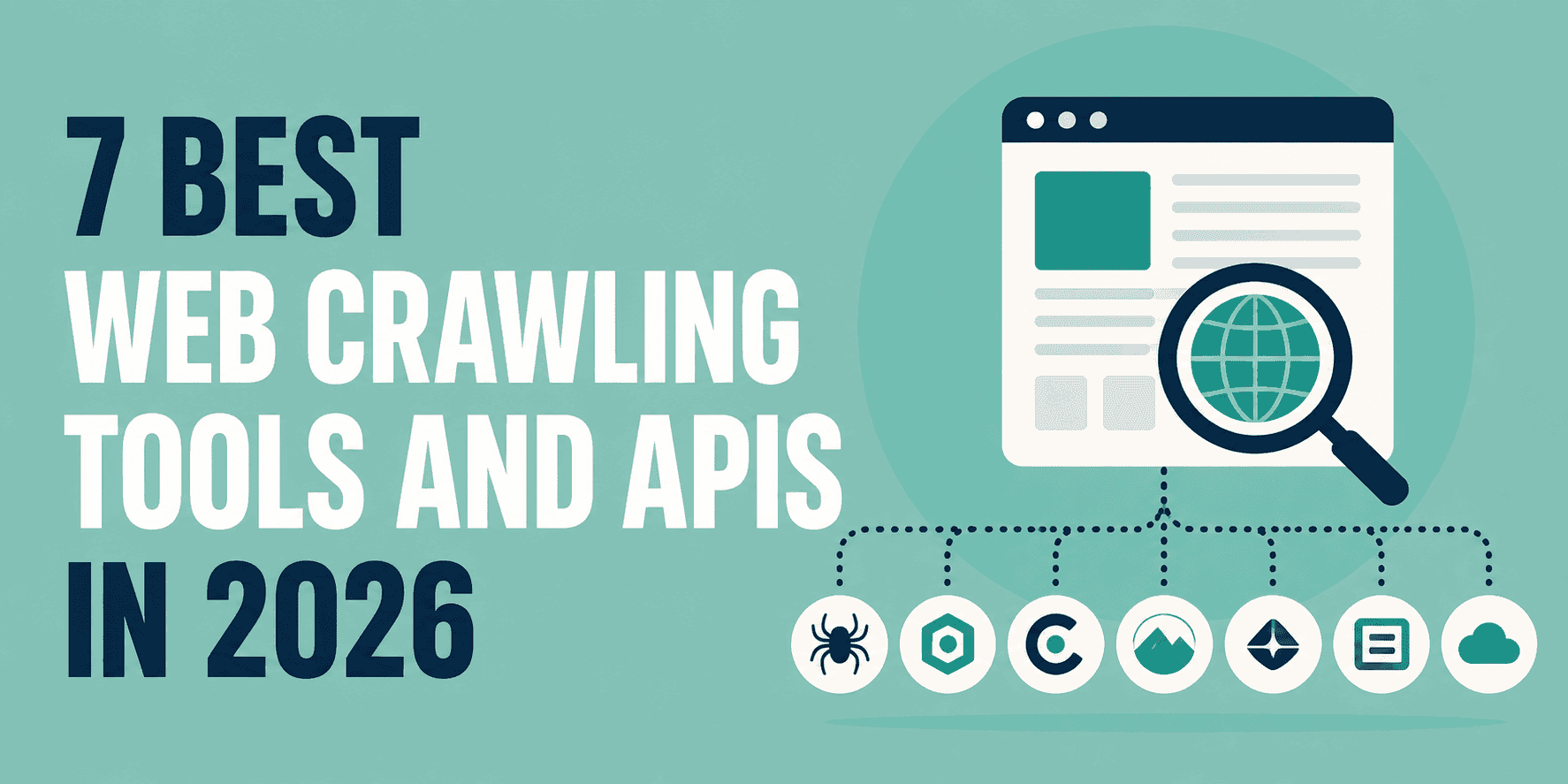
The 7 Best Web Crawling Tools and APIs in 2026
Here's a look at some of the leading web crawling tools and APIs that AI practitioners are leveraging in 2026:
1. Scrapy
Developer/Company: Scrapy is an open-source framework maintained by Zyte (formerly Scrapinghub).
Description: Scrapy is a powerful and popular open-source Python framework for large-scale web crawling and data extraction. It provides all the tools needed to efficiently extract data from websites, process it, and store it.
Key Features:
- Fast and Flexible: Built on top of Twisted, an asynchronous networking framework, allowing for high-performance crawling.
- Extensible: Highly customizable with middleware, pipelines, and extensions to handle various crawling needs like cookie handling, user-agent spoofing, and sitemap crawling.
- Built-in Selectors: Supports XPath and CSS selectors for efficient data extraction.
- Item Pipelines: Easily define how scraped items are processed and stored (e.g., saving to a database, validating data).
- Command-line Tools: Provides a rich set of commands for managing and running spiders.
- Open Source: Completely free to use and self-hostable.
Use Cases for AI Practitioners: Ideal for building custom, large-scale data pipelines for LLM pre-training, creating specific datasets for fine-tuning, or continuous competitive intelligence gathering where Python integration is key.
Pricing: Scrapy itself is free and open-source. The operational costs come from hosting, proxies, and developer maintenance. Zyte, the company behind Scrapy, offers commercial products like Zyte API and Scrapy Cloud for managed Scrapy deployments, which do have pricing tiers.
Official Link: Scrapy Official Website
2. Beautiful Soup
Developer/Company: Developed by Leonard Richardson.
Description: Beautiful Soup is a Python library designed for parsing HTML and XML documents. It creates a parse tree for parsed pages that can be used to extract data from HTML, which is often used in conjunction with a library like `requests` to fetch web pages.
Key Features:
- Easy to Use: Offers Pythonic idioms for iterating, searching, and modifying the parse tree.
- Robust Parsing: Handles malformed HTML gracefully, making it suitable for real-world web pages.
- Powerful Search: Provides methods for searching the parse tree using tags, attributes, CSS selectors, and text content.
- Encoding Detection: Automatically detects the encoding of incoming documents.
- Open Source: Free to use.
Use Cases for AI Practitioners: Excellent for rapid prototyping of scrapers, extracting specific elements from already fetched HTML for RAG systems, or cleaning raw HTML content before feeding it into an LLM. Often paired with other tools for fetching pages.
Pricing: Beautiful Soup is a completely free and open-source Python library.
Official Link: Beautiful Soup Documentation
3. Playwright
Developer/Company: Developed by Microsoft.
Description: Playwright is a Node.js library (with Python, Java, and .NET versions available) that enables reliable end-to-end testing and automation for modern web apps. Crucially for web crawling, it supports headless browser automation, allowing it to interact with JavaScript-heavy websites like a real user.
Key Features:
- Headless Browser Support: Controls Chromium, Firefox, and WebKit (Safari) browsers in a headless (no UI) or headed mode.
- Auto-wait: Automatically waits for elements to be ready, eliminating common flakiness issues in automation.
- Rich API: Provides a comprehensive API for interacting with pages, including clicking, typing, navigating, taking screenshots, and handling network requests.
- Context Isolation: Each test or scraping session runs in an isolated browser context, preventing state leakage.
- Multi-language Support: Available in TypeScript, JavaScript, Python, .NET, and Java.
- Open Source: Free under the Apache 2.0 license.
Use Cases for AI Practitioners: Essential for scraping data from dynamic, JavaScript-rendered websites, single-page applications (SPAs), or sites with complex user interactions. Great for generating synthetic user data for AI agents or collecting rich visual data (screenshots) for multimodal AI models.
Pricing: Playwright is free and open-source. The costs are primarily related to the infrastructure for running browsers at scale and developer time for script maintenance. Microsoft also offers Playwright MCP (Model Context Protocol) which is free, but LLM token costs can apply when using it with AI models.
Official Link: Playwright Official Website
4. Apify
Developer/Company: Apify, Inc., founded in 2015 and headquartered in Prague.
Description: Apify is a cloud-based web scraping and automation platform that allows developers and data teams to extract, process, and store data from websites at scale. It offers a marketplace of pre-built scrapers called "Actors" and a full SDK for building custom scrapers in JavaScript or Python.
Key Features:
- Apify Store (Actors): A vast marketplace with thousands of ready-made scrapers for popular websites (e.g., Google Maps, LinkedIn, Amazon).
- Cloud Platform: Handles infrastructure, proxy rotation, CAPTCHA solving, and scheduling, so users don't need to manage servers.
- SDKs (Crawlee): Provides open-source libraries for building custom scrapers in JavaScript/TypeScript (Crawlee) and Python.
- Headless Browser Automation: Integrates with headless browsers for dynamic content.
- Data Export Options: Exports data in various formats like JSON, CSV, and Excel, and integrates with Google Sheets, Make, Zapier, etc.
- AI-native tooling: Supports direct calls from AI agents and assistants via an MCP server.
Use Cases for AI Practitioners: Ideal for quickly acquiring structured data from common sources using pre-built Actors for LLM training or RAG. For custom needs, its SDKs and managed infrastructure are excellent for building robust data pipelines without significant DevOps overhead. Its AI-native tooling makes it highly suitable for feeding AI agents.
Pricing: Apify operates on a consumption-based credit model.
- Free Plan: $0/month with $5 in monthly credits, 8GB max Actor RAM, 25 concurrent runs. No credit card required.
- Starter Plan: $29/month, includes $29 in credits (at $0.20 per compute unit), 32 GB RAM, 32 concurrent runs.
- Scale Plan: $199/month, includes $199 in credits (at $0.16 per compute unit).
- Business Plan: $999/month, includes $999 in credits (at $0.13 per compute unit).
- Enterprise: Custom pricing with dedicated infrastructure and SLAs.
Official Link: Apify Official Website
5. Bright Data
Developer/Company: Bright Data Ltd. (formerly Luminati Networks).
Description: Bright Data is a comprehensive web data platform, known for its extensive proxy network and a suite of data collection products. It offers various tools, including a Web Scraper IDE, Web Unlocker, SERP API, and pre-collected datasets, making it suitable for enterprise-scale data extraction.
Key Features:
- Largest Proxy Network: Boasts one of the world's largest proxy networks, including residential, datacenter, ISP, and mobile IPs, crucial for bypassing anti-bot measures.
- Web Scraper IDE: A cloud-based integrated development environment for building, running, and managing web scrapers with pre-made templates, browser scripting, and debugging tools.
- Web Unlocker: An AI-powered solution that automatically handles CAPTCHAs, retries, and browser fingerprinting for even the most protected sites.
- SERP API: Dedicated API for extracting search engine results.
- Datasets Marketplace: Offers pre-collected, ready-to-use datasets from popular public sites.
- Compliance: Claims 100% compliance with data protection laws like GDPR and CCPA.
Use Cases for AI Practitioners: Best for enterprise-level data collection, especially when dealing with highly protected websites or needing massive volumes of data for complex AI models. Ideal for market research, competitive analysis, and building large-scale, high-quality datasets for AI training where reliability and anti-ban capabilities are paramount.
Pricing: Bright Data's pricing is product-based and often consumption-based.
- Web Scraper IDE: Pay-as-you-go at $1.50 per 1,000 page loads. Monthly plans start at $499 for 380,000 page loads ($1.30 per 1,000 page loads).
- Residential Proxies: Starts around $8.40/GB.
- Datacenter Proxies: Starts around $0.60/IP.
- Free Trial: Offers a 1,000-request, 1-week trial for the Web Scraper IDE.
Official Link: Bright Data Official Website
6. ScrapingBee
Developer/Company: ScrapingBee.
Description: ScrapingBee is a web scraping API designed to simplify data extraction by handling proxies, headless browsers, and anti-bot measures. It allows developers to send a URL and receive the raw HTML or structured data back, focusing on ease of use and reliability.
Key Features:
- Proxy Rotation & Management: Automatically rotates proxies to avoid IP bans.
- Headless Browser Rendering: Handles JavaScript-heavy pages using headless Chromium.
- Anti-bot Bypass: Offers premium and stealth proxies for harder targets.
- Simple API: A straightforward HTTP API for fetching web pages.
- Google Search Endpoint: Dedicated API for scraping Google SERP results.
- AI Query and Extraction Rules: Can convert page content into structured JSON.
Use Cases for AI Practitioners: Excellent for technical growth teams and developers who need reliable page retrieval without managing proxy infrastructure. Useful for collecting specific datasets for LLMs, content monitoring, and general-purpose scraping of moderately protected sites where an API-first approach is preferred.
Pricing: ScrapingBee uses a credit-based system, with different features consuming varying numbers of credits.
- Free Trial: 1,000 API credits.
- Freelance Plan: $49/month for 250,000 API credits, 50 concurrent requests.
- Startup Plan: $99/month for 1,000,000 API credits, 100 concurrent requests.
- Business Plan: $249/month for 3,000,000 API credits, 200 concurrent requests.
- Business+ Plan: $599/month for 8,000,000 API credits, 400 concurrent requests.
- Enterprise: Custom pricing.
Official Link: ScrapingBee Official Website
7. Zyte API (formerly Crawlera & Scrapy Cloud)
Developer/Company: Zyte (formerly Scrapinghub).
Description: Zyte API is an advanced web scraping API that provides automated ban handling, proxy rotation, and headless browser rendering. It's built on Zyte's extensive experience with Scrapy and offers AI-powered extraction capabilities, making it a robust solution for demanding web data extraction tasks.
Key Features:
- Automated Ban Handling & Proxy Rotation: Intelligently manages proxies and retries to bypass blocks, using a vast pool of IPs.
- AI Scraping: Uses AI to extract data points from web pages without needing to write manual selectors, especially useful for common data types like e-commerce products or articles.
- Headless Browser and Rendering: Supports JavaScript rendering for dynamic content.
- Pay-for-Success Model: Only charges for successfully delivered requests.
- Scrapy Cloud Integration: Offers a managed cloud environment for hosting and running Scrapy spiders.
- Compliance: GDPR and CCPA compliant, ISO 27001 certified.
Use Cases for AI Practitioners: Excellent for teams already using Python/Scrapy or those needing enterprise-grade reliability and scalability for complex data extraction. Its AI scraping features are particularly useful for generating structured datasets from various websites for LLMs and RAG with minimal configuration.
Pricing: Zyte API has a tiered, consumption-based pricing model, charging per successful request.
- Pay-as-you-go: Starts at $0.13 - $1.27 per 1,000 HTTP responses and $1.01 - $16.08 per 1,000 browser-rendered requests, with volume discounts available for monthly commitments.
- Commitment Plans: Discounts are offered for $100/month, $200/month, and $500/month commitments, reducing the per-request cost.
- AI Scraping: Starts around $0.60 per 1,000 requests.
- Scrapy Cloud: Free tier with 1 low-resource unit; paid units start at $9/month each.
- Free Credit: New accounts often receive $5 in free credit.
Official Link: Zyte API Official Website
Choosing the Right Tool for Your AI Project
Selecting the best web crawling tool depends heavily on your specific needs, technical expertise, and project scale. Here are some factors to consider:
- Technical Skill Level: If you're a Python developer, Scrapy or Beautiful Soup offer maximum control. For less coding, platforms like Apify, Bright Data, or ScrapingBee provide managed solutions.
- Website Complexity: For static HTML sites, Beautiful Soup might suffice. For dynamic, JavaScript-heavy sites or those with strong anti-bot measures, Playwright, Apify, Bright Data, or Zyte API are better choices due to their headless browser and unblocking capabilities.
- Scale of Data: For small, one-off scrapes, open-source libraries are fine. For millions of pages, consider managed platforms that handle scaling, proxies, and infrastructure.
- Budget: Open-source tools are free but incur infrastructure and maintenance costs. APIs and cloud platforms have subscription or consumption-based pricing, which can be more predictable for large-scale operations.
- Output Format: Do you need raw HTML, structured JSON, or LLM-ready Markdown? Some tools specialize in cleaner output for AI applications.
- Maintenance: Building and maintaining your own crawlers requires ongoing effort as websites change. Managed services offload this burden.
The world of web crawling for AI is constantly evolving. By understanding the strengths of these leading tools and APIs, AI practitioners can efficiently gather the high-quality data that fuels innovation and powers the next generation of intelligent systems.
Frequently Asked Questions
What is the difference between web crawling and web scraping?
Web crawling is the process of discovering and indexing web pages by following links, similar to how search engines operate. Web scraping, on the other hand, involves extracting specific data points or content from those web pages once they've been accessed. Crawling is about discovery; scraping is about extraction. Many tools and APIs combine both functionalities.
Why are proxies important for web crawling, especially for AI data collection?
Proxies are crucial for large-scale web crawling because they allow your requests to appear as if they are coming from different IP addresses. Websites often detect and block IPs that make too many requests too quickly (rate limiting) or exhibit bot-like behavior. By rotating proxies, crawlers can avoid these blocks, ensuring continuous and successful data collection, which is vital for gathering extensive datasets for AI models.
Can web crawling tools bypass all anti-bot measures?
No, not all anti-bot measures can be bypassed easily or reliably. Websites employ increasingly sophisticated techniques, including CAPTCHAs, advanced browser fingerprinting, and machine learning-based bot detection. While many modern crawling tools and APIs offer features like headless browsers, proxy rotation, and even AI-powered unblockers, some sites remain extremely challenging to scrape consistently. It's an ongoing cat-and-mouse game between scrapers and website defenses.
Is it legal to scrape data from websites for AI purposes?
The legality of web scraping is complex and varies by jurisdiction, the website's terms of service, and the type of data being collected. Generally, scraping publicly available data that does not contain personal information is less risky. However, scraping data that is copyrighted, behind a login, or explicitly prohibited by a website's `robots.txt` file or terms of service can lead to legal issues. Always consult legal counsel and respect website policies when undertaking scraping projects, especially for commercial or large-scale AI applications.