Key Takeaways
- Fine-tuning is a powerful technique that adapts large, pre-trained AI models to perform specific tasks with high accuracy using smaller, specialized datasets.
- It saves significant time, computational resources, and cost compared to training an AI model from scratch.
- Parameter-Efficient Fine-Tuning (PEFT) methods like LoRA and QLoRA make fine-tuning even more accessible by drastically reducing memory and computational requirements.
- Fine-tuning helps AI models specialize, reduce bias, and mitigate "hallucinations" for domain-specific applications.
The world of Artificial Intelligence often sounds like a realm reserved for PhDs and complex algorithms. But what if we told you that one of the most impactful techniques in modern AI – fine-tuning – is actually quite simple to grasp, even for a "noob"? If you've ever used an AI chatbot or seen AI generate stunning images, chances are fine-tuning played a big part in making it so good at its job.
At NerdsTool, we're all about breaking down complex AI concepts into plain, understandable language. Today, we're diving deep into fine-tuning: what it is, why it matters, and how these incredibly smart pre-trained models learn new, specialized skills.
What Exactly is Fine-Tuning?
Imagine you've hired a brilliant new chef. This chef has already studied at the best culinary schools, mastered thousands of recipes from around the world, and understands the fundamental principles of cooking. They have a vast general knowledge of food. Now, you want them to specialize in creating a specific type of cuisine for your restaurant – say, authentic Neapolitan pizza. You wouldn't ask them to go back to culinary school from scratch, would you? Instead, you'd teach them the specific nuances of Neapolitan pizza making: the dough hydration, the specific ingredients, the oven temperature, and the traditional techniques.
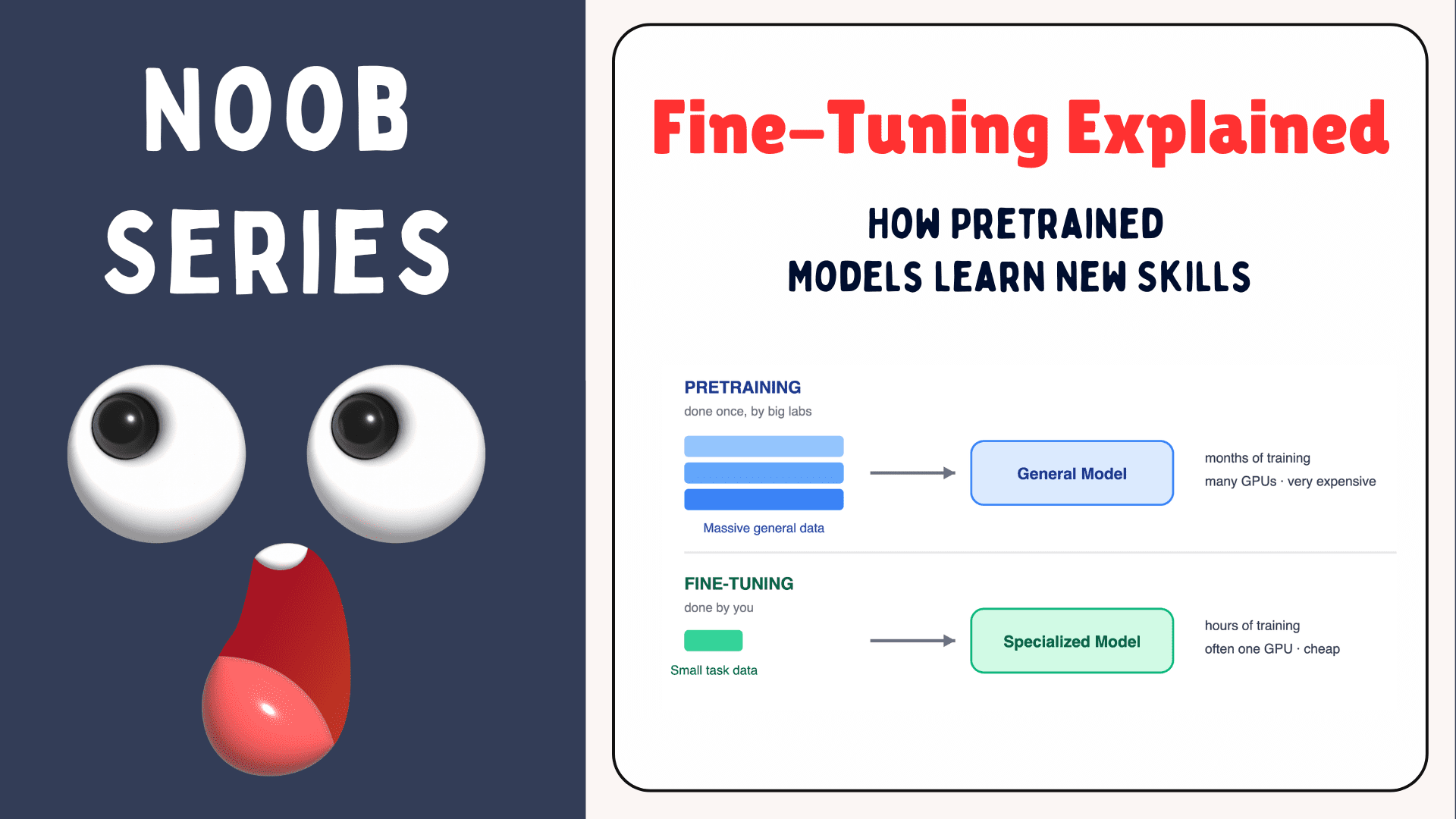
Fine-tuning an AI model is very much like this. You start with a "pre-trained model" – an AI model that has already learned a vast amount of general knowledge from an enormous dataset. This initial training is incredibly expensive and time-consuming, often taking months or years and requiring massive computational resources.
Then, you take this intelligent, pre-trained model and train it further on a much smaller, specific dataset that's directly related to the new task you want it to master. This process adapts the model's existing knowledge to perform better on a particular, specialized job.
Pre-Trained Models: The Foundation
Before a model can be fine-tuned, it must first be "pre-trained." This initial phase involves feeding the model colossal amounts of data, allowing it to learn general patterns, structures, and representations. For example, a large language model (LLM) might be pre-trained on nearly the entire internet – billions of text documents, books, articles, and websites.
During pre-training, the model learns fundamental skills like understanding grammar, vocabulary, context, and even basic reasoning. For LLMs, this often means learning to predict the next word in a sentence. For image models, it could be learning to identify common objects or shapes. These models, sometimes called "foundation models," become powerful general-purpose tools.
Popular examples of pre-trained models that are frequently fine-tuned include:
- Large Language Models (LLMs): BERT (from Google), GPT models (from OpenAI), Llama models (from Meta), RoBERTa (from Facebook AI), and Gemini (from Google). These are great for text-based tasks.
- Image Models: VGG16, Inception, ResNet (trained on ImageNet), Faster R-CNN, Mask R-CNN, YOLO (for object detection). These excel at computer vision tasks.
Why Fine-Tuning is a Game-Changer
Fine-tuning offers several compelling advantages that make it a cornerstone of modern AI development:
1. Improved Accuracy and Relevance
General-purpose models, while broad in their knowledge, might not be perfectly tailored for niche applications. Fine-tuning allows a model to specialize, significantly boosting its accuracy and relevance for specific tasks, like understanding legal jargon or a particular brand's tone of voice.
2. Faster and More Cost-Effective
Training an AI model from scratch is prohibitively expensive and time-consuming. Fine-tuning, by contrast, starts with an already intelligent model, requiring far less data, computational power, and time. This makes AI customization accessible to more businesses and individuals.
3. Customization and Specialization
Need an AI that can specifically answer questions about your company's HR policies? Or generate marketing copy in your unique brand voice? Fine-tuning allows you to imbue the model with domain-specific knowledge, style, and behavior.
4. Data Efficiency
Fine-tuning can achieve high performance with smaller, specialized datasets, which is invaluable when large amounts of labeled data are scarce or expensive to collect. You don't need "the entire internet" again; just enough relevant examples for your specific task.
5. Mitigating AI Limitations
Fine-tuning can help address common AI issues like:
- Knowledge Cutoff: Models only know what they were trained on. Fine-tuning can update them with newer, specific information.
- Hallucinations: By focusing the model on a specific domain, fine-tuning can reduce instances where the AI generates false or irrelevant information.
- Bias: While not a complete fix, fine-tuning with more balanced, task-specific data can help reduce biases inherited from the initial large training dataset.
How Fine-Tuning Works (The Guts of It)
The core idea behind fine-tuning is a concept called transfer learning. Instead of learning everything from scratch, the model "transfers" the general knowledge it gained during pre-training to a new, related task.
Here's a simplified breakdown of the process:
- Load the Pre-trained Model: You start by loading a pre-trained model, which comes with its internal "weights" (the numerical values that define its learned knowledge) already set to "good values."
- Prepare Your Task-Specific Dataset: You gather a smaller, high-quality dataset relevant to your new task. This dataset typically consists of input-output pairs (e.g., a movie review and its sentiment, or a legal document and its summary).
- Adjust Learning Rate: During fine-tuning, the learning rate (how much the model adjusts its weights with each training step) is usually set much lower than during pre-training. This prevents the model from "forgetting" its general knowledge by drastically overwriting its learned patterns.
- Continue Training: You then feed your specialized dataset to the pre-trained model. The model adjusts its weights, but instead of learning general features, it refines its existing knowledge to excel at the new, specific task. Often, only the "top layers" of the neural network (which are more task-specific) are adapted, while the earlier layers (which capture more general features) might be frozen or updated more slowly.
- Evaluation: After fine-tuning, you evaluate the model's performance on a separate validation dataset to ensure it has learned the new skill effectively without "overfitting" (meaning it performs well on the training data but poorly on new, unseen data).
Types of Fine-Tuning: Making it Efficient
While "full fine-tuning" involves updating all parameters of a pre-trained model, this can still be computationally intensive for massive models with billions of parameters. This led to the development of more efficient techniques:
Parameter-Efficient Fine-Tuning (PEFT)
PEFT methods aim to reduce the number of trainable parameters that need to be updated, significantly decreasing computational resources and memory storage. Popular PEFT techniques include:
- LoRA (Low-Rank Adaptation): LoRA works by introducing small, trainable "low-rank matrices" into specific layers of the pre-trained model. The vast majority of the original model's parameters remain frozen, and only these small adapter matrices are updated during fine-tuning. This drastically reduces the number of parameters to train (often 0.5-5% of the total) while maintaining comparable performance to full fine-tuning.
- QLoRA (Quantized Low-Rank Adaptation): QLoRA takes LoRA a step further by combining it with "quantization." Quantization compresses the model's weights into lower-bit representations (e.g., 4-bit or 8-bit), which dramatically reduces the memory footprint. This makes it possible to fine-tune massive models even on consumer-grade GPUs with limited VRAM.
PEFT methods are often the default choice for fine-tuning large language models today, making customization more accessible and affordable.
Practical Use Cases: Where Fine-Tuning Shines
Fine-tuning is used across various AI applications:
- Custom Chatbots: Fine-tuning an LLM on your company's internal documentation, customer support transcripts, or product manuals can create a chatbot that provides accurate, domain-specific answers.
- Content Generation: Adapting a text generation model to match a specific writing style, tone, or industry terminology for marketing copy, blog posts, or creative writing.
- Image Style Transfer: Fine-tuning an image generation model (like Stable Diffusion) to create images in a specific artistic style or with particular characteristics.
- Sentiment Analysis: Customizing a language model to accurately detect sentiment (positive, negative, neutral) in reviews or social media mentions for a particular product or industry.
- Code Generation: Fine-tuning models on specific coding examples to improve their ability to generate code in a particular programming language or for specific tasks.
- Healthcare: Adapting models to understand medical terminology and assist with tasks like disease diagnosis or medical record summarization.
Tools and Frameworks for Fine-Tuning
For those looking to get hands-on, several popular tools and frameworks simplify the fine-tuning process:
- Hugging Face Transformers: This library is a go-to for working with pre-trained models, especially for NLP tasks. It provides a
TrainerAPI that streamlines the fine-tuning process, making it accessible even without deep knowledge of the underlying model architecture. - PyTorch and TensorFlow: These are foundational deep learning frameworks. While Hugging Face builds on them, you can also implement fine-tuning directly using PyTorch or TensorFlow for more granular control.
- Google Cloud Vertex AI: Offers services for fine-tuning LLMs, including models like Gemini, with features for managing datasets and evaluating performance.
- Databricks: Provides tools for fine-tuning LLMs, leveraging its lakehouse platform for data management, training, and evaluation.
Challenges and Considerations
While powerful, fine-tuning isn't without its challenges:
- Data Quality and Quantity: Even with smaller datasets, the quality, relevance, and representativeness of your fine-tuning data are paramount. Poor data can lead to poor performance or amplified biases.
- Overfitting: If fine-tuned too aggressively on a small dataset, the model might "memorize" the training examples instead of learning generalizable patterns, performing poorly on new data. Techniques like regularization and data augmentation can help.
- Catastrophic Forgetting: Over-specializing a model can sometimes cause it to "forget" its general knowledge acquired during pre-training. PEFT methods often help mitigate this.
- Computational Resources: While less demanding than training from scratch, fine-tuning large models still requires significant computational resources, especially for full fine-tuning. PEFT methods are designed to address this.
- Ethical Considerations: Fine-tuning can introduce or amplify biases present in the fine-tuning data, leading to unfair or discriminatory outcomes. Careful data curation and evaluation are crucial.
Conclusion
Fine-tuning is a powerful and accessible technique that unlocks the true potential of sophisticated AI models. It allows us to take a model that already possesses vast general intelligence and teach it new, specialized skills for our unique needs. For AI practitioners, developers, and even freelancers looking to leverage AI tools, understanding fine-tuning means being able to customize off-the-shelf models, reduce development costs, and create highly specific, high-performing AI solutions. It's the bridge that connects the general brilliance of foundation models to the precision required for real-world applications, making AI truly adaptable and impactful.
Frequently Asked Questions
What is the main difference between training and fine-tuning an AI model?
Training an AI model means building it from scratch, starting with random parameters and learning general patterns from a massive dataset. This is very resource-intensive. Fine-tuning, on the other hand, takes an already pre-trained model and further trains it on a smaller, task-specific dataset to adapt its existing knowledge for a particular use case.
Can I fine-tune any pre-trained AI model?
Theoretically, yes, fine-tuning can be applied to most pre-trained neural network architectures. However, the effectiveness depends on how closely related the pre-training task is to your desired fine-tuning task. Models from platforms like Hugging Face are specifically designed to be easily fine-tuned.
What are LoRA and QLoRA, and why are they important?
LoRA (Low-Rank Adaptation) and QLoRA (Quantized Low-Rank Adaptation) are Parameter-Efficient Fine-Tuning (PEFT) methods. They are important because they drastically reduce the computational resources and memory needed to fine-tune large AI models. Instead of updating all billions of parameters, they introduce small, trainable matrices (LoRA) or combine this with memory-saving quantization (QLoRA), making fine-tuning more accessible on standard hardware.
How much data do I need for fine-tuning?
The amount of data needed for fine-tuning is significantly less than for pre-training. While there's no fixed number, hundreds to a few thousand high-quality, relevant examples can often yield good results for many tasks. The key is quality and relevance over sheer quantity.