Key Takeaways
- SmolVLM2-2.2B is a compact yet powerful multimodal AI model from Hugging Face, designed for efficient local video and image analysis.
- It can run on a single consumer GPU (like an RTX 3060 with 5.2GB VRAM) or even a MacBook Pro M2, making advanced AI accessible without expensive cloud APIs or high-end clusters.
- The model excels at video summarization, visual question answering, and OCR by treating videos as sequences of images, using an efficient tokenization strategy.
- SmolVLM2-2.2B offers a strong capability-to-size trade-off, outperforming other 2B-scale models on benchmarks like Video-MME, making it ideal for local AI pipelines.
In the rapidly evolving world of artificial intelligence, the ability to process and understand video content is becoming increasingly important. From analyzing security footage to summarizing lengthy meetings or educational lectures, the demand for efficient video understanding tools is growing. Traditionally, this has often meant relying on expensive cloud-based APIs or high-end GPU clusters, putting local, accessible video AI out of reach for many. This is where a model like SmolVLM2-2.2B truly changes the game.
Developed by the Hugging Face TB (Textbook) Research team, SmolVLM2-2.2B represents a significant step forward for local AI. It's a lightweight, multimodal vision-language model (VLM) specifically designed to run efficiently on consumer-grade hardware, making powerful video summarization and analysis accessible to a broader audience of AI practitioners, developers, and tech-savvy freelancers.
What is SmolVLM2-2.2B?
SmolVLM2-2.2B is a compact yet highly capable vision-language model (VLM) with 2.2 billion parameters. The "Smol" in its name highlights its small footprint, which is a deliberate design choice to enable local, on-device processing. It is part of the broader SmolVLM2 family, which also includes even smaller 256M and 500M parameter variants, though the 2.2B version is generally recommended for robust video understanding tasks due to its superior accuracy.
This model is built on an architecture based on Idefics3, combining a shape-optimized SigLIP vision encoder with a SmolLM2-1.7B language backbone. This combination allows it to process and understand various inputs, including videos, images, and text, and generate coherent text outputs.
The model was officially announced by Hugging Face on February 20, 2025, with its base and instruct versions available on the Hugging Face platform. It operates under the Apache 2.0 license, promoting open access and use.
Why Local Processing Matters: The Power of On-Device AI
The emphasis on "local" processing with SmolVLM2-2.2B isn't just a technical detail; it's a fundamental shift with several key benefits, especially for AI practitioners and freelancers:
- Privacy and Security: For sensitive data like internal meeting recordings, medical footage, or proprietary content, uploading to a third-party cloud service can be a non-starter due to privacy concerns and compliance regulations. Local processing ensures your data never leaves your machine.
- Cost Efficiency: Cloud AI APIs typically bill per minute or per token, which can quickly become expensive when processing large volumes of video. A local pipeline involves a one-time hardware investment and electricity, making it more cost-effective for extensive use.
- No Rate Limits or Vendor Lock-in: With a local setup, you control the processing schedule and capacity. You can batch process as much as your GPU can handle, offline, without worrying about API rate limits or being tied to a specific cloud provider's ecosystem.
- Accessibility: SmolVLM2-2.2B's ability to run on a single consumer GPU, such as an NVIDIA RTX 3060 (requiring only 5.2GB of VRAM for video inference) or even a MacBook Pro M2, democratizes access to advanced video AI. This means you don't need an expensive data center or specialized hardware to start building powerful applications.
How SmolVLM2-2.2B Works for Video Summarization
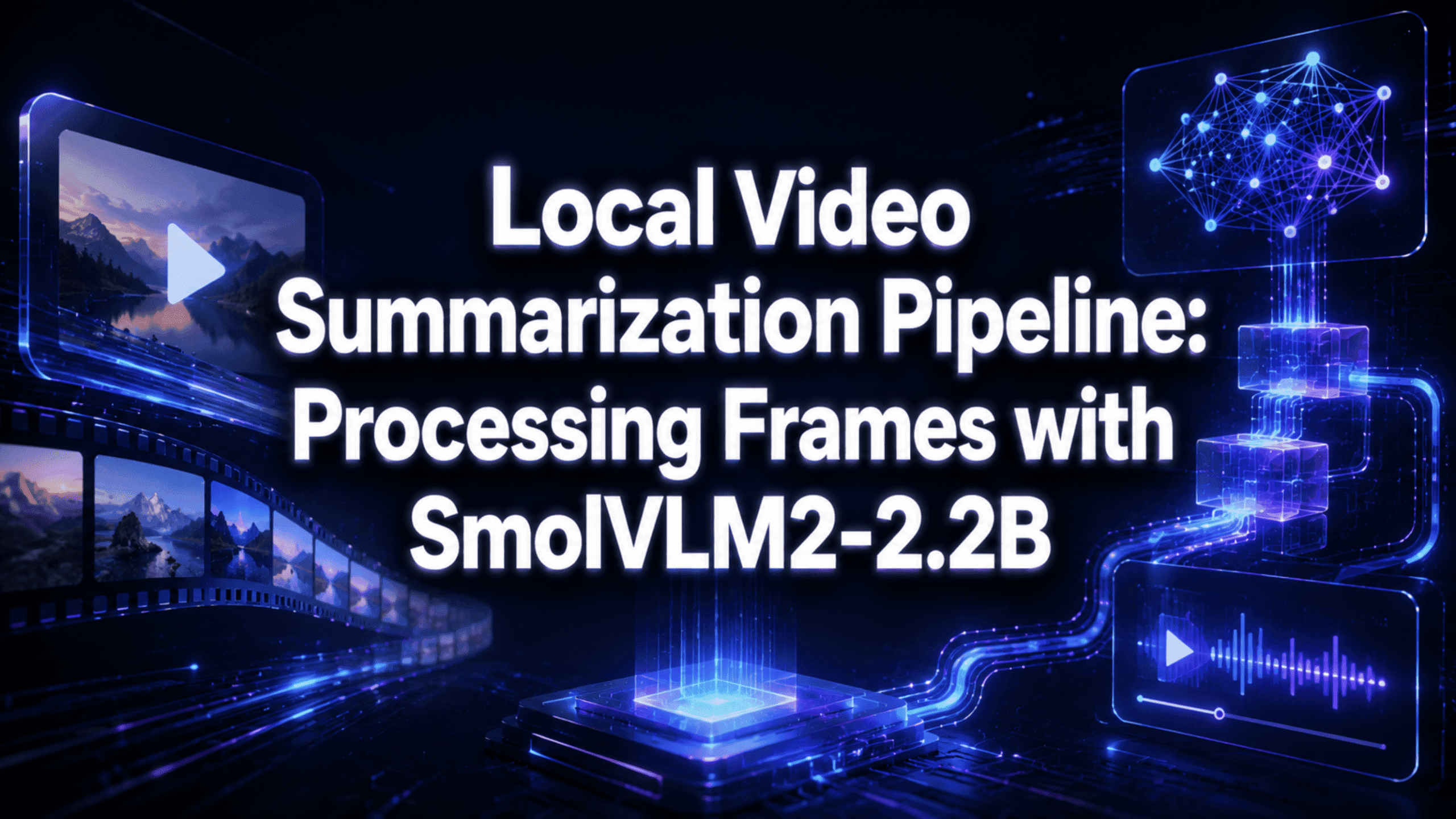
Understanding how SmolVLM2-2.2B processes video is key to building effective local pipelines. Unlike some larger, more complex models that might have dedicated video encoders, SmolVLM2 takes a pragmatic approach: it treats video as a sequence of images.
Here's a high-level look at the typical pipeline:
- Frame Extraction: The first step involves extracting individual frames from the video at configurable intervals. Tools like FFmpeg are commonly used for this. The frequency of frame extraction depends on the video's content and the desired level of detail in the summary.
- Efficient Tokenization: This is where SmolVLM2's clever design shines. Many VLMs tokenize images at very high density, leading to massive token counts for multiple frames. SmolVLM2, however, uses a pixel shuffle strategy that compresses each 384x384 image patch into just 81 tokens. This means that 50 frames, for example, become roughly 4,050 image tokens—a manageable number for a single inference call on consumer GPUs.
- VLM Processing: The extracted (and efficiently tokenized) frames are then fed into SmolVLM2-2.2B as a multi-image sequence within a single chat message. You can prompt the model with specific questions or instructions, such as "Describe what happens across these frames," "Identify key moments," or "Summarize the main activities."
- Text Output Generation: SmolVLM2-2.2B processes these visual inputs along with your text queries to generate descriptive text outputs. This can include per-frame scene descriptions, identification of key moments with timestamps, action items, or a narrative summary of the video.
- (Optional) Audio Transcription and Fusion: For videos with significant dialogue, a comprehensive summarization pipeline often includes a separate step to transcribe the audio. Tools like OpenAI's Whisper (or faster-whisper) can generate timestamped transcripts. This transcript can then be combined with the visual descriptions from SmolVLM2-2.2B and fed into a small local Large Language Model (LLM) to create a richer, more complete multimodal summary, searchable index, or chapter markers.
The Capability-Size Trade-off: Why 2.2B is Significant
The core appeal of SmolVLM2-2.2B lies in its "genuinely useful point on the capability-size trade-off curve." In the world of AI models, bigger often means better performance, but it also means significantly higher computational demands. SmolVLM2-2.2B strikes a remarkable balance:
- Strong Performance: On standard long-form video understanding benchmarks like Video-MME, SmolVLM2-2.2B outperforms every other existing 2B-scale model. It achieves a Video-MME score of 52.1, an MLVU score of 55.2, and an MVBench score of 46.27. This indicates its strong ability to reason about complex temporal events in videos.
- Memory Efficiency: Requiring only 5.2GB of GPU RAM for video inference, it can run comfortably on widely available consumer graphics cards like the RTX 3060, or even on a MacBook Pro M2, and within the free Google Colab T4 tier. This low memory footprint is a direct result of its efficient architecture, particularly its image tokenization strategy.
This combination of strong performance and low resource requirements makes SmolVLM2-2.2B an excellent choice for local deployment, where larger models (70B+ parameters) would demand multiple A100 GPUs and take minutes per clip to process.
Real-World Applications for AI Practitioners and Freelancers
For individuals and small businesses working with video content, SmolVLM2-2.2B opens up a wealth of possibilities:
- Meeting Summarization: Automatically generate concise summaries of recorded meetings, highlighting key discussion points, decisions, and action items. This can be invaluable for productivity and record-keeping.
- Lecture and Course Content Analysis: Quickly get overviews of educational videos, identify important concepts, or extract specific information without watching the entire recording.
- Surveillance and Security Footage Review: Efficiently analyze hours of surveillance video to detect specific events, object movements, or anomalies, saving significant manual review time.
- Content Creation and Editing: For video editors and content creators, SmolVLM2-2.2B can help in automatically tagging scenes, identifying highlights, or generating descriptions for social media, streamlining workflows.
- Document and Chart Understanding (within video frames): Beyond general video understanding, SmolVLM2-2.2B also demonstrates strong performance in tasks like Optical Character Recognition (OCR) and visual question answering on documents or charts appearing in video frames.
- Robotics and Automation: Its compact size and efficiency make it suitable for edge deployment in robotics for real-time scene understanding and action prediction.
Setting Up a Local Video Summarization Pipeline
While a full step-by-step code tutorial is beyond the scope of this deep-dive, here's a conceptual outline of how you might set up a local pipeline using SmolVLM2-2.2B:
- Environment Setup:
- Install Python and necessary libraries:
transformers,torch,Pillow,ffmpeg-python(for frame extraction). - Ensure you have a compatible GPU with sufficient VRAM (e.g., 5.2GB for SmolVLM2-2.2B) and the appropriate drivers (CUDA for NVIDIA). Flash Attention 2 is recommended for optimal performance.
- Install Python and necessary libraries:
- Video Pre-processing (Frame Extraction):
- Use
ffmpegto extract frames at a desired interval (e.g., 1 frame per second or every few seconds, depending on the video's pace). - Example (conceptual):
ffmpeg -i input.mp4 -vf fps=1 output_frames/frame_%04d.png
- Use
- Loading SmolVLM2-2.2B:
- Utilize the Hugging Face
transformerslibrary to load the model and its processor. The model can be found on Hugging Face as HuggingFaceTB/SmolVLM2-2.2B-Instruct or HuggingFaceTB/SmolVLM2-2.2B-Base. - Example (conceptual):
from transformers import AutoProcessor, AutoModelForImageTextToText
import torch
from PIL import Image

model_path = "HuggingFaceTB/SmolVLM2-2.2B-Instruct"
processor = AutoProcessor.from_pretrained(model_path)
model = AutoModelForImageTextToText.from_pretrained(
    model_path,
    torch_dtype=torch.bfloat16,
    _attn_implementation="flash_attention_2"
).to("cuda")
- Utilize the Hugging Face
- Batch Inference:
- Load the extracted frames as PIL Images.
- Group multiple frames into a single input sequence for the model, as SmolVLM2-2.2B is optimized to handle multi-image inputs.
- Construct your prompt, asking the model to describe the sequence or answer specific questions.
- Pass the processed images and text prompt to the model for inference.
- Output Processing:
- Parse the text output from the model.
- Structure the summaries into a usable format, such as JSON, including frame descriptions, timestamps, or identified key events.
- (Optional) Audio Integration:
- Use the OpenAI Whisper model or faster-whisper to transcribe the video's audio.
- Employ a small local LLM (e.g., another Hugging Face model optimized for text) to fuse the visual summaries with the audio transcript for a richer, more comprehensive output.
For those looking for quantized versions for even lighter local deployment, community builds like the GGUF builds for Ollama are available, allowing it to run on a wider range of consumer hardware, including laptops and smartphones.
The Future of Local VLMs and Video AI
SmolVLM2-2.2B isn't just a model; it's a demonstration of a crucial trend: the move towards making powerful AI more accessible and runnable on everyday devices. This approach bypasses the need for constant cloud connectivity and massive computational resources, fostering innovation and privacy for developers and users. As models become even more optimized and hardware continues to advance, we can expect to see an explosion of local AI applications, particularly in areas like video understanding, where real-time, private processing is highly valued.
The work by Hugging Face TB Research team with SmolVLM2 shows that "small" doesn't mean "less capable." Instead, it means smarter design, efficient architectures, and a focus on practical utility for real-world workflows. This model empowers individuals to build sophisticated AI solutions right on their desks, truly bringing advanced AI to every device.
Frequently Asked Questions
What is SmolVLM2-2.2B?
SmolVLM2-2.2B is a compact, 2.2 billion parameter multimodal vision-language model developed by Hugging Face. It's designed for efficient analysis of video, images, and text, generating text-based responses, and is particularly notable for its ability to run on a single consumer GPU.
What are the main benefits of using SmolVLM2-2.2B for video summarization?
The primary benefits include its ability to run locally on consumer hardware (saving costs and ensuring data privacy), its strong performance on video understanding benchmarks despite its small size, and its efficient processing of video frames, making advanced video AI accessible for various real-world applications.
What kind of hardware do I need to run SmolVLM2-2.2B?
SmolVLM2-2.2B requires approximately 5.2GB of GPU VRAM for video inference. This means it can run on a single consumer GPU like an NVIDIA RTX 3060, a MacBook Pro M2, or even a free Google Colab T4 tier. For optimal performance, a modern GPU supporting bfloat16 and Flash Attention 2 is recommended.
Can SmolVLM2-2.2B generate images or videos?
No, SmolVLM2-2.2B is designed for understanding and generating text outputs based on visual and text inputs. It does not support image or video generation.