Key Takeaways
- Agentic AI allows systems to autonomously plan, execute, and adapt to achieve complex goals, extending beyond traditional generative AI's content creation.
- Successful Agentic AI deployments depend on understanding and correcting five common misconceptions, not solely on advanced model capabilities.
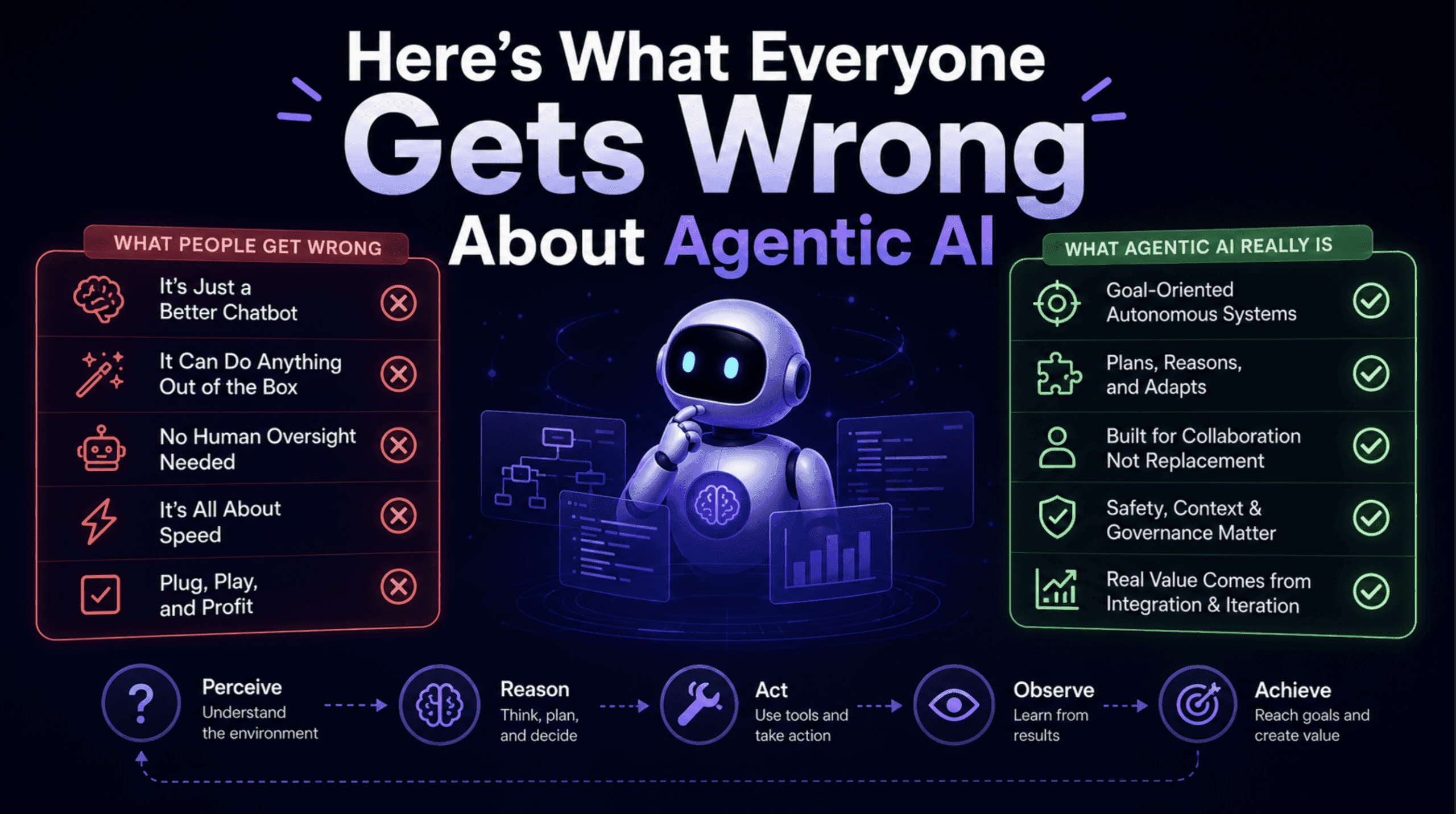
- Key misconceptions include overestimating autonomy, confusing demos with production deployments, believing more tools always mean smarter agents, assuming agents are "set and forget," and viewing them as human replacements.
- Frameworks like LangChain, AutoGen (and its successor, Microsoft Agent Framework), and CrewAI help build agentic systems, but careful design and human oversight are crucial for real-world success.
The world of Artificial Intelligence is always moving fast. Just when we wrap our heads around generative AI, a new concept takes center stage: Agentic AI. This advanced form of AI promises systems that can not only understand and generate content but also act autonomously to achieve specific goals. It sounds like something out of science fiction, and in many ways, it is, but it's also very real and already being deployed in various industries. However, despite its immense potential, many teams struggle with their first Agentic AI projects. The problem isn't the technology itself; it's often rooted in several common misconceptions that lead to predictable failures.
At NerdsTool, we believe that understanding the core concepts and avoiding these pitfalls is key to unlocking the true power of Agentic AI. This deep dive will explain what Agentic AI is, why it matters, and crucially, what everyone gets wrong about it, offering correctable insights for AI practitioners and freelancers looking to leverage this exciting technology.
What Exactly Is Agentic AI?
Think of traditional AI as a highly skilled assistant waiting for your instructions. You ask it a question, it gives you an answer. You tell it to generate an image, and it creates one. Agentic AI takes this a significant step further. It's an AI system designed to accomplish a specific goal with limited supervision. Instead of just generating content based on learned patterns, Agentic AI applies those outputs toward concrete objectives, executing actions through various tools to complete complex tasks autonomously.
At its core, Agentic AI involves AI agents—machine learning models that mimic human decision-making. These agents can perceive their environment, reason about the best course of action, plan a sequence of steps, and then execute those steps using available tools. They also have memory, allowing them to learn from past interactions and continuously improve their performance over time. This means an Agentic AI system can set its own goals, break down complex tasks into smaller manageable steps, and adapt its approach based on real-time feedback, all with minimal human intervention.
While a single AI agent can handle tasks sequentially, the true power of Agentic AI often comes from multi-agent systems. Here, multiple specialized agents collaborate, share insights, and hand off tasks to each other, much like a human team working together towards a common objective.
Key Components of Agentic AI:
- Perception: Gathering data from the environment (sensors, APIs, databases, user input) to understand the current state.
- Reasoning: Using large language models (LLMs) as a "brain" to process information, evaluate options, and determine appropriate actions.
- Planning: Breaking down complex goals into a series of actionable steps.
- Action: Executing tasks by calling external tools, APIs, or other systems.
- Memory: Storing relevant information and learning from feedback to improve future decisions.
- Adaptability: Adjusting actions based on real-time input and changing environments.
Why Agentic AI Matters for AI Practitioners and Freelancers
The implications of Agentic AI are vast. It's not just about automating repetitive tasks; it's about automating entire workflows and decision-making processes. For AI practitioners and freelancers, this technology opens up new avenues for creating highly sophisticated solutions and services. Imagine:
- Automated Research Assistants: An agent that can scour the internet, summarize findings, and even draft reports on a given topic, freeing up countless hours for consultants and researchers.
- Personalized Marketing Campaigns: Agents that analyze customer data, generate tailored content, deploy it across platforms, and then optimize the strategy based on real-time performance.
- Intelligent Customer Support: Systems that manage inquiries, resolve issues, and provide personalized support, escalating complex cases to human agents only when necessary.
- Code Generation and Testing: AI agents that can write, test, and debug code, significantly accelerating software development cycles.
- Fraud Detection and Financial Analysis: Agents monitoring transactions, identifying anomalies, and even executing trades based on market indicators.
Companies like AT&T are already leveraging agentic AI for tasks such as digital receptionists to identify spammers and fraudsters. eBay uses an internal agentic AI platform called Mercury for LLM-driven recommendation experiences. Google has developed Jules, an AI coding agent that assists developers by fixing bugs and writing tests. These examples highlight the tangible benefits of agentic AI in boosting efficiency, reducing operational costs, and enabling innovation.
The Five Misconceptions About Agentic AI (And How to Correct Them)
Despite the excitement, many initial Agentic AI deployments face challenges. According to Gartner, over 40% of Agentic AI projects are expected to be canceled by the end of 2027, primarily due to human errors in deployment, not technological flaws. The feed item correctly points out that Agentic AI isn't failing because the technology is bad, but because of specific misconceptions. Let's break down these common pitfalls and how to avoid them.
Misconception 1: "Autonomous" Means It Works Without Supervision
When people hear "Agentic AI," they often equate "agentic" with "autonomous," and "autonomous" with "hands-off." The assumption is that once deployed, an agent will simply handle everything on its own. This leads teams to minimize oversight and guardrails, expecting the agent to "know" not to do harmful things.
The Reality: Agentic AI operates with conditional automation, not total autonomy. Agents act within boundaries that you define, using specific tools, carefully crafted prompts, and explicit stopping rules. What appears as autonomy is actually a series of planned steps with built-in permission checks. Most enterprise AI agent deployments require strong "human-in-the-loop" governance.
Correction: Design your agents with clear parameters and robust oversight mechanisms. Implement human-in-the-loop processes where critical decisions require human approval or intervention. Define specific roles and responsibilities for both agents and human supervisors. Think of it as empowering a highly capable intern: they can perform many tasks, but they still need clear instructions, supervision, and access control.
Misconception 2: A Demo Is the Same as a Deployment
This is arguably the most expensive misconception. Impressive demos often showcase Agentic AI performing 2-3 step workflows on clean, controlled inputs. A human might be secretly curating inputs, watching outputs, and discarding failed runs. Teams see these "happy path" scenarios and mistakenly believe production deployment will be equally smooth.
The Reality: Production environments are messy. They involve 5-20 step workflows, real-world data with inconsistencies, ambiguous inputs, unexpected API responses, partial failures, and edge cases no one anticipated. The leap from a controlled demo to a robust production system requires significant engineering effort to handle these complexities, including retry logic, fallback paths, and graceful degradation. Prototyping an agent might take an afternoon, but making it production-ready can take months.
Correction: Approach deployment with a realistic understanding of real-world complexity. Focus on thorough testing that simulates production conditions, including stress testing, edge case handling, and integration with existing legacy systems. Invest in robust monitoring and observability tools to track agent behavior in live environments. Understand that the goal is not just to make it work once, but to make it not break under varying conditions.
Misconception 3: More Tools Equals a Smarter Agent
It's natural to think that giving an AI agent access to more tools and capabilities will make it more intelligent and versatile. However, this often backfires in Agentic AI systems.
The Reality: While tools extend an agent's capabilities, an excessive number or poorly integrated tools can increase the "attack surface for failure." This can lead to "functional hallucination," where the agent selects the wrong tool, passes malformed arguments, fabricates a tool result, or bypasses a necessary step. The underlying cause is often "scope creep," where agents are tasked with more than their underlying infrastructure can reliably support.
Correction: Design agents with a focused set of tools relevant to their specific role and goals. Instead of building one "super agent," consider a multi-agent system where each agent has a narrow scope and specialized tools, collaborating as needed. Ensure tools are well-defined, robust, and have clear input/output specifications. Prioritize quality and relevance of tools over sheer quantity.
Misconception 4: AI Agents Are Reliable Once They Work
Many teams assume that once an Agentic AI system is successfully deployed and appears to be working, it will continue to perform reliably without much ongoing attention. This "set and forget" mentality can lead to unexpected failures down the line.
The Reality: Agent behavior is often "non-stationary." This means the same inputs don't always guarantee the same outputs. Factors like API changes, fluctuating tool availability, minor prompt modifications, or even updates to the underlying language model can cause behavioral drift. An agent that performed perfectly last week might degrade this week, and reliability problems often manifest under load and over time in production.
Correction: Implement continuous monitoring, logging, and regression testing for your Agentic AI systems. Don't just evaluate outputs; monitor the actual behaviors and decision-making processes of your agents. Establish clear performance metrics and alerts for deviations. Treat agents as dynamic systems that require ongoing care and optimization, similar to any complex software. Remember, failures are often a system property, not just a flaw in the model itself.
Misconception 5: AI Agents Will Replace Human Workers
A common fear and misconception is that Agentic AI will lead to widespread job displacement, with autonomous agents taking over human roles entirely. This perspective often creates resistance to adoption and misses the true value proposition of Agentic AI.
The Reality: Most Agentic AI systems are designed to augment, not replace, human capabilities. They excel at handling repetitive, data-intensive, or well-defined tasks, freeing up human workers to focus on more complex, creative, and strategic activities that require judgment, empathy, and nuanced understanding. Agentic AI is an enabler, optimizing existing processes and cutting down manual handoffs, allowing humans to do higher-level work.
Correction: Frame Agentic AI as a tool for amplification, not replacement. Focus on integrating agents to support human teams, defining clear roles and collaboration paths between AI and human workers. Invest in change management and education to help employees understand how agents can enhance their productivity and allow them to contribute more strategically. Successful deployments leverage agents to redefine and rethink workflows, working alongside humans to achieve better outcomes.
Building Agentic AI Systems: Popular Frameworks
For those looking to build Agentic AI systems, several frameworks simplify the development process by providing pre-built components for perception, reasoning, action, and memory management. These frameworks help abstract complexity, enabling faster prototyping and scaling of autonomous applications.
- LangChain: An open-source framework that facilitates the integration of language models with various tools, APIs, and data sources. It offers pre-built agent architectures and integrations for rapid development of dynamic, responsive, and intelligent systems. LangChain agents use an "Action-Observation Loop" to iteratively call tools and refine results.
- LangGraph: Built on LangChain, LangGraph is a graph-based framework designed for building expressive, customizable, and reliable agentic workflows. It provides low-level primitives for designing diverse control flows (single, multi-agent, hierarchical) and supports human-in-the-loop interactions.
- AutoGen: Developed by Microsoft Research, AutoGen is an open-source framework for building AI agents and facilitating cooperation among multiple agents to solve tasks through conversational patterns. It simplifies the creation of multi-agent systems using LLMs. However, it's important to note that AutoGen is now in maintenance mode, and for new projects, Microsoft recommends using the Microsoft Agent Framework, which is its enterprise-ready successor with stable APIs and long-term support.
- CrewAI: An open-source Python framework that orchestrates role-playing autonomous AI agents into "crews" to collaboratively complete tasks. Each agent in CrewAI has a defined role, goal, and backstory, and they work together to delegate tasks and make decisions autonomously. It's gaining traction for its focus on multi-agent collaboration.
- LlamaIndex: An open-source data orchestration framework for building generative AI and Agentic AI solutions. It offers prepackaged agents and tools, with a focus on data integration and retrieval-augmented generation (RAG) to ground agents in relevant company knowledge bases.
The Path Forward for Agentic AI
Agentic AI is undeniably a powerful evolution in the AI landscape. Its ability to perceive, reason, plan, and act autonomously offers transformative potential across nearly every industry. However, its successful integration hinges on a clear understanding of its capabilities and limitations. By recognizing and actively correcting the common misconceptions discussed above, AI practitioners and freelancers can move beyond the hype and build robust, reliable, and truly impactful Agentic AI solutions.
The key is to approach Agentic AI not as a magical, fully autonomous entity, but as a sophisticated system requiring careful design, structured autonomy, rigorous testing, continuous monitoring, and strategic human collaboration. By doing so, we can harness its power to augment human potential and solve complex problems in ways previously unimaginable.
Frequently Asked Questions
What is the core difference between Generative AI and Agentic AI?
Generative AI primarily focuses on creating content like text, images, or code based on prompts. Agentic AI takes this further by using generative models as a "brain" to understand goals, plan multi-step actions, and then execute those actions autonomously using various tools to achieve a specific objective.
Are Agentic AI systems truly autonomous?
No, not in the sense of being entirely hands-off or self-aware. Agentic AI operates with "conditional automation." It acts within predefined boundaries, uses specific tools, and follows explicit rules and prompts set by humans. While it can make decisions and take multiple steps, it generally requires human oversight and intervention, especially in complex or critical scenarios.
What are some real-world examples of Agentic AI?
Agentic AI is being used in various sectors. Examples include AI-powered trading bots that analyze market data and execute trades, autonomous vehicles that use real-time sensor data for navigation, customer service agents that manage inquiries and resolve issues, systems for fraud detection in financial services, and AI agents that assist developers by writing and testing code.
How can freelancers and small businesses start using Agentic AI?
Freelancers and small businesses can leverage Agentic AI by exploring open-source frameworks like LangChain, CrewAI, or LlamaIndex. These frameworks provide tools and components to build custom agents for tasks like automated research, content generation with integrated publishing, or managing client communication workflows. Starting with well-defined, smaller-scope tasks and gradually expanding capabilities is a practical approach.