Key Takeaways
- Small Language Models (SLMs) offer a cost-effective and efficient alternative to large LLMs for specialized tasks, reducing operational costs and enabling on-device deployment.
- Hugging Face's Transformers library is a crucial open-source toolkit for developing, fine-tuning, and deploying SLMs, offering features like quantization and distillation.
- smolLM3, developed by Hugging Face, is a state-of-the-art 3-billion parameter, open-source model designed for efficient reasoning, multilingual support, and long-context understanding.
- This 3B model demonstrates competitive performance against larger 4B models, making advanced AI more accessible for resource-constrained environments.
In the rapidly evolving world of artificial intelligence, Large Language Models (LLMs) like GPT-4 and Llama 2 have captured headlines with their impressive general-purpose capabilities. However, running these colossal models in production often comes with a hefty price tag, demanding significant computational resources and incurring substantial operational costs. For many real-world applications, especially those focused on specific tasks, deploying a massive 70-billion parameter model is simply overkill and financially unsustainable.
This is where Small Language Models (SLMs) step in, offering a compelling alternative. Imagine building a focused AI pipeline where a well-trained 3-billion parameter model can match or even surpass the performance of a much larger 70B model on your specific task, all at a fraction of the cost. This isn't just a hypothetical scenario; it's becoming a tangible reality thanks to advancements in model architecture, training methodologies, and powerful open-source tools like the Hugging Face Transformers library, combined with innovative models like smolLM3.
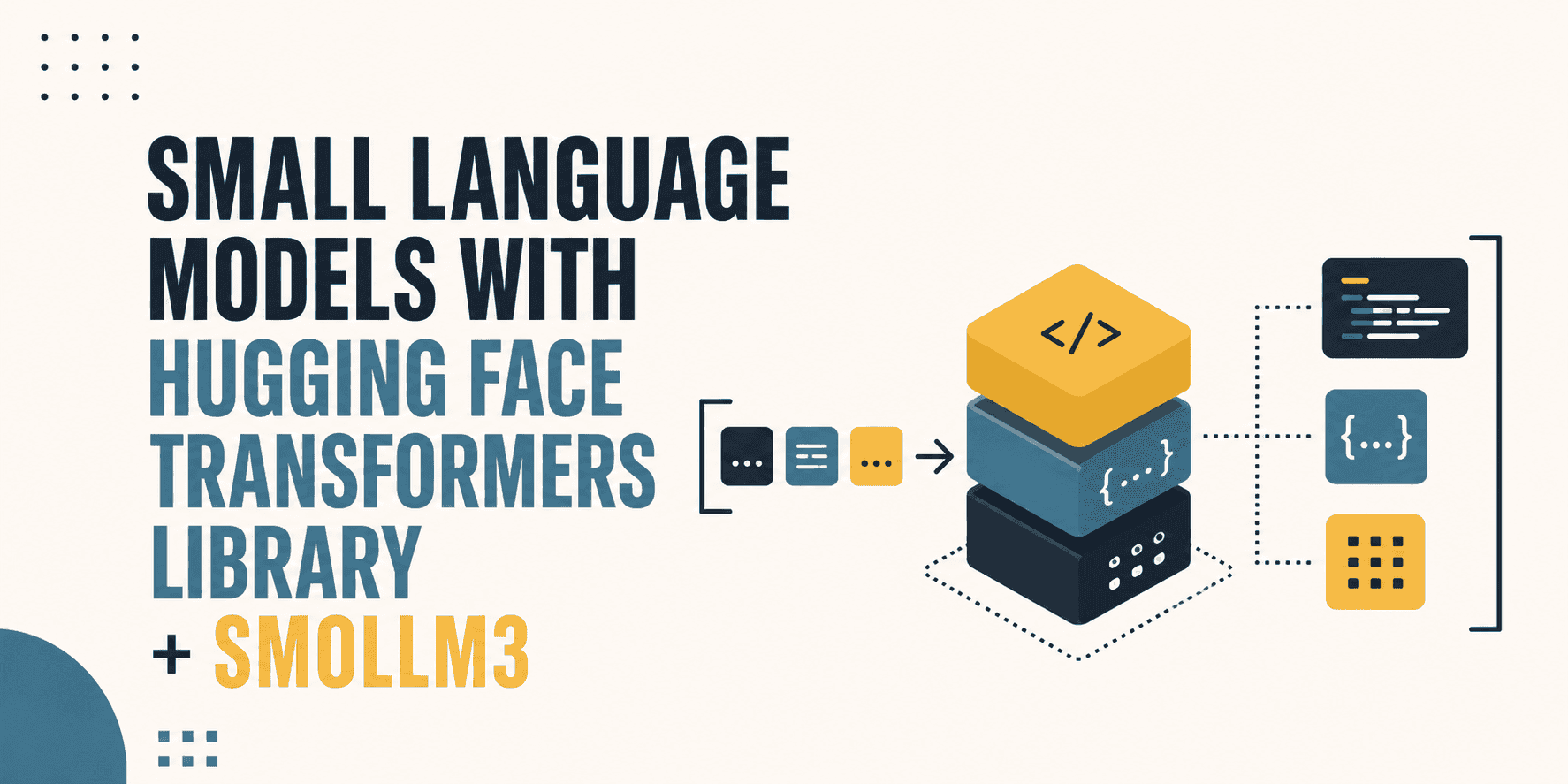
This article dives deep into the world of SLMs, exploring why they are gaining traction, how the Hugging Face Transformers library empowers their development, and highlights smolLM3 as a prime example of what compact AI can achieve.
What Are Small Language Models (SLMs)?
Small Language Models (SLMs) are a category of language models designed to perform specific tasks using fewer computational resources compared to their larger counterparts, Large Language Models (LLMs). Unlike LLMs, which might have hundreds of billions or even trillions of parameters, SLMs typically range from millions to a few billion parameters.
The core idea behind SLMs is efficiency. They are built with simpler neural architectures and fewer parameters, allowing for faster training, reduced energy consumption, and easier deployment on devices with limited resources, such as edge devices, mobile applications, or consumer-grade GPUs.
Why SLMs Matter: The Practical Edge
The shift towards SLMs is not just about size; it's about practical advantages that directly impact development and deployment:
- Cost-Effectiveness: Training and running SLMs require significantly less computational power and memory, translating into lower cloud computing bills and reduced hardware investments.
- Faster Inference and Training: Their smaller size means quicker processing times for inference, making them ideal for real-time applications. Training and fine-tuning also complete much faster.
- Resource Efficiency and Edge Deployment: SLMs can operate effectively in resource-constrained environments. This makes them perfect for on-device AI solutions, enabling applications to run locally on laptops, smartphones, or IoT devices without needing constant cloud connectivity.
- Specialization and Domain Expertise: While LLMs are generalists, SLMs can be highly specialized. By training or fine-tuning an SLM on a specific dataset, it can achieve superior performance for a narrow domain, often outperforming larger, general-purpose models on that particular task. For example, a well-trained 3B model can match or beat a 70B model on a specific task.
- Improved Privacy: Local deployment of SLMs can enhance data privacy by processing sensitive information directly on the user's device, reducing the need to send data to external servers.
However, it's important to note some limitations. SLMs may have a limited capacity for complex language comprehension and can exhibit reduced accuracy in highly intricate tasks compared to LLMs. They might also require more extensive fine-tuning to adapt to new domains.
Hugging Face Transformers: The Developer's Toolkit for SLMs
The Hugging Face Transformers library is an indispensable tool for anyone working with language models, especially SLMs. It's an open-source Python library that provides a vast collection of pre-trained models, primarily focusing on Natural Language Processing (NLP), but also extending to Computer Vision, Audio, and Multimodal tasks. Built on PyTorch, TensorFlow, and JAX, it offers remarkable flexibility and interoperability across different deep learning frameworks.
Key Features for SLM Development:
- Access to a Model Hub: The Hugging Face Hub hosts over 1 million model checkpoints, including many efficient SLMs, making it easy to discover and integrate models into your projects.
- Simplified Model Loading and Usage: The library abstracts away much of the complexity of deep learning, allowing developers to load and use state-of-the-art models with just a few lines of code. This user-friendliness makes advanced AI accessible to a broader range of practitioners.
- Fine-Tuning Capabilities: For domain-specific tasks, fine-tuning a pre-trained SLM is crucial. The Transformers library provides robust tools and a `Trainer` class to efficiently adapt models to custom datasets, leading to significant performance gains on targeted applications.
- Quantization Support: Quantization is a powerful technique to reduce the memory and computational costs of models by representing weights and activations with lower-precision data types (e.g., 8-bit or 4-bit integers instead of 32-bit floating points). Hugging Face Transformers seamlessly integrates with libraries like Bitsandbytes, simplifying the quantization process and enabling models to run on devices with limited memory. It also supports advanced quantization algorithms like AWQ, GPTQ, and AQLM.
- Knowledge Distillation: This technique involves transferring knowledge from a larger, more complex "teacher" model to a smaller, more efficient "student" model. The student learns to mimic the teacher's output, retaining much of its performance while significantly reducing its size and computational requirements. Hugging Face provides tools and concepts for implementing knowledge distillation.
- Efficient Inference: The library offers optimized inference classes like `Pipeline` for various machine learning tasks, ensuring fast and efficient execution of SLMs in production environments.
Hugging Face Platform Pricing (for services, not the open-source library):
While the Transformers library itself is open-source, Hugging Face offers various paid services on its Hub for collaboration, hosting, and dedicated inference. These services are separate from using the open-source library locally.
- Free Tier: Includes access to over 2 million public models and datasets, 100 GB of private repository storage, community Spaces, and limited ZeroGPU access.
- PRO Account ($9/month): Designed for individual developers, it offers 8x ZeroGPU quota with top priority, 1 TB private storage, $2/month in Inference Provider credits, and Spaces Dev Mode (SSH and VS Code access).
- Team Plan ($20/user/month): For collaborative teams, this plan provides PRO perks for all members, 12 TB base public storage (plus 1 TB per seat), pooled Inference Provider credits, and organizational billing controls.
- Enterprise Plan (starting at $50/user/month): Offers custom pricing for larger organizations, focusing on compliance, centralized billing, and dedicated account management.
- Dedicated Inference: For production workloads, Hugging Face provides dedicated and autoscaling infrastructure for deploying models, with pricing starting as low as $0.033 per hour, billed by the minute.
Introducing smolLM3: A 3B Powerhouse
smolLM3 is a prime example of a state-of-the-art Small Language Model that pushes the boundaries of what compact AI can achieve. Developed by Hugging Face, smolLM3 is a 3-billion parameter model designed for efficiency and powerful capabilities.
Key Details and Features:
- Developer: Hugging Face.
- Release Date: It was released around July 2025.
- Parameters: 3 billion parameters.
- Architecture: smolLM3 employs a decoder-only transformer architecture, building on foundational designs like Llama. It integrates key optimizations such as Grouped Query Attention (GQA), which significantly reduces the KV cache size during inference, and No Position Encoding (NoPE) with a 3:1 ratio, enhancing long-context performance.
- Training Data: The model was extensively trained on 11.2 trillion tokens using a carefully structured three-stage curriculum. This diverse dataset includes web content, code, mathematics, and reasoning data. Post-training involved midtraining on an additional 140 billion reasoning tokens, followed by supervised fine-tuning and alignment through Anchored Preference Optimization (APO).
- Context Length: It has a native context length of 64,000 tokens, which can be extended up to an impressive 128,000 tokens using YaRN (Yet Another RoPE Extension). This capability makes it ideal for handling comprehensive document analysis and extended conversations.
- Multilingual Support: smolLM3 is proficient in six natively supported languages: English, French, Spanish, German, Italian, and Portuguese, making it versatile for global applications.
- Dual-Mode Reasoning: A standout feature is its dual-mode reasoning system, allowing users to toggle between explicit reasoning and more concise responses using specific commands. This is embedded within its chat template.
- Open-Source: smolLM3 is fully open-source under the Apache 2.0 license, including its weights and full training details, promoting transparency and community innovation.
- Hardware Requirements: It is designed to run efficiently on consumer GPUs, with official documentation noting it can operate on devices with as little as 4GB-8GB of VRAM for inference (e.g., ~6GB in FP16).
- Tool Calling: The model supports advanced functionalities like tool calling using structured schemas (XML and Python tools), enabling its integration into complex agent workflows.
Performance Benchmarks:
Despite its compact size, smolLM3 delivers exceptional performance. It has been shown to outperform other 3B models like Llama-3.2-3B and Qwen2.5-3B, and remains competitive with larger 4B alternatives such as Qwen3 and Gemma3. This demonstrates that thoughtful engineering and meticulous training can yield state-of-the-art results even with fewer parameters.
You can find the model and its details on the Hugging Face Hub and explore its code and resources in the Smol Models GitHub repository.
How SLMs Work (High-Level): Optimizing for Efficiency
Achieving powerful performance with a smaller footprint involves several key techniques:
- Efficient Architectures: As seen with smolLM3, designing models with optimized attention mechanisms (like GQA) and positional encoding strategies (like NoPE/YaRN) can significantly improve efficiency without sacrificing capability.
- Knowledge Distillation: This process involves training a smaller "student" model to mimic the predictions and internal representations of a larger, more powerful "teacher" model. The student learns not just the correct answers but also the probability distribution of the teacher's outputs, effectively transferring complex knowledge.
- Quantization: This technique reduces the precision of the numerical representations of a model's weights and activations. For instance, converting 32-bit floating-point numbers to 8-bit integers drastically shrinks the model size and speeds up computations, making it feasible for devices with limited memory.
- Pruning: This involves removing less important connections or neurons from a neural network, effectively making the model sparser and smaller without significant performance degradation.
- Specialized Training: SLMs are often trained on highly curated datasets relevant to their target tasks or domains, allowing them to develop deep expertise where it matters most, rather than attempting to learn general knowledge.
Implications for AI Practitioners
For software developers and AI practitioners, the rise of SLMs, coupled with tools like Hugging Face Transformers, opens up new avenues for innovation:
- Democratization of AI: SLMs make advanced AI capabilities accessible to a broader range of developers and organizations, even those with limited computational resources.
- Cost Reduction: Developers can significantly cut down on inference and training costs, making AI solutions more economically viable for small businesses and startups.
- Real-time Applications: The faster inference speed of SLMs enables the creation of real-time AI applications, such as instant customer support bots, on-device language translation, or immediate content generation.
- Customizable Solutions: With the ease of fine-tuning offered by Hugging Face, developers can build highly specialized AI models tailored precisely to their unique business needs or user requirements.
- Edge AI Development: SLMs are perfect for developing AI applications that run directly on edge devices, enabling offline functionality, reduced latency, and enhanced privacy for users.
- Hybrid Architectures: Developers can combine SLMs with LLMs in hybrid systems. For instance, an SLM could handle initial filtering or specific tasks, while an LLM is reserved for more complex queries, balancing accuracy, cost, and performance.
When choosing between an LLM and an SLM, practitioners should carefully consider the specific task requirements, available resources, performance expectations, and the importance of factors like cost and latency. For focused, domain-specific problems, SLMs often present a more efficient and effective solution.
The Future of Compact AI
The development of Small Language Models like smolLM3, supported by versatile libraries like Hugging Face Transformers, marks a significant shift in the AI landscape. It challenges the notion that "bigger is always better" and highlights the power of thoughtful engineering and optimization. As research continues into more efficient architectures, advanced distillation techniques, and innovative quantization methods, SLMs are poised to become even more capable and widespread.
This trend will likely lead to a future where AI is not just confined to massive data centers but is omnipresent, running efficiently on a multitude of devices and seamlessly integrated into our daily lives, making AI truly accessible and impactful for everyone.
Frequently Asked Questions
What is the main difference between an LLM and an SLM?
The main difference lies in their size and scope. LLMs (Large Language Models) have billions or trillions of parameters, offering broad general-purpose capabilities but requiring significant resources. SLMs (Small Language Models) have fewer parameters (typically millions to a few billion), are more resource-efficient, and are often specialized for specific tasks, offering cost and performance benefits for focused applications.
Why should a developer choose an SLM over an LLM for a project?
Developers should choose an SLM for projects that prioritize cost-efficiency, faster inference speeds, reduced energy consumption, or require deployment on resource-constrained devices like smartphones or edge hardware. SLMs are also ideal when building highly specialized AI solutions for specific tasks where a well-trained smaller model can achieve comparable or even superior performance to a general-purpose LLM.
What role does the Hugging Face Transformers library play in working with SLMs?
The Hugging Face Transformers library is crucial for SLM development as it provides easy access to a vast array of pre-trained models, including many SLMs. It offers powerful tools for fine-tuning models on custom datasets, and supports optimization techniques like quantization and knowledge distillation, which are essential for making SLMs even more efficient and deployable.
Can smolLM3 be fine-tuned for specific use cases?
Yes, smolLM3 is a fully open-source model under the Apache 2.0 license, meaning it can be fine-tuned for specific domains or tasks. Its efficient size makes fine-tuning accessible even on hardware with limited resources, and Hugging Face provides comprehensive documentation and tools to support customization.