Key Takeaways
- WebMCP is a new open web standard co-developed by Google and Microsoft that lets websites expose structured, callable tools directly to AI agents in the browser.
- It aims to make AI agent interactions with websites significantly faster, more reliable, and more efficient than current screen-scraping methods.
- Developers can implement WebMCP using either a Declarative API (HTML attributes) for simple forms or an Imperative API (JavaScript) for dynamic interactions.
- WebMCP is currently in early preview and origin trials in Chrome, with broader stable browser support expected by mid-to-late 2026.
The internet, as we know it, was built for humans. Buttons, forms, navigation menus – every element is designed for a person to see, understand, and interact with. But what happens when the "user" isn't human? What if it's an AI agent trying to book a flight, fill out a support ticket, or compare products?
Until recently, AI agents interacting with websites have largely been like tourists without a map, trying to guess their way around. They resort to screen scraping, analyzing pixels, or parsing raw HTML, which is slow, unreliable, and prone to breaking with every minor website update. This is where WebMCP steps in, promising a fundamental shift in how AI agents engage with the web.
WebMCP, or Web Model Context Protocol, is an exciting new open web standard that acts as a bridge, allowing websites to explicitly tell AI agents what they can do and how to do it. It’s a game-changer for developers and anyone building or using AI tools, making the web more "agent-ready."
What Exactly is WebMCP?
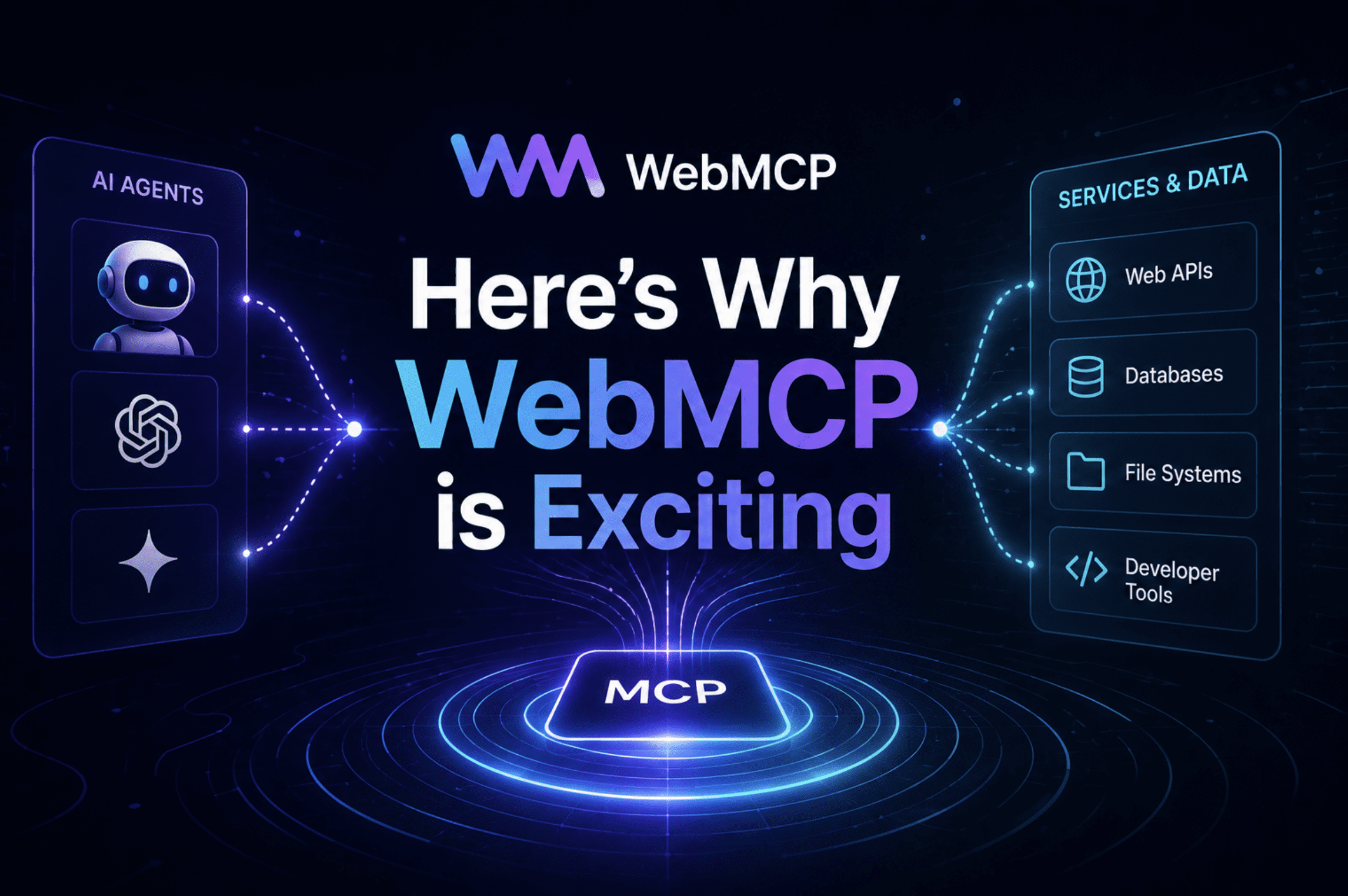
At its core, WebMCP is a proposed open web standard that enables websites to expose structured, callable tools directly to browser-based AI agents. Think of it as giving your website an API that AI agents can understand and use, without you having to build and maintain a separate backend API for every interaction.
This initiative is a collaborative effort, jointly developed by engineers from Google's Chrome team and Microsoft's Edge team, and is being incubated through the W3C Web Machine Learning Community Group. The concept has roots in earlier independent proposals, including Alex Nahas's MCP-B project at Amazon, which eventually merged into the unified WebMCP proposal.
The goal is to create a parallel interface layer for the web – one designed for machines rather than just humans. While the visual layer for humans remains, WebMCP introduces a structured, schema-driven, programmatic layer that AI agents can natively consume.
Why WebMCP Matters: Solving the Agent-Web Interaction Problem
The traditional way AI agents interact with websites is inefficient and fragile. They often rely on:
- Screen Scraping: Taking screenshots and feeding them to multimodal AI models, which is computationally expensive and slow.
- DOM Parsing: Analyzing the Document Object Model (DOM) to infer the purpose of elements, which is brittle and breaks easily if the website's layout changes.
These methods consume significant "tokens" (the units of text or data processed by AI models), leading to higher costs and latency for AI services. A simple task for a human might require dozens of sequential agent interactions, each adding to the processing burden.
WebMCP directly addresses these problems by providing a standardized "contract" between the website and the AI agent. Instead of guessing, the website explicitly declares its capabilities as "tools" with clear inputs and outputs. This leads to several key benefits:
- Increased Reliability: Agents no longer guess; they call defined functions, making interactions robust to UI changes.
- Improved Efficiency: Structured tool calls are significantly more efficient, with studies showing an 89% increase in token efficiency compared to screenshot-based approaches and a 67% reduction in computational overhead. This translates to faster and cheaper AI agent operations.
- Enhanced Accuracy: Explicit JSON Schemas for inputs and outputs reduce the chances of AI agents "hallucinating" or misunderstanding how to use a website's features.
- Better User Experience: Ultimately, this means AI assistants can complete tasks for users more seamlessly, quickly, and accurately, leading to richer web experiences.
How WebMCP Works at a High Level
WebMCP operates by allowing web developers to define and register specific "tools" that represent actions an AI agent can take on a webpage. These tools are exposed through a new browser API, navigator.modelContext.
The core pillars of WebMCP, as highlighted by Google's Khushal Sagar, are Context, Capabilities, and Coordination:
- Context: Providing agents with a full understanding of the user's current activity and available actions, even those not immediately visible.
- Capabilities: Defining the specific actions agents can perform (e.g., filling forms, navigating, making purchases) with clear contracts for each tool.
- Coordination: Managing the handoff and collaboration between the user and the agent, ensuring the user maintains control, especially for sensitive actions.
Developers have two main ways to implement WebMCP:
1. Declarative API
For simpler interactions, especially with existing HTML forms, the Declarative API is the path of least resistance. It involves adding specific attributes to your HTML elements:
toolname: A unique identifier for the tool.tooldescription: A natural language description of what the tool does.toolautosubmit(optional): To allow automatic submission by agents.
With these attributes, an existing HTML form can become agent-callable without needing extensive JavaScript. The agent can automatically discover the tool and infer its input schema from the form fields.
2. Imperative API
For more complex, dynamic interactions that go beyond simple form submissions, the Imperative API uses JavaScript. Developers register tools using the navigator.modelContext.registerTool() method. This allows for:
- Defining custom JavaScript functions as tools.
- Managing application state.
- Handling multi-step workflows.
- Providing explicit JSON Schemas for tool inputs and outputs.
This approach offers greater flexibility and control, allowing developers to expose virtually any client-side functionality as an agent-callable tool.
Security and Privacy
WebMCP is designed with security in mind. It's gated by origin isolation requirements and permissions policies, ensuring that tools are only available in secure contexts. For sensitive actions, the specification includes mechanisms to request user interaction with a confirmation dialog, maintaining a "human-in-the-loop" approach where users are aware of and can approve agent actions. This is not a headless browsing standard; the user is always present and collaborating with the agent.
Current Status and How to Get Started
WebMCP is actively under development and evolving rapidly within the W3C. Here’s a snapshot of its current status:
- W3C Standard: It is a Draft Community Group Report under the W3C Web Machine Learning Community Group. The specification was formally accepted in September 2025.
- Browser Support:
- An early preview was launched in Chrome 146 Canary in February 2026.
- Chrome 146 stable was expected around March 10, 2026.
- It's currently available for local development by enabling a flag in Chrome: navigate to
chrome://flags/#enable-webmcp-testingand set it to Enabled. - An Origin Trial for WebMCP runs from Chrome 149 through Chrome 156, allowing developers to test it on real users in production without a flag.
- While Microsoft is a co-author, official Edge support is expected by mid-to-late 2026, but not yet formally announced. Firefox and Safari have not yet indicated plans.
- Resources for Developers:
- Official W3C Spec Repository: webmachinelearning/webmcp
- Official Demos and Reference Implementations: GoogleChromeLabs/webmcp-tools
- WebMCP.dev: Official Library, Examples, and Documentation
- Model Context Tool Inspector Extension: A Chrome extension to inspect, execute, and validate WebMCP tools.
- Chrome AI Early Preview Program: For early access to WebMCP and Chrome AI APIs.
What WebMCP Means for AI Practitioners and Developers
For anyone working with AI, especially in agent development or web automation, WebMCP is a significant development:
- Easier Agent Development: Developers building AI agents will have a standardized, reliable way to interact with websites, reducing the need for complex and brittle parsing logic. This means less time spent on reverse-engineering UIs and more time on core agent intelligence.
- Richer Web Experiences: Websites can expose their functionality in a machine-readable format, leading to more intelligent and capable AI assistants that can perform complex tasks like booking multi-city trips, submitting detailed support tickets, or filtering e-commerce results with precision.
- Interoperability: As an open standard, WebMCP aims to be model-agnostic, meaning it can work with various AI models and platforms (Gemini, Claude, ChatGPT, etc.). This fosters a more open and collaborative ecosystem for AI on the web.
- "Agentic SEO": For web developers and SEO professionals, making websites WebMCP-ready will become crucial. Just as structured data helps search engines understand content, WebMCP will help AI agents understand functionality, potentially becoming a new frontier for "Agentic SEO". Websites that are easily usable by agents will likely gain a significant advantage.
WebMCP vs. Model Context Protocol (MCP)
It's important to clarify the relationship between WebMCP and the broader Model Context Protocol (MCP). They are complementary, not competing:
- MCP (Traditional): Often runs on a separate server and is used for headless backend operations, connecting AI agents to tools and services like databases, APIs, or SaaS platforms.
- WebMCP: Is a browser-native implementation of the Model Context Protocol. It runs client-side within the browser tab and inherits the user's existing authentication and session. It's specifically designed for agents to interact with live web applications and their UI.
A single product or service might use both: MCP for backend integrations and WebMCP for its customer-facing web interface, leveraging the best of both worlds.
Conclusion
WebMCP represents a pivotal moment in the evolution of the web. By providing a standardized, structured way for AI agents to interact with websites, it promises to make automated tasks faster, more reliable, and more accessible. For developers, this means building more robust agent integrations and creating richer, more intelligent web experiences. As the "agentic web" becomes a reality, understanding and implementing WebMCP will be essential for any tech professional looking to stay ahead in the AI landscape.
Frequently Asked Questions
What problem does WebMCP solve for AI agents?
WebMCP solves the problem of AI agents struggling to interact with websites designed for humans. Instead of relying on slow, unreliable methods like screen scraping or guessing UI elements, WebMCP allows websites to explicitly declare their functionalities as structured, callable tools, making agent interactions faster, more accurate, and less prone to breaking.
Who is developing WebMCP and what is its current status?
WebMCP is a joint effort by Google's Chrome team and Microsoft's Edge team, incubated through the W3C Web Machine Learning Community Group. It's currently in early preview and origin trials in Chrome (available via a flag or in Chrome 149+ origin trial), with broader stable browser support expected by mid-to-late 2026.
Are there different ways to implement WebMCP on a website?
Yes, developers can implement WebMCP using two main APIs: the Declarative API, which involves adding special attributes (like toolname and tooldescription) to existing HTML forms for simple interactions; and the Imperative API, which uses JavaScript's navigator.modelContext.registerTool() method for more complex, dynamic, and state-aware functionalities.
How does WebMCP differ from traditional Model Context Protocol (MCP)?
While both aim to connect AI agents with tools, WebMCP is specifically designed for client-side, browser-native interactions. It runs within the user's browser session, leveraging existing authentication. Traditional MCP, on the other hand, typically runs on a separate backend server and is used for headless operations and connecting to services beyond the browser interface. They are complementary protocols.