Key Takeaways
- A loss function is a mathematical tool that measures how "wrong" a machine learning model's prediction is compared to the actual correct answer for a single data point.
- It provides crucial feedback, guiding the model to adjust its internal parameters (like weights and biases) during training to minimize errors and improve accuracy.
- Different types of loss functions exist for different tasks, such as Mean Squared Error (MSE) and Mean Absolute Error (MAE) for regression, and Binary/Categorical Cross-Entropy for classification.
- Choosing the right loss function is vital as it directly impacts how a model learns, its performance, and how it handles specific data characteristics like outliers.
Loss Function Explained For Noobs: How AI Models Learn From Their Mistakes
Ever wondered how an AI model, like the one that recommends your next movie or helps your self-driving car navigate, actually "learns" to do its job? It's not magic; it's a carefully designed process of trial and error, guided by a fundamental concept called the loss function. Think of it as the model's internal critic, constantly telling it, "Nope, that's not quite right," or "Getting warmer!" This guide will break down loss functions in simple terms, showing you how these mathematical tools help AI models understand when they're wrong and, more importantly, how to get better.
What Exactly is a Loss Function?
At its core, a loss function is a mathematical formula that quantifies the difference between what a machine learning model predicts and what the actual correct answer is. This difference is often called the "error" or "loss." The higher the loss value, the worse the model's prediction for that specific piece of data. Conversely, a lower loss indicates a more accurate prediction.
Imagine teaching a child to identify a cat. You show them a picture and they say "dog." You'd tell them, "No, that's a cat." The "loss" here is the incorrect identification. If they say "cat," the loss is zero. A loss function does something similar for AI models, but with numbers. It gives the model a numerical score for how wrong its guess was.
Why Do Loss Functions Matter So Much?
Loss functions are the backbone of how machine learning models learn. Without them, models would have no way to evaluate their own performance or know which direction to improve. Here's why they're so important:
- Performance Measurement: Loss functions give us a clear, quantifiable way to measure how well a model is performing. By looking at the loss value, we can tell if our model is making good predictions or if it's way off track.
- Direction for Improvement: This is the crucial part. The loss function doesn't just tell the model it's wrong; it provides a signal that guides the model on how to adjust its internal parameters (like weights and biases in a neural network) to reduce that error. This adjustment process is called "optimization."
- Balancing Bias and Variance: A good loss function helps the model find a balance between oversimplifying things (bias) and memorizing the training data too well (variance or overfitting). This balance is key for a model to perform well on new, unseen data.
How Models Learn: The Feedback Loop
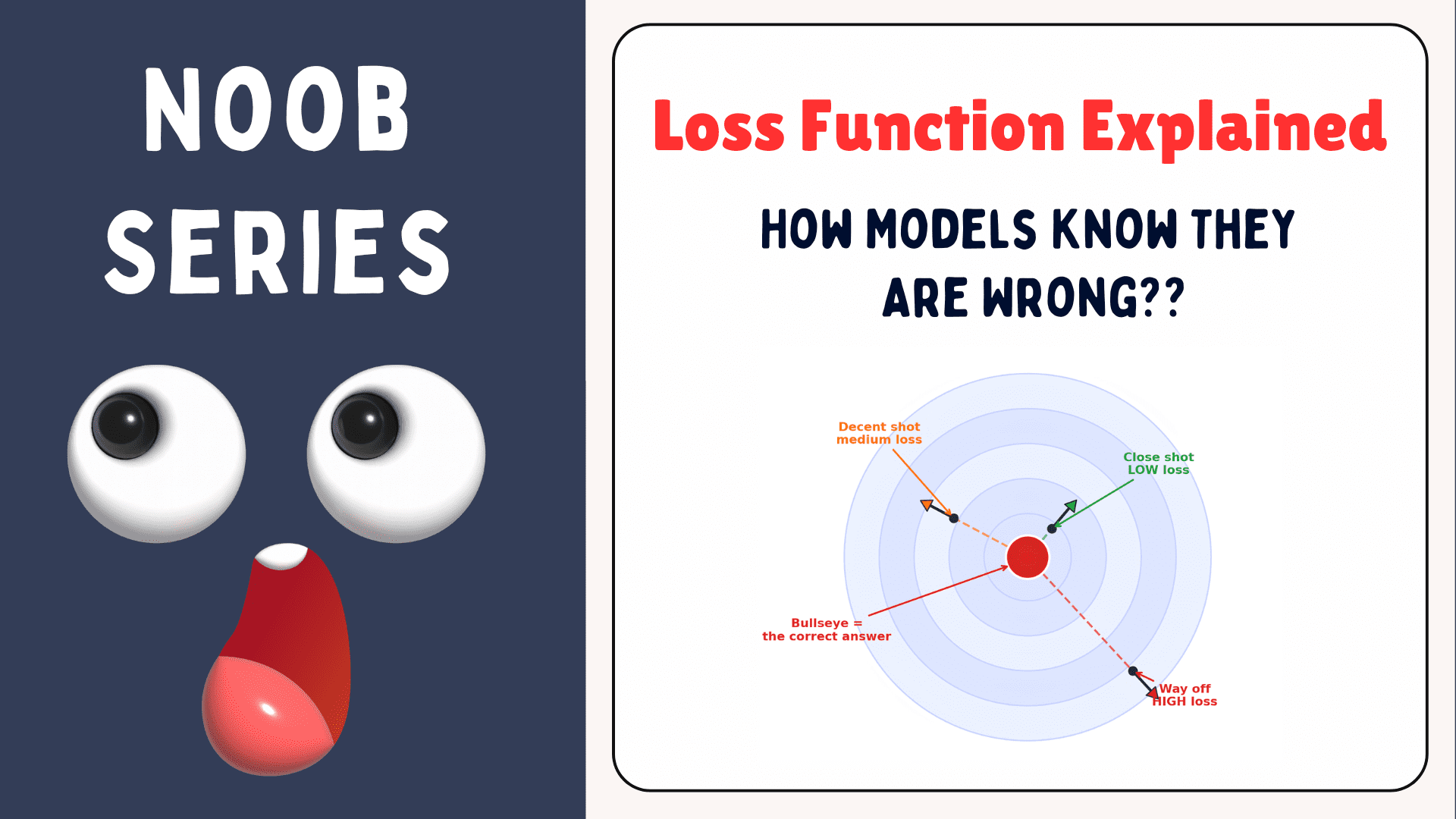
Think of training a machine learning model like practicing target shooting. Each shot is a prediction. The loss function is like seeing how far your shot landed from the bullseye. If you miss far to the left, you adjust your aim to the right for the next shot. If you're close, you make smaller adjustments.
In the world of AI, this feedback loop happens thousands, even millions, of times:
- Prediction: The model takes an input (e.g., an image, a sentence, numerical data) and makes a prediction.
- Calculate Loss: The loss function compares this prediction to the actual correct answer and calculates a numerical "loss" value.
- Optimize: An optimization algorithm (like Gradient Descent) uses this loss value to figure out how to tweak the model's internal settings (parameters) to make a more accurate prediction next time. It essentially finds the "steepest downhill" direction on the "error landscape" to minimize the loss.
- Repeat: This process repeats over and over with different pieces of data until the model's loss is minimized to an acceptable level.
This iterative adjustment is how a model "learns" patterns and relationships in the data, gradually improving its ability to make accurate predictions.
Common Types of Loss Functions (and When to Use Them)
The type of loss function you choose depends heavily on the kind of problem you're trying to solve. Machine learning tasks generally fall into two main categories: regression (predicting a continuous number) and classification (predicting a category or class).
For Regression Problems (Predicting Numbers)
Regression tasks involve predicting a continuous numerical value, like house prices, temperature, or stock values.
1. Mean Squared Error (MSE) / L2 Loss
MSE is one of the most common loss functions for regression. It calculates the average of the squared differences between the predicted values and the actual values.
- How it works: For each prediction, it subtracts the true value, squares the result, and then averages all these squared errors across the dataset. Squaring the errors does two important things: it makes all errors positive, and it heavily penalizes larger errors.
- When to use it: MSE is great when large errors are particularly undesirable, as it amplifies their impact. For example, in predicting house prices, a large error might be more detrimental than several small ones, and MSE ensures such large errors are minimized.
- Considerations: Because it squares errors, MSE is sensitive to outliers. A few extreme data points can significantly skew the loss and make the model focus too much on them.
2. Mean Absolute Error (MAE) / L1 Loss
MAE calculates the average of the absolute differences between predictions and actual values.
- How it works: Instead of squaring the differences, MAE takes the absolute value of each error. This means that all errors contribute linearly to the total loss, regardless of their size.
- When to use it: MAE is more robust to outliers than MSE because it doesn't penalize large errors as severely. It's useful when all errors, regardless of magnitude, should be treated equally. For instance, in delivery time estimates, an average error of 10 minutes is straightforward to understand.
- Considerations: While robust, MAE's gradient is constant, which can sometimes lead to slower convergence during training compared to MSE, especially when the errors are small.
3. Huber Loss / Smooth Mean Absolute Error
Huber Loss is a hybrid loss function that combines the best characteristics of both MSE and MAE.
- How it works: It behaves like MSE for small errors (errors below a certain threshold, δ) and like MAE for large errors (errors above δ). This quadratic behavior for small errors helps with smooth optimization, while the linear behavior for large errors reduces the influence of outliers.
- When to use it: Huber Loss is excellent when you want a balance: you want to penalize small errors effectively but also want robustness against outliers. It's often used in robust regression tasks or when dealing with noisy datasets. For example, in financial modeling where extreme price movements (outliers) are common but shouldn't disproportionately affect the typical relationship, Huber Loss can be a better choice than MSE.
- Considerations: You need to choose the 'delta' (δ) parameter, which determines the threshold between quadratic and linear penalization. This choice can impact performance.
For Classification Problems (Predicting Categories)
Classification tasks involve assigning data points to specific categories or labels, such as "spam" or "not spam," or identifying objects in an image.
1. Binary Cross-Entropy (BCE) / Log Loss
BCE is the go-to loss function for binary classification problems (where there are only two possible classes, like 0 or 1).
- How it works: It measures the dissimilarity between the predicted probabilities (output by the model, usually after a sigmoid activation function) and the true binary labels. It heavily penalizes predictions that are confident but wrong. For example, if the model predicts a 99% chance of "spam" but it's actually "not spam," the BCE loss will be very high.
- When to use it: Ideal for problems like spam detection, fraud detection, sentiment analysis (positive/negative), or medical diagnosis (disease/no disease).
- Considerations: BCE is designed for two classes. For more than two classes, you'd use Categorical Cross-Entropy.
2. Categorical Cross-Entropy (CCE)
CCE is an extension of Binary Cross-Entropy for multi-class classification problems (three or more categories).
- How it works: The model typically outputs a probability distribution across all possible classes (often using a softmax activation function, where probabilities sum to 1). The true labels are usually "one-hot encoded" (e.g., if there are three classes and the true class is the second one, it's represented as). CCE then measures how well the predicted probability distribution aligns with the true one-hot encoded labels. It penalizes the model based on the probability it assigns to the correct class.
- When to use it: Widely used in image classification (e.g., identifying different objects in pictures), natural language processing (text classification), and speech recognition.
- Considerations: Requires the true labels to be one-hot encoded. If your labels are integers (e.g., 0, 1, 2), you might use "Sparse Categorical Cross-Entropy," which handles the one-hot encoding internally.
3. Hinge Loss
Hinge Loss is primarily used for "maximum-margin" classification, most notably with Support Vector Machines (SVMs).
- How it works: Unlike cross-entropy, which focuses on probabilities, Hinge Loss aims to maximize the margin between classes. It penalizes predictions that are not only incorrect but also those that are correct but too close to the decision boundary (within a certain "margin"). The goal is to ensure predictions are confidently classified.
- When to use it: Best suited for binary classification problems where you want a clear separation between classes, often with SVMs.
- Considerations: Hinge Loss requires true labels to be -1 and +1, not 0 and 1. It's less common in deep neural networks compared to cross-entropy due to its non-differentiable point at the margin, which can make optimization slightly trickier, although it can be used.
Choosing the Right Loss Function
Selecting the right loss function is a critical decision that influences your model's training and overall performance. Here are a few factors to consider:
- Problem Type: Is it a regression problem (predicting continuous values) or a classification problem (predicting categories)? This is the first and most important distinction.
- Data Characteristics: Does your data contain many outliers? If so, MAE or Huber Loss might be better for regression than MSE. Are your classes balanced or imbalanced?
- Model Output: Does your model output raw scores, probabilities, or something else? Cross-entropy functions work well with probabilistic outputs.
- Business Objective: What does "success" look like for your specific application? Sometimes, a technically perfect model (low loss) might not align with the real-world business goal. For example, in fraud detection, you might prioritize catching almost all fraud (even if it means some false positives) over minimizing all errors equally.
Many machine learning libraries like scikit-learn, TensorFlow, and PyTorch have these common loss functions built-in, making them easy to implement.
Loss Function vs. Cost Function vs. Objective Function: Clarifying the Terms
You might hear these terms used interchangeably, and often they are, but there's a subtle distinction in some contexts:
- Loss Function: This typically refers to the error calculated for a single training example.
- Cost Function: This is generally the average of the loss functions over an entire training dataset. It quantifies the model's performance across all training examples. When people talk about "minimizing the error" during training, they are usually referring to minimizing the cost function.
- Objective Function: This is the most general term. It refers to any function that you are trying to optimize (either minimize or maximize) during the training process. Both loss functions and cost functions are types of objective functions, but an objective function could also be something like maximizing a likelihood function, which isn't strictly a "loss."
For most practical purposes, especially when starting out, "loss function" and "cost function" are often used to mean the same thing: the measure that guides your model's learning.
What This Means for AI Practitioners and Freelancers
Understanding loss functions isn't just an academic exercise; it has real-world implications for anyone working with AI models, from data scientists to freelancers leveraging AI tools:
- Better Model Selection: Knowing different loss functions helps you choose the right one for your specific project, leading to more effective and accurate models. Using a default function without understanding its implications can lead to a model that performs poorly on your specific data or business objective.
- Debugging and Performance Tuning: When your model isn't performing as expected, understanding the loss function can help you diagnose issues. Is the loss not decreasing? Is it fluctuating wildly? This insight can guide hyperparameter tuning and model architecture adjustments.
- Communicating Model Performance: Being able to explain why a particular loss function was chosen and what its values mean helps you communicate model performance clearly to clients or non-technical stakeholders.
- Developing Custom Solutions: For advanced tasks or unique problems, you might need to design custom loss functions. A solid grasp of the fundamentals is essential for this.
Conclusion
Loss functions are truly the unsung heroes of machine learning. They are the mathematical compass that guides AI models through the complex landscape of data, pointing them toward more accurate predictions and helping them learn from every "mistake." By understanding what loss functions are, why they matter, and the different types available, you gain a deeper insight into the core mechanics of AI. This knowledge empowers you to build, train, and deploy more intelligent and effective AI solutions, making you a more skilled practitioner in the rapidly evolving world of artificial intelligence.
Frequently Asked Questions
What is the main purpose of a loss function in machine learning?
The main purpose of a loss function is to quantify the error between a machine learning model's predicted output and the actual correct output for a given data point. It provides a numerical score that tells the model how "wrong" its prediction was, guiding the model to adjust its parameters during training to minimize this error and improve accuracy.
What is the difference between a loss function and a cost function?
While often used interchangeably, in some contexts, a loss function measures the error for a single training example, whereas a cost function is the average of the loss functions across an entire training dataset. The cost function is typically what is minimized during the overall training process.
How do I choose the right loss function for my AI project?
Choosing the right loss function depends on the type of machine learning problem (e.g., regression for continuous values, classification for categories), the characteristics of your data (e.g., presence of outliers), and your specific business or project objectives. For example, MSE is common for regression if large errors need strong penalization, while Binary Cross-Entropy is standard for binary classification tasks.
Can I create my own custom loss function?
Yes, in advanced scenarios or for specialized problems, you can define and implement custom loss functions. Machine learning frameworks like TensorFlow and PyTorch allow you to write your own functions that calculate the error based on your specific needs, which can be particularly useful for unique data characteristics or complex objectives.