Key Takeaways
- The 2026 minimal AI engineer toolkit focuses on robust frameworks, MLOps, distributed computing, and deployment for production-grade autonomous systems.
- Key tools include PyTorch for deep learning, MLflow for experiment tracking, Kubernetes for orchestration, Hugging Face for pre-trained models, DVC for data versioning, and Ray for distributed AI.
- These tools empower AI engineers to build, deploy, and manage complex AI applications with efficiency and reproducibility.
- Mastering this toolkit is essential for AI practitioners aiming to deliver reliable, scalable AI solutions in the coming years.
The Minimal AI Engineer Toolkit for 2026: Building Production-Grade Autonomous Systems
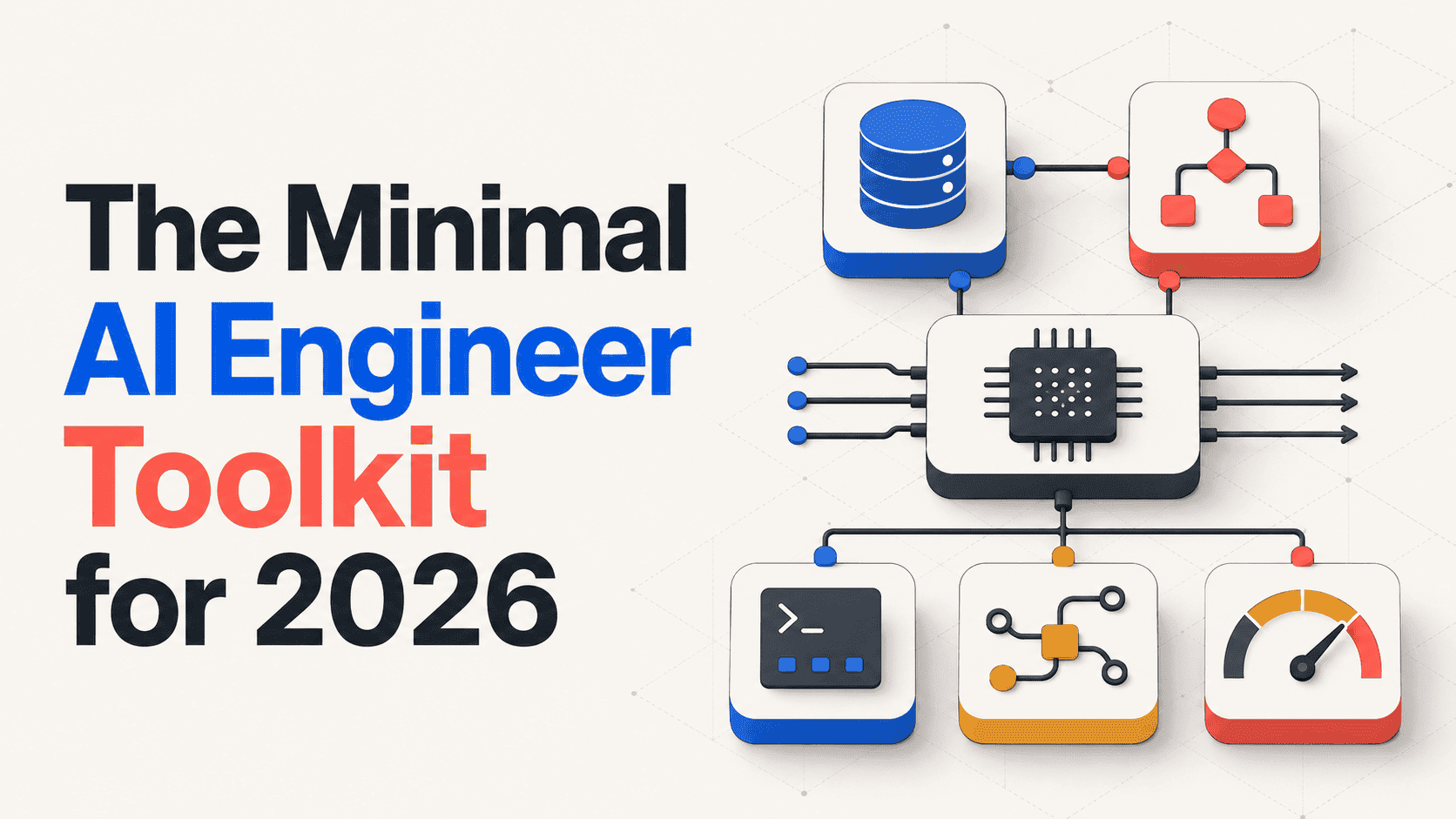
The field of Artificial Intelligence is always moving forward, and for AI engineers, staying equipped with the right tools is crucial. As we look towards 2026, the demand for building and deploying production-grade autonomous systems is growing. This isn't just about training a model; it's about creating intelligent systems that can operate reliably, scale efficiently, and integrate seamlessly into real-world applications. To achieve this, a carefully chosen set of tools forms the backbone of any successful AI engineering workflow.
This article dives deep into the essential toolkit that AI engineers will need in 2026. We're talking about more than just coding; we're talking about a comprehensive ecosystem that supports everything from model development and experimentation to robust deployment, monitoring, and data management. These tools are designed to streamline the complex process of bringing AI from research to a fully functional, autonomous product. Understanding what each tool offers and how they fit together is key for any AI practitioner aiming to make an impact in the coming years.
Why a "Minimal" Toolkit Matters for 2026
In the fast-paced world of AI, it's easy to get overwhelmed by the sheer number of tools available. A "minimal" toolkit isn't about limiting your capabilities; it's about focusing on the most impactful, versatile, and industry-standard solutions that provide maximum leverage. For 2026, this means tools that support:
- Scalability: Autonomous systems often require significant computational resources and need to handle increasing loads.
- Reproducibility: Ensuring that experiments, models, and deployments can be recreated consistently is vital for debugging and continuous improvement.
- Reliability: Production systems must be stable and perform as expected under various conditions.
- Efficiency: Reducing development cycles and operational overhead is critical for competitive advantage.
- Integration: Tools that play well together create a smoother, more automated MLOps pipeline.
The following six tools represent a powerful combination that addresses these needs, forming a solid foundation for any AI engineer tackling the challenges of autonomous systems in 2026.
The Six Essential Tools for AI Engineers in 2026
1. PyTorch: The Flexible Deep Learning Framework
What it is and why it's essential: PyTorch is an open-source machine learning framework that has become a favorite among researchers and developers for its flexibility and Python-centric approach. For 2026, its dynamic computational graph and ease of debugging make it ideal for rapidly prototyping and iterating on complex neural network architectures, which are often at the heart of autonomous systems. It's also well-suited for research-heavy environments where exploration and experimentation are paramount, before models are hardened for production.
Key Features:
- Dynamic Computation Graph: Unlike static graphs, PyTorch's graph is built on the fly, offering greater flexibility for complex models and easier debugging.
- Python-First Approach: Seamless integration with the Python ecosystem, making it intuitive for developers.
- Strong GPU Acceleration: Highly optimized for NVIDIA GPUs, enabling fast training of large models.
- Extensive Ecosystem: Includes libraries like TorchVision for computer vision, TorchText for natural language processing, and TorchAudio for audio processing.
- Distributed Training: Robust support for scaling training across multiple GPUs and machines.
- TorchScript and ONNX Export: Tools for optimizing models for deployment and exporting to various production environments.
Developer/Company: Primarily developed by Meta AI (formerly Facebook AI Research).
Pricing/Availability: PyTorch is open-source and completely free to use.
Official Link: PyTorch Official Website
2. MLflow: The MLOps Lifecycle Manager
What it is and why it's essential: MLflow is an open-source platform designed to manage the entire machine learning lifecycle. As autonomous systems become more complex, managing experiments, ensuring reproducibility, and deploying models reliably are critical. MLflow provides a standardized way to track experiments, package code, and manage models, making it an indispensable tool for MLOps in 2026. It helps AI engineers move from experimental models to production-ready systems with confidence.
Key Features:
- MLflow Tracking: Records parameters, code versions, metrics, and output files when you run your ML code, helping you compare results across experiments.
- MLflow Projects: Packages ML code in a reusable and reproducible format, allowing other data scientists or automated tools to run your code.
- MLflow Models: Provides a standard format for packaging ML models, allowing them to be deployed across various tools (e.g., Docker, Apache Spark, Azure ML).
- MLflow Model Registry: A centralized hub for managing the full lifecycle of MLflow Models, including versioning, stage transitions (e.g., Staging to Production), and annotations.
Developer/Company: Developed by Databricks as an open-source project.
Pricing/Availability: MLflow is open-source and free. Databricks also offers a managed version of MLflow as part of its commercial platform.
Official Link: MLflow Official Website
3. Kubernetes: The Container Orchestrator for Scalable AI
What it is and why it's essential: Kubernetes (K8s) is an open-source system for automating deployment, scaling, and management of containerized applications. For AI engineers in 2026, Kubernetes is fundamental for deploying and managing machine learning models as scalable services. Autonomous systems often consist of multiple microservices, each potentially running an AI model. K8s ensures these services are always available, can scale up or down based on demand, and are resilient to failures, making it a cornerstone for production AI.
Key Features for AI:
- Container Orchestration: Automates the deployment and management of Docker containers, perfect for packaging ML models and their dependencies.
- Automated Rollouts & Rollbacks: Manages updates to applications without downtime and can revert to previous versions if issues arise.
- Self-Healing: Automatically restarts failed containers, replaces them, and schedules them on healthy nodes.
- Service Discovery & Load Balancing: Distributes network traffic to ensure stable and performant model inference.
- Resource Management: Efficiently allocates computational resources (CPU, GPU, memory) to AI workloads.
- Declarative Configuration: Defines the desired state of your applications, and Kubernetes works to maintain that state.
Developer/Company: Originally designed by Google, now maintained by the Cloud Native Computing Foundation (CNCF).
Pricing/Availability: Kubernetes is open-source and free. Cloud providers offer managed Kubernetes services (e.g., Google Kubernetes Engine, Azure Kubernetes Service, Amazon EKS) which incur infrastructure costs.
Official Link: Kubernetes Official Website
4. Hugging Face Ecosystem: Leveraging Pre-trained Intelligence
What it is and why it's essential: The Hugging Face ecosystem, particularly its Transformers library, has become a cornerstone for working with state-of-the-art pre-trained models. For AI engineers building autonomous systems in 2026, leveraging these models for tasks like natural language understanding, text generation, image recognition, or even generating new data (with Diffusers) significantly accelerates development. It provides access to a vast array of models that can be fine-tuned for specific applications without needing to train from scratch.
Key Features:
- Transformers Library: Provides thousands of pre-trained models for a wide range of tasks across modalities (NLP, computer vision, audio) including large language models (LLMs) and vision transformers.
- Hugging Face Hub: A central platform for sharing and discovering models, datasets, and interactive demos (Spaces).
- Diffusers Library: Focuses on state-of-the-art diffusion models for generative AI tasks, such as text-to-image generation.
- Accelerate Library: Simplifies distributed training and mixed-precision training for PyTorch models across various hardware setups.
- Inference Endpoints & Spaces: Managed services for deploying and hosting models and interactive demos with ease.
Developer/Company: Hugging Face Inc.
Pricing/Availability: The core libraries are open-source and free. Hugging Face offers paid services like Inference Endpoints, Spaces hosting, and Enterprise Hub for commercial use.
Official Link: Hugging Face Official Website
5. DVC (Data Version Control): Reproducible Data & Models
What it is and why it's essential: DVC (Data Version Control) is an open-source system for machine learning projects that makes them reproducible and shareable. In 2026, autonomous systems rely heavily on continuously updated datasets and models. DVC solves the critical problem of versioning large datasets, models, and machine learning pipelines, integrating seamlessly with Git. This ensures that every experiment and deployment is fully reproducible, crucial for debugging, auditing, and collaborative development.
Key Features:
- Data & Model Versioning: Tracks large files and datasets alongside code using Git, without storing them directly in your Git repository.
- Experiment Reproducibility: Allows you to reproduce any previous experiment state by checking out the associated code, data, and model versions.
- Pipeline Management: Defines and manages complex multi-stage ML pipelines, ensuring that data dependencies are correctly handled.
- Data Caching: Efficiently stores and retrieves data artifacts to save space and time.
- Cloud Storage Integration: Supports various remote storage options like S3, Google Cloud Storage, Azure Blob Storage, and more.
Developer/Company: Iterative.ai.
Pricing/Availability: DVC is open-source and free. Iterative.ai also provides DVC.org as a managed service and commercial offerings.
Official Link: DVC Official Website
6. Ray: Distributed Computing for Scalable AI
What it is and why it's essential: Ray is an open-source unified framework for scaling AI and Python applications. For building production-grade autonomous systems in 2026, the ability to distribute computations – from data processing and model training to hyperparameter tuning and model serving – is paramount. Ray provides a simple yet powerful API to parallelize Python code and offers specialized libraries for common AI workloads, making it ideal for complex, distributed AI applications like reinforcement learning, simulations, and large-scale model serving.
Key Features:
- Ray Core: A simple, general-purpose API for building and running distributed applications in Python.
- Ray AIR (AI Runtime): A unified API and set of libraries for common ML workloads, including data ingestion, distributed training, hyperparameter tuning, and model serving.
- Ray Tune: A scalable library for hyperparameter optimization, capable of running hundreds or thousands of trials in parallel.
- Ray RLlib: A scalable reinforcement learning library, supporting a wide range of algorithms and environments.
- Ray Serve: A scalable, production-ready model serving library that allows you to deploy models from any ML framework.
Developer/Company: Anyscale, originally developed at UC Berkeley's RISELab.
Pricing/Availability: Ray is open-source and free. Anyscale offers a managed Ray platform for enterprises.
Official Link: Ray Official Website
How This Toolkit Works Together at a High Level
Imagine an AI engineer building an autonomous drone system. They would likely use PyTorch to develop and train the drone's navigation and object recognition models. Throughout the training process, MLflow would track all experiments, hyperparameters, and model versions, ensuring reproducibility and easy comparison of different approaches. The large datasets used for training would be managed and versioned with DVC, keeping them in sync with the model code.
Once a model is ready, it might incorporate components from the Hugging Face Ecosystem, leveraging pre-trained vision transformers for robust object detection, which are then fine-tuned on custom drone data. For scaling the training or running complex simulations for reinforcement learning, the engineer would turn to Ray to distribute these computationally intensive tasks across a cluster.
Finally, when deploying the models to production, they would be containerized (e.g., using Docker) and orchestrated by Kubernetes. This ensures the inference endpoints are highly available, scalable, and resilient, serving the autonomous drone in real-time. This integrated workflow allows the AI engineer to focus on innovation rather than infrastructure headaches, delivering robust autonomous capabilities.
What This Means for AI Practitioners and Freelancers
For AI practitioners and freelancers, mastering this minimal toolkit for 2026 isn't just about knowing individual tools; it's about understanding how they integrate to form a cohesive, efficient, and reliable MLOps pipeline. The ability to move an AI model from concept to a production-grade autonomous system is a highly sought-after skill. Proficiency with these tools translates directly into:
- Increased Efficiency: Automate repetitive tasks, speed up experimentation, and streamline deployment.
- Enhanced Reproducibility: Ensure that your work can be consistently replicated, a key aspect for client trust and project handovers.
- Scalability: Build solutions that can handle real-world demands, from small-scale prototypes to large enterprise deployments.
- Career Advancement: These are the tools that leading tech companies and innovative startups are using, making these skills highly valuable in the job market.
By focusing on these core technologies, AI engineers can position themselves at the forefront of developing the next generation of intelligent, autonomous systems.
Frequently Asked Questions
What is the main goal of a "minimal" AI engineer toolkit for 2026?
The main goal is to provide AI engineers with a focused set of powerful, versatile, and industry-standard tools that enable them to efficiently build, deploy, and manage production-grade autonomous systems, ensuring scalability, reproducibility, and reliability. It's about maximizing impact with essential tools rather than getting overwhelmed by too many options.
Are these tools open-source or commercial?
Most of the core tools mentioned, like PyTorch, MLflow, Kubernetes, Hugging Face libraries, DVC, and Ray, are open-source and free to use. However, some of the companies behind these projects (e.g., Databricks for MLflow, Anyscale for Ray, Hugging Face Inc.) offer managed services or enterprise versions with additional features and support, which are commercial offerings.
Why is data versioning (like DVC) so important for autonomous systems?
Autonomous systems are highly data-driven, and the performance of their AI models depends critically on the quality and consistency of their training data. Data versioning with tools like DVC ensures that every version of a dataset used for training or testing is tracked alongside the corresponding model and code. This makes experiments reproducible, helps debug performance regressions, and ensures compliance and auditability, which are vital for reliable autonomous operations.
How do these tools help with the deployment of AI models?
Tools like Kubernetes and Ray Serve (part of the Ray ecosystem) are crucial for deployment. Kubernetes orchestrates containers (e.g., Docker images of your trained models), ensuring they are deployed, scaled, and managed reliably in production environments. Ray Serve specifically focuses on creating scalable and resilient model serving endpoints, integrating well with distributed AI applications. MLflow also aids deployment by standardizing model packaging and facilitating transitions to production environments.