Key Takeaways
- Running AI coding models locally boosts privacy, speed, and control over your development workflow.
- GGUF models are optimized for efficient local inference on consumer hardware, making powerful AI accessible without cloud costs.
- The top local coding models offer diverse capabilities, from code generation and debugging to agentic workflows and multimodal development.
- Tools like Ollama and LM Studio simplify the process of downloading and running these models on your machine.
In the fast-paced world of software development, Artificial Intelligence has moved from a futuristic concept to an everyday assistant. While cloud-based AI coding tools offer convenience, a growing number of developers are turning to local AI models. Why? For unmatched privacy, blazing-fast inference speeds, and complete control over their coding environment. As we look to 2026, the landscape of locally runnable AI coding models is more vibrant and powerful than ever.
This article dives deep into the best coding models you can run right on your own machine. We'll explore options perfect for private AI coding, those optimized for fast GGUF inference, models enabling complex agentic workflows, and even some pushing the boundaries of multimodal development. Get ready to transform your local setup into a powerful AI-driven coding powerhouse.
Why Local Matters: The Power of On-Device AI for Developers
The shift towards running AI models locally isn't just a trend; it's a strategic move for many developers. Here’s why:
- Uncompromised Privacy: When you run a model locally, your code never leaves your machine. This is crucial for sensitive projects, proprietary algorithms, and maintaining client confidentiality, eliminating concerns about data being processed or stored on third-party servers.
- Blazing-Fast Inference: Cloud AI services often introduce latency due to network communication. Local models, especially when optimized with formats like GGUF and leveraging your GPU, can provide near-instantaneous code suggestions, completions, and debugging insights. This dramatically speeds up the development cycle.
- Cost-Effectiveness: While there's an initial investment in hardware (primarily a decent GPU), running models locally eliminates recurring subscription fees or pay-per-token charges associated with cloud APIs. Over time, this can lead to significant cost savings, especially for heavy users.
- Offline Capability: Internet down? No problem. Local models work entirely offline, ensuring your AI coding assistant is always available, whether you're on a plane, in a remote location, or experiencing network issues.
- Full Customization and Control: You have complete control over the model, its configuration, and how it integrates into your workflow. You can fine-tune it with your own codebase, experiment with different parameters, and even swap models on the fly, tailoring the AI to your specific needs.
How Local Coding Models Work (A Quick Look)
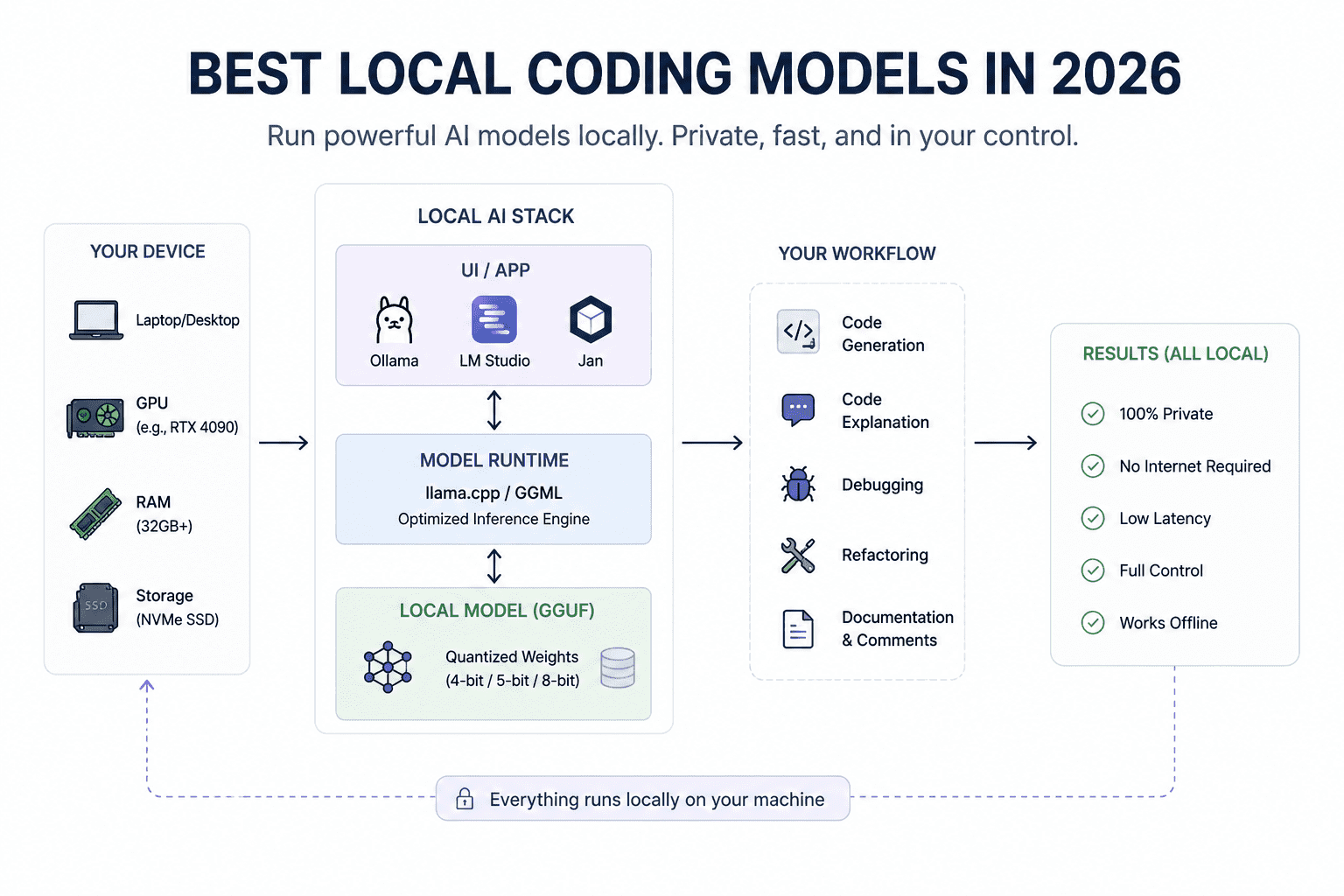
Running large language models (LLMs) locally used to be a daunting task, requiring specialized knowledge and powerful servers. Thanks to advancements in quantization and projects like GGML and its successor GGUF, it's now accessible to many developers with modern consumer hardware.
- GGUF Format: GGUF (GPT-Generated Unified Format) is a file format designed for efficient CPU and GPU inference of LLMs. It allows models to be highly quantized, meaning their numerical precision is reduced (e.g., from 32-bit floating point to 8-bit, 4-bit, or even 2-bit integers) without a drastic loss in performance. This significantly reduces the model's memory footprint and computational requirements, making it runnable on consumer-grade GPUs and even CPUs.
- Tools for Local Inference: Platforms like Ollama and LM Studio have democratized local LLM deployment. They provide user-friendly interfaces to download, manage, and run GGUF models, often exposing them as local API endpoints compatible with existing tools and IDEs.
- Hardware Requirements: While GGUF makes models more accessible, a dedicated GPU with a decent amount of VRAM (Video RAM) is highly recommended for optimal performance, especially for larger models. GPUs with 12GB, 16GB, or even 24GB of VRAM are becoming common among developers who want to run these powerful models smoothly. For smaller models or less demanding tasks, a modern CPU with ample system RAM can also suffice.
Top 7 Coding Models You Can Run Locally in 2026
Here are some of the leading open-source coding models that are excellent candidates for local deployment, offering a range of capabilities for various development needs.
1. Code Llama (Meta)
Developer: Meta AI
Code Llama is a large language model from Meta specifically designed for coding tasks. Built on top of Llama 2, it's capable of generating code, completing code, debugging, and explaining code in natural language. Code Llama comes in various sizes (7B, 13B, 34B, and 70B parameters) and includes specialized versions like Code Llama - Python for Python-specific tasks and Code Llama - Instruct for instruction following.
Key Features for Local Coding:
- Code Generation & Completion: Highly proficient in generating entire functions, classes, or completing partial code snippets.
- Code Explanations: Can explain complex code sections, making it valuable for understanding legacy code or learning new libraries.
- Debugging Assistance: Helps identify potential errors and suggests fixes.
- Multiple Languages: Supports various programming languages including Python, C++, Java, PHP, Typescript, C#, Bash, and more.
- GGUF Availability: Widely available in GGUF format on platforms like Hugging Face, making it a prime candidate for local inference via Ollama or LM Studio.
Official Resource: Meta AI Code Llama Blog, Code Llama on Hugging Face
2. CodeGemma (Google)
Developer: Google
CodeGemma is Google's family of open code models, built on the Gemma architecture. It's specifically fine-tuned for code-related tasks and comes in different sizes, including a 7B parameter base model, an instruct-tuned variant, and a 2B parameter model. CodeGemma is designed to be lightweight and efficient, making it suitable for local deployment while still offering strong performance in code generation and understanding.
Key Features for Local Coding:
- Efficient Code Generation: Excellent for generating boilerplate code, functions, and solving coding challenges.
- Code Completion & Fill-in-the-Middle: Excels at completing code and filling in missing sections within existing code.
- Small Footprint: The 2B and 7B variants are particularly well-suited for running on devices with limited resources.
- Instruction Following: The instruct-tuned model is good at responding to specific coding prompts and requests.
- GGUF Optimization: Available in GGUF format, ensuring good performance on local hardware.
Official Resource: Google AI Blog: CodeGemma, CodeGemma on Hugging Face
3. DeepSeek Coder (DeepSeek AI)
Developer: DeepSeek AI
DeepSeek Coder is a series of large language models specifically trained for code. It boasts a unique training methodology that focuses on high-quality code and text data, resulting in impressive capabilities across various programming languages. DeepSeek Coder models are available in multiple sizes, from 1.3B to 33B parameters, with both base and instruct-tuned versions. It's known for strong performance on coding benchmarks.
Key Features for Local Coding:
- High Accuracy: Achieves strong results on coding benchmarks like HumanEval and MBPP.
- Multi-language Support: Proficient in over 80 programming languages.
- Code Infilling: Excellent at predicting and filling in missing code within a sequence.
- Instruction-tuned variants: The instruct models are fine-tuned to follow user prompts for code generation, explanation, and debugging.
- GGUF Ready: Community-contributed GGUF versions are widely available, making it easy to run locally.
Official Resource: DeepSeek Coder Official Page, DeepSeek AI on Hugging Face
4. Mixtral 8x7B (Mistral AI)
Developer: Mistral AI
While not exclusively a coding model, Mixtral 8x7B is a Sparse Mixture-of-Experts (SMoE) model from Mistral AI that has demonstrated exceptional performance across a wide range of tasks, including coding. Its architecture allows it to selectively activate specific "expert" networks for different parts of an input, leading to higher efficiency and speed compared to dense models of similar parameter count. This makes it a very capable general-purpose model that excels in coding contexts when prompted correctly.
Key Features for Local Coding:
- Versatile Code Assistance: Can generate, complete, explain, and refactor code, as well as answer general programming questions.
- High Performance: Often outperforms larger models in benchmarks due to its efficient SMoE architecture.
- Fast Inference: The sparse activation means only a fraction of the model's parameters are used per token, leading to faster inference speeds, especially beneficial locally.
- GGUF Availability: Extremely popular in the local AI community, with numerous GGUF quantizations available for various hardware setups.
Official Resource: Mistral AI Blog: Mixtral 8x7B, Mixtral 8x7B on Hugging Face
5. StarCoder2 (Hugging Face & ServiceNow)
Developer: Hugging Face, ServiceNow, and others
StarCoder2 is the successor to the highly regarded StarCoder, developed by a consortium including Hugging Face and ServiceNow. This family of models (3B, 7B, 15B parameter versions) is trained on 250 programming languages from BigCode's "The Stack v2" dataset. It's designed to be a strong general-purpose coding model, excelling in code generation, completion, and understanding across a broad spectrum of languages.
Key Features for Local Coding:
- Broad Language Support: Trained on a massive dataset covering 250 programming languages, making it highly versatile.
- Fill-in-the-Middle Capabilities: Excellent for completing code within existing files.
- Robust Code Understanding: Capable of understanding complex code structures and providing relevant suggestions.
- Open-Source Focus: Designed with the open-source community in mind, encouraging local deployment and experimentation.
- GGUF Versions: Available in GGUF format, allowing for efficient local execution.
Official Resource: Hugging Face Blog: StarCoder2, StarCoder2 on Hugging Face
6. Llama 3 (Meta) - Instruct Variants
Developer: Meta AI
While Llama 3 is a general-purpose LLM, its instruct-tuned variants (8B and 70B parameters) have shown remarkable capabilities in coding tasks. Its extensive training data and advanced architecture allow it to generate high-quality code, understand complex programming concepts, and follow nuanced instructions. When fine-tuned or used with effective prompting, Llama 3 can serve as a powerful coding assistant for a wide array of development needs, including agentic workflows.
Key Features for Local Coding:
- Strong General Intelligence: Its foundational understanding translates well to complex coding problems, logical reasoning, and multi-step tasks.
- Code Generation & Refactoring: Excels at generating new code and improving existing code quality.
- Agentic Workflow Potential: Its strong reasoning abilities make it suitable for integration into agentic systems that break down and execute complex coding projects.
- High-Quality Instruction Following: The instruct models are highly responsive to detailed prompts for coding.
- Extensive GGUF Support: As a leading open model, Llama 3 has widespread GGUF support across all major local inference platforms.
Official Resource: Meta AI Blog: Llama 3, Meta Llama on Hugging Face
7. Fuyu-8B (Adept) - Multimodal for Visual Coding
Developer: Adept AI
Fuyu-8B stands out as a multimodal model that can process both images and text. While not solely a "coding model" in the traditional sense, its ability to understand visual inputs alongside code makes it incredibly valuable for specific developer workflows. Imagine providing a screenshot of a UI alongside a code snippet and asking Fuyu-8B to generate the corresponding code or identify discrepancies. This opens up new possibilities for front-end development, UI generation, and visual debugging.
Key Features for Local Coding (Multimodal):
- Image + Text Understanding: Can take images (like UI mockups, diagrams, error screenshots) and text (code, instructions) as input.
- UI Generation Assistance: Potentially assists in generating front-end code from visual designs or explaining UI elements.
- Visual Debugging: Helps in understanding errors or unexpected UI behavior by analyzing screenshots alongside code.
- Relatively Small Size: At 8B parameters, it's manageable for local deployment, especially with GGUF quantizations.
- GGUF Availability: Community efforts have made GGUF versions available for local experimentation.
Official Resource: Adept AI Blog: Fuyu-8B, Fuyu-8B on Hugging Face
Choosing the Right Model for Your Workflow
With so many excellent local coding models available, selecting the right one depends on your specific needs:
- For Pure Code Generation & Completion: Code Llama, CodeGemma, DeepSeek Coder, and StarCoder2 are top contenders. Consider their specific strengths in the languages you use most.
- For General-Purpose Coding & Reasoning: Mixtral 8x7B and Llama 3 Instruct variants offer broader capabilities, useful for complex problem-solving, architectural discussions, and agentic tasks.
- For Resource-Constrained Devices: CodeGemma 2B/7B or smaller quantized versions of other models will be your best bet.
- For Multimodal Development (UI/UX, Visual Debugging): Fuyu-8B opens up unique possibilities by integrating visual context into your coding workflow.
- For Agentic Workflows: Models with strong instruction following and reasoning, like Llama 3 Instruct or Mixtral, are excellent foundations for building autonomous coding agents.
Conclusion
The ability to run powerful AI coding models locally has truly democratized access to advanced AI assistance for developers. From enhancing privacy and speed to offering unparalleled control and cost savings, local AI is rapidly becoming an indispensable part of the modern development toolkit. As models continue to evolve and tools for local inference become even more user-friendly, the future of AI-powered coding on your own hardware looks incredibly promising. Experiment with these models, integrate them into your workflow, and unlock a new level of productivity and innovation.
Frequently Asked Questions
What are the main benefits of running coding AI models locally?
The main benefits include enhanced privacy since your code never leaves your machine, faster inference speeds due to no network latency, cost savings by avoiding cloud API fees, and the ability to work offline. You also gain full control and customization over the model's behavior and integration.
What kind of hardware do I need to run these models locally?
While some smaller models can run on a powerful CPU with sufficient RAM, a dedicated GPU with at least 12GB of VRAM is highly recommended for optimal performance, especially for larger models or more demanding tasks. GPUs with 16GB or 24GB VRAM offer even better performance and allow for running bigger models or more complex quantizations.
What is GGUF and why is it important for local AI models?
GGUF is a file format designed for efficient inference of large language models on consumer hardware. It uses quantization techniques to reduce the model's size and memory footprint without significant performance loss, making it possible to run powerful LLMs on your local CPU or GPU.
Can I fine-tune these local coding models with my own codebase?
Yes, many of these open-source models can be fine-tuned on your specific codebase to tailor their performance to your project's unique style, patterns, and requirements. This typically involves using frameworks like Hugging Face Transformers and requires more significant computational resources than just running inference.