Key Takeaways
- Small Language Models (SLMs) are compact AI models designed for efficiency, lower costs, enhanced privacy, and on-device deployment.
- SLMs excel in specialized tasks like on-device AI, domain-specific applications, and secure local processing, offering a practical alternative to larger models.
- Popular SLMs include Mistral 7B, Google's Gemma, Microsoft's Phi-3-mini, and TinyLlama, each offering unique strengths for various use cases.
- These models are highly customizable through fine-tuning, making them ideal for businesses and developers seeking tailored, resource-efficient AI solutions.
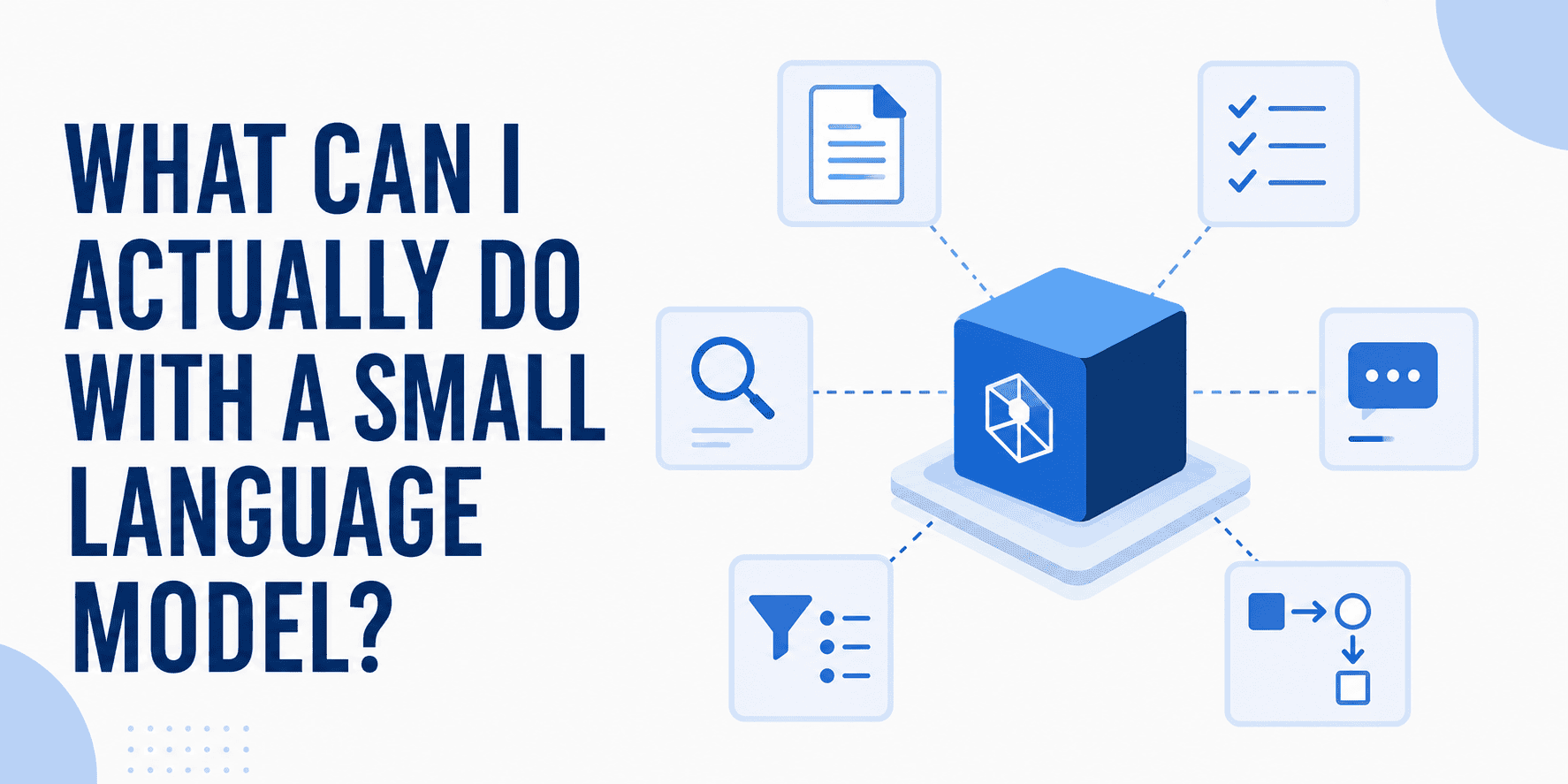
What Can I Actually Do with a Small Language Model? A Deep Dive into Practical AI
The world of Artificial Intelligence often highlights massive, general-purpose models like GPT-4 or Gemini Ultra, known as Large Language Models (LLMs). These models are impressive, capable of handling a vast array of complex tasks. However, a quieter, yet equally significant, shift is happening with the rise of Small Language Models (SLMs). These compact AI models are proving that you don't always need colossal computing power to achieve powerful, practical AI solutions. For AI practitioners, developers, and even freelancers looking to integrate AI into their workflows, understanding SLMs is crucial. They offer a compelling blend of efficiency, cost-effectiveness, and specialized performance, often without the heavy computational demands or privacy concerns associated with their larger counterparts. This article dives deep into what SLMs are, why they matter, how they work, and the real-world scenarios where they truly shine.What Exactly is a Small Language Model (SLM)?
Simply put, a Small Language Model (SLM) is a computational model designed to understand and generate natural language, much like an LLM, but on a smaller scale. The "small" refers primarily to the number of parameters the model contains. While LLMs can boast hundreds of billions or even trillions of parameters, SLMs typically range from a few million to around 10 billion parameters. This reduction in size isn't just about making them "mini" versions; it's a strategic design choice. SLMs are built with simpler neural architectures, allowing them to operate with significantly less computational power and memory. This efficiency translates directly into faster training times, reduced energy consumption, and the ability to deploy these models on devices with limited resources. Think of it this way: if an LLM is a vast, general-purpose encyclopedia, an SLM is a highly specialized, concise handbook. While the encyclopedia can answer almost anything, the handbook provides expert-level detail on a specific topic, often more quickly and efficiently for that particular need.Why Do Small Language Models Matter Now?
The growing interest in SLMs isn't just a trend; it's a response to practical needs and limitations of LLMs. Here are some key reasons why SLMs are becoming increasingly important:- Cost-Effectiveness: Running large language models can be incredibly expensive due to high GPU usage and cloud infrastructure costs. SLMs require significantly less computational power, leading to lower hardware expenses and reduced operational costs for data storage, processing, and maintenance. This makes AI more accessible to smaller businesses, startups, and individual developers.
- Enhanced Data Privacy and Security: Many organizations deal with sensitive data that cannot leave their internal infrastructure. SLMs can be deployed on-premises or within private cloud environments, ensuring that confidential information remains in-house and isn't transmitted to external servers. This is crucial for compliance with regulations like GDPR and HIPAA.
- Faster Inference and Real-time Processing: Due to their smaller size, SLMs generate responses much faster. This low latency is essential for real-time applications such as chatbots, customer service automation, and live transcription services, where immediate feedback is critical.
- On-Device and Edge AI: SLMs are lightweight enough to run locally on devices like smartphones, embedded systems, laptops, and IoT devices, without needing a constant internet connection or cloud services. This capability enables offline functionality and brings AI directly to the user's device, enhancing accessibility and user experience.
- Specialization and Customization: While LLMs are generalists, SLMs can be fine-tuned for specific tasks and domains, often achieving comparable or even superior performance to larger models in those niche areas. This makes them highly effective for applications requiring specific knowledge, such as legal document analysis or medical diagnostics.
How Do SLMs Work Under the Hood (The Basics)?
SLMs are built using simplified versions of the artificial neural networks found in LLMs. They primarily use transformer architectures, which are excellent at processing sequential data like text. Here’s a high-level overview:- Fewer Parameters: The core difference is the number of parameters. These are the internal variables the model learns during training that influence its behavior and predictions. SLMs have far fewer parameters, making them leaner and more efficient.
- Simplified Architecture: SLMs often employ fewer layers in their neural networks compared to LLMs. Innovations like Grouped-Query Attention (GQA) and Sliding Window Attention (SWA), seen in models like Mistral 7B, help reduce computational overhead and memory usage while still handling longer contexts efficiently.
- Focused Training Data: Instead of being trained on vast, general datasets spanning the entire internet, SLMs can be trained on more focused, high-quality datasets. This targeted training helps them develop expertise in a specific domain.
- Fine-tuning: A common practice with SLMs is fine-tuning. This involves taking a pre-trained SLM and further training it on a smaller, domain-specific dataset. Fine-tuning adjusts the model's parameters to optimize its performance for a particular task, making it highly specialized and accurate for that specific use case. Techniques like Low-Rank Adaptation (LoRA) and Quantized LoRA (QLoRA) make this process even more efficient, reducing memory and compute requirements.
Real-World Operations Scenarios for SLMs
The true power of SLMs comes to life in practical applications. Here are several broad operational scenarios where SLMs are making a significant impact:1. On-Device Processing and Edge AI
SLMs are perfect for situations where AI needs to run directly on a device without relying on cloud servers.- Smartphones and Wearables: Imagine a language assistant on your phone that can draft emails, summarize messages, or translate conversations even without an internet connection. SLMs enable real-time transcription, personalized user experiences, and enhanced privacy for sensitive data like health information, all processed locally.
- IoT Devices: Smart home devices, industrial sensors, and autonomous vehicles can use SLMs for local command processing, anomaly detection, and real-time decision-making, reducing latency and ensuring functionality even in remote areas.
2. Specialized Domain Expertise and Niche Applications
When a general LLM might be overkill or lack the necessary precision, SLMs, often fine-tuned, step in.- Customer Support Chatbots: SLMs can be trained on a company's specific product documentation and FAQs to provide highly accurate and consistent customer support. This reduces the workload on human agents and offers instant, relevant answers.
- Legal and Medical Assistants: For legal firms, an SLM can quickly summarize legal documents, extract key clauses, or assist in contract review. In healthcare, SLMs can help process medical records, generate reports, or provide initial consultation support, all while keeping patient data secure on-premises.
- Code Generation and Review: Developers can use SLMs to assist with code completion, debugging, documentation, and even code review, especially when fine-tuned on specific programming languages or internal coding standards.
3. Data Privacy and Security-Critical Environments
For industries and applications handling highly sensitive or regulated data, SLMs offer a robust solution.- Financial Services: Banks can deploy SLMs within their secure networks to analyze financial transactions for fraud detection, summarize internal reports, or assist with compliance checks without exposing data to external cloud services.
- Government and Defense: SLMs can process classified documents and provide insights in secure, isolated environments, ensuring that sensitive intelligence remains protected.
- Internal Enterprise Tools: For any business with proprietary or confidential data, SLMs can power internal knowledge bases, document analysis tools, or communication assistants, all operating within the company's own infrastructure.
4. Cost-Effective and Resource-Constrained Solutions
SLMs democratize AI by making powerful capabilities accessible without significant investment.- Small Businesses and Startups: Companies with limited budgets can leverage SLMs to automate tasks like content generation, marketing copy creation, or basic data analysis without incurring high operational costs.
- Offline Operations: For scenarios where internet connectivity is unreliable or unavailable, such as field operations, remote work, or embedded systems, SLMs provide essential AI functionality.
5. Customization and Fine-tuning for Unique Needs
The ability to tailor an SLM to very specific requirements is a huge advantage.- Brand Voice Consistency: Businesses can fine-tune SLMs to generate content that perfectly matches their brand's tone, style, and terminology for marketing, social media, or customer communications.
- Personalized Learning and Tutoring: Educational platforms can create SLMs trained on specific curricula to provide personalized tutoring, answer student questions, and generate practice materials.
Popular Small Language Models and Projects
The SLM landscape is rapidly evolving, with several models gaining traction for their capabilities and efficiency:- Mistral 7B (Mistral AI): Released in September 2023 by French startup Mistral AI, Mistral 7B is a 7.3 billion parameter model. It's known for outperforming larger models like Llama 2 13B on various benchmarks and approaches CodeLlama 7B performance on code tasks. Mistral 7B uses architectural innovations like Grouped-Query Attention (GQA) and Sliding Window Attention (SWA) for faster inference and efficient handling of longer contexts. It's available under the Apache 2.0 license, allowing for unrestricted use and fine-tuning.
- Gemma (Google DeepMind): Google DeepMind, along with other Google teams, developed the Gemma family of lightweight, open models. Launched in early 2024, Gemma models are built from the same research and technology used for the Gemini models. They come in various sizes (e.g., Gemma 4 E2B, E4B, 12B, A4B, 31B) and specialized domains, with versions optimized for mobile devices, laptops, and servers. Gemma is designed for responsible AI development and supports fine-tuning across major frameworks.
- Phi-3-mini (Microsoft): As part of Microsoft's Phi-3 series, Phi-3-mini is a 3.8 billion-parameter model released in April 2024. It's designed for efficiency and offers performance comparable to larger models like GPT-3.5, excelling in reasoning and coding. Phi-3-mini is optimized for devices with limited computational resources, including notebooks, smartphones, and edge devices, and supports fine-tuning for specific tasks. It's available in various formats, including PyTorch and quantized GGUF, making it convenient for different application scenarios.
- TinyLlama (OpenLM Research / Hugging Face Community): The TinyLlama project aims to pretrain a 1.1 billion parameter Llama model on 3 trillion tokens. Initiated in September 2023, TinyLlama boasts the same architecture and tokenizer as Llama 2, making it highly compatible with existing projects. Its compact size (4-bit quantized version takes only 637 MB) makes it ideal for deployment on edge devices and mobile applications, enabling real-time machine translation without an internet connection. TinyLlama models are available under the Apache 2.0 license on platforms like Hugging Face and GitHub.
The Future is Small: What This Means for AI Practitioners and Freelancers
The rise of SLMs signals a significant shift towards more accessible, efficient, and specialized AI. For AI practitioners, this means:- Broader Deployment Opportunities: The ability to run AI models on edge devices opens up new avenues for innovation in industries like manufacturing, healthcare, and smart cities.
- Reduced Development and Operational Costs: Experimenting with and deploying AI solutions becomes more financially viable, especially for niche applications that don't require the full power of an LLM.
- Enhanced Control and Customization: Fine-tuning SLMs allows for highly tailored solutions that meet specific business needs, ensuring greater accuracy and relevance.
- Focus on Data Quality: Since SLMs rely on smaller, more focused datasets, the emphasis shifts to curating high-quality, domain-specific data for effective fine-tuning.
- Build Specialized AI Services: Offer bespoke AI solutions to clients by fine-tuning SLMs for their unique industry or company data, providing a competitive edge.
- Integrate AI Locally: Develop applications that run AI directly on client machines, addressing privacy concerns and offering offline capabilities.
- Optimize Workflows: Use local SLMs for tasks like content summarization, personalized writing assistants, or code snippets, boosting personal productivity without cloud API costs.
Frequently Asked Questions
What is the main difference between an SLM and an LLM?
The main difference lies in their size and scope. LLMs (Large Language Models) have hundreds of billions or even trillions of parameters, are trained on vast datasets, and are general-purpose. SLMs (Small Language Models) have fewer parameters (millions to billions), are more resource-efficient, and are often fine-tuned for specific, specialized tasks.
Can SLMs run offline without an internet connection?
Yes, one of the significant advantages of SLMs is their ability to run locally on devices like smartphones, laptops, and edge devices, often without needing an internet connection. This enhances privacy and allows for offline functionality.
Are SLMs as accurate as LLMs?
For general, broad tasks, LLMs typically offer greater accuracy due to their vast training data and parameter count. However, for specific, domain-centric tasks, a well-fine-tuned SLM can achieve comparable or even better performance than a larger, general-purpose LLM, especially when trained on high-quality, specialized data.
What are some popular examples of Small Language Models?
Some prominent examples of Small Language Models include Mistral 7B by Mistral AI, the Gemma family of models developed by Google DeepMind, Microsoft's Phi-3-mini, and the open-source TinyLlama project.