Key Takeaways
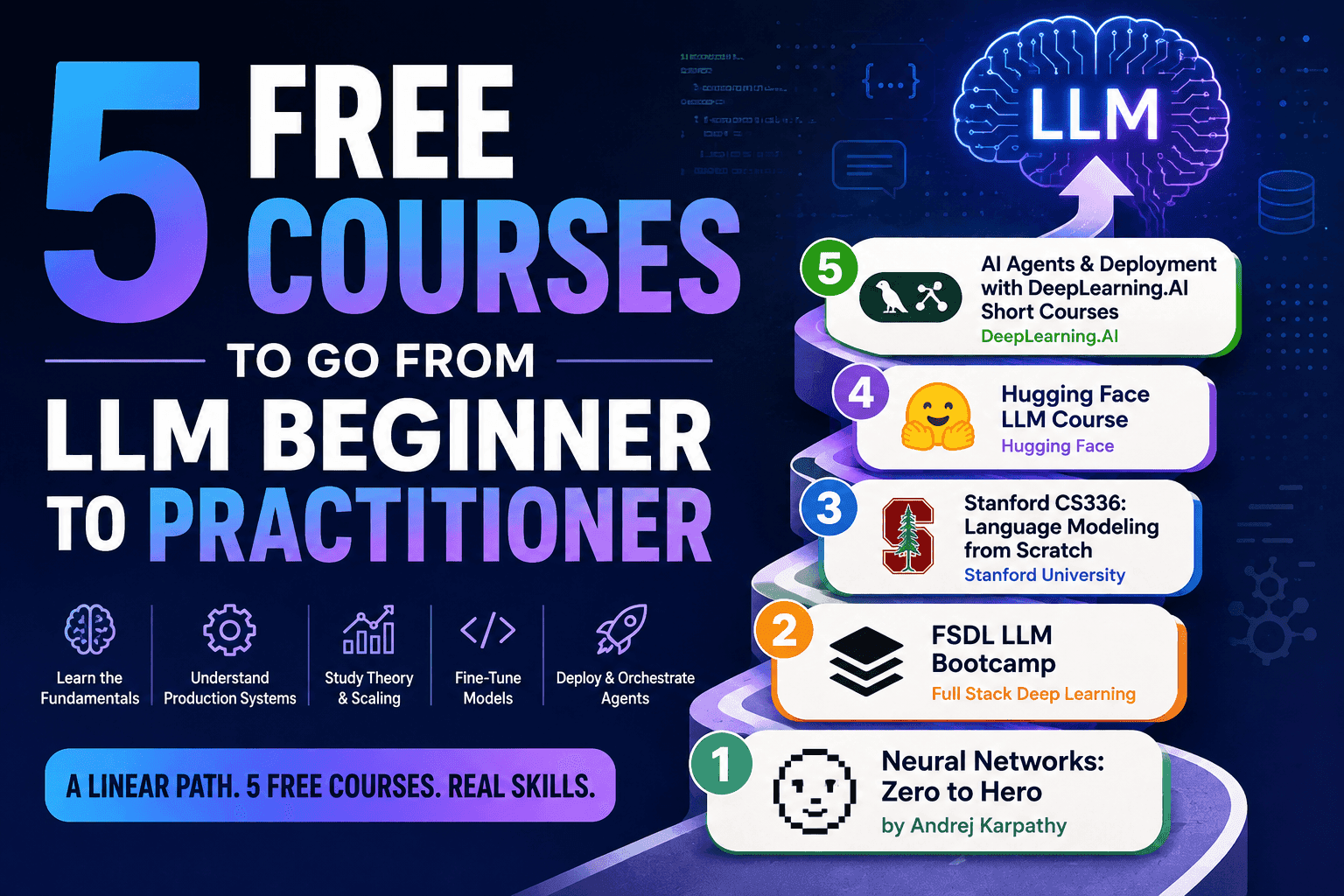
- This article outlines a free, linear learning path to become an LLM practitioner, starting from deep learning basics.
- The curated pipeline includes five high-quality, free online courses from leading platforms like DeepLearning.AI and Hugging Face.
- You'll learn foundational neural networks, the Transformer architecture, core LLM concepts, API interaction, and advanced application development with frameworks like LangChain.
- This learning journey is ideal for developers, data scientists, and tech-savvy individuals looking to build practical LLM applications without upfront costs.
The world of Large Language Models (LLMs) is moving incredibly fast. What was cutting-edge yesterday is standard practice today, and staying on top of these changes can feel like a full-time job. Many aspiring AI practitioners and developers want to dive in, but the sheer volume of information and the cost of specialized training can be daunting. How do you go from understanding what an LLM is to actually building something useful with one?
Good news: you don't need to break the bank to get started. We've put together a curated, linear pipeline of five high-signal free courses that will take you from the absolute basics of neural networks to deploying production-grade LLM applications. This isn't just a random list; it's a structured path designed to build your knowledge step-by-step, ensuring you grasp the fundamentals before tackling more complex topics.
Why This Curated Path Matters
Learning about LLMs can be overwhelming. There are countless articles, tutorials, and courses, but often they jump into advanced topics without solidifying the basics. This can leave learners with fragmented knowledge and a lot of unanswered questions. Our goal here is to provide a clear, logical progression that mirrors how a professional might approach learning this technology:
- Builds Foundational Knowledge: You'll start with the core concepts of deep learning that underpin all LLMs.
- Demystifies Complex Architectures: Understand the Transformer, the innovative design that powers models like GPT and BERT.
- Covers Practical Application: Move beyond theory to learn how to interact with LLM APIs and build real-world tools.
- Introduces Advanced Frameworks: Get hands-on with tools that streamline LLM development, making you more efficient.
- Completely Free: All resources are accessible without any subscription fees, making high-quality AI education available to everyone.
This path is designed for software developers, data scientists, machine learning engineers, and even tech-savvy freelancers who want to integrate AI into their work. If you have some programming experience (ideally Python) and a desire to learn, you're ready to begin.
The 5-Step Journey: From Basics to Building
Step 1: The Foundations of Deep Learning: Neural Networks and Backpropagation
Before you can truly understand LLMs, you need to grasp the basics of how neural networks learn. This first course provides that essential bedrock, covering the fundamental building blocks of modern AI.
- Course: Neural Networks and Deep Learning
- Developed by: DeepLearning.AI, taught by Andrew Ng.
- What you'll learn: This course, part of the larger Deep Learning Specialization, introduces you to the exciting field of deep learning. You'll understand what neural networks are, how to build them, and how they are trained using algorithms like backpropagation. Key topics include logistic regression as a neural network, vectorization, shallow neural networks, and deep neural networks. It also covers practical aspects like hyperparameter tuning and regularization.
- Why it matters: This course is crucial because it lays the groundwork. Without understanding how a neural network processes information and learns from data, the inner workings of an LLM would remain a black box. It provides the core mathematical and algorithmic intuition necessary for more advanced topics.
Step 2: Mastering the Transformer Architecture: The Heart of Modern LLMs
Once you have a solid understanding of neural networks, the next logical step is to dive into the Transformer architecture. This revolutionary design is the backbone of almost all modern LLMs, and understanding it is key to becoming a proficient practitioner.
- Course: Hugging Face NLP Course
- Developed by: Hugging Face, a leading open-source AI company.
- What you'll learn: This comprehensive and incredibly practical course teaches you how to use the Hugging Face ecosystem, which is synonymous with modern NLP and LLM development. You'll learn about tokenizers, datasets, and, most importantly, the Transformer architecture itself. The course covers fine-tuning pre-trained models for various tasks and deploying them.
- Why it matters: The "Attention Is All You Need" paper introduced the Transformer in 2017, completely changing the landscape of natural language processing. This course not only explains how Transformers work but also gives you hands-on experience with the tools used by virtually every LLM developer. It's a direct bridge from theoretical deep learning to practical LLM implementation.
Step 3: Understanding Large Language Models: Core Concepts and Capabilities
With a grasp of neural networks and the Transformer, you're now ready for an introduction specifically focused on Large Language Models. This short course provides a high-level overview of what LLMs are, their capabilities, and common use cases.
- Course: Large Language Models (LLMs)
- Developed by: DeepLearning.AI
- What you'll learn: Taught by Isa Fulford (OpenAI) and Andrew Ng (DeepLearning.AI), this course quickly brings you up to speed on the fundamentals of LLMs. You'll explore their potential, understand their limitations, and learn about common applications like summarization, text generation, and question answering. It also touches upon ethical considerations and the future of LLMs.
- Why it matters: This course serves as an excellent conceptual bridge. It takes your understanding of the underlying technology and applies it directly to the specific domain of LLMs, preparing you for more hands-on development with these powerful models.
Step 4: Building Intelligent Systems with LLM APIs
Now that you understand the theory and core concepts, it's time to get practical. The next step focuses on interacting with LLMs directly through their APIs, a skill essential for building real-world applications.
- Course: Building Systems with the ChatGPT API
- Developed by: DeepLearning.AI in collaboration with OpenAI.
- What you'll learn: Also taught by Isa Fulford (OpenAI) and Andrew Ng (DeepLearning.AI), this course dives into prompt engineering and how to build applications using the ChatGPT API. You'll learn techniques like few-shot prompting, chain-of-thought prompting, and how to use external tools (like retrieval augmented generation, or RAG) to enhance LLM capabilities. It also covers best practices for building robust and safe LLM applications.
- Why it matters: This course is a game-changer for practical application development. Most developers interact with LLMs via APIs, and mastering prompt engineering and integrating external tools is critical for creating useful, reliable, and innovative LLM-powered systems. This course moves you from theoretical understanding to hands-on development.
Step 5: Advanced Application Development with Frameworks like LangChain
Finally, to become a true LLM practitioner, you need to know how to orchestrate complex interactions with LLMs and external data sources. Frameworks like LangChain are designed precisely for this, enabling you to build sophisticated, multi-step LLM applications.
- Course: LangChain for LLM Application Development
- Developed by: DeepLearning.AI in collaboration with LangChain.
- What you'll learn: Taught by Harrison Chase, the creator of LangChain, this course introduces you to the powerful LangChain library. You'll learn how to build applications that chain together LLMs with other components, manage memory in conversational agents, load and process data for LLMs, and create agents that can dynamically decide which tools to use.
- Why it matters: Building advanced LLM applications often requires more than just a single API call. LangChain provides the tools to create complex workflows, integrate with databases, use specialized tools, and build conversational agents with memory. This course elevates your skills from basic API interaction to constructing intelligent, context-aware LLM systems, which is essential for production-grade applications.
Who is This Path For?
This curated learning path is perfect for:
- Software Developers: Looking to integrate AI capabilities into their applications or pivot into AI engineering.
- Data Scientists: Who want to expand their machine learning knowledge specifically into the realm of generative AI and NLP.
- Machine Learning Engineers: Seeking to specialize in LLM development and understand modern application frameworks.
- Freelancers & Consultants: Aiming to offer services that leverage LLMs for content creation, automation, data analysis, or building custom AI solutions for clients.
- Students & Researchers: Anyone with a technical background eager to explore the practical aspects of LLMs without financial barriers.
Beyond the Courses: Continuous Learning and Practice
Completing these five courses will give you a robust foundation and practical skills, but the journey doesn't end there. The field of AI, especially LLMs, is constantly evolving. To truly go from practitioner to expert, consider these next steps:
- Read Research Papers: Keep an eye on new developments from major conferences (NeurIPS, ICML, ACL) and pre-print servers like arXiv.
- Experiment with Open-Source Models: Download and experiment with models available on Hugging Face or other platforms. Try fine-tuning them on your own datasets.
- Build Projects: The best way to solidify your learning is by building. Start with small projects, apply what you've learned, and gradually tackle more complex ideas. Contribute to open-source projects.
- Join Communities: Engage with other practitioners in online forums, Discord servers, or local meetups. Share your knowledge and learn from others.
- Stay Updated: Follow leading AI researchers, companies, and blogs (like NerdsTool!) to keep up with the latest tools, techniques, and breakthroughs.
Conclusion
The journey from an LLM beginner to a practitioner capable of building production-grade applications is a significant one, but it doesn't have to be expensive or unstructured. By following this carefully curated pipeline of free, high-quality courses, you can systematically acquire the knowledge and hands-on skills needed to thrive in the exciting world of Large Language Models. Dive in, learn diligently, and start building!
Frequently Asked Questions
What prerequisites do I need for these courses?
A basic understanding of Python programming is highly recommended. For the first course, "Neural Networks and Deep Learning," some familiarity with linear algebra and calculus can be helpful, but Andrew Ng does a great job of making it accessible. The subsequent courses build on the concepts learned, so following the linear path is key.
Are these courses truly free, or do they have hidden costs?
Yes, all the courses listed are genuinely free to access and learn from. For Coursera courses, you typically get free access to all course materials, lectures, and exercises through the audit option. If you want a verified certificate, there might be a fee, but learning the content is free. The Hugging Face course and DeepLearning.AI short courses are completely free for all content and learning.
How long will it take to complete this entire learning path?
The time commitment varies greatly depending on your prior experience and how much time you can dedicate each week. "Neural Networks and Deep Learning" can take several weeks (e.g., 4-6 weeks at a few hours per week). The Hugging Face course is quite extensive and can take anywhere from 3-8 weeks. The DeepLearning.AI short courses are typically 1-2 hours each. Realistically, plan for at least 3-6 months to thoroughly complete all five courses and genuinely absorb the material, especially if you're also working on practical projects.
Will completing these courses qualify me for an LLM job?
These courses provide an excellent foundation and practical skills, which are crucial for entry-level or junior LLM-focused roles. However, most professional roles also require practical project experience, a portfolio, and often a deeper understanding of specific sub-fields (like MLOps for LLMs, specialized model architectures, or domain-specific applications). Think of this path as a strong launchpad, not the final destination. Continuous learning, building projects, and contributing to the community will be vital for career advancement.