Key Takeaways
- ChatGPT Work is a goal-oriented agent mode within ChatGPT, designed for professionals to tackle multi-step tasks across connected applications.
- It leverages advanced OpenAI models like GPT-5.5 and GPT-6 Astra, offering enhanced performance, longer context windows, and robust data privacy for business users.
- OpenAI offers various tiers, including ChatGPT Plus for individuals ($20/month), ChatGPT Business ($20-$100/user/month), and ChatGPT Enterprise (custom pricing), each with increasing features and usage limits.
- While powerful for content creation, data analysis, and workflow automation, users should be aware of limitations like potential hallucinations and the need for human oversight.
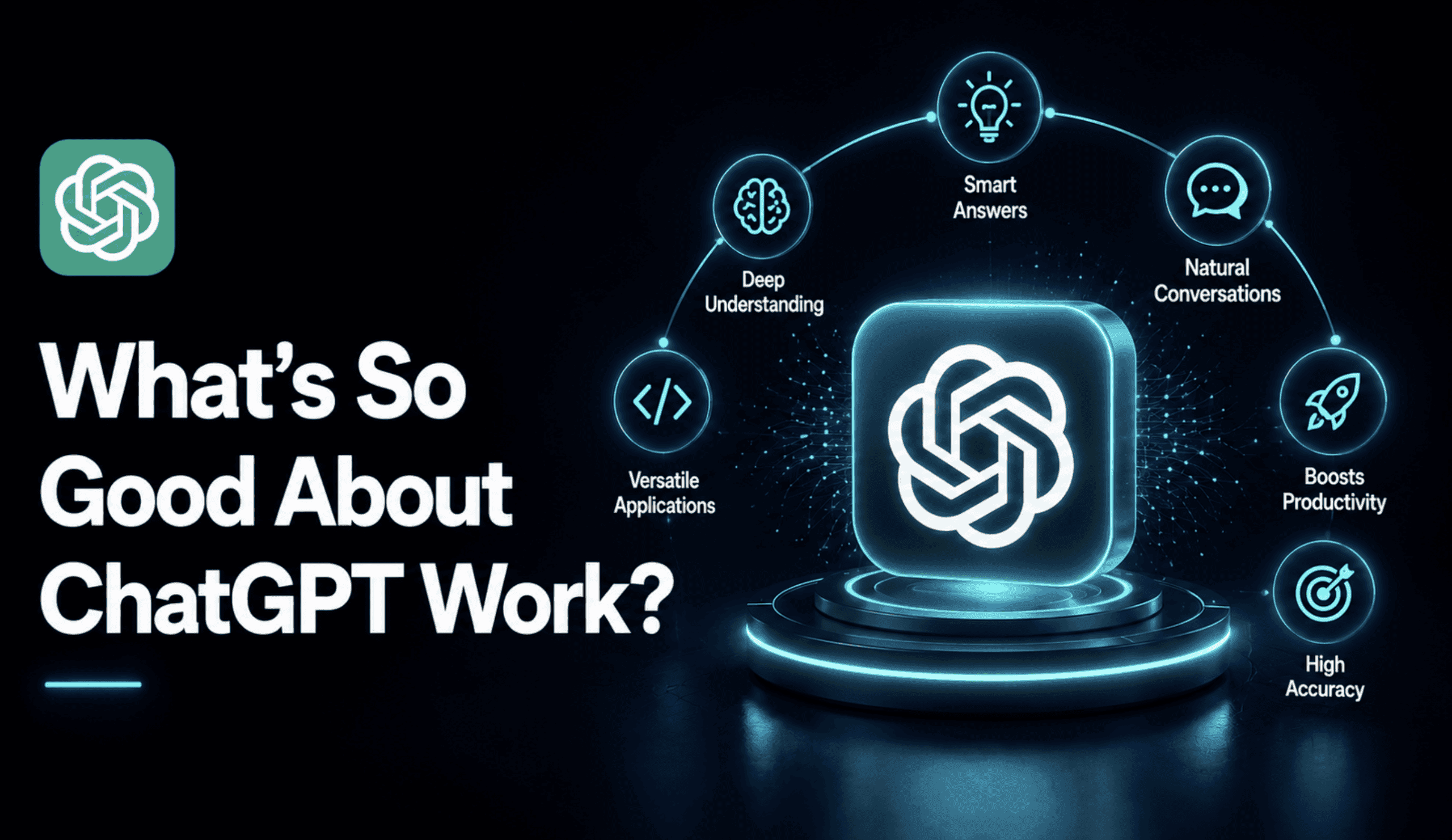
The world of Artificial Intelligence moves fast, and keeping up with the latest tools and their real-world impact can be a job in itself. Among the many AI advancements, ChatGPT has stood out, especially in professional settings. But what exactly makes "ChatGPT Work" so effective? This article dives deep into the technology, features, and practical applications of ChatGPT for professionals, examining where it truly shines and where its current limits lie.
First, let's clarify what "ChatGPT Work" means. It's not a standalone product with that exact name. Instead, it refers to the advanced capabilities and specific tiers of OpenAI's ChatGPT service designed for professional use, including features like persistent memory, integration with external tools, and goal-oriented task execution. This often encompasses offerings like ChatGPT Plus, ChatGPT Team (now called ChatGPT Business), and ChatGPT Enterprise.
What is ChatGPT and Who is Behind It?
ChatGPT is a generative AI chatbot developed by OpenAI, an AI research and deployment company founded in 2015. OpenAI's mission is to ensure that artificial general intelligence (AGI) benefits all of humanity. Initially launched as a free research preview on November 30, 2022, built on the GPT-3.5 series, ChatGPT quickly gained immense popularity, reaching one million users in five days. Since its initial release, OpenAI has continuously updated ChatGPT, introducing more advanced models and features.
The Core Technology: Large Language Models and Transformers
At the heart of ChatGPT's capabilities are Large Language Models (LLMs), specifically generative pre-trained transformers (GPTs). LLMs are a type of deep learning model trained on vast amounts of text and other data. During this training, they learn statistical patterns in language, including how words and ideas relate to each other.
The "transformer" architecture is a key component of these models. It's a neural network architecture known for its ability to process sequential data, like text, in a highly efficient way. Unlike older models that processed words one by one, transformers can process entire sequences simultaneously, thanks to a mechanism called "self-attention." This allows the model to weigh the importance of different words in a sentence when generating a response, capturing long-range dependencies in the text. The architecture typically consists of an encoder and a decoder. The encoder processes the input text, transforming it into a format the model can understand, while the decoder generates the output.
This sophisticated architecture enables ChatGPT to perform a wide range of language-related tasks, such as answering questions, summarizing and translating text, generating content, analyzing information, and even writing computer code.
How ChatGPT Work Elevates Professional Productivity
For freelancers and consultants, "ChatGPT Work" isn't just about asking questions; it's about automating and enhancing complex workflows. It transforms ChatGPT from a simple chatbot into a powerful AI assistant that can manage multi-step projects and integrate with other tools.
Goal-Oriented Agent Mode
One of the most significant advancements for professional users is the introduction of a goal-oriented agent mode, often referred to as "Work Mode." Instead of merely responding to individual prompts, you can give ChatGPT an overarching goal—like creating a report, generating a spreadsheet, or drafting a website. The AI then plans the necessary steps, draws context from your connected applications and files, and delivers a completed draft. This shifts the interaction from conversational to task-oriented, making it feel more like briefing a human assistant.
Persistent Memory and Context
Traditional chat tools often reset with each new conversation, losing context. ChatGPT Work Mode addresses this by maintaining a persistent context layer. This means the AI remembers who you are, what you're working on, and the tools you have integrated, allowing for more coherent and efficient multi-session projects.
Advanced Data Analysis and Code Interpretation
ChatGPT Work offers enhanced data analysis capabilities, previously known as Code Interpreter. This feature allows both technical and non-technical users to analyze information quickly. For example, financial researchers can crunch market data, marketers can analyze survey results, and data scientists can debug code. This is a game-changer for tasks involving large datasets, enabling summarization, cleaning, and visualization of data.
Integration with External Tools
The ability to integrate with external tools like Gmail, Slack, and Google Drive transforms ChatGPT into a unified workspace. This connectivity allows the AI to pull and push information across your existing professional ecosystem, streamlining workflows and reducing manual data transfer.
Customization and Collaboration
For teams, ChatGPT Work (or ChatGPT Business/Enterprise) provides features like shareable chat templates for internal collaboration and the ability to build custom workflows. This can help teams leverage the technology without needing advanced prompt engineering skills, ensuring consistency and efficiency across an organization. Custom GPTs can also be created and published, tailored to specific company workflows.
ChatGPT Offerings for Professionals: Tiers and Pricing
OpenAI provides several tiers to cater to different user needs, from individual power users to large enterprises.
- Free Tier: The basic version offers unlimited everyday text chats, typically running on models like GPT-5.5 Instant. It includes limited access to features like file uploads, image generation, voice, and data analysis. While a good starting point, it has usage limits that power users will quickly hit.
- ChatGPT Plus: Priced at $20 per month, this individual subscription provides priority access to OpenAI's flagship models (like GPT-5.5 and GPT-6 Astra, depending on updates), faster response speeds, and higher usage limits. Plus users get expanded access to advanced reasoning, image generation, voice conversations, file uploads, and deep research tools. It's ideal for solo professionals and freelancers who need more robust capabilities.
- ChatGPT Pro: Introduced in December 2024, this individual plan is aimed at research and coding work, priced at $200 per month (though prices can vary, with some reports of $100/month tiers as well). It offers substantially more usage than Plus, with unlimited access to OpenAI's most advanced models, including "o1" models (GPT-5 based reasoning models) and an "o1 Pro" mode for extended computation.
- ChatGPT Business (formerly Team): Designed for small to medium-sized teams, ChatGPT Business requires a minimum of two seats. Standard seats cost $25 per user per month on monthly billing, or $20 per user per month when billed annually. Premium seats are $125 per user per month, or $100 annually, offering 5x the usage of Standard seats with no five-hour limit. This plan includes a shared workspace, admin controls, SSO, and, crucially, ensures that your business data is not used for training OpenAI's models by default. It's a significant upgrade for collaborative work, providing higher message caps and administrative features compared to Plus.
- ChatGPT Enterprise: Aimed at large organizations, Enterprise offers custom pricing and is designed for large-scale deployment. It provides enterprise-grade security and privacy, unlimited higher-speed access to advanced models (like GPT-4, GPT-4o, and GPT-5), longer context windows (up to 128,000 tokens), and unlimited access to advanced data analysis. Key features include an admin console for bulk member management, SSO, domain verification, analytics dashboards, and custom data retention policies. Enterprise plans also come with 24/7 priority support and service-level agreements (SLAs).
Where ChatGPT Work Holds Up Against Competition and Benchmarks
ChatGPT, powered by OpenAI's latest models, consistently ranks among the top-performing AI assistants. The evolution from GPT-3.5 to GPT-4, GPT-4o, and now GPT-5.5 and GPT-6 Astra has brought significant improvements in reasoning, knowledge, mathematics, and coding.
For instance, GPT-4o, released in May 2024, demonstrated elite-level performance in general language understanding tests like MMLU and multi-task evaluations, often scoring above 85. It also showed a significant increase in speed, with an average latency of 0.32 seconds, much faster than previous versions. While it performs well across many benchmarks, other models like Claude-3-Opus have shown strengths in specific areas, such as summarization tasks.
The current flagship model for complex reasoning and coding is GPT-6 Astra, with GPT-5.6 Sol being a strong contender for complex professional work. GPT-5.6 Terra balances intelligence and cost, while GPT-5.6 Luna is designed for cost-sensitive, high-volume tasks. These models support text and image input, text output, multilingual capabilities, and vision.
For coding, OpenAI has specialized models like GPT-5.3 Codex for agentic coding and multi-file refactors, and GPT-5.3 Codex-Spark for real-time IDE autocomplete. This specialization ensures that professionals can choose the right tool for the specific coding task, optimizing for latency, depth, and context window.
The Honest Limits of ChatGPT Work
Despite its impressive capabilities, ChatGPT, like all current AI, has limitations that professionals must understand:
- Hallucinations and Factual Accuracy: LLMs can sometimes generate information that sounds plausible but is factually incorrect or made up, a phenomenon known as "hallucination." This means human oversight and fact-checking remain critical, especially for sensitive or high-stakes tasks.
- Knowledge Cutoff: While models are continuously updated, there's always a knowledge cutoff date beyond which the model hasn't been explicitly trained on new information. For example, GPT-5.6 Sol's knowledge cutoff is February 16, 2026, and GPT-6 Astra's is April 30, 2026. For real-time information, integration with web search tools is necessary, but even then, users should verify sources.
- Bias in Training Data: Since LLMs learn from vast amounts of internet data, they can inadvertently pick up and perpetuate biases present in that data. This can lead to biased or unfair outputs, requiring careful prompt engineering and review.
- Lack of True Understanding or Consciousness: ChatGPT generates responses based on statistical patterns and learned relationships, not genuine understanding, consciousness, or personal experience. It doesn't "think" or "feel" in the human sense.
- Complexity of Reasoning: While models like GPT-6 Astra are designed for complex reasoning, there are still limits to their ability to handle highly abstract or multi-layered logical problems without explicit guidance or breakdown into smaller steps.
- Security and Privacy Concerns (for lower tiers): While Enterprise and Business tiers offer robust data privacy by not using customer data for training, users of Free, Plus, and Pro tiers must opt out to prevent their chats from potentially improving OpenAI's models.
What ChatGPT Work Means for AI Practitioners and Freelancers
For freelancers and consultants, ChatGPT Work represents a powerful shift in how they can approach their daily tasks. It's an opportunity to:
- Boost Productivity: Automate repetitive tasks like drafting emails, summarizing documents, generating reports, and creating content, freeing up time for higher-value work.
- Enhance Creativity: Use the AI as a brainstorming partner, generating ideas for marketing campaigns, creative writing, or problem-solving.
- Improve Research Capabilities: Leverage advanced data analysis and deep research tools to quickly sift through large datasets and synthesize information.
- Streamline Workflows: Integrate ChatGPT with existing productivity tools to create seamless automated workflows.
- Develop New Skills: Learning to effectively prompt and manage AI agents becomes a crucial skill, allowing freelancers to offer more sophisticated services.
However, it also means adapting to a new paradigm. The role of the human shifts from execution to oversight, curation, and strategic direction. Understanding both the immense power and the inherent limitations of these tools is key to harnessing them responsibly and effectively in a professional context.
Frequently Asked Questions
What is the primary difference between ChatGPT Plus and ChatGPT Business?
ChatGPT Plus is an individual subscription for $20/month, offering higher usage limits, faster access to advanced models, and expanded features like image generation and deep research. ChatGPT Business, priced at $20-$100/user/month with a two-seat minimum, is designed for teams. It adds collaboration features like a shared workspace, admin controls, SSO, and a commitment that your business data will not be used for training OpenAI's models by default.
Can ChatGPT Work integrate with my existing business tools?
Yes, ChatGPT Work Mode is designed to integrate with external tools such as Gmail, Slack, and Google Drive. This allows it to pull context and data from your connected applications and deliver completed tasks directly into your workflow.
What models power ChatGPT Work for professional users?
Professional tiers like ChatGPT Plus, Business, and Enterprise provide access to OpenAI's most advanced models, including GPT-5.5 and GPT-6 Astra. These models offer superior reasoning, knowledge, and performance compared to the free version, with specialized variants available for tasks like coding.
How does ChatGPT Enterprise handle data privacy and security?
ChatGPT Enterprise offers enterprise-grade security and privacy, including SOC 2 compliance, encryption of conversations in transit and at rest, and an explicit commitment that customer data is not used to train OpenAI's models. It also provides features like domain verification, SSO, and custom data retention policies.