Key Takeaways
- Prompt engineering and optimization are essential for getting reliable and high-quality results from Large Language Models (LLMs).
- Strategies like few-shot prompting, chain-of-thought, and structured outputs significantly improve LLM performance for diverse tasks.
- Few-shot prompting provides examples to guide the model, while chain-of-thought breaks down complex problems into manageable steps.
- Structured outputs ensure LLMs deliver responses in predictable formats like JSON, making integration with other systems much easier.
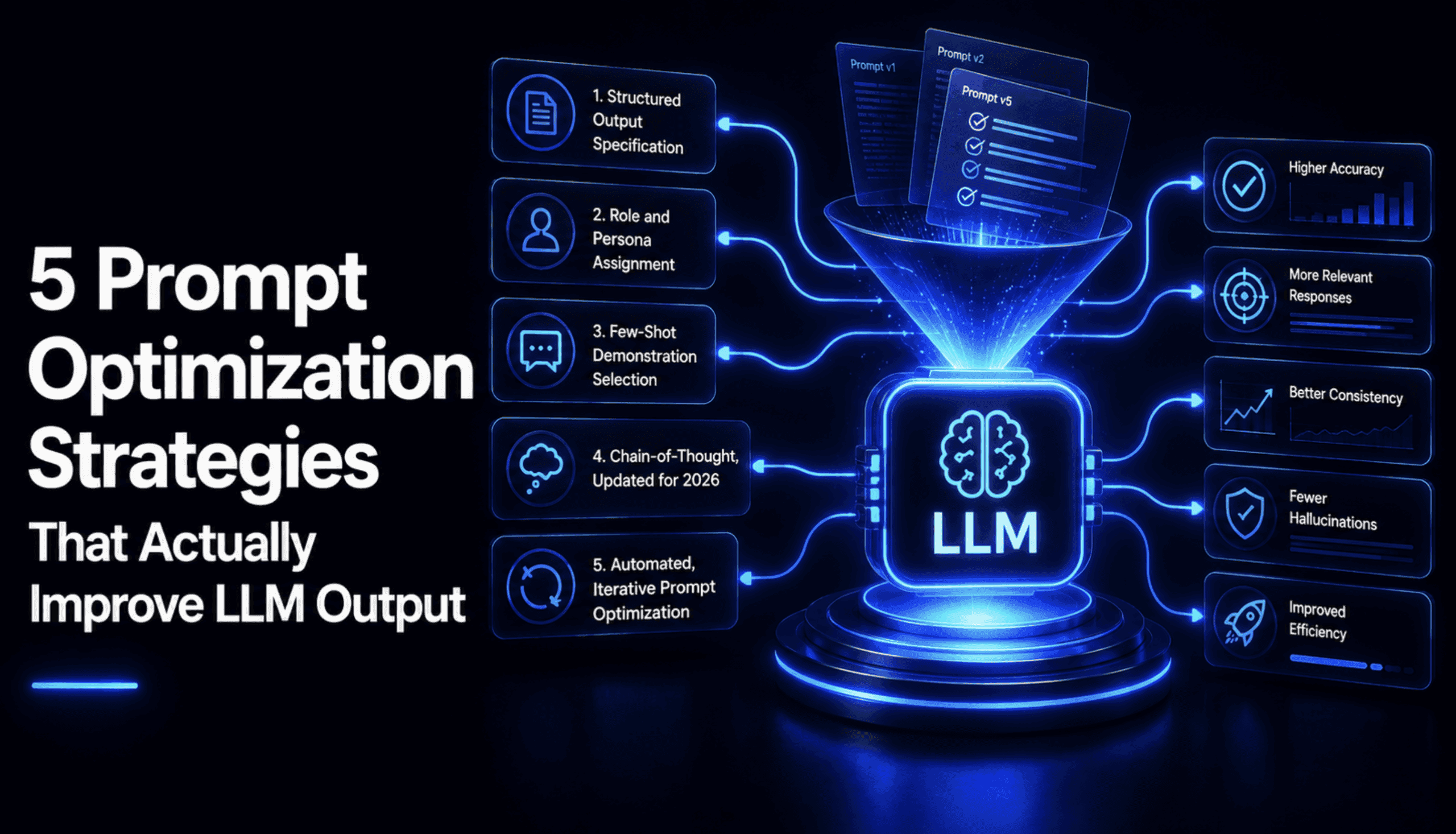
Mastering LLM Output: 5 Prompt Optimization Strategies That Work
Large Language Models (LLMs) have taken the tech world by storm, offering incredible capabilities from generating creative content to automating complex tasks. However, if you've ever tried using an LLM, you know that the quality of its output can vary wildly. The secret to consistently getting great results isn't just about using the latest, most powerful model; it's about how you talk to it. This is where prompt optimization and prompt engineering come into play.
In this deep dive, we'll explore five effective strategies to optimize your prompts, ensuring your LLMs deliver higher quality, more accurate, and more useful outputs. Whether you're an AI practitioner building applications or a freelancer leveraging AI tools, understanding these techniques will unlock the full potential of LLMs.
What Exactly Are Prompt Engineering and Prompt Optimization?
Before we dive into specific strategies, let's clarify two closely related but distinct terms: prompt engineering and prompt optimization.
Prompt Engineering: The Art of Crafting Instructions
Prompt engineering is the practice of carefully crafting instructions, or "prompts," to guide an AI language model toward producing desired outputs. It's both an art and a science, involving iterative efforts to improve how different formats, phrases, and contextual elements perform. Think of it as providing a roadmap for the AI, steering it toward the specific output you have in mind. This discipline gained prominence with the release of large models like GPT-3 around 2020-2021, as researchers began systematically exploring how different input formulations affected model outputs.
Prompt Optimization: Refining for Peak Performance
Prompt optimization builds on prompt engineering. It's the process of improving the structure, content, and clarity of an existing or original prompt to enhance the model response generated by an LLM. While prompt engineering might involve designing a prompt from scratch using techniques like few-shot or chain-of-thought, prompt optimization focuses on refining and tuning that prompt to improve performance across multiple runs or datasets. It involves iterative testing, output evaluation, and continuous improvement, often with an eye on efficiency and cost-effectiveness.
Why LLM Output Quality Matters
The quality of an LLM's output directly impacts its usefulness. An unoptimized prompt can lead to generic, inconsistent, irrelevant, or even inaccurate responses. For businesses and individuals relying on LLMs, this can translate to wasted time, increased operational costs (as LLM services often charge based on token usage), and unreliable applications. Improving output quality ensures that LLMs perform tasks more accurately, reliably, and efficiently, whether it's for data analysis, content creation, or customer service.
5 Prompt Optimization Strategies That Actually Improve LLM Output
1. Few-Shot Prompting: Learning by Example
Few-shot prompting is a technique where you provide an LLM with a small number of examples (typically 2-5) of a task within your prompt to guide its performance. This method leverages the model's ability to learn and generalize from limited data, making it especially useful when you don't have enough data to fine-tune an entire model.
How it Works:
Instead of just giving the LLM an instruction, you include one or more input-output pairs that demonstrate the desired behavior. The model then uses these examples to understand the pattern, tone, or format you're looking for, applying that learning to a new, unseen input.
Example: Sentiment Analysis
Let's say you want to classify the sentiment of customer reviews. A few-shot prompt might look like this:
Review: "The product arrived quickly and works perfectly!"
Sentiment: Positive

Review: "I had issues with the delivery and the item was damaged."
Sentiment: Negative

Review: "It's okay, nothing special, but it gets the job done."
Sentiment: Neutral

Review: "This software is incredibly intuitive and has boosted my productivity!"
Sentiment:
By providing the examples, you're showing the model exactly how to categorize sentiment. Research suggests that while you can include many examples, diminishing returns are often seen after 2-3 examples, and it's generally recommended not to go beyond eight.
When to Use It:
- For tasks requiring specific output formats or styles.
- When classifying text (e.g., sentiment, topic).
- For code generation or data extraction.
- When you need to guide the model on nuanced tasks with limited labeled data.
2. Chain-of-Thought (CoT) Prompting: Breaking Down Complexity
Chain-of-Thought (CoT) prompting is an advanced technique that enhances an LLM's reasoning capabilities by encouraging it to break down complex tasks into a series of simpler, more manageable steps. It essentially asks the model to "think step by step" before arriving at a final answer, mimicking human cognitive processes.
How it Works:
With CoT prompting, you instruct the LLM to explain its thought process or provide intermediate reasoning steps. This can be done by including examples of step-by-step reasoning (few-shot CoT) or simply by adding phrases like "Let's think step by step" to your prompt (zero-shot CoT).
Example: Math Problem Solving
Consider a word problem:
Standard Prompt: "If a baker makes 20 cookies and sells 12, then bakes another 10, how many cookies does the baker have now?"
LLM Output (without CoT): "18 cookies." (Potentially incorrect or lacks explanation)

Chain-of-Thought Prompt: "If a baker makes 20 cookies and sells 12, then bakes another 10, how many cookies does the baker have now? Let's think step by step."
LLM Output (with CoT):
"Step 1: The baker starts with 20 cookies.
Step 2: The baker sells 12 cookies: 20 - 12 = 8 cookies.
Step 3: The baker bakes another 10 cookies: 8 + 10 = 18 cookies.
Final Answer: The baker has 18 cookies now."
This step-by-step breakdown makes the reasoning transparent and often leads to more accurate results, especially for tasks requiring logical deduction.
When to Use It:
- For complex questions with multiple parts or requiring multi-step logical reasoning.
- In mathematical problems or symbolic reasoning tasks.
- For debugging code or complex data analysis scenarios.
- When you need greater control and insight into how the LLM arrives at its responses.
3. Structured Outputs: Ensuring Predictable Formats
Structured outputs refer to the ability of LLMs to generate responses in specific, predefined formats rather than just free-form text. This is crucial for integrating LLM outputs into applications, databases, or other systems that expect data in a predictable structure, such as JSON, XML, or markdown tables.
How it Works:
You explicitly instruct the LLM to return its response in a particular format. Many modern LLM APIs, like OpenAI's, now offer native support for structured outputs, allowing developers to supply a JSON Schema, Pydantic, or Zod object to constrain model responses. This capability, often referred to as "function calling" or "tool calling," ensures the model's output exactly matches the provided schema.
Example: Extracting Contact Information
Suppose you want to extract contact details from a block of text into a JSON object:
Prompt: "Extract the name, email, and phone number from the following text and return it as a JSON object.
Text: 'Please contact John Doe at john.doe@example.com or call him at 555-123-4567 for further details.'"
Desired JSON Schema:
{
"type": "object",
"properties": {
"name": { "type": "string" },
"email": { "type": "string", "format": "email" },
"phone_number": { "type": "string" }
},
"required": ["name", "email", "phone_number"]
}
LLM Output:
{
"name": "John Doe",
"email": "john.doe@example.com",
"phone_number": "555-123-4567"
}
Tools and libraries like LangChain also provide methods for achieving structured outputs, including .with_structured_output(), PydanticOutputParser, and StructuredOutputParser, which can work with various schema definitions.
When to Use It:
- For data extraction, parsing, and normalization.
- When integrating LLMs with APIs, databases, or other programmatic systems.
- For building agents that need to pass structured data between tasks.
- Whenever consistency and machine-readability of the output are critical.
4. Clear and Specific Instructions: The Foundation of Good Prompting
This might seem obvious, but many users underestimate the power of simply being clear and specific in their prompts. LLMs are powerful, but they are not mind-readers. Vague instructions often lead to vague or undesirable outputs.
How it Works:
Be explicit about:
- The Task: What do you want the LLM to do? (e.g., "Summarize," "Translate," "Generate ideas," "Extract information").
- The Role: Assign the LLM a persona if it helps (e.g., "Act as a marketing expert," "You are a helpful coding assistant").
- Constraints: What should the output NOT include? (e.g., "Do not mention pricing," "Avoid jargon").
- Format: Clearly state the desired output format (e.g., "List in bullet points," "Write a 500-word essay," "Respond in Markdown").
- Context: Provide all necessary background information.
- Target Audience: Who is the output for? (e.g., "Explain this to a 5-year-old," "Write for a technical audience").
Example: Summarizing an Article
Vague Prompt: "Summarize this article."
Better Prompt: "Summarize the following article for a busy executive. Focus on the key findings and business implications, keeping it under 200 words. Present the summary as a short paragraph followed by three bullet points for actionable insights.
[Article Text]"
The second prompt leaves little room for ambiguity and guides the LLM to produce a highly targeted and useful summary.
When to Use It:
- Always. Clear instructions are the bedrock of effective prompting for any task.
- Especially important for complex tasks where misinterpretation could lead to significant errors.
5. Iterative Refinement and Experimentation: The Scientific Approach
Prompt optimization is rarely a one-shot deal. It's an iterative process of trying, evaluating, and improving. Even with the best initial prompt, you'll often find opportunities for refinement.
How it Works:
- Start with a Baseline: Craft your initial prompt using clear instructions and relevant strategies.
- Test and Evaluate: Run the prompt and carefully examine the output. Does it meet your expectations? Is it accurate, relevant, and in the correct format? Identify specific areas where it falls short.
- Analyze Failures: Understand why the prompt failed. Was it too vague? Did it lack context? Did the model misunderstand a key instruction?
- Refine: Based on your analysis, make specific adjustments to the prompt. This could involve adding more examples, clarifying instructions, changing the output format, or breaking down the task further.
- Repeat: Continue this cycle of testing, evaluating, and refining until the output consistently meets your quality standards.
Some advanced prompt optimization techniques even involve using one LLM to critique and suggest improvements for prompts used by another LLM (known as metaprompting or LLM-driven refinement), creating an automated feedback loop.
When to Use It:
- For any task where output quality and consistency are critical.
- When you're developing an LLM-powered application and need robust, reliable performance.
- When dealing with new or complex problem domains where initial prompts might not be perfect.
Impact on AI Practitioners and Freelancers
For AI practitioners, mastering these prompt optimization strategies means building more robust, efficient, and reliable AI applications. It reduces the need for extensive fine-tuning in many cases, making LLMs more accessible and adaptable. For freelancers, these techniques are game-changers. Whether you're a writer generating content, a marketer crafting campaigns, a developer integrating AI into tools, or a data analyst extracting insights, effective prompting allows you to:
- Boost Productivity: Get high-quality outputs faster, reducing manual editing and rework.
- Enhance Quality: Deliver superior results to clients, strengthening your reputation.
- Expand Capabilities: Tackle more complex and nuanced tasks with confidence.
- Reduce Costs: Optimize token usage by getting it right the first time, saving on API expenses.
Conclusion
The journey to unlocking the full potential of Large Language Models lies in the art and science of prompt optimization. By strategically applying techniques like few-shot prompting, chain-of-thought, and structured outputs, combined with clear instructions and iterative refinement, you can dramatically improve the quality and reliability of LLM-generated content. These strategies empower users, from seasoned AI developers to creative freelancers, to transform LLMs from powerful but unpredictable tools into indispensable, high-performing assistants.
Frequently Asked Questions
What is the main difference between prompt engineering and prompt optimization?
Prompt engineering involves the initial design and creation of prompts to guide an LLM, often from scratch. Prompt optimization, on the other hand, focuses on refining and improving existing prompts through iterative testing and analysis to enhance their performance and output quality.
Can I use these prompt optimization strategies with any LLM?
Generally, yes. While the effectiveness might vary slightly between different LLM architectures and sizes, the core principles of few-shot, chain-of-thought, structured outputs, and clear instructions are widely applicable across most modern LLMs, including those from OpenAI, Google, Anthropic, and others. Specific implementations for structured outputs might leverage native API features (like OpenAI's function calling) or external libraries (like LangChain).
How many examples should I include for few-shot prompting?
For few-shot prompting, providing 2 to 5 examples is typically a good range. While more examples might seem better, research indicates that there are often diminishing returns after a few, and including too many can increase token usage without significantly improving output quality.
Is Chain-of-Thought prompting only useful for math problems?
No, Chain-of-Thought prompting is highly effective for any task requiring multi-step reasoning or logical deduction, not just math problems. This includes complex problem-solving, code generation, strategic planning, and detailed analysis where breaking down the task into intermediate steps helps the LLM process information more accurately.