Key Takeaways
- SerpApi's new Markdown output for search results dramatically cuts token usage for AI agents, reducing costs and fitting more data into context windows.
- This feature transforms verbose JSON into clean, LLM-friendly Markdown, achieving an average token reduction of 50%, and up to 90% for complex search queries.
- It's available across all 100+ SerpApi APIs at no extra cost, offering developers a simple way to optimize AI workflows.
- By shrinking the data footprint, AI practitioners can build more sophisticated agents, handle longer conversations, and improve the overall efficiency and affordability of their AI applications.
In the fast-evolving world of artificial intelligence, efficiency is a game-changer. As AI agents become more sophisticated and rely heavily on real-time data, the cost and performance implications of processing vast amounts of information become critical. One of the biggest hurdles for developers building these agents is managing "tokens" – the fundamental units of text that AI models consume. Every token costs money and occupies precious space within an AI's "context window." When you're feeding an AI agent search results, the raw data can be surprisingly bulky, leading to higher costs and limited contextual understanding.
This is where SerpApi steps in with a clever solution: a new Markdown output feature designed to significantly reduce the token footprint of search results. Imagine cutting down the data an AI needs to process by half, or even more, without losing essential information. That's the promise SerpApi offers, making AI agents smarter, faster, and more affordable.
Understanding the AI Agent's Dilemma: Context Windows and Token Costs
Before diving into how SerpApi's innovation works, let's clarify the core concepts that make this feature so important for AI practitioners.
The "Context Window" Problem
Think of an AI model's "context window" as its short-term memory or workspace. It's the maximum amount of information—measured in tokens—that the model can consider at any one time when generating a response to your prompt. This includes your input, any system prompts, conversation history, and even the model's own generated output. A larger context window allows AI models to process longer inputs, summarize extensive information, and provide more accurate, complex, and nuanced responses.
However, context windows have limits. If you exceed this limit, the model starts "forgetting" earlier parts of the conversation or truncates its input, which can lead to degraded performance and less coherent responses. This is particularly challenging for AI agents that need to perform multi-step tasks or synthesize information from multiple sources, like search results.
The "Token Cost" Burden
Beyond memory, tokens directly impact cost. Large Language Models (LLMs) are typically priced based on the number of tokens processed, both for input and output. For example, leading models like Google's Gemini 2.5 Pro or OpenAI's GPT-5.6 Terra have specific rates per million tokens for input and output. While individual token costs have decreased over time, the overall consumption by sophisticated AI agents is increasing, making cost optimization a continuous challenge.
Every token in the context window costs money and adds processing time. The computational cost of an AI model's attention mechanism grows quadratically with the length of the input, meaning longer contexts not only cost more but also take significantly longer to process. For developers building AI-powered applications, reducing token usage directly translates to lower operational costs and potentially faster response times.
The Role of Search Results in AI Agents
Many AI agents need access to real-time, up-to-date information to perform tasks like answering questions, conducting research, or generating content. This often involves integrating with search engine APIs to get current search results. When an AI agent requests search results from an API, it typically receives them in a structured format, most commonly JSON (JavaScript Object Notation).
While JSON is excellent for programmatic parsing by software, it can be quite verbose for an AI model. It includes many characters that are necessary for machine readability (like curly braces, square brackets, commas, and quotation marks) but don't add semantic value for an LLM trying to understand the core information. This "noise" inflates the token count, consuming valuable context window space and increasing costs.
Introducing SerpApi and Its Markdown Innovation
SerpApi, founded by CEO Julien Khaleghy, is a leading platform that provides real-time, structured search data from over 100 search engines, including Google, Bing, and Amazon. It handles the complexities of web scraping, such as proxies, CAPTCHA solving, and parsing, to deliver clean, structured data.
Recognizing the growing needs of AI agents, SerpApi launched its new Markdown output feature in August 2026. This innovation is specifically designed to deliver real-time search results in a format optimized for LLMs and AI agents. Instead of the traditional JSON, developers can now receive search data as clean, LLM-friendly Markdown.
What's Inside a Search Result, Field by Field, in Markdown?
The core idea behind SerpApi's Markdown output is intelligent summarization and re-formatting. When you request search results, SerpApi meticulously breaks down the raw data (like organic results, local results, shopping results, etc.) into individual fields such as titles, links, snippets, and sources.
In a standard JSON output, each of these fields comes with its own keys, quotation marks, commas, and structural elements (like nested objects and arrays) that add to the token count. For example, a single organic search result might look something like this in JSON:
{
  "position": 1,
  "title": "Coffee - Wikipedia",
  "link": "https://en.wikipedia.org/wiki/Coffee",
  "displayed_link": "en.wikipedia.org › wiki › Coffee",
  "snippet": "Coffee is a beverage brewed from...",
  "source": "Wikipedia"
}
In contrast, SerpApi's Markdown output intelligently streamlines this. It removes all the superfluous JSON syntax while retaining all the essential information. For instance, instead of separate "title" and "link" fields, it renders them as a native Markdown link: [Coffee - Wikipedia](https://en.wikipedia.org/wiki/Coffee). Result arrays, such as a list of organic results, are presented as clean Markdown tables, which are highly readable and structured for LLMs.
Crucially, the Markdown output also strips away "noise" – unnecessary metadata, tracking fields, and duplicated values that LLMs don't typically need for comprehension but still count as tokens. This targeted reduction ensures that the AI receives only the most relevant, semantically valuable information.
The Token-Saving Magic: How Markdown Makes a Difference
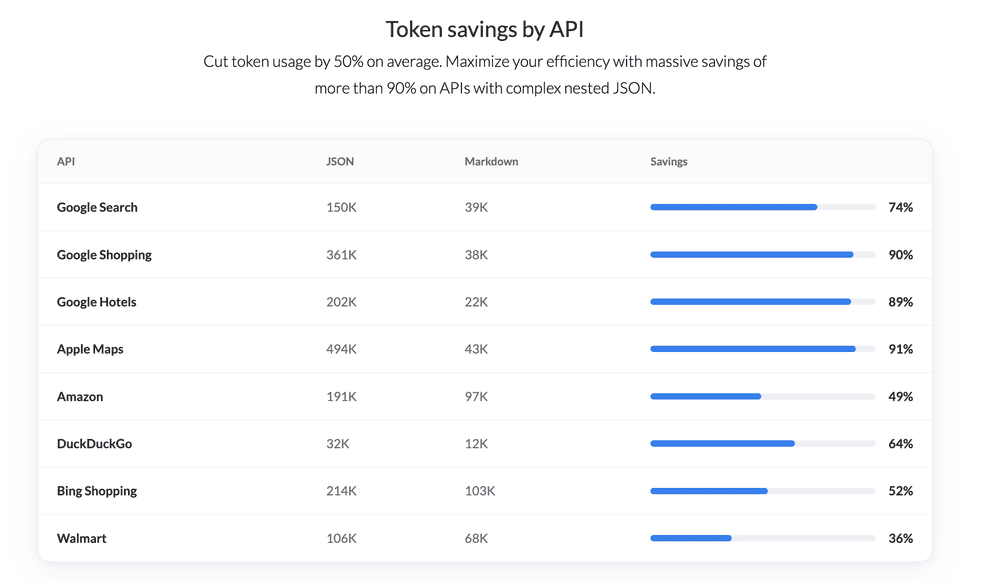
The impact of this transformation is significant. SerpApi's Markdown output reduces token consumption by roughly 50% on average compared to JSON. For some APIs and complex nested JSON structures (like those found in Google Shopping, Google Hotels, or Apple Maps results), the token reduction can be as high as 74% to 90%.
This isn't just about saving a few characters; it's about fundamentally changing how efficiently AI agents can interact with search data. By delivering the same data in a much more compact form, SerpApi helps developers:
- Reduce Costs: Fewer tokens processed mean lower API costs for LLM providers. Since token consumption is a primary driver of AI agent expenses, this directly impacts the bottom line.
- Expand Context Windows: With search results taking up significantly less space, AI models can fit more information into their context windows. This means they can process more search results, maintain longer conversation histories, or incorporate more internal reasoning steps, leading to a deeper understanding and more comprehensive responses.
- Improve Speed: Fewer tokens to process can also contribute to faster inference times, leading to quicker responses from AI agents.
- Enhance Readability for LLMs: Markdown has emerged as a dominant language for AI models because of its clean, human-readable structure. This makes it easier for LLMs to parse and understand the information, potentially leading to better quality outputs.
Real-World Implications for AI Practitioners
For anyone building or leveraging AI agents, SerpApi's Markdown output opens up new possibilities:
- More Sophisticated AI Agents: Developers can build agents that perform more complex research tasks, synthesize information from a wider array of search results, or engage in longer, more nuanced dialogues without hitting context limits.
- Cost-Efficient Development: Freelancers and small businesses can develop and deploy AI solutions more affordably, making advanced AI capabilities accessible to a broader audience. This is especially relevant given the per-token pricing models of most LLMs.
- Better Decision-Making: Agents can be "grounded" with more real-time, relevant information, reducing the likelihood of hallucinations and improving the accuracy and reliability of their outputs.
- Streamlined Workflows: The ability to easily switch between JSON (for programmatic use cases) and Markdown (for LLM consumption) on a request-by-request basis provides great flexibility.
Getting Started with SerpApi's Markdown Output
One of the most appealing aspects of this feature is its ease of adoption. SerpApi's Markdown output is available across all 100+ of its APIs, at no additional cost. You don't need a new endpoint or complex configuration.
If you're already using SerpApi, you can implement Markdown output immediately in one of three ways:
- Query Parameter: Add
&output=mdto your existing API request URL. - Route Extension: Change your API endpoint from
/searchto/search.md. - Accept Header: Include
Accept: text/markdownin your request headers.
This seamless integration means developers can quickly experiment with and deploy the token-efficient format into their existing AI agent pipelines. SerpApi offers a free tier of 250 searches per month for testing, with paid plans starting at $25 per month for 1,000 searches.
Conclusion
The innovation from SerpApi, transforming verbose JSON search results into lean, LLM-optimized Markdown, is a significant step forward for AI practitioners. By addressing the critical challenges of token consumption and context window limitations, it empowers developers to build more capable, cost-effective, and efficient AI agents. As AI systems continue to integrate real-time web data, solutions like SerpApi's Markdown output will be foundational to unlocking the next generation of intelligent applications.
Frequently Asked Questions
What is a token in the context of AI models?
In AI, a token is the basic unit of text that a language model processes. It's not always a full word; it can be a part of a word, a single character, or a punctuation mark. Roughly, one English token is about four characters or 0.75 words.
Why is reducing token usage important for AI agents?
Reducing token usage is crucial for AI agents because it directly impacts two key areas: cost and context window capacity. AI models charge based on tokens processed, so fewer tokens mean lower operational costs. Additionally, by reducing the amount of data a search result occupies, more information can fit into the AI's limited context window, allowing for more complex tasks and better understanding.
How much can SerpApi's Markdown output reduce token usage?
SerpApi's Markdown output can reduce token consumption by approximately 50% on average compared to traditional JSON output. For certain APIs with highly complex and nested JSON structures, the reduction can be even more substantial, reaching up to 90%.
Is SerpApi's Markdown output feature available to all users?
Yes, SerpApi's Markdown output is available across all 100+ of its search APIs and is included at no additional cost for all plans, including the free tier.