Key Takeaways
- Agentic AI systems go beyond simple responses, acting autonomously to achieve goals with minimal human oversight.
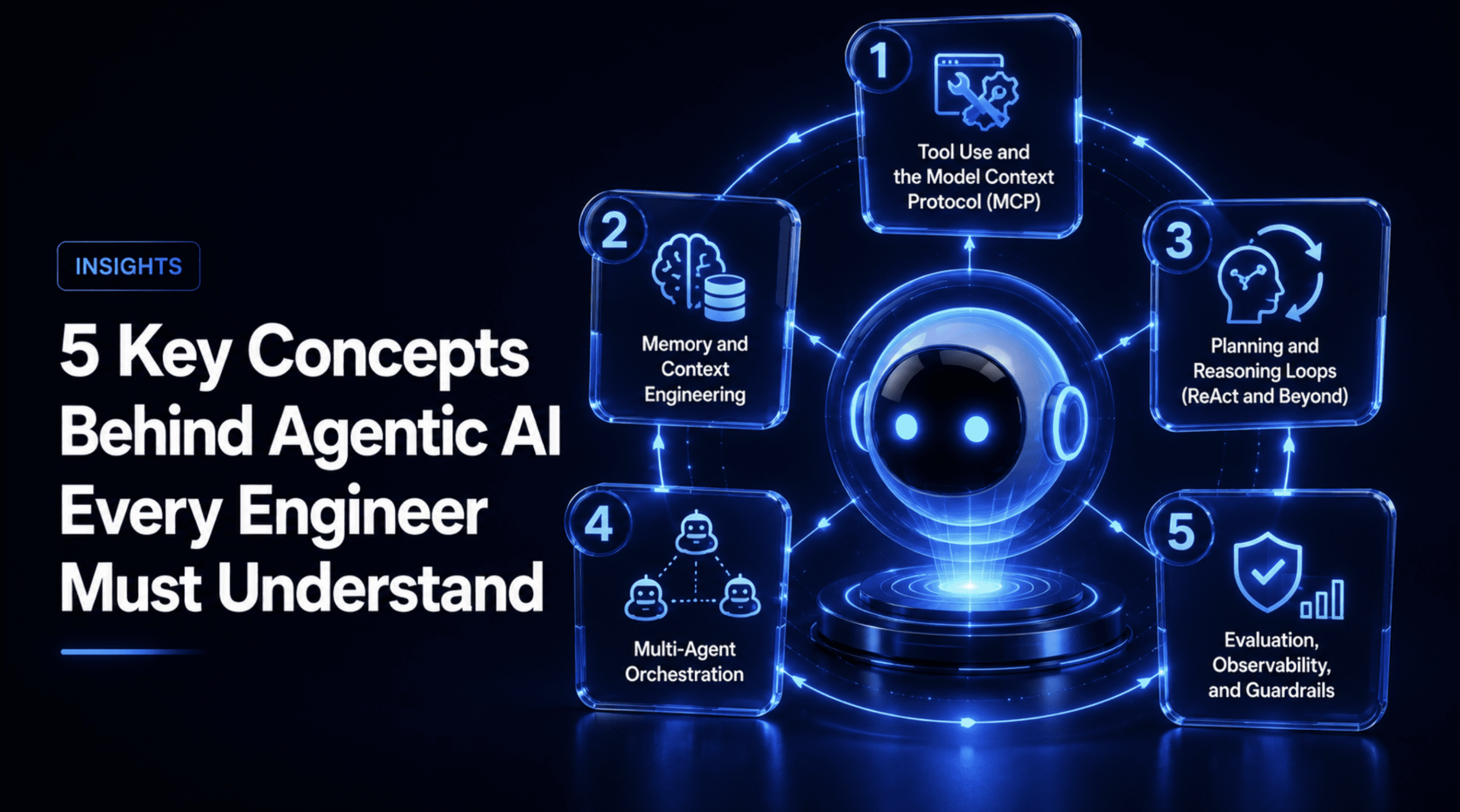
- Key concepts for engineers include Autonomy & Goal Management, Perception, Planning & Reasoning, Memory & Learning, and Tool Use.
- Frameworks like LangChain and projects like AutoGPT demonstrate these concepts in practice, enabling complex, multi-step AI workflows.
- Understanding these foundational ideas is crucial for building robust, adaptive, and effective AI agents.
Artificial Intelligence is constantly evolving, and one of the most exciting developments is the rise of Agentic AI. Unlike traditional AI models that simply respond to prompts, agentic systems can act independently, make decisions, and work towards complex goals with limited human intervention. This shift from reactive tools to proactive, autonomous entities opens up vast possibilities for automation and intelligent problem-solving across industries.
For any engineer looking to build the next generation of AI applications, understanding the core concepts behind these agentic systems is not just helpful—it’s essential. It’s about grasping the underlying "ideas that actually hold agentic systems together" to move beyond basic chatbots and create truly capable AI agents.
This deep dive will explain the five foundational concepts every engineer must understand to effectively work with Agentic AI.
What Exactly is Agentic AI?
Before we jump into the core concepts, let's clarify what Agentic AI means. At its heart, Agentic AI refers to systems designed to achieve specific goals autonomously. Think of it as an AI that doesn't just answer a question, but actively takes steps to solve a problem. These systems use AI agents, which are machine learning models that mimic human decision-making to tackle problems in real-time.
The key differentiator from generative AI, like a standard chatbot, is the capacity for independent action and goal-driven behavior. While a generative AI might create content, an agentic AI can use that content, plan further actions, and execute them to complete a complex task. For example, a generative AI might write a marketing email, but an agentic AI could then deploy that email, track its performance, and adjust the marketing strategy based on the results.
Agentic AI systems exhibit autonomy, goal-driven behavior, and adaptability, making them capable of handling multi-step problem-solving tasks and tracking progress over time.
5 Key Concepts Behind Agentic AI
1. Autonomy & Goal Management
Autonomy is arguably the most defining characteristic of Agentic AI. It's the ability for an AI system to operate independently, without needing constant human oversight or step-by-step instructions. Once given a high-level objective, an autonomous agent decides its course of action and carries it out, rather than waiting for a human to specify each step.
Coupled with autonomy is robust goal management. An agentic system doesn't just react; it has a clear objective and works strategically to achieve it. This involves breaking down complex goals into smaller, manageable sub-tasks. For instance, if an agent's goal is "research the best vegan restaurants in San Francisco and create a detailed itinerary," it will autonomously identify relevant search terms, formulate queries, gather information, and then structure it into an itinerary.
Why it matters for engineers: Engineers must design agents that can interpret ambiguous goals, decompose them effectively, and maintain focus on the overarching objective even as circumstances change. This requires careful consideration of how goals are defined, prioritized, and how the agent tracks its progress and makes decisions when faced with multiple paths.
How it works at a high level: Large Language Models (LLMs) often serve as the "brain" for these agents, interpreting the main goal and using their reasoning capabilities to break it down into a sequence of actionable steps. Frameworks like AutoGPT, developed by Toran Bruce Richards and released in March 2023, are prime examples, allowing users to define a high-level goal which the system then autonomously breaks into sub-tasks and executes.
2. Perception & Environmental Interaction
For an AI agent to act intelligently, it first needs to understand its surroundings. Perception refers to an AI agent's ability to gather, interpret, and process data from its environment to make informed decisions. This is akin to human senses, but for an AI, it involves collecting input from various sources like sensors, databases, APIs, user interfaces, or even the internet.
Once data is collected, the agent must interpret it to understand the current state, recognize patterns, identify objects, and grasp the context of its operation. For example, an agent in a robotic system might use cameras and sensors to collect visual and environmental data, then process that information to decide its next physical action.
Why it matters for engineers: Building robust perception capabilities is crucial. Engineers need to integrate various data sources, design effective data processing pipelines, and ensure the agent can make sense of diverse, often unstructured, information. This also means understanding how to filter noise and focus on relevant data to avoid overwhelming the agent.
How it works at a high level: Perception systems often rely on specialized AI models for tasks like computer vision (for images/video), natural language processing (for text/speech), and sensor fusion (combining data from multiple sensors). The processed information is then fed into the agent's reasoning core to inform its decision-making.
3. Planning & Reasoning Engine
Once an agent perceives its environment and has a goal, it needs to figure out how to bridge the gap between the two. This is where the planning and reasoning engine comes in—it's the cognitive core that enables an AI agent to decide what to do, how to do it, and when to do it. Unlike traditional models that give a single, immediate answer, agentic systems use iterative logic, strategic planning, and self-correction to achieve high-level goals.
Planning involves generating a sequence of actions that are likely to achieve a goal, often by breaking down complex tasks into smaller, manageable steps (task decomposition). Reasoning, on the other hand, involves analyzing information, drawing conclusions, and evaluating and revising those actions as new information comes in.
A widely adopted pattern in modern agentic AI is the "Reason + Act" (ReAct) framework. Here, the agent alternates between reasoning steps (thinking about what to do) and action execution (performing a task or calling a tool). It observes the results of its actions, updates its reasoning, and repeats the cycle until the goal is met.
Why it matters for engineers: Engineers build the control logic that drives this planning and reasoning. This involves designing the prompts and internal thought processes that guide the LLM, implementing mechanisms for task decomposition, error handling, and self-correction. The robustness of this engine directly impacts the agent's ability to handle complex, dynamic, and uncertain real-world scenarios.
How it works at a high level: LLMs are crucial here, acting as the control logic engine. They interpret instructions, evaluate context, select tools, and determine the sequence of actions. Techniques like Chain-of-Thought (CoT) prompting, where the AI "shows its work" by detailing logical steps, are often used to improve reasoning accuracy.
4. Memory & Learning
Imagine an AI assistant that forgets everything you told it five minutes ago. Frustrating, right? Memory is what allows an AI agent to retain and recall relevant information across time, tasks, and multiple interactions. This is a critical capability that transforms an AI from a stateless tool into a stateful, adaptive system.
Memory in AI agents goes beyond just a chat history. It involves storing past experiences to improve decision-making and overall performance, enabling agents to retain context, recognize patterns, and adapt based on past interactions. This can include short-term memory (for the current session's context) and long-term memory (for persistent knowledge across sessions, often implemented with vector databases).
Learning, an extension of memory, allows agents to adapt and improve over time. By storing and analyzing past data and outcomes, an agent can refine its strategies and become more efficient. This is essential for goal-oriented applications that require continuous learning and feedback loops.
Why it matters for engineers: Designing an effective memory system is key to building intelligent, personalized, and robust agents. Engineers must consider how information is stored, retrieved efficiently, and how the agent learns from its experiences without incurring excessive costs or slowing down response times. This often involves integrating vector databases and sophisticated retrieval mechanisms.
How it works at a high level: LLMs are inherently stateless, meaning they don't remember previous interactions on their own. Therefore, external memory components are added. Short-term memory might involve passing conversation history within the LLM's context window. Long-term memory often uses vector databases to store embeddings of past interactions or knowledge, which can be retrieved as needed.
5. Tool Use & Action Execution
An AI agent that can only "think" but not "act" is severely limited. Tool use refers to an AI agent's ability to call defined external functions or services at runtime to retrieve information or execute actions. These "tools" can be anything from simple API queries, database operations, web scraping, code execution, or even interacting with other AI agents.
Tool use is what truly differentiates agentic AI from a basic chatbot. A chatbot responds; an agent with tool use acts. It allows the agent to connect to the present, access real-time data, and interact with the real world beyond its training data. For example, an agent can use a weather tool to give you current conditions, or a database tool to check an order status.
Why it matters for engineers: Engineers are responsible for defining these tools, exposing them to the agent, and ensuring secure and efficient interaction. This involves creating clear tool descriptions, unambiguous parameter names, and robust schemas so the LLM knows what the tool does, when to use it, and what inputs to pass. Proper guardrails and error handling are also crucial, as tools can trigger real-world actions.
How it works at a high level: The LLM, as part of its reasoning process, decides which tool to invoke based on the task and current context. This is often implemented through "function calling," where the LLM generates a structured call to an external function. The tool executes, and its output is fed back into the agent's perception/reasoning loop, allowing it to decide the next step.
Putting it All Together: The Agent Loop
These five concepts don't operate in isolation; they are deeply intertwined within what's often called the "agent loop" or "Reason-Act-Observe" loop. An agent continuously:
- Perceives its environment (gathering information).
- Reasons and Plans (deciding what to do next to achieve its goal).
- Acts (executing an action, often using a tool).
- Observes the outcome of its action (which feeds back into perception).
- Learns and updates its Memory based on these observations, refining its future plans and actions.
This continuous cycle allows agentic AI systems to adapt, self-correct, and make progress towards complex objectives autonomously. Frameworks like LangChain, an open-source framework, provide pre-built agent architectures and integrations for models, tools, and databases, making it easier for engineers to implement these agentic patterns.
The Future is Agentic
Understanding these five core concepts—Autonomy & Goal Management, Perception & Environmental Interaction, Planning & Reasoning, Memory & Learning, and Tool Use & Action Execution—is fundamental for any engineer working with Agentic AI. These are the building blocks that enable AI systems to move beyond simple automation and into truly intelligent, adaptive, and autonomous problem-solving. As AI continues to advance, the ability to design and implement robust agentic systems will be a critical skill, shaping the next wave of technological innovation.
Frequently Asked Questions
What is the main difference between Agentic AI and Generative AI?
Generative AI primarily focuses on creating new content, like text or images, based on prompts. Agentic AI, while often using generative AI (especially LLMs) as its "brain," goes a step further by autonomously planning, reasoning, and executing a series of actions to achieve a specific goal with minimal human intervention.
Are there any popular frameworks for building Agentic AI?
Yes, several frameworks help engineers build agentic AI systems. LangChain is a popular open-source framework that provides tools and integrations for building agents, memory, and connecting to various tools. Projects like AutoGPT, released in March 2023 by Toran Bruce Richards, also showcase autonomous AI agent capabilities.
Why is "Tool Use" so important for AI agents?
Tool use is critical because it allows AI agents to interact with the real world beyond their internal knowledge. Without tools, an agent is limited to its training data, which is a snapshot of the past. By using tools like APIs, databases, or web scrapers, agents can access real-time information, perform actions in external systems, and extend their capabilities to solve practical problems.
How do AI agents "remember" things?
Since Large Language Models (LLMs) are inherently stateless, memory for AI agents is typically implemented through external components. Short-term memory might involve passing conversation history within the LLM's context window, while long-term memory often utilizes vector databases to store embeddings of past interactions or knowledge, which can be retrieved as needed to provide context and enable learning.