Key Takeaways
- Training large language models (LLMs) on consumer GPUs is possible by using smart engineering techniques to manage memory and computation.
- Key methods include quantization (like QLoRA), parameter-efficient fine-tuning (PEFT such as LoRA), gradient accumulation, and memory-optimized attention (FlashAttention).
- These techniques significantly reduce GPU memory usage and training time, making advanced AI accessible to more developers and researchers.
- Frameworks like Hugging Face Accelerate and bitsandbytes integrate many of these approaches, simplifying their adoption for practitioners.
Large Language Models (LLMs) have taken the world by storm, showing incredible capabilities in understanding and generating human-like text. But if you've ever tried to train or fine-tune one of these giants, you know the biggest hurdle: hardware. Specifically, the massive amount of GPU memory and computational power they demand. This often puts LLM development out of reach for many, especially those relying on consumer-grade GPUs like an NVIDIA RTX 3090 or 4090, which typically have 24GB of VRAM.
The good news? You don't always need a server farm or a budget for enterprise-grade A100s or H100s. Smart engineering techniques can drastically reduce the memory footprint and computational requirements, allowing you to train or fine-tune powerful LLMs even on limited hardware. This article dives into seven proven approaches that make this possible.
Why Is LLM Training So Demanding?
Before we explore the solutions, it helps to understand the core problem. LLMs are "large" for a reason – they have billions of parameters. Each parameter needs to be stored in GPU memory. During training, you also need space for:
- Model Weights: The actual parameters of the model.
- Gradients: Values calculated during backpropagation to update the weights. These are typically the same size as the weights.
- Optimizer States: For optimizers like AdamW, these can be 2-4 times the size of the model weights, depending on the precision.
- Activations: Intermediate outputs of each layer that are needed for backpropagation. These can be very large, especially for deep networks and long sequences.
- Batch Data: The input data (text sequences) currently being processed.
When you add up all these components, even a "small" LLM with 7 billion parameters can easily exceed 24GB of VRAM if trained naively in full precision (FP32). This is where memory-efficient techniques become essential.
7 Engineering Approaches for Efficient LLM Training
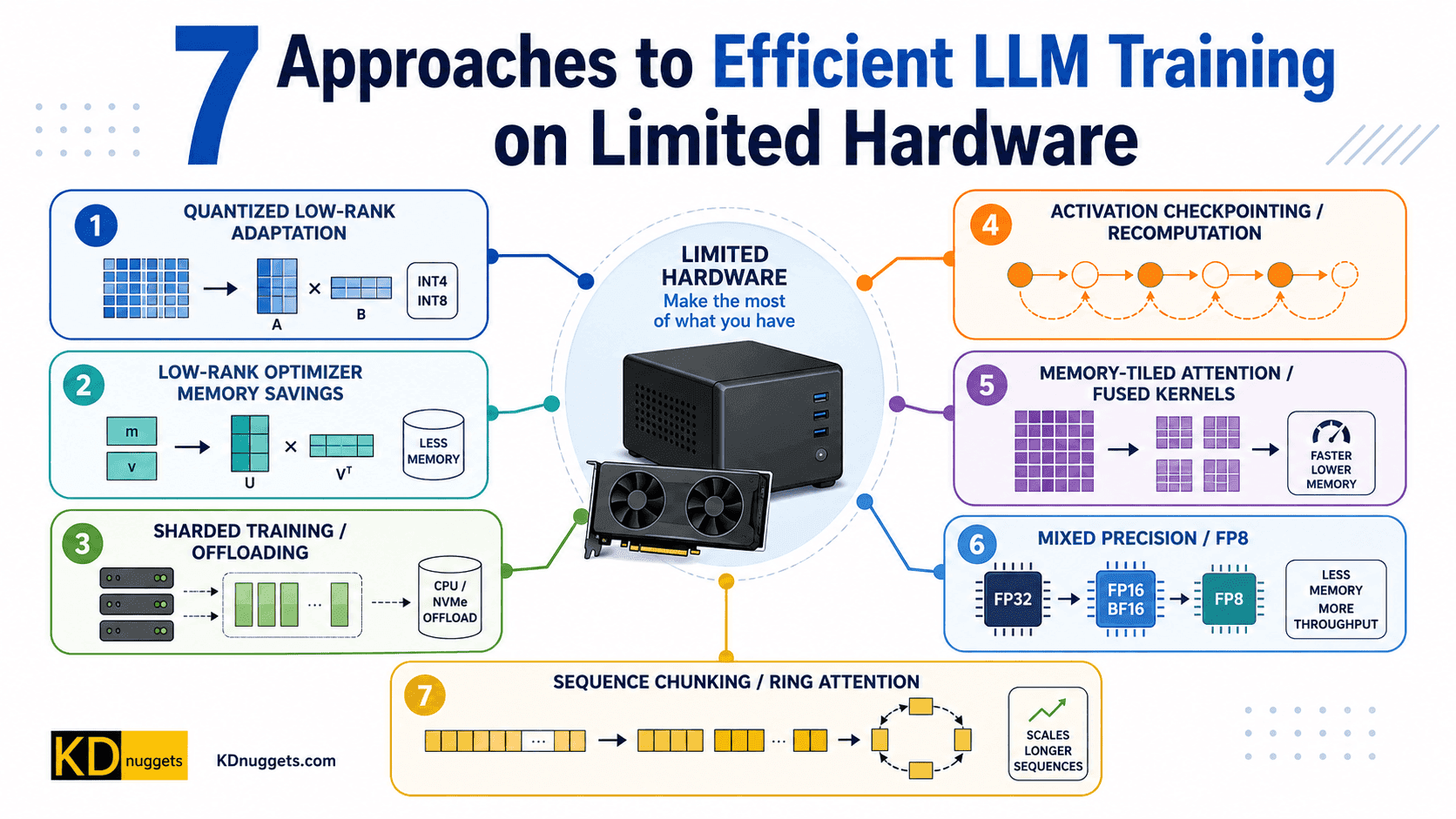
Here are seven powerful techniques that allow you to train LLMs on consumer GPUs without running out of memory, making advanced AI development more accessible.
1. Quantization: Shrinking the Model's Footprint
Quantization is about reducing the precision of the numbers used to represent a model's weights and activations. Instead of using 32-bit floating-point numbers (FP32), which take up a lot of memory, you can use 16-bit (FP16 or BF16), 8-bit (INT8), or even 4-bit (INT4) integers. This significantly cuts down the memory needed to store the model.
- How it works: The core idea is to map higher-precision numbers to lower-precision ones. For example, a range of FP32 values can be represented by a smaller set of INT8 values. During training, some parts might still use higher precision for critical calculations (like gradients) to maintain accuracy, while weights are stored in lower precision.
- Impact on limited hardware: A model stored in INT4 will take roughly 1/8th the memory of an FP32 model. This is a game-changer for fitting large models onto smaller GPUs.
- Real-world example: bitsandbytes, developed by Tim Dettmers, is a popular library that implements 8-bit and 4-bit quantization for PyTorch models. Its integration with Hugging Face Transformers allows you to load and fine-tune massive models like Llama 2 7B or even 13B on a single consumer GPU by loading them in 4-bit precision using QLoRA.
2. Parameter-Efficient Fine-Tuning (PEFT) with LoRA
Full fine-tuning of an LLM means updating every single parameter, which is memory-intensive. Parameter-Efficient Fine-Tuning (PEFT) methods only train a small subset of the model's parameters, drastically reducing memory and computational costs while often achieving comparable performance to full fine-tuning.
- How it works: LoRA (Low-Rank Adaptation of Large Language Models) is a prominent PEFT technique. Instead of training the entire pre-trained weight matrix, LoRA injects small, trainable low-rank decomposition matrices (A and B) into the existing pre-trained layers. During fine-tuning, the original pre-trained weights remain frozen, and only these much smaller A and B matrices are updated. The output of these adapter layers is then added to the original output.
- Impact on limited hardware: LoRA reduces the number of trainable parameters by orders of magnitude (e.g., from billions to millions or even thousands). This means less memory for gradients and optimizer states, making fine-tuning possible on GPUs with limited VRAM.
- Real-world example: The Hugging Face PEFT library provides easy-to-use implementations of LoRA, Prefix Tuning, Prompt Tuning, and other PEFT methods. Combining LoRA with 4-bit quantization (QLoRA) allows fine-tuning models like Llama 2 7B on a single 24GB GPU.
3. Gradient Accumulation: Simulating Larger Batch Sizes
Training LLMs often benefits from large batch sizes because they provide a more stable estimate of the gradient, leading to better convergence. However, large batch sizes consume significant GPU memory. Gradient accumulation offers a clever workaround.
- How it works: Instead of processing a full batch at once, you process several smaller "mini-batches" sequentially. After each mini-batch, you calculate the gradients but don't immediately update the model weights. Instead, you accumulate these gradients. Only after processing a specified number of mini-batches (the "accumulation steps") do you perform a single weight update using the aggregated gradients.
- Impact on limited hardware: This effectively simulates a larger batch size without requiring the entire batch's activations and data to be held in memory simultaneously. It trades off memory for computation time (more forward/backward passes) but is often a worthwhile trade-off on memory-constrained devices.
- Implementation: Most deep learning frameworks like PyTorch and TensorFlow support gradient accumulation directly. Hugging Face Accelerate also provides utilities for this.
4. Offloading and Paging: CPU as an Extended Memory
When GPU memory is exhausted, the CPU's much larger RAM can act as a temporary storage space. This technique, often called offloading or paging, involves moving less frequently used parts of the model or optimizer states to CPU memory and bringing them back to the GPU only when needed.
- How it works: This is typically managed by specialized libraries or frameworks. For example, some techniques might offload the optimizer states to CPU memory, only loading them to the GPU during the weight update step. Others might offload entire layers of a model that are not currently involved in the forward or backward pass.
- Impact on limited hardware: While slower due to PCIe bus transfer speeds between CPU and GPU, offloading can enable training models that would otherwise not fit into GPU memory at all.
- Real-world example: Libraries like DeepSpeed (especially its ZeRO (Zero Redundancy Optimizer) stages) and Hugging Face Accelerate provide features to automatically manage offloading model parameters and optimizer states to CPU or even disk.
5. FlashAttention: Memory-Efficient Attention
The self-attention mechanism, a core component of Transformers and LLMs, is computationally expensive and memory-intensive, especially for long input sequences. FlashAttention is a re-engineered attention algorithm that significantly reduces memory usage and speeds up computation.
- How it works: Developed by researchers at Stanford, FlashAttention reorders the attention computation, performing it in tiles and avoiding writing the large intermediate attention matrices to GPU High Bandwidth Memory (HBM). Instead, it leverages the faster, but smaller, SRAM (Static Random-Access Memory) on the GPU. This reduces the number of reads/writes to HBM, which is the bottleneck.
- Impact on limited hardware: By dramatically reducing the memory footprint of the attention mechanism, FlashAttention allows for much longer sequence lengths to be processed on the same GPU, or larger models to fit into memory. It also offers significant speedups.
- Availability: FlashAttention is integrated into popular libraries like PyTorch (as
torch.nn.functional.scaled_dot_product_attentionin recent versions) and is often used in frameworks like Hugging Face Transformers.
6. Gradient Checkpointing: Trading Compute for Memory
During the forward pass of a neural network, intermediate activations are computed and stored. These activations are needed during the backward pass to calculate gradients. For very deep networks like LLMs, storing all these activations can consume a lot of memory.
- How it works: Gradient checkpointing (also known as activation checkpointing) is a technique where you only store a subset of the activations during the forward pass. When the backward pass needs an activation that wasn't stored, it recomputes it on the fly.
- Impact on limited hardware: This technique significantly reduces the memory footprint for activations. The trade-off is increased computation time because some parts of the forward pass are re-executed during the backward pass. For memory-bound tasks, this is often a good compromise.
- Implementation: PyTorch provides
torch.utils.checkpoint.checkpoint, and frameworks like Hugging Face Transformers allow enabling gradient checkpointing with a simple configuration flag.
7. Mixed Precision Training: Balancing Speed and Memory
Mixed precision training involves using both 16-bit (FP16 or BF16) and 32-bit (FP32) floating-point types during training. This is distinct from quantization in that it's typically used for the training process itself rather than just storing the model in lower precision for inference or fine-tuning (though they can be combined).
- How it works: Model weights and activations are typically stored in FP16/BF16, which halves their memory usage compared to FP32. However, certain critical operations (like accumulating gradients or calculating loss) might still use FP32 to maintain numerical stability and prevent issues like vanishing gradients. A "loss scaler" is often used to prevent underflow of small gradients when operating in FP16.
- Impact on limited hardware: Halving the memory for weights and activations provides substantial memory savings. Additionally, modern GPUs (especially NVIDIA's Tensor Cores) can perform FP16/BF16 computations much faster than FP32, leading to significant training speedups.
- Implementation: PyTorch's Automatic Mixed Precision (AMP) utilities (
torch.cuda.amp) and frameworks like Hugging Face Accelerate make mixed precision training easy to enable.
Bringing It All Together: Frameworks and Tools
While understanding individual techniques is important, modern AI development rarely requires you to implement them from scratch. Libraries and frameworks have integrated these approaches, making them accessible with minimal code changes.
- Hugging Face Accelerate: This library provides a simple API to run PyTorch training scripts on any kind of distributed setup, including single-GPU with mixed precision, gradient accumulation, and CPU offloading. It acts as a wrapper around your training loop, handling the complexities of memory management and distribution.
- DeepSpeed: Microsoft's DeepSpeed offers a comprehensive suite of optimizations, including the ZeRO (Zero Redundancy Optimizer) family, which partitions model states (optimizer states, gradients, and parameters) across multiple GPUs or CPU memory. It also includes techniques like DeepSpeed-Ulysses for memory-efficient attention.
- bitsandbytes: As mentioned, this library is crucial for 8-bit and 4-bit quantization, especially when combined with LoRA for QLoRA.
What This Means for AI Practitioners
The advent of these memory-efficient training techniques has democratized LLM development. No longer are state-of-the-art models exclusive to large corporations with vast computational resources. Developers, researchers, and even hobbyists with consumer GPUs can now:
- Fine-tune larger models: Adapt powerful pre-trained LLMs to specific tasks or datasets that would have been impossible before due to memory constraints.
- Experiment faster: Iterate on ideas more quickly without waiting for access to expensive, high-end hardware.
- Reduce costs: Significantly lower the financial barrier to entry for advanced AI research and application development.
- Foster innovation: Enable a broader community to contribute to and push the boundaries of LLM capabilities.
These engineering solutions are not just incremental improvements; they are fundamental shifts that are making cutting-edge AI more open and accessible. By understanding and applying these techniques, you can unlock the full potential of LLMs on your existing hardware.
Frequently Asked Questions
What is the biggest challenge when training LLMs on consumer GPUs?
The biggest challenge is typically GPU memory (VRAM). LLMs have billions of parameters, and during training, not only the model weights but also gradients, optimizer states, and activations need to be stored in VRAM, which quickly exceeds the capacity of consumer GPUs (e.g., 24GB).
Can I fine-tune a 7 billion parameter LLM on a single 24GB GPU?
Yes, absolutely. By combining techniques like 4-bit quantization (e.g., QLoRA) and Parameter-Efficient Fine-Tuning (PEFT) such as LoRA, you can fine-tune 7 billion parameter models, and sometimes even larger ones, on a single GPU with 24GB of VRAM.
Do these memory-saving techniques impact model performance or training speed?
Sometimes there are trade-offs. Quantization can slightly reduce model accuracy if not carefully managed, though 4-bit and 8-bit methods are often very close to full precision. Techniques like gradient accumulation and gradient checkpointing trade increased training time for reduced memory usage. However, mixed precision training and FlashAttention can actually speed up training while reducing memory.
Which frameworks make it easiest to implement these techniques?
Hugging Face Accelerate and DeepSpeed are two of the most popular and comprehensive frameworks. Accelerate provides a user-friendly way to apply many of these optimizations to standard PyTorch training loops, while DeepSpeed offers advanced memory management and distribution strategies, especially useful for very large models or multi-GPU setups. The bitsandbytes library is also crucial for quantization.