Key Takeaways
- Fundamental machine learning algorithms are still vital for data scientists, offering explainability and efficiency where large language models (LLMs) might be overkill.
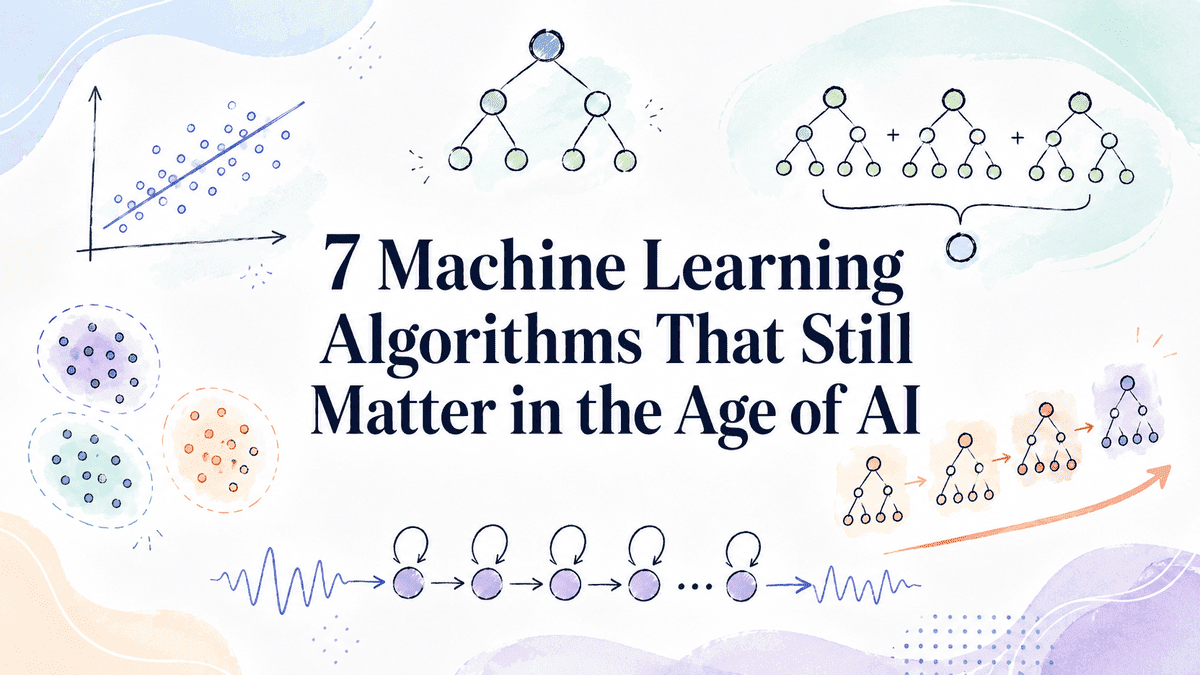
- Algorithms like Linear Regression, Logistic Regression, Decision Trees, SVM, KNN, K-Means, and Random Forest form the bedrock of predictive modeling and data analysis.
- These classic methods are powerful for various tasks, from predicting continuous values to classifying data and finding hidden patterns.
- Scikit-learn in Python provides robust and easy-to-use implementations for all these essential algorithms.
7 Machine Learning Algorithms That Still Matter Beyond LLMs
In today's fast-paced world of artificial intelligence, it's easy to get swept up in the excitement surrounding large language models (LLMs) and generative AI. These powerful tools are certainly impressive, pushing the boundaries of what machines can do with human-like text, images, and more. However, for any aspiring or experienced data scientist, focusing solely on the latest trends would be a mistake. The truth is, the foundational machine learning algorithms, the ones that have been around for decades, still hold immense value and are crucial for a solid understanding of the field. They often provide more interpretable, efficient, and appropriate solutions for many real-world problems.
This article dives into seven essential machine learning algorithms that every data scientist should master. We'll explore what they are, why they're important, how they generally work, and where you might use them, along with a nod to their practical implementation in Python using libraries like scikit-learn.
Why Fundamentals Still Rule
Before we jump into the algorithms themselves, let's quickly discuss why these "classic" methods remain so relevant:
- Interpretability: Many foundational algorithms are easier to understand. You can often trace how a decision is made or how a prediction is formed, which is critical in fields like healthcare, finance, or anywhere transparency is key.
- Efficiency: For many tasks, these algorithms are computationally less expensive and faster to train than complex deep learning models, especially with smaller datasets.
- Versatility: They form the building blocks for more advanced techniques and can solve a wide range of classification, regression, and clustering problems effectively.
- Baseline Performance: Often, a well-tuned classical algorithm can provide a strong baseline against which more complex models can be compared. If a sophisticated LLM doesn't significantly outperform a simpler model, the simpler model might be the better choice for practical deployment.
The 7 Essential Machine Learning Algorithms
1. Linear Regression
What it is: Linear Regression is a supervised learning algorithm used for predicting continuous values. Imagine you have a scatter plot of data points, and you want to find the "best fit" straight line that describes the relationship between an input variable (or variables) and an output variable. That's essentially what linear regression does.
Why it matters: It's often the first algorithm taught in machine learning because it’s simple, easy to understand, and forms the basis for many more complex models. It's excellent for understanding the linear relationship between variables and for making predictions when that relationship holds.
How it works: The algorithm tries to find the coefficients (slope and intercept) of a line (or hyperplane in higher dimensions) that minimizes the sum of the squared differences between the predicted values and the actual values (this is called the "least squares" method). It dates back to the early 1800s, with contributions from mathematicians like Adrien-Marie Legendre and Carl Friedrich Gauss.
Practical Python: You can implement Linear Regression using sklearn.linear_model.LinearRegression. It's straightforward: import the model, create an instance, and call its fit() and predict() methods.
2. Logistic Regression
What it is: Despite its name, Logistic Regression is primarily a classification algorithm. Instead of predicting a continuous value, it predicts the probability that an input belongs to a certain class (e.g., 0 or 1). It then uses a threshold to classify the input.
Why it matters: It's widely used for binary classification problems (two classes) and is a robust, interpretable model. Think of spam detection, predicting whether a customer will churn, or diagnosing a disease. The logistic function, which is central to this algorithm, was developed by Pierre Verhulst in the 19th century while studying population growth.
How it works: Logistic Regression uses a sigmoid (or logistic) function to map any real-valued number into a probability between 0 and 1. It models the log-odds of an event as a linear combination of predictors. The algorithm then finds the optimal coefficients for this linear combination through an optimization process, often using gradient descent.
Practical Python: sklearn.linear_model.LogisticRegression is your go-to in scikit-learn for this algorithm.
3. Decision Trees
What it is: A Decision Tree is a supervised learning algorithm that can be used for both classification and regression tasks. It builds a model in the form of a tree structure, where each internal node represents a test on an attribute, each branch represents an outcome of the test, and each leaf node represents a class label or a numerical prediction.
Why it matters: Decision Trees are intuitive and easy to visualize, making them highly interpretable. They can handle both numerical and categorical data and don't require extensive data preprocessing like scaling. They were first introduced by J. Ross Quinlan in the 1980s with the ID3 algorithm.
How it works: The tree recursively splits the data based on features that best separate the data into distinct groups. For classification, it aims to create "pure" leaf nodes (containing mostly one class). For regression, it aims for leaf nodes with similar output values. Common splitting criteria include Gini impurity or entropy for classification, and mean squared error for regression.
Practical Python: Scikit-learn offers sklearn.tree.DecisionTreeClassifier and sklearn.tree.DecisionTreeRegressor.
4. Support Vector Machines (SVM)
What it is: Support Vector Machines (SVMs) are powerful supervised learning algorithms used for classification and regression. They work by finding an optimal hyperplane that separates data points of different classes in a high-dimensional space, maximizing the margin between the closest data points (called support vectors).
Why it matters: SVMs are particularly effective in high-dimensional spaces and when the number of dimensions is greater than the number of samples. They are also memory efficient as they only use a subset of training points (the support vectors) in the decision function. The original SVM algorithm was invented by Vladimir N. Vapnik and Alexey Ya. Chervonenkis in 1964, with significant refinements in the 1990s by Vapnik and his colleagues.
How it works: For linearly separable data, SVM finds a straight line (or hyperplane) that best divides the classes. For data that isn't linearly separable, SVM uses a "kernel trick" to transform the data into a higher-dimensional space where a linear separation might be possible. Common kernels include linear, polynomial, and Radial Basis Function (RBF).
Practical Python: Use sklearn.svm.SVC for classification and sklearn.svm.SVR for regression.
5. K-Nearest Neighbors (KNN)
What it is: K-Nearest Neighbors (KNN) is a simple, non-parametric, supervised learning algorithm that can be used for both classification and regression. It's a "lazy learner" because it doesn't build a model during training; it just stores the training data. When it needs to make a prediction, it looks at the 'K' closest data points in the training set.
Why it matters: KNN is easy to understand and implement. It's effective for simple classification and regression tasks, especially when the decision boundary is irregular. Its origins can be found in research by Evelyn Fix and Joseph Hodges in 1951.
How it works: To classify a new data point, KNN finds the K-nearest data points in the training set based on a distance metric (like Euclidean distance). For classification, the new point is assigned the class that is most common among its K neighbors (majority vote). For regression, it predicts the average (or weighted average) of the K neighbors' values.
Practical Python: Scikit-learn provides sklearn.neighbors.KNeighborsClassifier and sklearn.neighbors.KNeighborsRegressor.
6. K-Means Clustering
What it is: K-Means is an unsupervised learning algorithm used for clustering. It groups similar data points into 'K' clusters, where 'K' is a predefined number. The goal is to make sure data points within the same cluster are as similar as possible, and data points in different clusters are as different as possible.
Why it matters: It's one of the most popular clustering algorithms due to its simplicity and efficiency, especially for large datasets. It's used in market segmentation, image compression, and anomaly detection. The term "k-means" was first used by James MacQueen in 1967, though the idea goes back to Hugo Steinhaus in 1956 and Stuart Lloyd in 1957.
How it works: The algorithm starts by randomly placing K "centroids" (cluster centers). Then, it iteratively performs two steps: 1) It assigns each data point to the closest centroid. 2) It updates the centroid's position by taking the mean of all data points assigned to that cluster. This process repeats until the centroids no longer move significantly.
Practical Python: Implement K-Means with sklearn.cluster.KMeans.
7. Random Forest
What it is: Random Forest is an ensemble learning method that builds multiple decision trees and combines their predictions to get a more accurate and stable result. It can be used for both classification and regression tasks.
Why it matters: It's known for its high accuracy, robustness against overfitting (a common problem with single decision trees), and ability to handle large datasets with many features. Random Forest was introduced by Leo Breiman in 2001, building upon earlier work on decision trees and ensemble methods like bagging.
How it works: During training, Random Forest creates a "forest" of decision trees. Each tree is trained on a random subset of the training data (a process called "bagging" or bootstrap aggregation) and considers only a random subset of features at each split point. For classification, the final prediction is determined by a majority vote of the individual trees; for regression, it's the average of their predictions.
Practical Python: Scikit-learn provides sklearn.ensemble.RandomForestClassifier and sklearn.ensemble.RandomForestRegressor.
The Enduring Value in a Modern AI Landscape
While LLMs and generative AI are undoubtedly transformative, they are often resource-intensive and can be opaque in their decision-making. For many common data science problems, these seven foundational algorithms offer elegant, efficient, and understandable solutions. They are the bedrock upon which more complex AI systems are built, and a deep understanding of them will serve any developer or data scientist well, regardless of how quickly the AI landscape evolves.
Mastering these algorithms not only equips you with practical tools but also builds a strong intuition for how machine learning works. So, before you reach for the latest, greatest AI model, take the time to truly understand these timeless classics. Your data science journey will be much richer for it.
Frequently Asked Questions
What is the main difference between classification and regression algorithms?
Classification algorithms predict a categorical outcome, meaning they assign data points to specific categories or classes (e.g., "spam" or "not spam", "cat" or "dog"). Regression algorithms, on the other hand, predict a continuous numerical value (e.g., house prices, temperature, sales figures).
Why are these "older" machine learning algorithms still important with the rise of LLMs?
These foundational algorithms offer several advantages: they are often more interpretable, meaning you can better understand how they arrive at a decision; they are typically more computationally efficient for many tasks; and they can serve as excellent baselines or components in more complex systems. For many common problems, they provide robust and perfectly adequate solutions without the overhead of larger models.
What is scikit-learn and why is it recommended for these algorithms?
Scikit-learn is a popular, open-source Python library for machine learning. It provides efficient implementations of a wide range of supervised and unsupervised learning algorithms, including all the ones discussed here. Its consistent API makes it easy to learn and use, and it integrates well with other scientific Python libraries like NumPy and Pandas.
Can these algorithms be used in combination with modern AI techniques?
Absolutely! These algorithms often act as powerful components within larger AI systems. For example, features extracted by deep learning models could be fed into a Random Forest for final classification, or clustering algorithms might be used to preprocess data for an LLM. Understanding the fundamentals allows for more creative and effective hybrid approaches.